
If you are weighing nearshoring vs offshoring tradeoffs for a physical product, the short version is this: nearshoring moves production to a nearby country and buys you shorter lead times, easier communication and tighter control at a higher unit cost, while offshoring moves it far away and buys you the lowest quoted price at the cost of transit time, inventory sitting in the water, and more handoffs between you and the people making the part. Neither wins outright. The right model depends on what your part is worth, how fast it has to arrive, and how much disruption you can absorb. This guide breaks that decision down the way a sourcing manager actually works through it.
The mistake I see most often is comparing two numbers on a quote sheet. A factory price in Mexico and a factory price in Vietnam are not comparable until you add freight, duty, financing, quality failures, and the cost of the two weeks your product spends on a vessel. Once you build the full landed cost, the offshore advantage frequently narrows to something like 10 to 25 percent on high-volume, low-value parts and disappears entirely on fast-turn or complicated work.
Here is the framework I use. Take one representative part, not your best seller and not your worst headache, and run it through cost, lead time, flexibility, and risk. In 2026, most of the manufacturers I talk to are landing somewhere in the middle rather than picking a side.
Table of Contents
- Nearshoring vs Offshoring Tradeoffs Explained at a Glance
- Nearshoring vs Offshoring: What Is the Difference?
- Which Option Has Lower Total Cost?
- How Do Lead Times and Supply-Chain Reliability Compare?
- Which Is Better for Quality and Manufacturing Flexibility?
- How Do Labor Markets and Talent Availability Affect the Decision?
- What Risks Do Nearshoring and Offshoring Create?
- Which Option Fits Different Manufacturing Use Cases?
- How to Compare Nearshoring and Offshoring for Your Business
- Which Should You Choose?
- Frequently Asked Questions
- Conclusion: Choose the Supply Chain That Fits the Product
Nearshoring vs Offshoring Tradeoffs Explained at a Glance
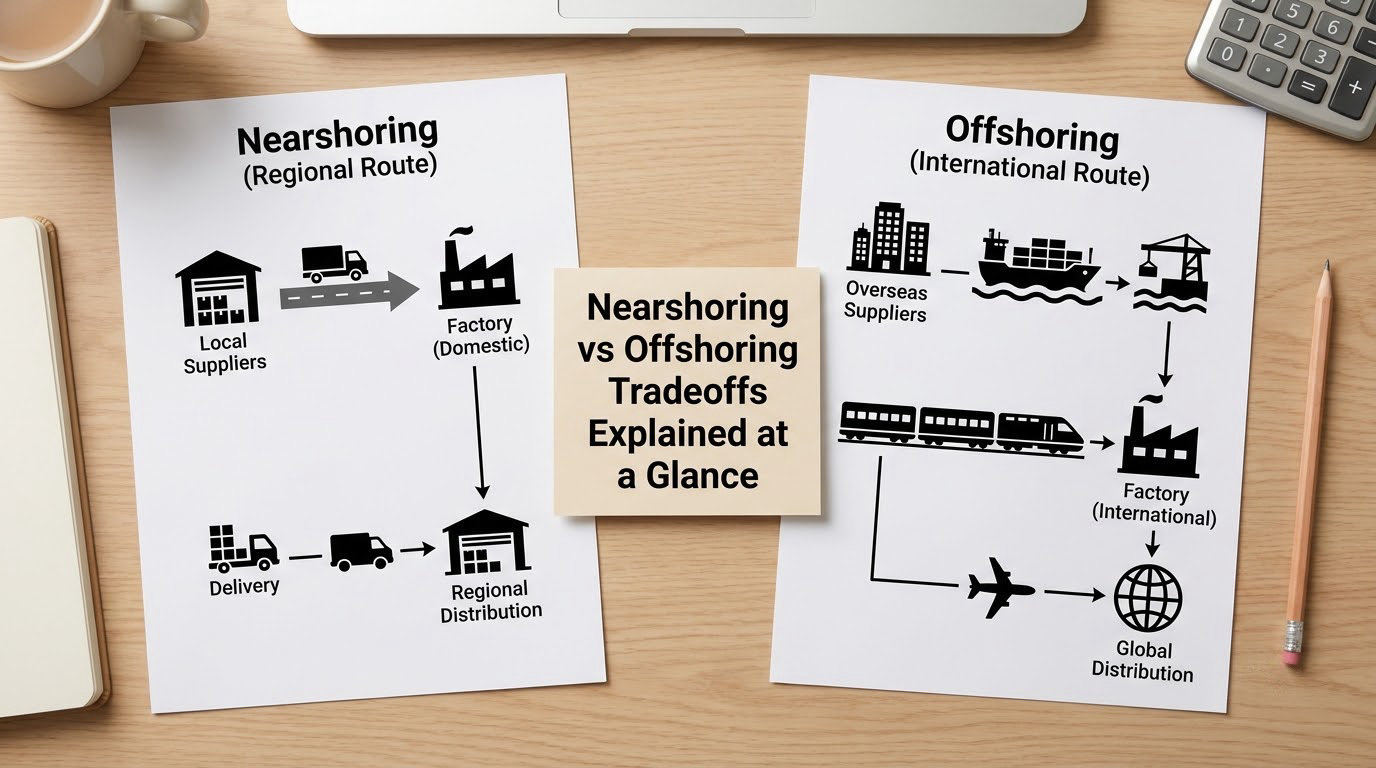
| Criterion | Nearshoring | Offshoring | Who wins |
|---|---|---|---|
| Quoted unit cost | Higher | Lower | Offshore, usually |
| Landed cost including freight and duty | Competitive on most molded parts | Lower on high volume, narrow on complex parts | Depends on volume and part value |
| Labor pool and wage levels | Moderate wages, shallow pools in some specialties | Lowest wages, deep specialty pools in some countries | Offshore for scale, nearshore for depth nearby |
| Production plus transit lead time | Days to a few weeks | Weeks, plus ocean transit and customs | Nearshore |
| Communication and time zone overlap | Full or near-full overlap | Partial or no overlap | Nearshore |
| On-site visits and audits | A day trip or a short flight | A twelve-hour flight plus a week of travel | Nearshore |
| Change handling and engineering support | Fast, informal, same-day answers | Slower, formal, more translation | Nearshore |
| Supply chain risk exposure | Concentrated regionally, shorter lanes | Long lanes, port and canal exposure, more borders | Neither is low; nearshore has fewer failure points |
| Tariff and trade policy exposure | Often covered by a regional trade agreement | Varies widely, can change on short notice | Nearshore, when a qualifying agreement exists |
| Best fit | Fast-turn, high-mix, tooling-intensive, supply-sensitive work | High-volume, stable, price-driven, simple parts | Use case by use case |
Read the table as a set of defaults, not laws. A nearshore shop with poor tooling management can be worse than a well-run offshore plant, and the tariff line depends entirely on what is being imported and from where.
Nearshoring vs Offshoring: What Is the Difference?
Nearshoring and offshoring are both forms of outsourcing, and both mean that a company you do not own makes something for you. The difference is distance, and everything else follows from that distance. Nearshoring typically points to a country that shares a border or sits within a few time zones, such as Mexico for US buyers or Poland and Romania for European buyers. Offshoring points to a distant market such as Vietnam, India or China, chosen mainly for wage levels and supplier depth.
It helps to place the other two models next to these two so the map is complete. Onshoring means keeping production inside your own country, which is expensive but simple. Reshoring, sometimes called inshoring, means bringing work back from offshore back into your home country. And right-shoring, sometimes called split-shoring, is the hybrid where you deliberately split a portfolio across both nearshore and offshore rather than committing everything to one model.
One warning about vocabulary. A lot of writing uses the two words as synonyms because everything offshore is technically also foreign. The distinction people mean is proximity, and if a supplier is one ocean and twelve time zones away, calling it nearshore changes nothing about your landed cost. Judge distance in transit hours, not in marketing language.
Which Option Has Lower Total Cost?
Offshore usually wins on the factory price. Whether it wins on your total cost is a different question, and it comes down to a handful of line items that quotes leave out. Landed cost is the honest comparison, and it is built from more than the piece price.
- Direct labor and overhead in the quote. This is the number everyone looks at first.
- Tooling and amortization. A mold is a fixed cost spread across your run quantity. A short run in a low-price country can still carry a large tooling bill per part.
- Inbound freight. Air for samples and urgent replacements, ocean or rail for production volume, plus drayage and port charges at the far end.
- Duty and tariffs. A regional trade agreement can zero this out for nearshore goods. Offshore duties are typically higher and can change with policy.
- Inventory carrying cost. Long transit means more pipeline inventory, more safety stock, and cash tied up for weeks before a single unit sells.
- Quality failures. Rework, scrap, freight back, and the schedule slip that follows. A four percent reject rate offshore can erase a fifteen percent labor gap.
- Management overhead. Travel, audits, timezone overlap losses, freight forwarder fees, and the person on your team who exists only to reconcile offshore purchase orders.
- Currency and payment terms. Terms of 30, 60 or 90 days and the local currency the invoice is written in.
Here is a rough shape from the comparisons I have run. On a high-volume molded part with steady demand, the offshore landed cost often lands 10 to 25 percent under the nearshore equivalent, before you count the working capital sitting in transit. On a low-volume, high-mix assembly with frequent revisions, the gap usually closes and often reverses, because the cost is dominated by engineering hours and expediting rather than piece price.
The line item people forget is the cost of delay. If a product earns money in its first year of availability, shipping a finished-goods equivalent from offshore instead of building a real part near your market can cost more than the entire freight bill. If the program is speed-sensitive, price the delay before you price the part.
How Do Lead Times and Supply-Chain Reliability Compare?
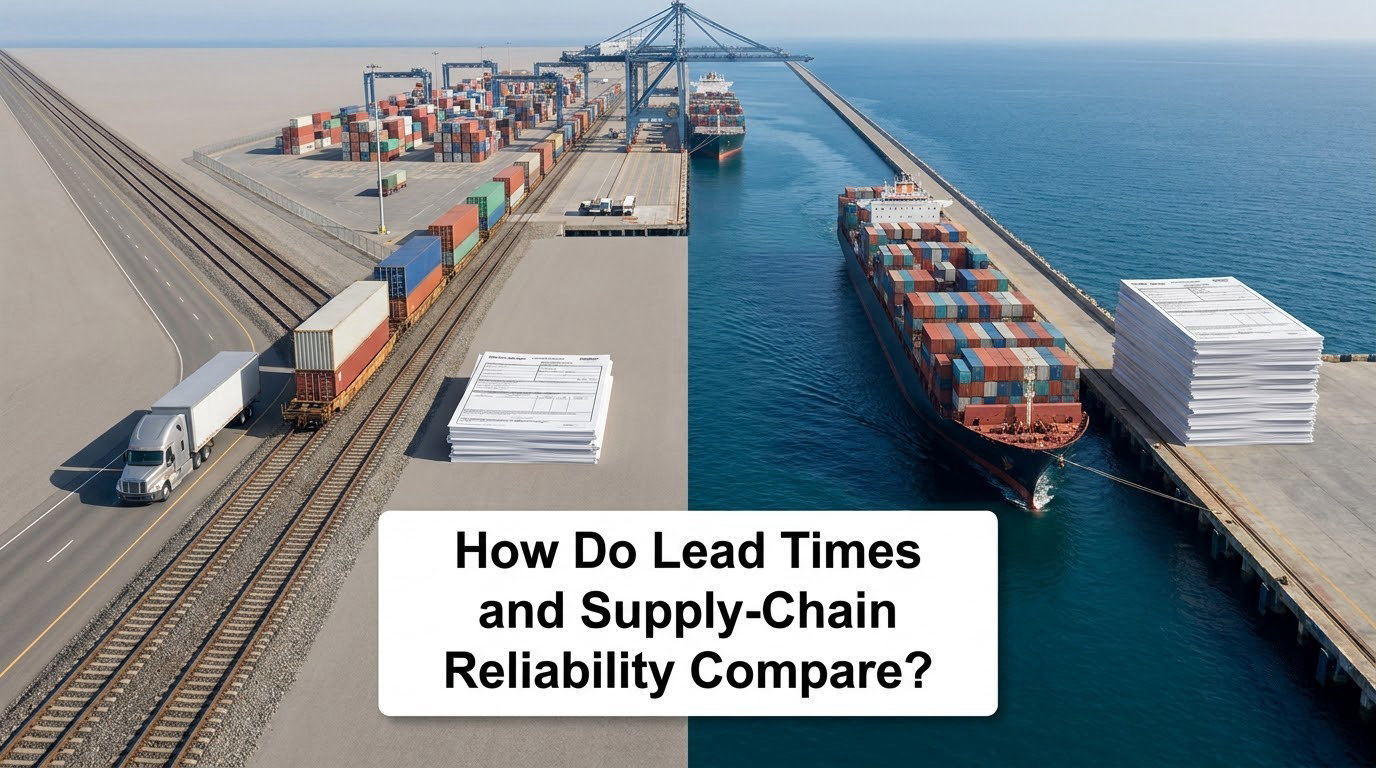
Nearshore wins on lead time, and this is the single most reliable difference between the two models. When a plant is a two-day drive or a short flight away, a material shortage becomes a phone call and a courier. When it is eleven time zones and one ocean away, a shortage becomes an expedite request, a new booking, and a revised promise date.
Total lead time is the sum of several pieces, and only one of them is the factory’s own production schedule.
- Queue time for engineering, revisions and purchasing decisions.
- Production and finishing time at the plant.
- First-article or pre-shipment inspection and any corrective cycle.
- Transit, whether that is truck, rail, air or ocean.
- Customs clearance and any documentation hold.
- Final delivery into your dock or distribution center.
The transit piece is where the gap opens up. A nearshore lane might add a day or two to a quote that took three weeks to produce. An ocean lane can add three to six weeks of transit and schedule uncertainty on top of a comparable production time, and air freight compresses transit at a cost that is often larger than the labor savings you were chasing.
Reliability is not the same as speed, and I want to be straight about this. Nearshoring is not automatically more reliable. A nearshore supplier that depends on a single resin importer can be just as fragile as an offshore one, and a single-region nearshore strategy concentrates your risk in a smaller box. What nearshore does buy you is a shorter recovery time. When something goes wrong offshore, the fix, the replacement tool or the expedited air shipment is a bigger problem because distance makes every recovery action slower.
Inventory policy follows directly. Lower pipeline lead time means you can run lower safety stock and reorder more often, which frees working capital and reduces the risk of obsolescence. That benefit is real, and most offshore-versus-nearshore comparisons on cost quietly leave it out.
Which Is Better for Quality and Manufacturing Flexibility?
Nearshore is easier to hold to a standard, mostly because of geography. A first-article inspection, a mid-run audit or a mold trial that takes a nearshore team one travel day can be done on a Thursday and resolved the same week. The same visit offshore is a planning exercise, and in practice it gets deferred twice and then skipped.
That physical access drives three operational things. Change handling gets faster, because a design engineer can be in the room while a tool is modified rather than explaining a drawing change over email across two languages. New program launches get shorter, because tooling trials, material trials and first shots happen back to back instead of across three trips. And when something goes wrong, root-cause work happens in person, which is where most mold and process problems actually get solved.
For molded and machined work, the tooling decision deserves its own paragraph. Understanding the tolerance standard your part is held to is one thing. Deciding which country holds the mold in its yard is another, because the mold is usually the most valuable physical asset a program owns and it is the piece most often left ambiguous in a purchase agreement.
Offshore can hold quality well. Deep experience with a specific process, mature tooling shops and lower volume tolerance in some countries mean the defect rate is often lower than a small nearshore shop’s. The gap is not manufacturing ability, it is iteration speed. If your program changes every quarter, iteration speed matters more than any published capability deck.
Low-volume programs add one more wrinkle. When the run is small, tooling amortization per part is what dominates, not labor, which is exactly the situation where bridge tooling approaches can keep a program near your market instead of chasing offshore labor rates.
How Do Labor Markets and Talent Availability Affect the Decision?
Offshore is where the wage gap lives, and it is large. Direct labor in a lower-cost country can be a fraction of the equivalent near your own plant, and for labor-intensive, labor-content-heavy products that gap is what funds the whole business case. Labor content is the key variable: a part that is mostly material and machine time will not show much difference, while a part that is mostly handling and assembly will show a dramatic one.
Nearshore competes on a different currency. You are paying for availability, stability and the skills already present in the region. Molders, CNC machinists, tool and die technicians and quality engineers do not appear on demand, and a nearshore market that has trained them for two decades is a real advantage over an offshore location where you have to build that bench yourself.
There are tradeoffs in the nearshore labor market too. Turnover runs higher in some Mexican and Central American plants than in parts of Asia, wages in Central and Eastern Europe have climbed sharply as nearshore demand grew there, and the deepest tool-building or medical-grade expertise may still sit in only a handful of cities. Language coverage is usually a non-issue nearshore and a real cost offshore, where your drawings, change orders and inspection notes get translated or, more often, misunderstood.
Time zone coverage is the underrated one. With a four-hour difference you can run a standup, get a decision before your own day ends, and put a technician on a conference call at 7am local. With a twelve-hour difference you are working a shift handoff, and problems sit overnight. The practical test is simple: can the supplier answer a same-day question, and can you escalate it to a person with authority within an hour?
Choose on process fit rather than wage level. A plant that runs your material, your part geometry and your annual volume every day is worth more than a cheaper plant that is learning your part from scratch.
What Risks Do Nearshoring and Offshoring Create?
Both models carry risk, and the risk sections on supplier websites are almost always written to make offshoring sound reckless. Here is a fair accounting.
Tariff and trade policy exposure
Offshore imports are exposed to duties that can change through executive action or legislative negotiation, sometimes with a short compliance window. US goods imported from Mexico or Canada can qualify as originating under USMCA and enter duty-free, provided the part meets the origin rules, which is not automatic. For an EU buyer the equivalent logic applies with regional agreements. The right question is not whether your country is nearshore, it is whether your specific part qualifies for the preferential rate today and whether you can document that to customs.
Freight and lane exposure
Long ocean routes mean port congestion, schedule reliability that swings week to week, and disruption you cannot route around. A canal closure, a strike or a weather event thousands of miles from your factory still lands on your dock. Nearshoring removes most of that exposure, though it swaps in its own concentration in a smaller number of regional lanes and crossings.
Supplier and country concentration
The biggest single risk in most offshore programs is not the country, it is the plant. If one factory holds 80 percent of your volume, one quality problem or one owner walking out the door stops you. Nearshoring does not fix this by itself, but it makes qualifying a second source much more achievable, because a second source is a realistic candidate when it sits within a day of your business.
Intellectual property and tooling ownership
Designs, prints and process data leave your control in both models. Enforcement differs sharply. A contract enforcement mechanism that is close to your home court and your trade agreements, a language you can read without translation, and a plant your team can physically audit are all meaningfully different protections from a relationship you manage by email. Ownership of the mold, the terms for its maintenance, the insurance, and what happens to it if the relationship ends should be written down before the first shot, in both models but especially offshore.
Cybersecurity, compliance and geopolitical exposure
Data security standards and enforcement vary widely, and offshore exposure to trade sanctions, export controls and sudden regulatory shifts is real even in stable relationships. Nearshore work inside a single trade and legal bloc reduces that surface, which matters more each year as data-protection and forced-labor due diligence reach further into supplier requirements.
Which Option Fits Different Manufacturing Use Cases?
High-volume molded parts with stable demand
Offshore usually wins. High labor content, repeatable geometry, a long production run and a part that ships without rush create the conditions where a lower piece price survives the freight and duty math. The risk to manage is concentration, and the discipline to set is a qualified second source before you need it.
High-mix custom assemblies
Nearshore usually wins. Constant changeover, build-to-order configurations, kitting and last-minute substitutions reward proximity more than they reward a low piece price, because the cost is coordination rather than conversion. This is also the category where the language and time zone advantages turn into real throughput.
Rapid prototyping and new product launches
Nearshore, without much debate. Iterating a prototype across an ocean is slow and expensive, and the speed of the feedback loop is the whole point of prototyping. If offshore is your only option, design the iteration plan around long handoff times rather than pretending the time zone is not there.
Urgent replacement and obsolete parts
Nearshore. A discontinued component or a machine part that stops a line is priced against the cost of the downtime, not against piece cost, and no labor saving survives that comparison. Keeping molds, or qualifying a fast-turn supplier near your plant, is the practical hedge.
Packaging and secondary packaging
This is genuinely contested. Packaging is bulky and light, so freight per unit is high, but the goods are often low in value, so the percentage math still favors offshore in many cases. The deciding factor is usually packaging lead time and local print or decoration requirements, where nearshore frequently wins on speed.
Kitted and finished goods held close to demand
Nearshore, if you are replenishing US or European demand from regional warehouses. It shrinks the replenishment cycle, lets you hold less safety stock, and makes packaging and labeling changes cheap. That is the same working capital advantage as the lead time section, just measured in a different place.
Supply-sensitive and regulated production
Nearshore, particularly where you need on-site audits, documented traceability and fast corrective action. If your qualification process includes first-party or third-party audits of the plant itself, a plant a day away is a plant you actually visit.
How to Compare Nearshoring and Offshoring for Your Business
Use a repeatable process so the answer survives contact with your finance team. Six steps, and do them in this order.
1. Profile one representative part and its demand
Annual volume, average run size, part value, labor content, dimensional tolerance, material, and how much the demand curve moves. A single part with a messy profile will mislead you more than a broad survey of everything you make.
2. Map total cost for both models
Get quotes on the same basis, meaning the same Incoterm and the same documentation scope. DDP and DAP quotes are not comparable, because one puts the freight and duty inside the supplier’s price and the other does not. Then build the landed cost stack from the section above and add inventory carrying cost and the cost of delay.
3. Model the scenarios that actually stress the model
Run your plan, then run a demand spike, a 30 percent volume drop, a four-week port delay, a duty change, and a supplier that fails first-article. Offshore usually survives the base case and struggles with the volatility case. Nearshoring is the reverse, and the scenario that matters is the one your business has actually lived through.
4. Score the risks you cannot price
Tariff exposure, IP and tooling enforceability, supplier concentration, cybersecurity, political stability and your own management bandwidth. Write the scores down. This is where a nearshore bid with a higher number still wins, and where an offshore bid with a lower number should lose.
5. Test capability rather than reading about it
Ask for references running a comparable part at a comparable volume, then visit. If the plant is nearshore, visit twice before you commit. Verify how they handle change orders, nonconformances and mold maintenance on the floor, and check what certification actually covers. Where packaging performance matters, ISTA transit testing protocols give you a structured way to test the whole shipping system rather than a single box.
6. Run a pilot order before you move the program
One production order at realistic volume, with first-article inspection and a real on-time measurement. Then write the exit triggers down in advance: the on-time rate or defect rate that would make you move the next program, and what re-qualifying tooling elsewhere would cost. Deciding the trigger after things go badly is how people end up paying twice.
Which Should You Choose?
Choose nearshore when time, change, or visibility is worth more than the piece price. That covers fast-turn and high-mix work, urgent and obsolete parts, new product launches, anything supply-sensitive, and anything where you need to be on site. It also covers programs where the tool is valuable enough that you want it in a jurisdiction where you can enforce your ownership of it.
Choose offshore when the part is stable, high volume, labor-content-heavy and simple, your demand forecast is trustworthy, and you have real management bandwidth for cross-border execution. Offshore is not a compromise when it fits. For a high-volume molded part it is simply the right tool, and the discipline is to make sure the numbers are landed, not quoted.
Choose the hybrid when you have a portfolio rather than a product. Run high-volume, price-driven parts offshore and time-critical, change-heavy parts nearshore, and split individual programs where one site is credible on both counts. Most mature operations end up here, and the honest version of the hybrid is a deliberate allocation rule, not a vague plan to diversify eventually.
One caution on both. Whichever way you go, the decision that costs the most is usually not the country, it is committing volume to a single plant before you have audited it properly.
Frequently Asked Questions
What is the difference between offshoring and nearshoring?
Both move production to a company in another country. Nearshoring sends work to a nearby country that shares a border, language or time zone, such as Mexico for US buyers, while offshoring sends it to a distant market such as Vietnam or India for lower wages. The practical difference is distance, which drives lead time, freight cost, duty exposure and how easily you can visit the plant.
What is nearshoring in simple terms?
Nearshoring means outsourcing work to a country close enough to reach easily, usually within a few hours of travel and a few time zones of overlap. You still save money compared with making it at home, and you keep shorter lead times, easier communication and the ability to visit the factory. For a US manufacturer that usually means Mexico or Canada.
Is nearshoring more expensive than offshoring?
On the quoted factory price, almost always. On landed cost, the gap is much smaller and depends on volume and part value. Offshore usually wins by roughly 10 to 25 percent on high-volume, labor-intensive parts. On low-volume, complex or fast-turn work, freight, duty, inventory carrying and expediting can close the gap entirely and sometimes reverse it.
What are the four types of outsourcing?
The four models are onshoring, which keeps work in your own country; reshoring, which brings work back from offshore to your home country; nearshoring, which moves work to a nearby foreign country; and offshoring, which moves work to a distant country. A fifth, right-shoring or split-shoring, blends nearshoring and offshoring across a portfolio.
Which countries count as nearshoring?
For US buyers, nearshoring usually means Mexico, Canada and Central American countries such as Costa Rica and the Dominican Republic. For European buyers it typically means Central and Eastern Europe, including Poland, Romania, Czechia and Hungary, plus Turkey and the Mediterranean. What matters is transit hours and time zone overlap, not the label on the map.
Is outsourcing a dying concept?
No. What changed is how it is deployed. Research cited across the industry, including Bain work reporting that a large share of operations executives plan to increase onshoring and nearshoring, points to a shift toward hybrid, right-shored models rather than a retreat from outsourcing. The trend is toward matching each part to the model that fits it.
Conclusion: Choose the Supply Chain That Fits the Product
The nearshoring vs offshoring decision comes down to four variables in this order: total landed cost, required lead time, the flexibility your program actually needs, and how much disruption exposure you can live with. Nearshoring spends money to buy time and control. Offshoring spends time and control to buy money. Neither is a better practice; they are different purchases, and the price of each depends on your part, your volume and your tolerance for the week it all goes sideways.
Start with one representative part and do the work in a single afternoon. Map its unit economics on a landed basis for both a near and a far source, write down the lead time each one commits to, list the capability you would actually be buying, and name the disruption you would least like to live through. The decision usually makes itself before the spreadsheet gets fancy.