
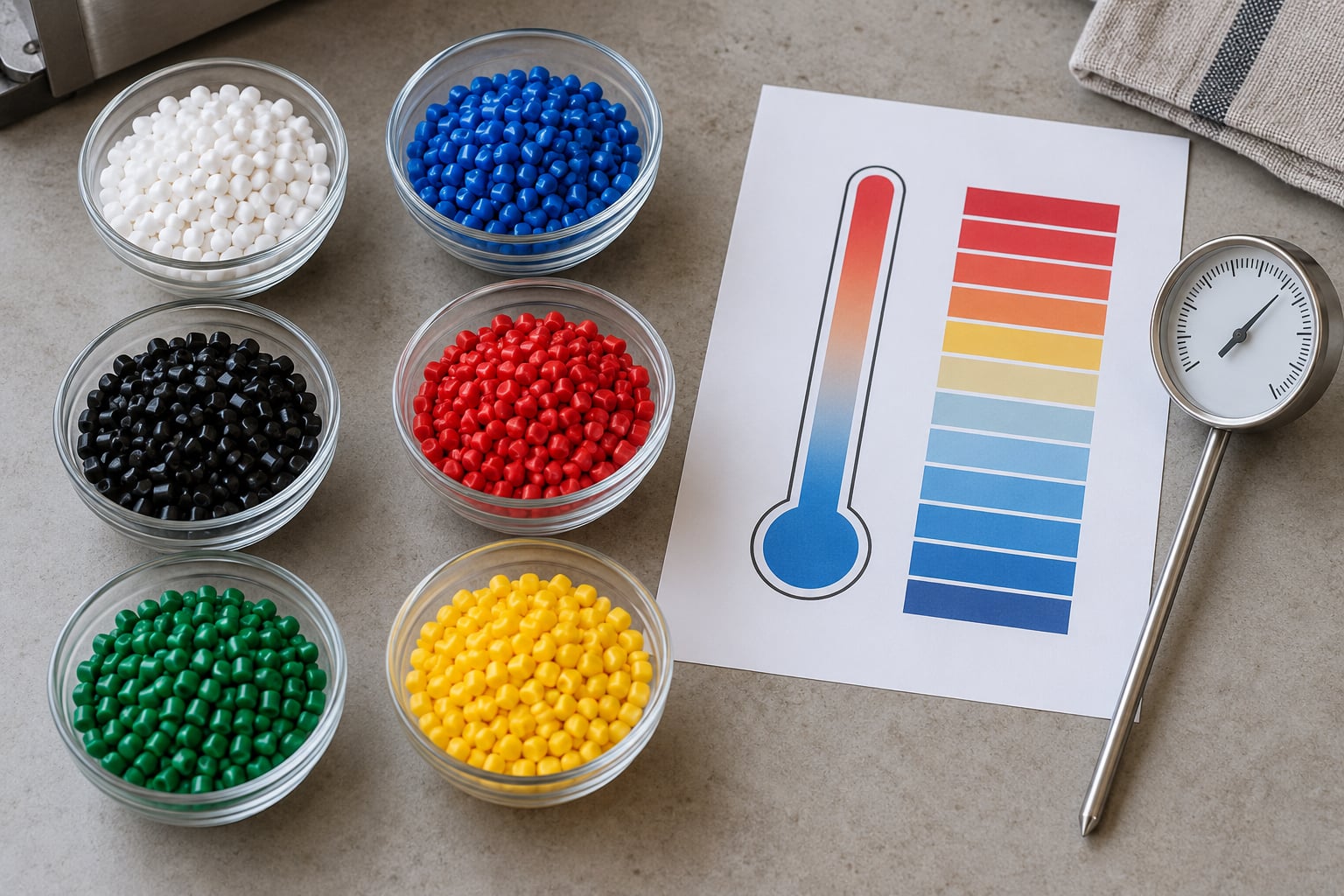
Among common plastics, LDPE melts at the lowest end at roughly 105 to 115 °C (221 to 239 °F), while PEEK sits at the top around 343 °C (657 °F). The melting points of common plastics chart below gives you twelve resins with melting temperature, glass transition temperature, a workable processing range and the point where the material starts to break down.
One warning before you use any chart, including this one. A melting point is a material property, not a machine setpoint. If you set a barrel to the number in a chart, you will almost certainly get short shots and cold shuts. The real process window usually sits 30 to 80 °C above the melting point and well below decomposition.
Last reviewed: October 2026. Values are approximate ranges reconciled from resin supplier technical data sheets and standard test methods, published as ranges because grade, filler and colourant all move the numbers. Always confirm against the technical data sheet for the specific grade you are buying.
Table of Contents
- Melting Points of Common Plastics Chart: 12 Resins Compared
- How to Read Melting Points of Common Plastics Chart
- Melting Point vs. Softening Temperature: What the Difference Means
- What Changes a Plastic’s Processing Temperature?
- Choosing a Plastic by Heat Resistance and Application
- How Melting Point Data Is Used in Manufacturing
- Practical Limits of the Chart
- Frequently Asked Questions
- Conclusion
Melting Points of Common Plastics Chart: 12 Resins Compared
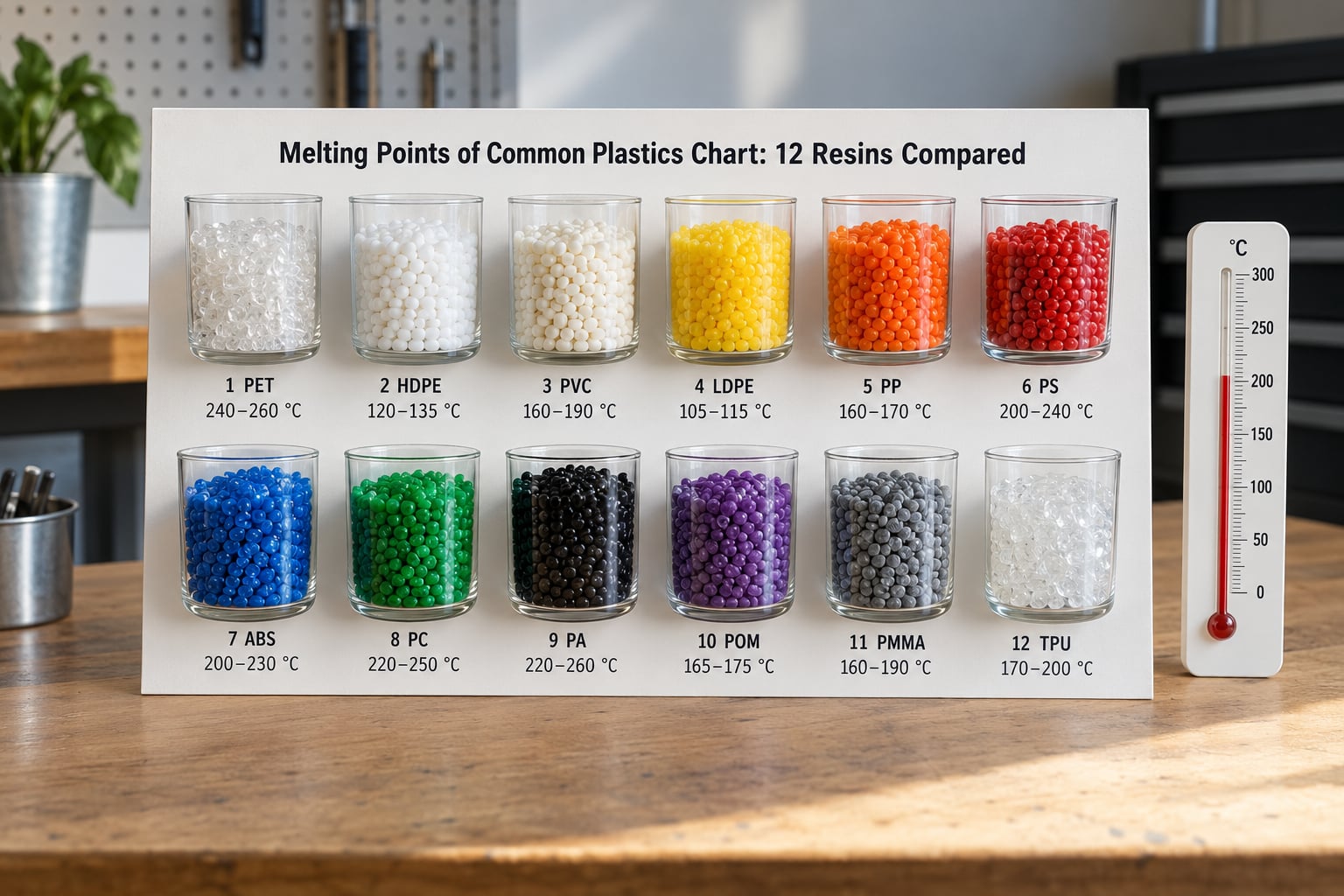
Read the chart by starting from the resin column, then checking that the melting range sits comfortably above the processing range you need. If your tooling cannot reach the processing range, the resin is the wrong choice regardless of how good the properties look on paper.
| Plastic | Abbreviation | Melt Tm °C | Melt Tm °F | Tg °C (approx) | Processing range °C | Decomposition | Typical uses |
|---|---|---|---|---|---|---|---|
| LDPE | LDPE | 105-115 | 221-239 | -125 | 150-230 | Above 400 | Film, bags, squeeze bottles, liners |
| HDPE | HDPE | 130-135 | 266-275 | -125 | 160-280 | Above 450 | Milk jugs, fuel tanks, pipe, caps |
| Polypropylene | PP | 160-175 | 320-347 | -10 to -20 | 190-290 | Above 400 | Housings, containers, fibres, automotive trim |
| Rigid PVC | PVC-U | 170-212 | 338-414 | 80 | 180-205 | From about 200 | Pipe, profiles, conduit, window frames |
| Polystyrene | PS | 240-260 | 464-500 | 100 | 200-260 | Above 270 | Packaging, cups, housings, foam |
| Polyethylene terephthalate | PET | 245-265 | 473-509 | 70-80 | 250-290 | Above 300 | Bottle preforms, trays, fibre, engineering blends |
| Polycarbonate | PC | 225-250 | 437-482 | 147 | 260-300 | 340-360 | Safety glasses, housings, lenses, medical parts |
| Nylon 6 | PA6 | 215-225 | 419-437 | 40-50 (dry) | 230-280 | Above 400 | Gears, bushings, textile, automotive |
| Nylon 66 | PA66 | 255-265 | 491-509 | 50-60 (dry) | 270-290 | Above 480 | Auto under-bonnet, connectors, clips |
| Acrylic | PMMA | 160-165 | 320-329 | 105 | 180-250 | Above 300 | Signs, display stands, light lenses |
| Acetal / polyoxymethylene | POM | 175-180 | 347-356 | -60 | 190-230 | 250-270 | Acetal gears, bearings, hinges, fuel systems |
| Polyetheretherketone | PEEK | 343 | 657 | 143 | 360-400 | Above 500 | Aerospace, medical implants, chemical pumps |
Two rows deserve a second look. Rigid PVC starts losing hydrogen chloride well below its melting range, so the top of that processing window is a hard ceiling rather than a suggestion. And PS decomposes above roughly 270 °C, which means a scrap rate spike is easier to cause than a melt failure.
How to Read Melting Points of Common Plastics Chart
The numbers are approximate by design. A chart cannot tell you the grade, the batch or the colour masterbatch you received, and each of those moves the result. Suppliers quote a range because that is what their test data actually supports.
Conversion is straightforward. Multiply the Celsius figure by 9, divide by 5, then add 32. The interesting part is the rounding: most charts round 105-115 °C up to 221-239 °F, but a shop manual that rounds to 220-240 °F is not wrong, just less precise.
Crystalline and amorphous plastics do not behave the same way during heating. A semicrystalline resin such as HDPE, PP or PA66 has a sharp transition where crystals break down and the material becomes a viscous liquid. An amorphous resin such as PS, ABS, PC or PMMA has no such transition. It softens gradually over a broad band above its glass transition temperature and never reaches a true liquid phase.
This is why amorphous rows look odd in a melting chart. The melting range for ABS, for example, is not missing data. The number does not exist for that structure.
Why suppliers publish a range instead of one number
Molecular weight distribution, copolymer ratio and the specific catalyst system all shift the peak. A high-molecular-weight grade of the same resin can sit 5 to 10 °C higher than a low-flow grade. Published ranges are the honest answer.
Melting Point vs. Softening Temperature: What the Difference Means
Melting point (Tm) applies only to polymers with enough crystalline structure to melt. Glass transition temperature (Tg) is the point where an amorphous region loses stiffness and turns rubbery. Vicat softening temperature and heat deflection temperature (HDT) are load-based tests that report the temperature at which a specific probe or loaded specimen deflects a set amount.
| Property | What it measures | Applies to | How to use it |
|---|---|---|---|
| Melting point (Tm) | Solid to viscous liquid transition | Semicrystalline only | Lower bound for a melt process |
| Glass transition (Tg) | Stiff solid to rubbery state | All polymers | Predicts stiffness and dimensional stability at heat |
| Vicat softening | Penetration of a defined probe | Mostly amorphous | Compares grades within one polymer family |
| Heat deflection (HDT) | Deflection of a loaded specimen | All polymers | Compares service limits, sensitive to wall thickness and fibre |
| Decomposition | Chemical breakdown | All polymers | Ceiling for melt temperature |
These values can be hundreds of degrees apart. PC has a melting range of 225-250 °C and a Tg of about 147 °C, so a part loaded in a hot car will soften and creep long before the resin could ever be melted. HDT and Tg are service temperature properties. Tm is a factory property.
A higher Tg simply means more stiffness at a given heat
It does not mean the material will survive a higher temperature. PC at 147 °C Tg holds stiffness in a hot enclosure better than ABS at 105 °C Tg, yet ABS has no melting point at all and PC does. Higher Tg buys stiffness, not heat resistance in the flame sense.
What Changes a Plastic’s Processing Temperature?
The chart value is for a clean, unfilled, uncoloured base resin. What arrives at your hopper is rarely that.
Molecular weight and flow grade
Higher molecular weight raises viscosity and usually nudges the melt range up. A low melt flow rate grade needs hotter barrel settings to fill the same geometry. This is why two shops running the same polymer name get different results.
Fillers, reinforcement and colourants
Glass fibre raises stiffness and shrinkage, and it raises the required screw torque. Talc and calcium carbonate change flow and can shift the effective processing temperature by several degrees. Pigments and masterbatches carry a carrier resin that sometimes melts below the base resin, which can cause a faint haze or a speckled surface.
Plasticizers
Flexible PVC and TPU contain plasticizers that depress Tg dramatically. That is why soft PVC feels different from rigid PVC long before any temperature is involved.
Moisture
Polyamides, PET, polycarbonate and ABS are hygroscopic. Wet resin hydrolyses at melt temperature, so a nominal 270 °C nylon part can degrade at 240 °C if it was never dried. Drying times vary widely by resin, and our guide to drying times for common engineering plastics covers the practical settings.
Crystallinity and cooling conditions
Crystallinity develops during cooling, and faster cooling gives lower crystallinity. This changes shrinkage, stiffness and the visible gloss of a moulded part even though the melt temperature never moved.
Choosing a Plastic by Heat Resistance and Application
Start from the service condition, not the melt temperature. The part has to survive its working environment first, and the process window has to fit the equipment second.
Injection molding
Most commodity resins fit standard barrel capacity. PP, ABS and HDPE run in a 190-290 °C window and mold well at moderate mold temperatures. Glass fibre reinforced PA6 and PA66 push the screw and the horsepower, not the temperature.
Extrusion and thermoforming
Extrusion cares about melt strength and drawdown as much as temperature. HDPE and LDPE dominate film and profile work. Thermoforming of sheet is set by the Vicat or HDT region, because the sheet has to hold its own weight in the mold before it cools.
Packaging
PET and HDPE handle hot fill. Rigid PVC takes pipe and profiles. PP covers hot-fill containers and dishwasher-safe items. The lowest-melting resins here are also the easiest to seal and print, which is why packaging leans on LDPE, HDPE and PP.
Electronics and automotive
Under-bonnet applications demand PA66, PPS or PEEK rather than commodity polypropylene. Connectors and housings commonly use PA66, PC and PBT. Flame-retardant grades exist for most of these families, and a flame retardant is a formulation, so the melting behaviour can differ from the neat resin in the chart.
High-temperature and specialty resins
Above 300 °C the options narrow fast. PTFE melts near 327 °C and is used well below that. PPS melts around 280-285 °C and holds up in aggressive chemical environments. Polyimide does not melt at all in normal processing; it is formed from solution or film casting. PEEK at 343 °C needs heated tooling and careful moisture control, but it is the workhorse for chemical, medical and aerospace parts.
Thermosets cannot be melted
Epoxy, phenolic (Bakelite), melamine-formaldehyde, unsaturated polyester and polyurethane thermosets cross-link during cure and will not flow again once set. Heating them past cure temperature produces decomposition rather than a melt, and hazardous fume. If you need a material that reheats and re-forms, it has to be a thermoplastic.
How Melting Point Data Is Used in Manufacturing
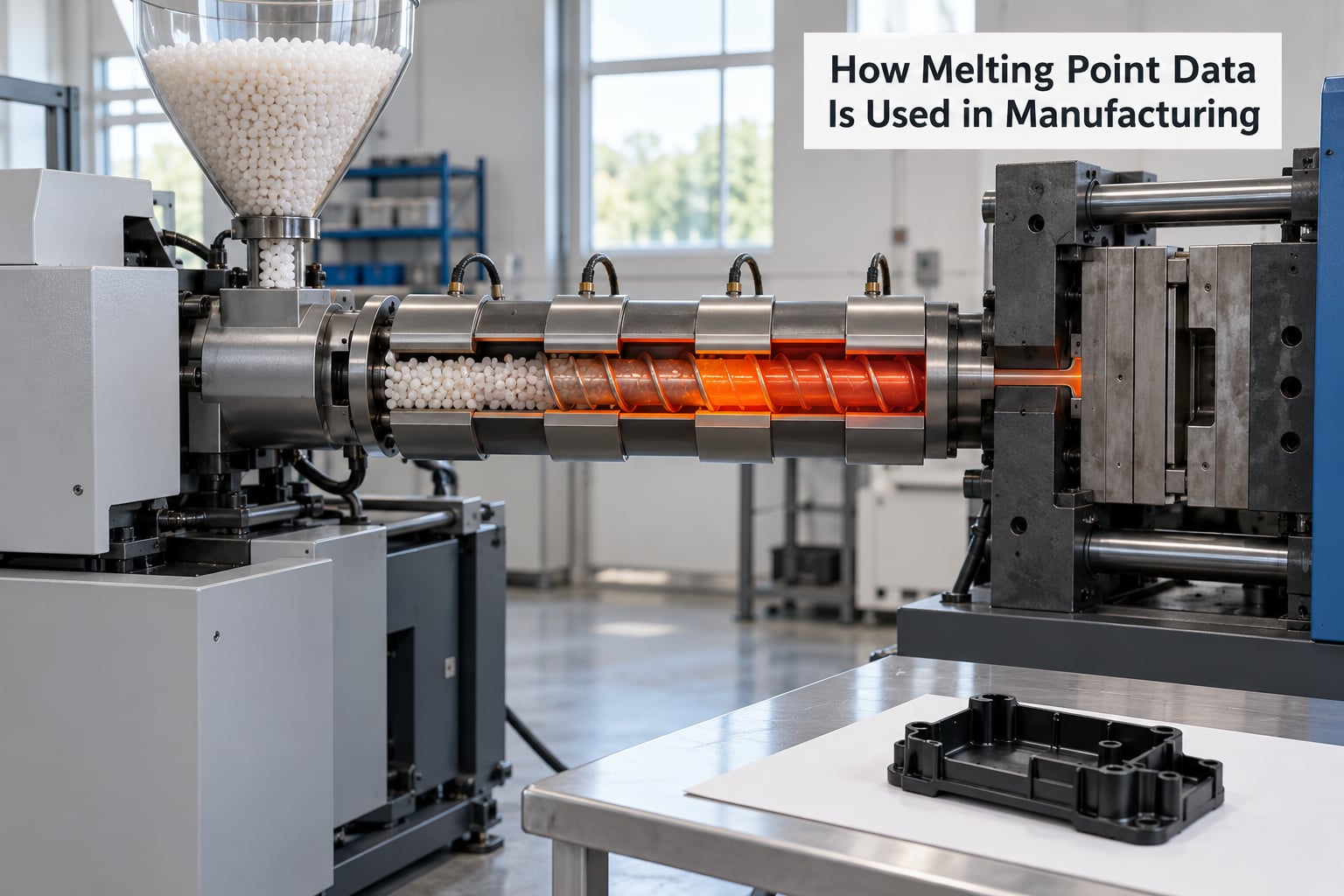
The chart is the starting point for four decisions: whether the resin can flow at all, how hot the barrel needs to run, how much cooling time the part needs, and what to tell your resin supplier when the lot behaves differently.
Melt temperature versus mold temperature
Melt temperature drives flow. Mold temperature drives the finished properties. Running a hot mold with a cooler melt is a legitimate cycle-time strategy in many applications.
| Resin | Suggested melt range °C | Suggested mold temperature °C |
|---|---|---|
| LDPE | 150-230 | 30-60 |
| HDPE | 160-280 | 40-80 |
| PP | 190-290 | 40-90 |
| Rigid PVC | 180-205 | 40-80 |
| PS | 200-260 | 30-60 |
| PET | 250-290 | 60-90 |
| PC | 260-300 | 80-120 |
| PA6 | 230-280 | 60-90 |
| PA66 | 270-290 | 80-120 |
| PMMA | 180-250 | 60-90 |
| POM | 190-230 | 60-90 |
| PEEK | 360-400 | 120-200 |
Cooling time and cycle estimation
Semicrystalline resins crystallize as they cool, and crystallization adds shrinkage on top of thermal contraction. Set the mold temperature at the low end and you increase shrinkage, sink marks and warpage. Set it at the high end and the part develops more crystallinity, higher stiffness and better dimensional stability, at the cost of cycle time.
Troubleshooting from the numbers
Short shots with a full barrel point to melt temperature, not to the melting point. Brittle or discoloured parts with black specks point to a resin sitting too close to decomposition. Silver streaks in nylon usually mean moisture, which ties back to dryer performance. If your setup is hot and dry and still misbehaves, check the grade’s melt flow index against what you are actually buying, and if the handling looks wrong, review our guide to choosing a resin dryer for hygroscopic plastics.
Recycling and sorting
Sorters and reprocessors use melt behaviour plus density to separate streams. Low-melting polyolefins form one economic stream, PET and PS form others, and engineering resins usually head straight to a specialist line. A degraded lot typically shows a shifted processing window and lower melt flow index, which is how reprocessors decide whether a batch is still usable.
Practical Limits of the Chart
This chart is a starting point for material selection, not a substitute for the grade-specific technical data sheet. Anything involving food contact, medical use, electrical insulation, flame retardancy or structural loading needs the supplier’s data for the exact grade, along with the relevant safety data sheet where handling and fume risk matter.
Two further limits are worth stating plainly. First, values are lab measurements on small specimens, and a thick moulded part will not reach the same temperature profile as a 1 mm test plaque. Second, service temperature is a function of part geometry, load and environment, so HDT and Tg values from the chart need adjusting for wall thickness and fibre content before you trust them in a design review. For anything involving mechanical property claims, pair this with our explanation of hardness testing for plastics.
Frequently Asked Questions
Which plastic has the highest melting point?
Among thermoplastics, PEEK has the highest melting point at about 343 °C (657 °F), followed by PTFE near 327 °C (621 °F) and PPS around 280-285 °C (536-545 °F). Polyimides go higher still but they do not melt, because they are processed from solution or film. These three are the practical high end of the melting points of common plastics chart.
Which plastic has the lowest melting point?
LDPE is the lowest of the common resins, melting between roughly 105 and 115 °C (221-239 °F). Flexible PVC sits close behind because its plasticizer content depresses the transition. Both melt well below the processing temperatures used for engineering plastics, which is why they dominate film, bags and liners.
Which plastics cannot be melted?
Thermosets cannot be melted. Once cured, epoxy, phenolic (Bakelite), melamine-formaldehyde, unsaturated polyester and polyurethane thermosets form a cross-linked network that cannot flow again. Heating them past the cure point drives decomposition rather than a melt, releasing corrosive or toxic fume. Polyimide behaves the same way and is processed from solution or film.
Is glass transition temperature the same as melting point?
No. Glass transition temperature is the point where an amorphous region turns from stiff to rubbery, and it applies to both crystalline and amorphous polymers. Melting point applies only to materials with enough crystalline structure to melt. Amorphous resins such as ABS, PC and PMMA have a Tg but no true melting point at all.
Will plastic melt at 300 degrees?
At 300 °C (572 °F) most polyolefins, PVC, PET, PA6 and PA66 flow readily. ABS, PS, PC and PMMA are already past the point of usefulness, and PS decomposes above roughly 270 °C. PEEK needs 360-400 °C to process properly. Always check the decomposition column before applying heat to a specific grade.
What is mold temperature in injection molding?
Mold temperature is the temperature of the cavity surface, held by a temperature controller unit rather than the barrel heater. It drives crystallinity, shrinkage, surface finish and residual stress. It is always lower than melt temperature, typically 30-90 °C below, and the correct value depends on whether you are optimizing for cycle time, gloss or dimensional accuracy.
Conclusion
Use the melting points of common plastics chart in four steps. Identify the resin and read both its melting range and its decomposition limit. Confirm the grade-specific values on the supplier technical data sheet, since fillers and molecular weight shift them. Keep processing temperature and service temperature in separate columns of your notes, because they answer different questions. Then validate with a real part before you commit to a production run.