
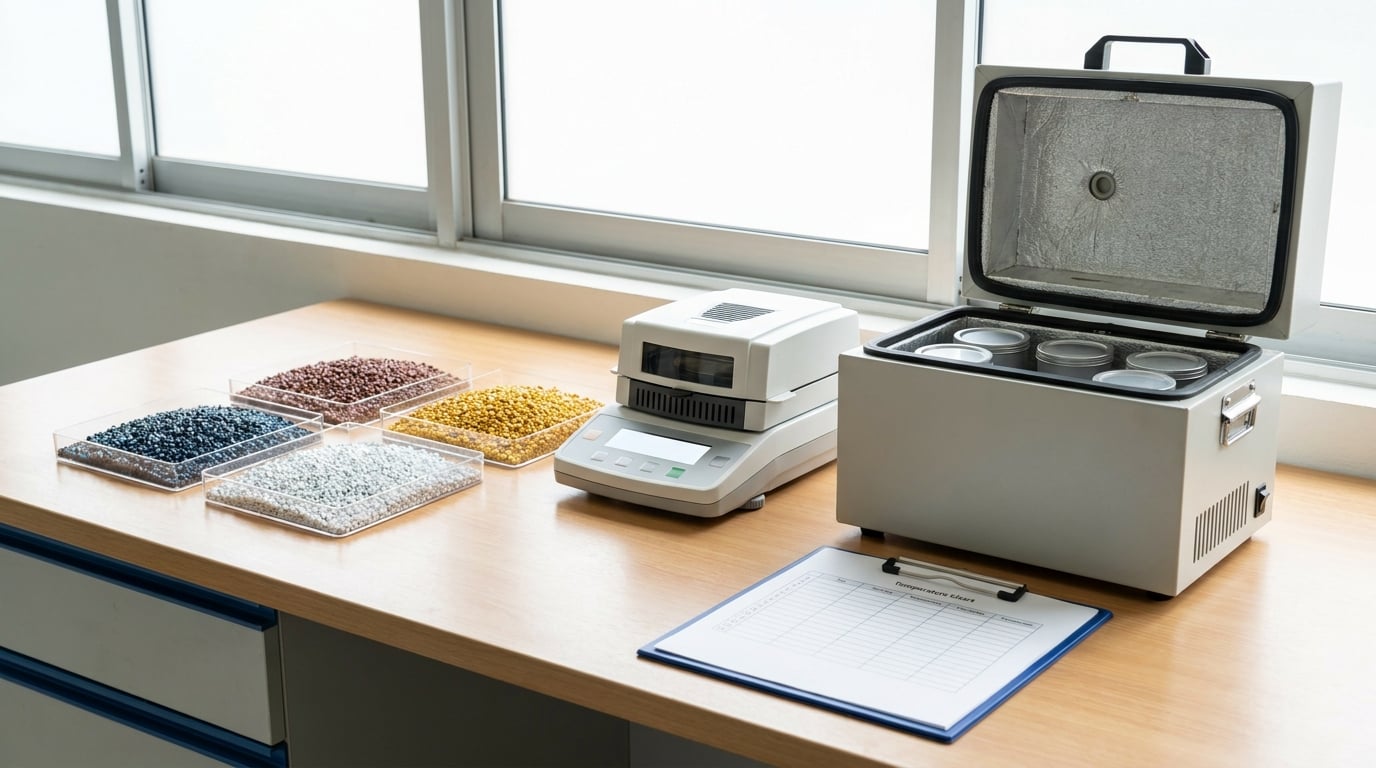
Drying times for common engineering plastics range from zero to roughly twelve hours, and the number that governs your line is the one printed on the technical data sheet for your exact grade. Hygroscopic resins such as polyamide, polycarbonate, ABS, PBT and PET typically sit in a dryer for two to six hours at 80 to 150 °C in air held at a -40 °F dew point, while POM and the polyolefins often need no drying at all. Everything below is an indicative starting reference, not a specification to copy into a work order.
The reason these numbers matter is that wet pellets do not fail loudly. They produce a batch of parts that look acceptable and then fail in the assembly line, or quietly lose strength in service. Drying is cheap next to either outcome.
Two datasheets for the same polymer family can quote four hours and twelve hours for the same material, and both can be defensible. This guide explains what each number means, where the variation comes from, and how to confirm your own resin is genuinely ready before you commit to a production rate.
Table of Contents
- Drying Times for Common Engineering Plastics at a Glance
- Why Engineering Plastics Must Be Dried Before Processing
- How Drying Time and Temperature Affect Processing
- Typical Drying Times by Resin Family
- Choosing the Right Drying Equipment
- Common Drying Mistakes and Production Problems
- How to Confirm the Resin Is Ready for Processing
- Frequently Asked Questions
- Can engineering plastic pellets be dried overnight?
- What is the difference between drying time and drying temperature?
- Do plastic pellets absorb moisture after they leave the dryer?
- How can I tell whether engineering plastic pellets are still wet?
- Can recycled engineering plastics use the same drying schedule as virgin resin?
- Conclusion
Drying Times for Common Engineering Plastics at a Glance
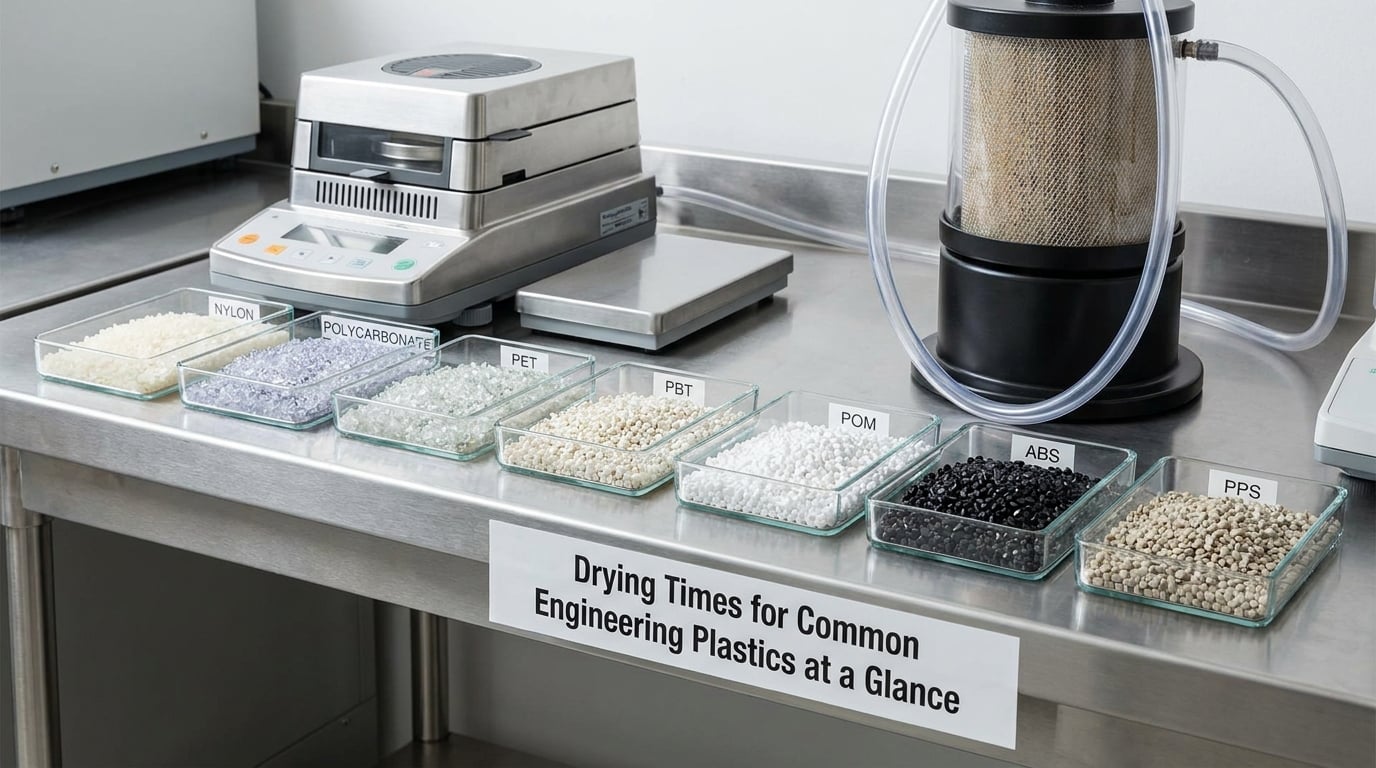
Typical drying times for common engineering plastics range from about two hours for ABS and PMMA to eight to twelve hours for unreinforced polyamide, and the required temperature sits between 80 °C for polyolefin control cases and 150 °C for PPS and PEEK. The table below collects indicative starting points only: your grade’s data sheet always overrides them.
| Resin or family | Drying temperature | Indicative time | Typical target moisture | Usual dryer |
|---|---|---|---|---|
| PA6, PA66 (standard grades) | 80 °C / 176 °F | 4 to 8 h (some grades to 12 h) | 0.10 to 0.20 % | Desiccant hopper |
| PA6, PA66 (low-moisture grades) | 80 °C / 176 °F | 2 to 4 h | 0.08 % or lower | Desiccant hopper |
| PA12, PA1010 | 80 °C / 176 °F | 4 to 6 h | 0.10 to 0.15 % | Desiccant hopper |
| PC (polycarbonate) | 110 to 120 °C / 230 to 248 °F | 4 to 6 h (up to 8 h cited) | 0.05 % or lower | Hot-air or desiccant hopper |
| PET (molding and bottle grades) | 120 to 150 °C / 248 to 302 °F | 4 to 6 h | 0.02 % | Desiccant hopper or crystallizer |
| PBT | 120 to 130 °C / 248 to 266 °F | 4 to 6 h | 0.05 to 0.10 % | Desiccant hopper |
| ABS | 80 to 90 °C / 176 to 194 °F | 2 to 4 h | 0.10 % or lower | Hot-air or desiccant hopper |
| PC/ABS, ASA blends | 80 to 100 °C / 176 to 212 °F | 2 to 4 h | 0.10 % or lower | Desiccant hopper |
| SAN | 80 °C / 176 °F | 2 h | 0.10 % or lower | Hot-air dryer |
| PMMA (acrylic), general purpose | 80 to 90 °C / 176 to 194 °F | 2 to 4 h if specified | 0.10 % or lower | Hot-air dryer |
| POM (acetal) | 80 to 90 °C / 176 to 194 °F | 1 to 2 h, often none | 0.20 % or lower | Hot-air dryer, optional |
| PPO / PPE | 120 to 130 °C / 248 to 266 °F | 3 to 4 h | 0.05 to 0.10 % | Desiccant hopper |
| PPS | 120 to 150 °C / 248 to 302 °F | 2 to 4 h | 0.10 % or lower | Desiccant hopper |
| PEEK and similar grades | 120 to 150 °C / 248 to 302 °F | 3 to 4 h where the supplier requires it | Grade specific | Desiccant hopper or vacuum |
| TPU (polyester and polyether grades) | 80 to 100 °C / 176 to 212 °F | 2 to 4 h | 0.10 % or lower | Desiccant hopper |
| PE, PP (control case) | Ambient, no drying | 0 h | No specification | None |
Read the temperature column in both units. Suppliers outside North America quote Celsius, and a mistranslated 80 °C setpoint carried across as 176 °F will cook the pellets instead of drying them.
Why Engineering Plastics Must Be Dried Before Processing
Engineering plastics absorb water because their polymer chains carry polar groups that hydrogen-bond with moisture: amide groups in polyamide, ester groups in PET and PBT, hydroxyl groups in PMMA and PBT. That absorption is not a surface effect. It continues until the pellet equilibrates with the humidity around it, and a bag of nylon left open in a humid warehouse can climb past its specification in a couple of days.
Water then reaches the melt in two ways. At the barrel it vaporises, and the steam forms voids, bubbles and the streaky silver marks called splay that show up as a haze on the part surface. Inside the melt it hydrolyses ester or amide bonds, permanently shortening chains. Molecular weight falls, viscosity drops, and the part comes out with lower tensile strength and worse dimensional stability even though it looks clean.
Polycarbonate is the extreme case among common engineering resins. Its ester bonds hydrolyse readily at melt temperature, and a PC part processed from wet pellets carries a permanent molecular weight loss that no downstream test catches. PET and PBT behave the same way at higher melt temperatures, which is why their data sheets pair a high drying temperature with a tight moisture ceiling.
Polyamide fails differently but just as predictably. Wet nylon raises melt viscosity, promotes splay at the gate and can produce brittle parts on a nominal 80 °C dry material that looks fine on the machine settings.
How Drying Time and Temperature Affect Processing
Drying time is how long pellets spend at temperature in dry air, and it is set by three separate clocks: pre-drying time before the run starts, continuous drying time during the run, and exposure time in the hopper and feed throat.
Pre-drying time is the dwell period after you charge the dryer. It has to cover the coldest point in the bed, which is the last material to reach temperature at the bottom of a deep hopper. Continuous drying time is the residence time each pellet gets once material is moving. Exposure time is the gap between the dryer outlet and the barrel throat, where pellets reabsorb moisture from ambient air, and warm humid shop air can undo a good dry in under an hour.
Temperature does the actual work because it sets the vapour pressure of water inside the pellet. Raise the temperature and the moisture diffuses out faster, up to a point. Past that point you are simply degrading the polymer: colour shifts, molecular weight loss and, for some grades, visible yellowing.
Airflow, bed depth, hopper capacity and ambient humidity finish the picture. Too little airflow through a full hopper means the material at the wall barely moves, so it dries in name only. Larger pellets and thick-walled parts hold moisture deeper inside and need longer than a fine powder stream. A dryer that can deliver a -40 °F dew point at your throughput in the middle of summer may not manage it in January, because the intake air is carrying far more moisture.
That is why a four-hour batch is not simply four times a one-hour batch. Moisture removal slows as the pellet dries, so the last fraction of a percent takes as long as or longer than the first.
Typical Drying Times by Resin Family
The resin families below behave differently enough that a single site-wide drying rule will always be wrong somewhere. Grade, molecular weight, formulation, wall thickness and equipment design all move the required conditions, so treat each value as a starting point for trials.
Polyamide (PA6, PA66, PA12)
Polyamide is the resin most often dried for too little, because it is sold in bags that look sealed and it absorbs fast. Standard PA6 and PA66 grades are usually dried at about 80 °C (176 °F) for four to eight hours, and some suppliers quote twelve hours for unreinforced low-viscosity molding grades. Low-moisture and ready-to-use grades carry a moisture ceiling of roughly 0.08 % and can need as little as two to four hours.
Higher-moisture nylon and low-moisture variants are genuinely different products. The low-moisture grade is crystallised and equilibrated at the supplier, so it arrives with less free water and reacts much faster in the dryer. Do not assume the bagged resin on your floor matches the grade you validated last quarter.
Reinforced grades dry a little differently from virgin resin. Glass fibre changes the thermal behaviour of the pellet, and some glass-filled PA66 data sheets shorten the recommended time while keeping the same temperature. Follow the filled grade’s sheet rather than the resin’s.
The symptoms of insufficient polyamide drying are well known: splay streaks near the gate, bubbles in thick sections, and parts that snap instead of bending. Practitioners chasing those defects usually find wet feed long before they find a machine fault.
Polycarbonate (PC)
Polycarbonate is normally dried at 110 to 120 °C (230 to 248 °F) for four to six hours, with some sources citing eight hours for unreinforced grades. The high temperature often surprises people, since it sits well above the heat deflection temperature of a finished part. It is a processing temperature, not a service temperature, and PC parts in service do not melt at 120 °C.
The time looks excessive until you look at the moisture limit. PC typically needs a residual moisture of 0.05 % or below to avoid measurable molecular weight loss during a normal melt residence time. Because hydrolysis is irreversible once it happens, over-drying by an hour is cheap insurance and under-drying by an hour is a permanent loss you cannot reverse.
PC blends and flame-retardant grades need more care than neat PC. Flame retardant packages are hygroscopic in their own right, and PC/ABS or PC/FR grades often carry tighter limits and shorter allowed exposure times than the base resin. Keep the hopper sealed and treat the FR data sheet as the controlling document.
PET, PBT, and Other Polyesters
PET and PBT are the most demanding of the common engineering plastics on moisture. PET molding grades are commonly dried at 120 to 150 °C (248 to 302 °F) for four to six hours against a target of about 0.02 %, which is the tightest ceiling in normal commercial processing. PBT sits slightly lower at 120 to 130 °C for four to six hours, with a target of 0.05 to 0.10 %.
These two families hydrolyse aggressively at melt temperature. Wet PET and PBT give you lower melt viscosity, a shift in colour toward yellow, and a mechanical drop that shows up in tensile and impact testing rather than on the part surface. Injection-molded PET parts are a good example: they can look flawless and still lose impact strength badly enough to shatter.
Reinforced polyester compounds dry at the same general temperatures but with attention to how the drying specification was written. Glass-reinforced PET and PBT grades sometimes quote a shorter time because the filler changes the thermal mass and the feed rate on the line is lower.
Acrylic, ABS, and SAN Polymers
ABS and PMMA usually dry at 80 to 90 °C (176 to 194 °F) for two to four hours, and grade-level data sheets range from as little as two hours to as much as 24 hours within the same family. That spread comes from glass content, colour concentrates, UV stabiliser packages and the moulding temperature the supplier expects.
General-purpose ABS is hygroscopic but forgiving. A short dry at modest temperature is usually enough, and many shops get clean parts with two hours. Highly moisture-sensitive acrylic is a different story: PMMA grades sold for coating, optical parts or outdoor glazing often specify drying that must not be skipped, because the water causes stress whitening and crazing in the finished part.
Drying becomes necessary rather than optional when a coating or metalliser layer is in the compound, when the resin has been in open storage, or when the colour masterbatch has a hygroscopic carrier. SAN sits between ABS and PS: it picks up moisture slowly, and many grades run fine with no drying unless the parts are in critical applications.
POM, PPS, and High-Performance Resins
POM has low moisture sensitivity, so most injection-molding grades are processed with no drying or a short one to two hours at 80 to 90 °C. Drying is still worthwhile when the material has sat in open storage, when regrind makes up a large share of the charge, or when the supplier lists a condition for a specific grade.
PPS is different again. Drying at 120 to 150 °C for two to four hours is common for moulding compounds, and the higher end of that range matters because PPS is normally processed at high melt temperatures. The exposure window after drying stays short at these temperatures, so sealed conveying is the practical choice.
PEEK and other high-performance grades vary so much by formulation that general guidance is unreliable. Drying at 120 to 150 °C for three to four hours is common where the supplier specifies it, and unreinforced grades from some suppliers require no pre-drying at all. The supplier’s sheet wins, every time.
TPU, TPE, and Elastomeric Grades
Thermoplastic polyurethane and thermoplastic elastomers are not one family with one drying rule. Polyester-based TPU is hydrolysis-sensitive and is normally dried at 80 to 100 °C (176 to 212 °F) for two to four hours before processing. Polyether-based TPU is far more hydrolytically stable and may need nothing at all.
TPES vary with the same variables: aromatic content, the hard-segment chemistry and any added stabilisers. TPEs based on styrenic blocks such as SEBS are commonly processed without drying. TPUs with higher aromatic content and polyester TPU grades sit at the other end of the range.
The practical rule is to ask the supplier whether the specific grade is moisture sensitive rather than assuming from the family name. A blanket drying requirement applied to every elastomer wastes energy and can cause problems as well, because some elastomers show surface degradation if held hot for long periods.
How to Set and Validate a Drying Schedule
A defensible drying schedule comes from the grade’s technical data sheet and gets confirmed with a measurement, not from a rule of thumb. This is the sequence that holds up in an audit or a customer qualification.
- Identify the exact grade, including reinforcement, colour and additive package. Write the supplier and the grade code on the work order.
- Read the data sheet and record drying temperature, indicative time, maximum moisture and the allowable exposure time after drying.
- Confirm the dryer can hold that temperature at your throughput, not just at no-load. Check the air-to-resin ratio and the bed depth against the dryer capacity.
- Verify the temperature independently. A dial on the control panel is a setpoint, not a measurement, so check with a calibrated probe or an in-line sensor at the outlet under load.
- Confirm moisture with a validated method before you release the material to production.
- Protect dried pellets with a sealed hopper lid and closed conveying. The exposure limit on the data sheet starts the moment material leaves the dryer.
- Recheck moisture after any interruption: a line stop, a power cut, a hopper refill or a shift change where the dryer idled empty.
Write the exposure limit on the card next to the hopper. Operators who know the resin has a two-hour exposure limit will behave differently from operators who assume it is fine until the parts look wrong.
Choosing the Right Drying Equipment
Dryer choice is a trade-off between how hygroscopic the resin is, how much you run, and how much control you need on the air. Dehumidifying dryers handle almost everything; hot-air dryers work for forgiving resins; vacuum dryers buy speed at a cost in capital and handling complexity.
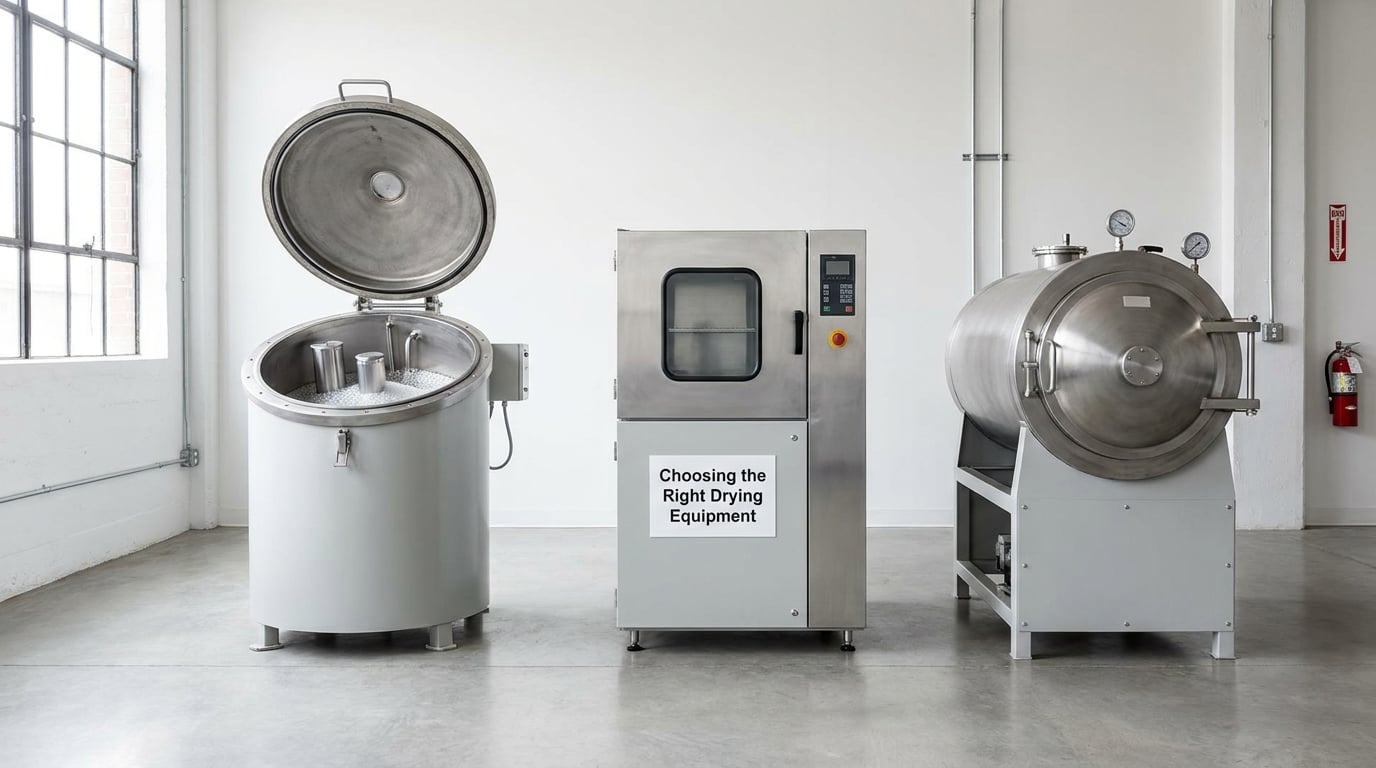
| Dryer type | Typical time to target | Dew point capability | Best suited to | Watch out for |
|---|---|---|---|---|
| Desiccant hopper dryer (twin-bed) | 4 to 8 h of continuous drying | Typically -40 °F / -40 °C or better | PA, PC, PET, PBT, PPO, PPS, filled grades | Desiccant saturates; verify dew point at the outlet, not at startup |
| Hot-air dryer | 2 to 6 h | Depends on inlet air; rarely better than -20 °F | ABS, PMMA, SAN, POM, TPU grades with low sensitivity | Humidity in the plant air sets your real dew point |
| Vacuum dryer | 30 to 60 min for many engineering resins | Very low moisture achievable | Small to medium lots, expensive polymers, short runs | Batch operation, no continuous feeding, more handling |
| Sealed conveying with a receiver | No extra drying time | Preserves what the dryer achieved | Any high-temperature or high-hygroscopic resin | Air leaks and gasketing become the weak link |
Vacuum drying reaches target in 30 to 60 minutes for many engineering plastics, which is dramatically faster than a desiccant cycle. It suits small lots and high-value polymers where drying eight hours of hopper time is not practical. It is a batch process, so it does not scale to a continuous molding line.
For continuous production, sizing matters more than most buyers expect. The dryer has to hold enough material in the bed to deliver your throughput while giving each pellet the residence time the data sheet asks for. Running a dryer above its rated capacity quietly shortens residence time, and the pellets leave wet even though the panel reads the right temperature.
Common Drying Mistakes and Production Problems
Most drying problems show up as a part defect with a familiar shape. Matching the symptom to the likely cause is faster than re-running trials blindly.
| Symptom | Likely moisture-related cause | Corrective action |
|---|---|---|
| Silver streaks or splay around the gate | Wet resin, or pellets exposed between dryer and barrel | Check outlet dew point under load, seal the hopper, extend drying time to the data sheet value |
| Bubbles and internal voids in thick sections | Moisture trapped inside thick pellets or parts | Extend drying time rather than temperature first; thicker sections need longer |
| Brittle parts or low tensile strength | Hydrolysis during melt, especially in PA, PC, PET, PBT | Verify moisture before processing, shorten melt residence time, check barrel for dead spots |
| Yellowing or colour shift | Over-drying, excessive temperature, or long residence in the barrel | Drop temperature toward the data sheet value and check the desiccant is not overheating the bed |
| Black specks or burnt particles | Resin left in a hot barrel or a dead spot, sometimes aggravated by wet feed | Purge the barrel, correct moisture, review screw and nozzle design |
| Moisture reading that disagrees with part quality | Sampling error: pellets cooled in open air before testing | Take samples into sealed containers immediately and retest |
| Pellets clumping or sticking after oven drying | Pellets cooled below the softening point while still wet | Cool in a sealed container or under dry air |
Two mistakes account for most of the rest. The first is trusting the startup reading: a desiccant dryer often shows its best dew point when the bed is empty and before the plant’s humid air has loaded the system. Measure under load at the hopper.
The second is regrind. Regrind reintroduces moisture after the virgin pellets were correctly dried, and it also carries whatever thermal history it already had. Re-dry regrind separately or blend it before drying, never after, and count the cycles. Each pass through a hot dryer is another exposure to oxygen and heat, and repeated cycles cost molecular weight in hydrolysis-prone resins long before anyone sees a defect.
How to Confirm the Resin Is Ready for Processing
You cannot see moisture in a pellet, so dryness has to be measured. Four methods cover most production situations, and each has a limitation worth knowing before you trust the number.
Karl Fischer titration is the reference method. It measures water directly and is accurate down to the fractions of a percent that polyester grades demand. It is a laboratory technique with skilled titration, and the sample must be handled so it does not pick up moisture on the way, which means sealed syringes or a closed transfer and a rapid test.
Near-infrared moisture analysis is fast enough for incoming inspection and batch-to-batch trending, and modern instruments handle polymer pellets well. Its weakness is calibration drift: an NIR reading is only as good as the calibration set for that grade, and a resin with a different additive package or colour can read low without being dry. Calibrate against Karl Fischer results for your own grades.
Loss on drying is the cheap option. Heat a weighed sample to a constant mass and work out the loss. For most thermoplastics it is adequate for incoming screening, but it can read high for grades with volatile additives or crystallisation water, and it says nothing about how moisture is distributed inside the pellet.
Process-performance checks are the practical fallback when no lab exists. A spiral-flow test, a stable melt flow rate across a weighed sample, or a short trial run followed by an inspection for splay will confirm that the process can handle the material. These methods prove the resin is good enough; they do not prove it is at a specific percentage.
For almost all lines, the practical combination is an in-line or portable dew point meter at the dryer outlet under load, plus one lab moisture measurement per lot to anchor the calibration.
Frequently Asked Questions
Can engineering plastic pellets be dried overnight?
It depends on the resin, not the convenience. Several engineering plastics are specified for four to six hours and gain nothing from a longer hold, while polyamide grades are sometimes published at eight to twelve hours. Continuous heating beyond the data sheet raises the risk of thermal ageing and colour shift. If your hopper runs overnight, size the dryer so material never sits longer than the exposure limit your grade allows.
What is the difference between drying time and drying temperature?
Time and temperature do different jobs. Temperature sets how quickly water can leave the pellet, so higher temperature means less dwell time is needed. Time is the dwell period needed for the coldest material in the bed to reach target moisture. Raising temperature to shorten time is only safe below the grade’s degradation ceiling, which for some polyphenylene oxide grades sits below the melting processing window.
Do plastic pellets absorb moisture after they leave the dryer?
They do, which is why data sheets list an exposure limit. Hygroscopic pellets in an open hopper reabsorb moisture from ambient air, and warm humid shop air makes the pickup faster. Sealed hoppers with level-sensor shutoffs, closed conveying, and a receiver at the machine all cut that exposure. For polyester and polyamide grades the exposure window after drying is often shorter than many operators expect.
How can I tell whether engineering plastic pellets are still wet?
You need a measurement, since wet pellets look identical to dry ones. Use a portable or in-line dew point meter at the dryer outlet under load, and a Karl Fischer titration on a sealed sample to anchor your process. If neither is available, run a short trial and inspect parts for splay and bubbles. Melt flow rate drift and spiral-flow tests give a useful pass or fail signal for the line.
Can recycled engineering plastics use the same drying schedule as virgin resin?
Not automatically. Regrind carries extra thermal history, possible contamination, and a different moisture level from virgin pellets, so it often needs the same or a longer dry rather than a shorter one. Dry regrind before blending, keep the ratio in your control plan, and check whether the resin supplier tolerates repeated drying cycles at all, since hydrolysis-prone grades lose molecular weight each time they are reheated.
Conclusion
Start by pulling the technical data sheet for the exact grade on your line and writing its temperature, time, moisture ceiling and exposure limit on the hopper card. Set the dryer to those values, verify the outlet dew point under load rather than at startup, and confirm moisture on a sealed sample before you release material to production. Those drying times for common engineering plastics are starting references; the measurement is what makes the schedule defensible.