
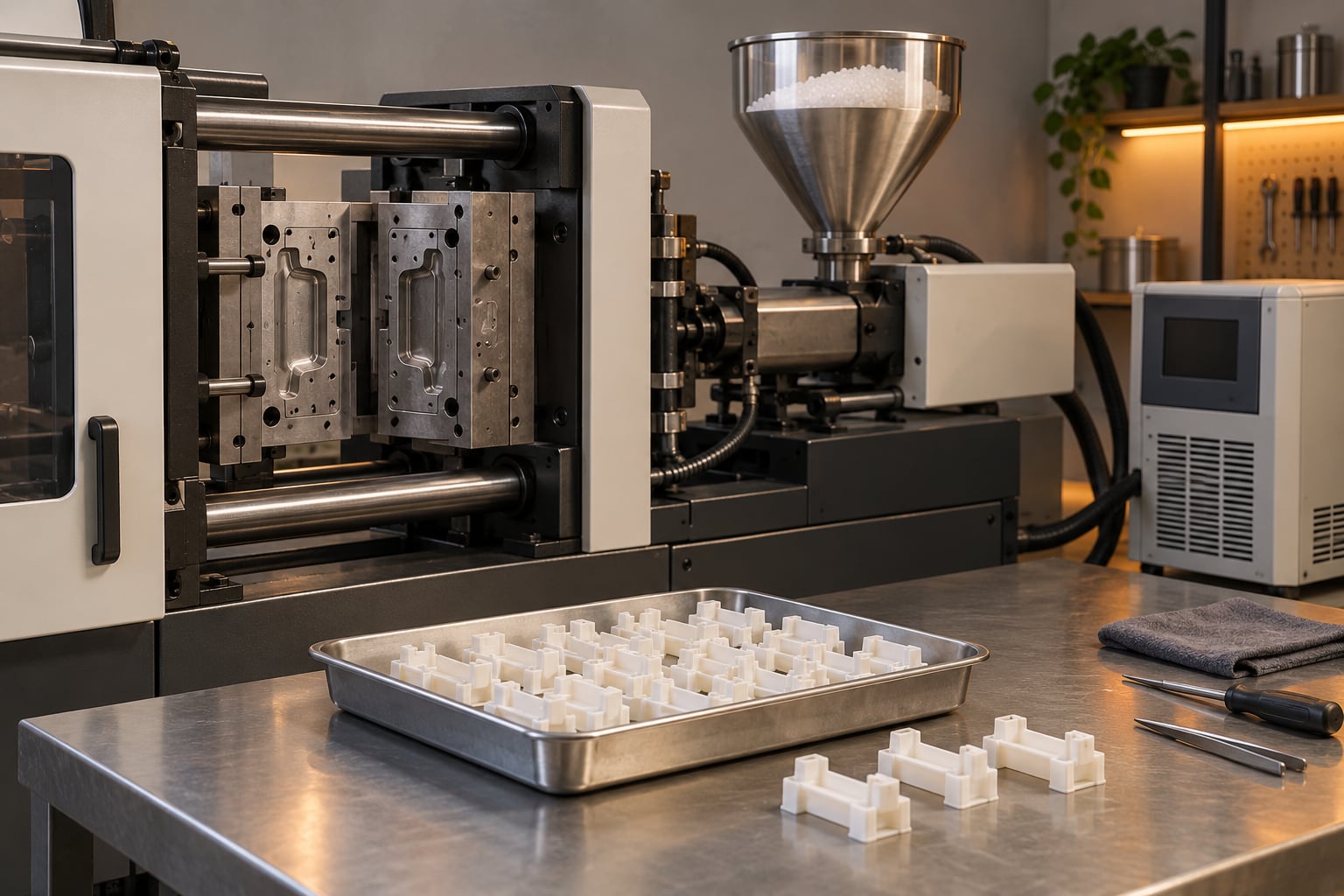
To start an injection molding business, you prove a product and a customer before you buy anything, then buy the smallest press that can run that part, tool it properly, document the process, and sell the first production run. A realistic timeline is 6 to 18 months from first conversation to shipping steady orders, and the capital requirement starts around 150,000 USD for a small shop and climbs quickly from there. Most new operators on this site describe the hard part as commercial rather than technical: the molding itself is a well-understood process, while finding customers who commit volume takes longer.
This guide walks through the full sequence, from choosing a niche to scaling responsibly. It assumes you are in the United States, working with thermoplastic resins, and targeting business customers who need repeatable parts in modest volumes. If your plan is captive production for a single product rather than a molding service company, the demand validation steps matter even more, since you have one customer by definition.
Table of Contents
- What You Need
- How to Start an Injection Molding Business: Step by Step
- Common Mistakes That Break New Injection Molding Businesses
- Frequently Asked Questions
- How much does it cost to start an injection molding business?
- How much do injection molding machines cost?
- How much does it cost to create an injection mold?
- How profitable is injection molding?
- What licenses, permits, and insurance does an injection molding business need?
- How do I choose between owning equipment and outsourcing production?
What You Need
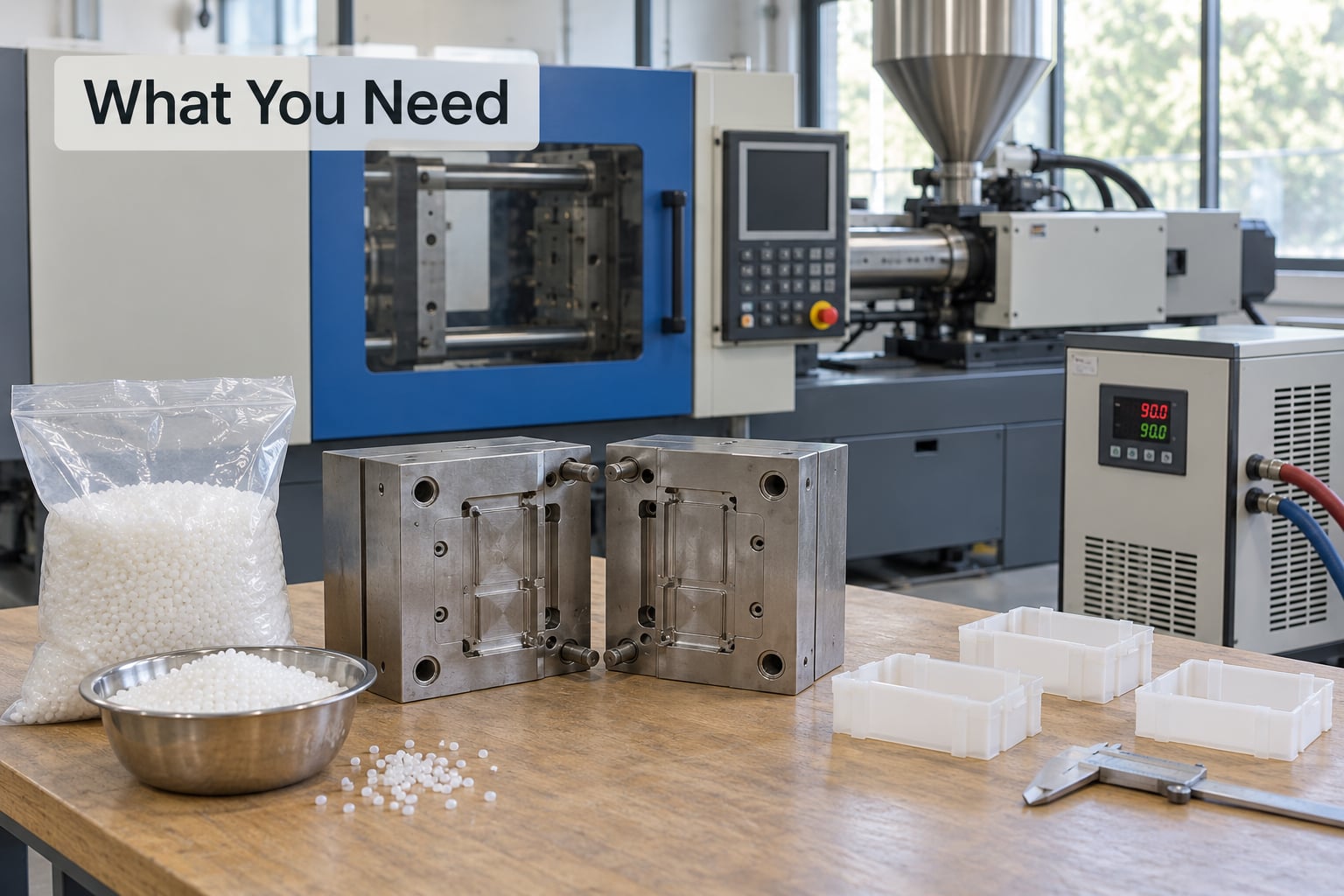
Here is the checklist most successful new molding shops work from. Every line item below has to be funded or resolved before a press is committed, and several of them surprise first-time owners because they fall outside the machine itself.
- A repeatable product. A part with clear specifications, steady demand, and dimensions a press can hold consistently. Cosmetic-only parts with tight appearance tolerances and exotic resins are the two categories that punish new shops hardest.
- A validated customer list. Names, part numbers, annual usage, target piece price, and a named contact at each. Interest without a written follow-up is not a pipeline.
- Facility and utilities. Roughly 1,000 square feet per press is a common planning rule of thumb, plus space for resin storage, drying, parts binning, inspection, and shipping. Three-phase power, adequate amperage, compressed air, a chiller or cooling tower connection, and a crane or hoist are baseline requirements.
- Machines. Benchtop manual presses start near 5,000 USD, automatic benchtop machines run 15,000 to 50,000 USD and up, and 100-to-300-ton industrial presses commonly land between 50,000 and 150,000 USD or higher. Used machines cut the entry point considerably if you can absorb a rebuild.
- Auxiliaries. A hopper dryer with dehumidification, a temperature controller for the mold, a water chiller, an air compressor, a resin grinder or granulator, mold carts, crane access, and a parts counter or conveyor for handling finished pieces.
- Tooling. Aluminum molds suit short runs and moderate volumes, steel molds suit high volume and wear resistance, and 3D printed or cast aluminum soft tooling suits prototypes and pilot quantities. A second source for tooling should be identified before an urgent order lands on your desk.
- Material supply. At least two resin distributors per material you run, plus drying equipment sized to your throughput. Resin pricing moves, so build quotes around current market data rather than numbers from a blog post.
- A quality system. Incoming inspection records, drying logs, setup sheets, first article inspection, in-process checks, nonconformance handling, lot traceability, and a place to file production records. Start with a documented system; pursue formal certification when customers require it.
- People. At launch, an operations manager, machine operators who can also do setup, a maintenance hand, and a quality technician. Many lean shops cross-train two or three people across all of those roles.
- Working capital. Three to six months of payroll, rent, utilities, resin, and insurance before the first large receivable lands. This line is the most common reason technically sound shops fail in year one.
- Licenses, permits, and insurance. A state business license, local occupancy and fire approvals, air permits for your equipment, and general liability, property, workers compensation, products liability, and equipment coverage. Requirements vary by state and county, so confirm with local authorities rather than assuming.
How to Start an Injection Molding Business: Step by Step
Define Your Target Product and Customer
The product decides everything else, so this is where the research belongs. A good first part for a new shop is repeatable, modest in volume, easy to inspect, and forgiving in wall thickness. A good first customer is one who gives you drawings or a specification, commits to a repeat order, and answers technical questions quickly.
Learn to say no to certain categories. Parts with visible cosmetic surfaces and class-A appearance requirements need tight process control, higher-grade tooling, and more inspection than a beginner shop can carry. Deep draw depths, thin fragile walls, and long fiber-filled materials each introduce failure modes that eat hours per shift. Very high-pressure engineering resins and liquid silicone rubber require equipment and knowledge you probably do not have yet.
You also want a part whose total landed cost works. Before designing anything, work out the resin weight, expected cycle time, tooling amortization, and packaging. A part that looks attractive on a piece price basis can be a losing product once scrap, freight, and customer returns are added. Write that number down, because you will need it again in every quote. If you want a method for the tooling side of that math, our guide on how to calculate injection molding tooling cost breaks it down part by part.
One more filter: how much does it cost the customer to switch away from you? Parts that get molded into an assembly, approved under a PPAP package, or listed in a regulatory filing are sticky. One-off cosmetic parts are not.
Validate Demand Before Buying Equipment
Validation is the step that separates shops that survive from shops that end up scrapping ABS for two years. Do it with numbers, not enthusiasm. For each target customer, estimate addressable volume, annual usage of that part, the piece price they currently pay, the annual cycle time you need to hit, the defect rate they will tolerate, and the switching cost of moving the part.
Then go talk to them. Ask for the current part, the current price, the current lead time, the pain points with the incumbent supplier, and what would make them move a portion of volume. Request sample parts so you can weigh and measure them. Offer a paid pilot rather than free samples, because a paying pilot reveals whether the order is real.
Written follow-up is what counts. A purchase order, a signed letter of intent, a forecast, or even a scheduled call with a stated part number and volume all belong in a validation file. Verbal enthusiasm does not pay for a press. Record everything in a spreadsheet that shows expected annual revenue by customer, and sanity-check it against the machine capacity you would need to serve it.
Rule of thumb from shops that have done this: if your validated pipeline does not fill roughly 60 percent of one shift on one machine for a year, buying that machine is early. Take a smaller machine, run it harder, and add capacity when the booked hours justify it.
Choose a Business Model and Location
There are three workable models, and the right one depends on whose risk you want to carry. Owning a molding shop means you hold the capital, control the process, and set your own prices. Operating as a contract molder means you sell capacity and service to customers who own the tooling, which is the classic path for a new business. The third option is a job shop or production partnership where you run parts for other molders or hold inventory for customers who sell finished goods.
Most beginners do well starting as contract molders with a single press, because tooling ownership risk sits with the customer. If your product idea is captive, an in-house cell with one machine and outside overflow capacity for peak weeks is a safer opening than a fully loaded plant.
Location matters less for cost than for labor and customers. Skilled machine operators and maintenance techs are not evenly distributed. A region with a plastics cluster gives you a labor pool, used machinery nearby, resin distributor support, and mold shops within driving distance. Power cost and electricity tariffs matter at volume, but a cheap building in an area with no operators will idle your press.
Check zoning and occupancy approval for manufacturing before signing any lease, confirm the electrical service can carry your planned machines plus growth, and ask about local incentives for equipment investment and job creation. State and local rules on air permits, wastewater from cooling loops, and noise differ, so talk to the local authority rather than reading a blog post about it.
Select Machines, Auxiliaries, and Tooling
Match the machine to the part, not the other way around. Clamping force is sized to the projected part area: a common starting rule is roughly one ton of clamp force for every two to four square inches of projected area, then verified against the mold maker’s requirements. Shot capacity should be about one to one-and-a-half times the part weight so the screw can fill the barrel and hold pressure consistently. Platen size and tie-bar spacing have to physically accept your mold footprint, with room for the mold to hang on the crane.
Electric machines suit accuracy, repeatability, and energy cost; hydraulic machines still cost less and suit tougher, higher-tonnage work. Buy the class of machine that matches the parts you have actually validated, and buy used only if you can budget a full rebuild of the screw, check rings, and hydraulics.
Auxiliaries decide how much of your machine’s capacity you can actually use. A poor hopper dryer or undersized chiller will limit throughput more than the press itself, because cycle time waits on cooling and drying. Budget for compressed air with a dryer, a water chiller sized to the mold, temperature control for hot runner or heated tools, and material handling that keeps operators from carrying resin by hand all day. Our list of 12 auxiliary equipment every molding shop needs is worth reading before you build that budget line.
On tooling, get design for manufacturability feedback before cutting steel. Draft on vertical walls, uniform wall thickness, rib and gosset placement rather than thick sections, gate location away from cosmetic surfaces, and ejector pin placement that does not mark a visible face. For a first part, an aluminum mold built for production service is often the best balance; 3D printed molds are useful for prototypes and short runs where the tooling will not survive volume.
Plan maintenance from day one: a documented preventive schedule, spare hot runner and heater parts on the shelf, and a mold maintenance log. Nobody plans for downtime, but every hour of unplanned downtime in month two costs you a delivery date you already promised.
Build the Cost and Cash-Flow Plan
Startup spending falls into six buckets: machines and auxiliaries, molds, installation and building improvements, first material purchases, payroll and training, and working capital. Add insurance, permits, professional fees, and marketing. Put every line on a spreadsheet with a month attached, because the timing of cash out matters more than the total.
Then build a per-part cost that you can defend in a quote. The math is straightforward: resin weight times current resin price gives material cost. Cycle time times your fully loaded machine rate gives machine cost, and a good rule is to charge the machine for the full cycle including mold changes amortized, not just the good cycles. Add direct labor minutes, expected scrap percentage, inspection and packaging, freight, overhead allocation, and tooling amortized across the committed volume.
What remains is margin. Set a floor for it, and walk away from jobs that clear your machine time but not your margin. Tooling is usually a separate customer charge, and be explicit about whether it is refundable at volume, because that decision shapes how customers treat your pricing.
Cash flow kills more new molding businesses than competition. Customers typically pay 30 to 60 days after shipment, resin is due on delivery, and payroll is weekly. Model a month where you ship a large order, get paid late, and still cover payroll. If your plan only works when every invoice clears on time, it does not work.
Financing options include equipment financing from lenders who specialize in machinery, bank lines of credit, SBA-backed loans, and owner investment. A term loan matched to the useful life of the equipment is usually the cleanest structure, and working capital line financing is the usual answer to the receivable gap. Build the model with realistic payment timing, not optimistic assumptions, before you commit to a building.
Recruit and Train the Right Team
At launch, most shops run with four to seven people wearing several hats. You need someone who owns the schedule and the numbers, operators who can set up a mold and adjust the process rather than just press a start button, a maintenance hand who can change a heater and read a schematic, and a quality technician who can measure parts and write a real inspection report. A scheduler or estimator and a sales person come next, often part time at first.
Operator salary levels vary widely by region, and experienced setter and maintenance technicians command a real premium over entry-level production workers. Budget for training as a line item: many hires with a manufacturing background have never run injection molding specifically, and paying for hands-on training plus a supplier-run process school is cheaper than paying for mistakes.
Cross-training is what keeps a small shop alive. When one person holds the only copy of the process knowledge, every absence becomes an emergency. Document setup sheets, changeover steps, and known problem fixes so the second person can run the job.
Automation and part picking are worth evaluating once volume justifies the cycle time, not before. A robot that pays for itself on a stable, high-volume part is a good investment; on a job shop with a mix of short runs, it is a money drawer with a gripper. Know your labor cost per hour first, and let that number drive the decision.
Create a Quality and Traceability System
Customers buying molded parts are buying consistency, so the quality system is your sales argument. Start with incoming material controls: resin lot numbers, drying time and temperature logged per lot, and moisture test results retained. A drying record is the first thing a quality auditor asks for and the first thing that explains a streak of bad parts.
Then set up setup sheets for each job that capture every process parameter: barrel zone temperatures, mold temperature, injection speed and pressure, hold pressure and time, cooling time, back pressure, screw speed, and cycle time. First article inspection happens on every new mold, after a major repair, or when a process parameter changes, and the report travels with the shipment.
In-process checks should be scheduled rather than random. Set a check every hundred shots, inspect critical dimensions with calipers or a gauge, and use a go/no-go fixture where one exists. Run SPC charts on the characteristics your customer actually cares about, because a control chart on an unimportant dimension is paperwork. Calibrate your measurement equipment on a schedule and keep the certificates. For a structured way to catch process risk before it reaches a customer, our walkthrough of FMEA for injection molding processes is built around a shop-floor example.
Build the corrective action loop: quarantine nonconforming material, open a nonconformance report, find the root cause, document the fix, and verify it. Lot traceability means you can tell a customer which resin lot, machine, mold, and shift produced any given carton, which is what makes you credible in regulated work.
Certifications follow customers rather than lead. ISO 9001 is the usual first step for general industrial work, IATF 16949 for automotive, ISO 13485 for medical devices, and export or defense work brings registration obligations of its own. A documented system in place from month one makes certification a formality; a shop with only spreadsheets in month twelve pays consultants to write the system for them.
Sell, Trial, and Retain Customers
Turn validated interest into orders with a simple, repeatable sales process. Have an RFQ template that asks for the drawing or model, material, annual usage, tolerances, required certifications, packaging, and the date the parts are needed. If a customer cannot answer annual usage, that is a lead, not a customer. Respond fast, because a fast, complete quote often beats a lower price.
Price with the per-part model, and show your math when a customer pushes hard: material, cycle time, machine rate, labor, scrap, overhead, and margin. Transparency in cost breakdown is a trust signal, particularly with buyers who have been burned by molders who quoted low and changed the price mid-run.
Sell the trial deliberately. Samples prove nothing about production; a pilot run of a few hundred parts with a first article report does. Quote realistic lead times, not the fastest one you could theoretically hit, because the first late delivery in a young relationship is expensive to recover from. Keep your promise dates and tell customers early when something slips.
Start with a manageable number of customers in one or two industries rather than selling to everyone. Buyers in a given industry share tooling knowledge, quality expectations, and referral networks, and concentrating there makes you easier to recommend. Trade shows, industry supplier directories, referrals from satisfied customers, and direct outreach to design engineers doing early development are the channels that most new shops report working. Most early business still arrives by referral, so over-deliver on the first runs and ask.
Watch the retention numbers, not just the revenue. A customer who places a second and third order is the signal that your pricing, quality, and communication worked. Schedule a short review call with each account after the first production run and a couple more after the first year.
Common Mistakes That Break New Injection Molding Businesses
Almost every failed new molding shop makes at least two of the same mistakes. The corrections are simple; the problem is that the mistake shows up on a schedule you cannot control.
Buying a large press before proving demand
A 300-ton machine costs several times a 100-ton machine and adds power, floor space, and crane requirements. If the validated pipeline only fills part of a smaller press, the extra capacity becomes dead capital and fixed cost. Start with the smallest machine that can hold your part with margin, and upgrade when booked hours say so.
Underestimating tooling and working capital
Molds are quoted per part design, and a production mold with cooling, slides, or multi-cavity layouts costs multiples of a simple cavity. Budget tooling and a cash reserve in the same conversation as the press, never later. Three to six months of operating expense is the minimum reserve most shops survive on, and many run leaner than that only by accident.
Choosing the wrong product
Cosmetic parts, ultra-thin walls, deep draws, and unusual materials all carry defect risk that a new team cannot absorb. Pick parts that are forgiving, inspectable, and boring to mold. Boring is a feature in your first year.
Treating samples as validated production
Samples prove the part can be made once. They do not prove it can be made repeatably at rate with an acceptable defect rate. Run a pilot lot, keep the data, and quote production pricing only after you have measured real cycle time and real scrap.
Ignoring maintenance
Deferred maintenance on heaters, thermocouples, check rings, and cooling lines shows up as random quality drift, which is harder to diagnose than a hard failure. Put preventive tasks on a printed schedule, keep critical spares on hand, and log every repair with the mold and the machine.
Depending on one customer
One account above half your revenue makes your business a supplier to that customer rather than a company. If the relationship is new and you financed equipment against its forecast, that risk is doubled. Build a pipeline of at least three active accounts, and know the order size that would hurt you.
Failing to document standards
When process knowledge lives in one person’s head, a vacation becomes a delivery problem. Write the setup sheets, keep the inspection records, and store lot data. It is dull work that decides whether a customer stays.
Ignoring the sales ramp
Equipment arrives on a schedule; customers do not. Many new shops are profitable on paper and lose cash during a twelve-month ramp because the first orders are small and slow. Plan for that runway, work the pipeline every week, and treat quoting speed as a competitive advantage.
A few launch tips that help: run one product family to start so setups and process knowledge concentrate. Quote with written assumptions so pricing disputes have a reference. Track quoted versus actual machine hours from the first job, because that gap is where your real rates are hiding. And revisit the business plan at 90 days with actual numbers instead of the plan you wrote in January.
Frequently Asked Questions
How much does it cost to start an injection molding business?
A small single-press shop typically needs 150,000 to 300,000 USD to get going, and that does not include a building purchase. That covers an automatic benchtop or used 100-ton press, a hopper dryer, chiller and compressor, a first production mold, installation, insurance, and about three to six months of working capital for payroll, resin, and rent. Adding a second press and larger industrial molds can push a launch well past half a million dollars.
How much do injection molding machines cost?
Manual benchtop machines start near 5,000 USD, automatic benchtop presses fall between 15,000 and 50,000 USD, and 100-to-300-ton industrial machines typically run 50,000 to 150,000 USD or more. Used equipment costs less but should be budgeted with a rebuild allowance for the screw, check rings, and hydraulics. Beyond the press, plan for a dryer, chiller, compressor, temperature control, and crane access, which together can approach the price of a small machine.
How much does it cost to create an injection mold?
3D printed or cast aluminum soft tooling can run a few thousand dollars and suits prototypes and short runs. Production aluminum molds typically land in the low tens of thousands of dollars, while production steel molds with cooling, slides, or multi-cavity layouts reach tens of thousands more. Price depends on cavity count, size, cooling complexity, and insert material. Always get the tooling quote in writing and amortize it explicitly in the piece price you quote.
How profitable is injection molding?
Profitability comes from machine utilization, not from high prices. A press that runs booked 60 to 70 percent of available hours can carry a healthy margin, while a press running 25 percent of the time has to charge unrealistic piece prices to cover itself. Track quoted machine hours against actual hours from the first job onward, and know your scrap rate and cycle time for every part you quote. Most new shops reach steady profitability somewhere between 18 and 36 months.
What licenses, permits, and insurance does an injection molding business need?
You need a state business license, local occupancy and zoning approval for manufacturing, fire code compliance, and any air permits your equipment requires. Insurance normally includes general liability, commercial property, workers compensation, products liability, and equipment coverage, with inland marine and cargo coverage for customer-owned tooling worth discussing. Requirements vary by state and county, so confirm with your local authority and an insurance broker before you sign a lease or buy a press.
How do I choose between owning equipment and outsourcing production?
Outsource when you have a prototype to validate, volume under a few thousand parts a year, or customers who insist on their own tooling. Own equipment when validated volume can fill a shift, cycle time gives you a cost advantage over a contract molder, and you need control of lead times and quality. A hybrid works well at the start: one in-house press for the parts you run constantly, and a qualified contract partner for overflow and for customers who bring their own molds.
If you take one action from this guide, make it the next customer conversation. Book meetings with a dozen buyers, ask what they pay and how many parts they use, and let those answers decide whether you start a molding business at all. The press comes later, and it will be a smaller one than you had in mind.