
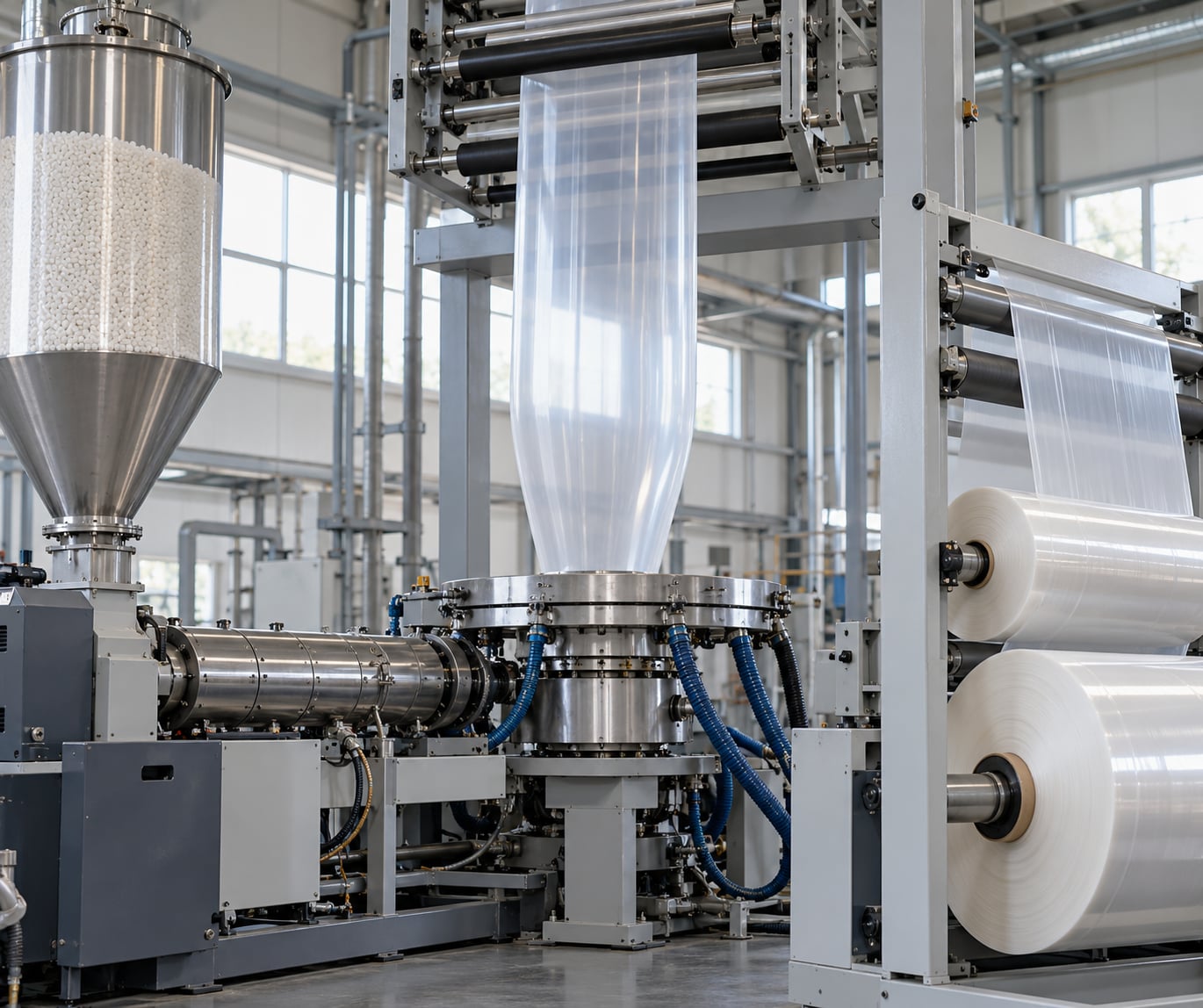
Most plastic bags are made in two stages. First, polyethylene resin pellets are melted and extruded into a thin continuous film, usually by blown film extrusion, and then that film is printed, cut, folded, and heat-sealed into finished bags on a converting line. Which resin and which extrusion route you pick decides the bag’s clarity, strength, seal window, and cost long before anyone cuts a single seam.
The rest of this guide walks the whole sequence the way a plant does: resin selection and additives, the difference between film making and bag making, blown film versus cast film, converting, closures, quality checks, printing, packing, and the environmental trade-offs buyers get asked about at the end of every quote.
Table of Contents
- How Plastic Bags Are Made: From Resin to Finished Bag
- What Materials Are Used to Make Plastic Bags?
- What Is the Main Difference Between Film and Bag Manufacturing?
- How Plastic Bags Are Made in Blown Film Extrusion
- How Are Plastic Bags Made with Cast Film Extrusion?
- How Are Plastic Bags Cut and Sealed?
- How Are Handles, Gussets, and Closures Added?
- What Quality Checks Are Used on Plastic Bags?
- How Are Plastic Bags Printed and Decorated?
- How Are Plastic Bags Packaged for Shipping?
- What Environmental Considerations Apply to Plastic Bag Production?
- Frequently Asked Questions
- Conclusion
How Plastic Bags Are Made: From Resin to Finished Bag
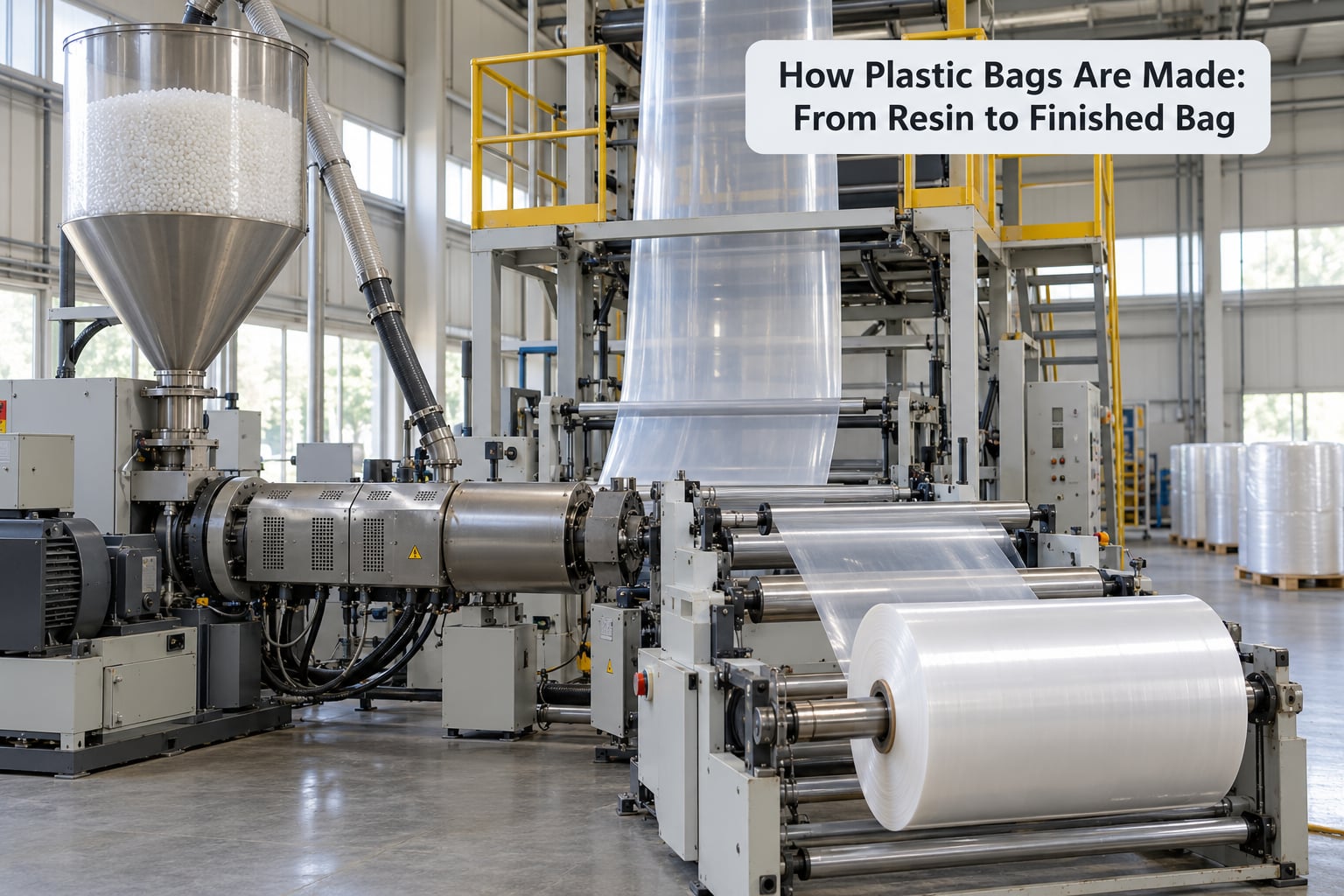
The process runs in a fixed order, and each stage feeds the next one. A buyer who understands the order can diagnose a weak bag faster than one who only sees the finished seam.
- Feedstock recovery. Ethylene is cracked out of crude oil or natural gas at a petrochemical plant. This happens far from the bag factory.
- Polymerization. Ethylene molecules are linked into long chains under heat and pressure, producing high-density, low-density, or linear low-density polyethylene.
- Pelletizing. The molten polymer is cooled, cut into pellets, blended with additives, and bagged or bulk-siloed.
- Resin preparation. Pellets are dried and metered into the extruder, usually through a gravimetric or volumetric dosing hopper.
- Film extrusion. The melt passes through a die to form either an inflated bubble (blown film) or a flat web quenched on a chill roll (cast film).
- Cooling and winding. The film is collapsed, trimmed, treated for print adhesion if needed, and wound onto large mill rolls.
- Converting. The rolls go to a bag-making machine that prints, folds, gussets, cuts, seals, counts, and packs finished bags.
The last three steps can be combined. Integrated lines extrude film straight into bags without ever winding a roll, which is faster but locks the operator into one bag style per machine.
What Materials Are Used to Make Plastic Bags?
Almost all bags start with polyethylene in one of three grades, and the grade decides the bag. High-density polyethylene is stiff and strong, low-density polyethylene is soft and clear, and linear low-density polyethylene blends both traits. Below that sit the polymers chosen for jobs polyethylene cannot do.
| Material | Character | Typical bag uses |
|---|---|---|
| HDPE | Rigid, high tensile strength, low stretch, slightly cloudy | Trash and bin liners, grocery tote bags, shrink film |
| LDPE | Soft, flexible, excellent clarity, easy heat seal | Produce bags, bakery bags, zip-style pouches, stretch film |
| LLDPE | Flexible with high puncture and tear resistance | Thin grocery carriers, industrial liners, heavy-duty trash bags |
| Polypropylene (PP) | Rigid, higher melting point, low haze option | Woven sacks, woven liners, strapping, some food overwrap |
| PVC | Clear, stiff, chemically resistant | Pharmacy and medical bags, shrink sleeves, cling film |
Additives are dosed into the melt before the die, usually below two percent of total weight. Slip agents keep stacked film from blocking, and slip is controlled because too much of it turns a bag slippery on the shelf. Anti-block raises the surface’s roughness so layers do not stick together. UV stabilizers extend outdoor life for agricultural and construction film, while masterbatch colorant tints the melt before extrusion rather than after.
For food contact, the resin, the additives, and the printing inks all have to clear the relevant FDA regulation for the intended temperature and use. A recycled-content layer can sit in the body of a bag while virgin layers handle the seal, which is how most recycled grocery bags are built.
What Is the Main Difference Between Film and Bag Manufacturing?
Film manufacturing makes a flat, wide web or tube on a machine built around an extruder and a die. Bag manufacturing, or converting, takes that finished film and turns it into discrete bags on machines built around sealing jaws and cutting knives. They are different disciplines with different failure modes.
Film producers worry about gauge variation, bubble stability, melt temperature, and resin lot consistency. Converters worry about seal temperature and dwell time, registration between print and cut, gusset folding, and how the bag counts once it is stacked.
Integrated bag-making lines do both in one pass. Film is extruded, collapsed, and fed directly into the bag machine, so the material never gets wound or unwound. It runs fast and keeps a steady gauge, and switching to a different bag size means a full changeover.
Two-step production buys flexibility. A converter can hold dozens of film recipes in inventory and run them across the same bag machine, and it is the usual setup for anything printed or with a closure.
How Plastic Bags Are Made in Blown Film Extrusion
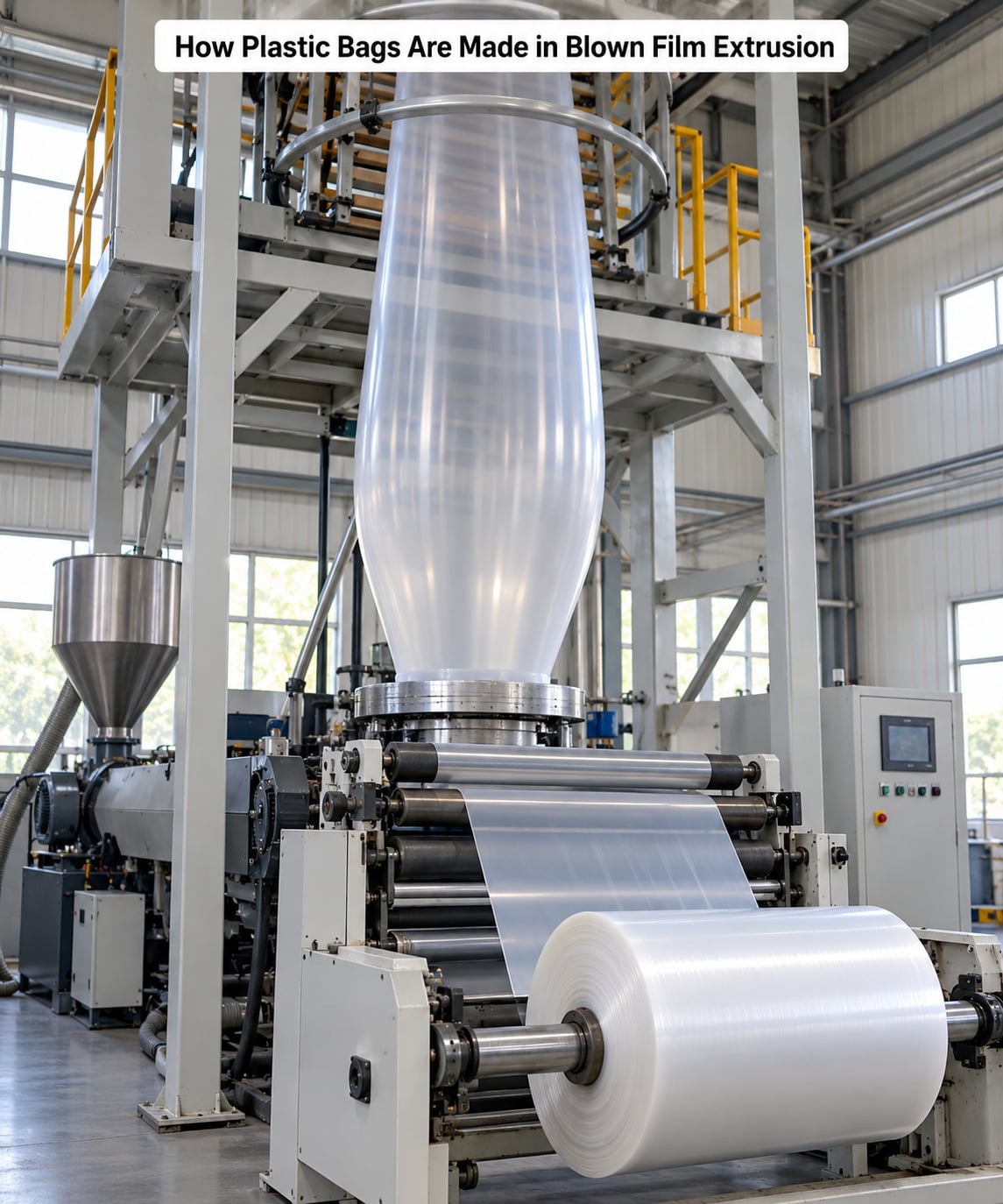
How plastic bags are made step by step through a blown film line
Blown film extrusion is the dominant route for bags because a single die produces a double-thickness tube with balanced mechanical properties on both faces. The bubble leaves the die as thick molten resin and stretches to final gauge in mid-air, and that stretching is what gives the film its strength.
- Drying. Pellets are held in a desiccant dryer until moisture sits in the low tens of parts per million. Water in the melt comes out as bubbles in the film, and those bubbles are the defect everyone argues about on the line.
- Feeding. Pellets fall through a hopper into the feed throat of the extruder while the barrel heats to a melting range commonly somewhere around 160 to 200 degrees Celsius, depending on grade.
- Melting and mixing. A turning screw conveys, compresses, and plasticizes the resin. Additives injected mid-barrel are dispersed here, which is why dosing is timed to the melt rather than to the hopper.
- Filtering. The melt passes through a screen pack or continuous screen changer to catch gels, black specks, and degraded particles.
- Extrusion through the die. Melt leaves a spiral mandrel die as a thick annular tube, and the die gap sets how much material the bubble starts with.
- Inflation and frost line. Air enters through the die center and inflates the tube. The frost line, the ring where the haze disappears and the film goes clear, marks the transition from melt to solid. Gauge is set mainly by air volume and line speed.
- Cooling and collapsing. Air rings and a cooling tower knock heat out, and nip rolls gradually collapse the tube flat without creasing it.
- Treatment, trimming, and winding. Corona treatment raises surface energy for ink adhesion, trim rolls cut the edges clean, and the layflat tube winds onto a mill roll.
Extrusion is where lightweighting happens. Planners steadily reduce gauge while holding tensile and seal performance, so a bag that used to run heavier now achieves the same load rating on less resin. Buyers and end users alike notice this: lightened carriers tear sooner, which is the most common complaint on bag lines that run commodity film.
Film properties are checked at the extruder with melt flow index and density, both of which describe how the resin will process. Dart impact, the drop weight the film survives, predicts puncture resistance in the finished bag. Holding a tolerance on all of that is the same discipline described in plastic part tolerance standards explained, applied to a web that moves at line speed.
How Are Plastic Bags Made with Cast Film Extrusion?
Cast film is the alternative to blown film, and it comes off a chill roll instead of out of the air. The melt is extruded through a flat die as a wide web, runs onto a polished chilled roller, and solidifies almost immediately. The web is stripped off, trimmed, and wound.
The chill roll does the cooling, so the film reaches its final gauge and physical properties before it ever leaves the machine. That tight control is why cast film shows excellent gauge uniformity, clean optical quality, and predictable print surfaces. It also runs faster than blown film at thin gauges, which is where high-speed packaging lines live.
Where blown film wins is tear resistance and stretch. The bubble stretches the resin in one direction, producing a balanced, tough film that handles the drop-and-tear abuse a grocery carrier takes. Many converter applications, including pre-printed retail film and laminating webs, prefer cast film for the surface quality and the simple two-ply structure.
Cast film costs less per pound of good output for flat, printed work. Blown film costs less per pound of tough, tear-resistant film. That trade-off is usually the whole argument.
How Are Plastic Bags Cut and Sealed?
Converting starts when a mill roll is mounted on a bag-making machine with an unwind, a print station if the bag is decorated, a folding and gusseting section, and a sealing and cutting station. The web moves in a continuous web-to-bag flow.
Two machine families dominate. A center-seal machine handles side gussets, producing bags with gussets folded to one side, the familiar flat square format used for bakery and produce bags. A side-seal machine makes tubular bags with a bottom seal and optional top seal, which is the classic grocery carrier shape. A pouch machine forms the U-shape or pillow shape used for zipper bags and retail pouches.
Sealing is hot knife and hot jaw work. A heated seal bar presses the film flat with controlled heat, pressure, and dwell time, and the seal window for polyethylene runs roughly 120 to 165 degrees Celsius depending on grade and gauge. The plastic softens and fuses; a seal that is too cool delaminates later, and one too hot causes puckering or blocks the film near the seam.
Cutting follows sealing. Rotary knife pairs or a guillotine-style knife box cut the web into discrete bags. In-line printers print color, registration marks, and handling instructions, registered to the cut so a warning lands in the same place on every bag. Perforation and easy-tear features are cut into the web at the same station.
On high-speed lines, a downstream device counts, stacks, and bands bags, and register control on the unwind keeps print lined up as the web is spliced from one roll to the next.
How Are Handles, Gussets, and Closures Added?
Handles and gussets are formed, not added later. A handle is a strip of film welded or die-cut into the bag body in a separate operation, and die-cut handles give clean edges at higher volume while welded loop handles cost less per handle. Automatic machines feed handle stock from a separate roll and seal it in place.
A gusset is a fold that lets the bag expand. A pleated gusset is set by a folding plate that tucks material inward on each side, and the side gusset is what gives a grocery bag that expandable square shape. A bottom gusset is folded in from the base so the bag can stand or carry bulk weight, and where it is placed determines whether the bag sits flat or opens on its own.
Closures split into reclosable and non-reclosable. A zipper is a molded plastic track with interlocking elements extruded onto the web, so the maker has to place the track, seal the bag body to it, and add a matching slider in one continuous operation. A press-to-close or slider zip on a pouch runs through the same pouch machine in a second pass. The slider and the one-way valve that appear on medical pouches are rigid molded parts, and they are the part of the bag where mold temperature control decides whether the teeth ever mate cleanly.
Tamper-evident closures take another form. They rely on a one-way valve, a tear-strip notch, or a welded strip that shows visible damage when opened. Medical and pharmaceutical bags use these heavily because the seal itself has to prove it was never opened.
What Quality Checks Are Used on Plastic Bags?
Quality control in film and bag plants is a short list of measurements repeated on a schedule. The same tests run at the line, on incoming material, and on finished goods, and results above or below spec trigger a hold rather than a rework.
- Gauge and gauge variation. Optical scanners read thickness across the web width, and a wide web profile means a bag with weak spots before it is ever cut.
- Seal strength. Seals are tested in tension to confirm they will not open in transit, on a standard test fixture at a set crosshead speed.
- Tear and dart impact. Tear tests measure how a notch propagates; dart impact drops a weighted hemisphere on film to predict puncture resistance.
- Tensile strength and elongation. Film is pulled until failure, which tells the planner whether the gauge is strong enough for the intended load.
- Seal window testing. Lab seals are made at a range of temperatures to find the band a production machine can run without delamination or burn-through.
- Dimensions and print registration. Cut length, gusset width, handle placement, and handle drop are checked, along with how closely print sits inside the cut path.
- Visual inspection. Operators run the web under light and reject gels, black specks, holes, wrinkles, and seal chatter.
- Defect rate tracking. A production target for defects per thousand bags is the number that runs on the shift report.
Most plants also test drop performance on a filled bag. It is crude but it catches exactly the failure customers complain about, a handle that lets go before the film tears.
How Are Plastic Bags Printed and Decorated?
Printing happens either on the extruder line or on the bag machine. Inline extrusion printing puts color on the film before it is wound, which is fast and locks registration to the web. Print on the bag machine gives tighter registration to the finished cut, which matters for anything carrying a logo that has to sit in the same spot on every bag.
Flexographic printing is the default for high-volume film. A plate is photoetched in rubber, mounted on a cylinder, and rolled onto each color station in order, so a six-color bag needs six stations and a drying path between them. Gravure printing uses engraved metal cylinders and a larger ink reservoir, so it holds fine detail and a broad ink range across very long runs of film.
Digital printing puts ink directly onto the film from an inkjet head with no plates. It carries variable data such as a name, a serial, or a single address in the same run, so short runs and personalized work stop being uneconomic. It costs more per bag than flexo at high volume, which is the entire calculation.
Polyethylene is chemically inert, so ink will not sit on it untreated. Corona treatment raises surface energy ahead of printing, inks are formulated for flexible substrate and flexographic solvents or water-based chemistries, and each pass of color is dried before the next station. Metallic and opaque white inks add their own passes because each has to cover what is underneath.
How Are Plastic Bags Packaged for Shipping?
Packing is the last station and the easiest to get wrong, because a perfect bag that arrives folded badly is a complaint anyway. Bags are folded or counted loose, then banded in bundles of a fixed count, and bundled bags go into corrugated cartons sized to avoid crushing the gussets.
High-volume grocery film arrives at the store on mill rolls, not folded, so the customer just feeds the roll into a bagging system. Retail and industrial converters ship cartons and bags folded to a flat pack, and the fold pattern is set by the customer’s own equipment, which is why a converter asks for the insertion method before choosing a fold.
Every carton gets a lot code that ties back to the resin batch, the film roll, and the converting shift. That traceability is what makes a recall possible when a food-contact or barrier claim goes wrong, and it is one of the first things a quality auditor asks to see.
Cartons are palletized and stretch-wrapped, then labeled with the count per case, the case dimensions, and the purchase order number. Warehouse storage wants the cases in a known case count so the receiving scanner can put away a full layer at once.
What Environmental Considerations Apply to Plastic Bag Production?
Not all plastic bags carry the same environmental profile, and treating them as one category is where most arguments go wrong. A heavy-duty industrial liner that does its job for a year and a 15-micron carrier used for ten minutes are not comparable products, and the resin input per functional use is the number worth measuring.
Lightweighting is the largest lever a converter has. Thinner gauge cuts resin use and case weight directly while holding the same load rating, which is why recycled and virgin film are often compared per thousand bags rather than per pound.
Recycled content has real limits in film. Mechanically recycled PE shortens polymer chains, so most recycled content is blended into the body of the bag with virgin layers at the seal. Sorters struggle with film as a loose material, and bags wrap around the spinning shafts at sorting facilities, which is why most curbside programs accept film only through store drop-off points.
Compostable bags are a different product, not a lighter version of a polyethylene bag. They are made from starch or PLA-based resins, they need a real industrial composting facility with heat, moisture, and time, and they do nothing for a landfill. Buyers should ask for certification evidence rather than a printed claim, and the assessment should follow the resin through to its end of life rather than stopping at the factory gate. How to run a lifecycle assessment on a plastic product walks through that accounting step by step.
Frequently Asked Questions
What is the main process used to make plastic bags?
The main process is blown film extrusion followed by converting. Resin pellets are dried, melted in an extruder, pushed through a circular die, and inflated into a thin tube. The tube is cooled, collapsed, and wound into a mill roll, then printed, cut, folded, gusseted, and heat-sealed into finished bags on a bag-making machine.
Are plastic bags made from blown film or cast film?
Both are used, and the choice depends on the bag. Blown film gives better tear and puncture resistance because the resin is stretched as the bubble inflates, so grocery carriers and trash liners usually use it. Cast film is quenched on a chilled roll, giving flatter gauge and better clarity, which suits pre-printed film and high-speed packaging lines.
What type of plastic is most commonly used for bags?
Polyethylene dominates, and it comes in three grades. HDPE is stiff and strong and is used for trash liners. LDPE is soft and clear and suits produce bags and pouches. LLDPE mixes both properties and is common in thin grocery carriers. Polypropylene takes woven sacks, PVC takes pharmacy bags, and compostable resins serve specialty food packaging.
How thick should a plastic bag be?
It depends on load and on the resin. Thin grocery carriers commonly run in the range of 15 to 25 microns, produce and bakery bags sit around 20 to 40 microns, and trash and industrial liners run heavier, often well above 60 microns. The right way to choose is to define the load, then confirm the gauge with a seal strength and dart impact test rather than by eye.
Can plastic bags be recycled after use?
Polyethylene is technically recyclable, but ordinary curbside collection will not take it. Loose film wraps around sorting equipment and jams the process, so most programs only accept bags through store drop-off bins. Clean, dry, single-material bags convert well, while multilayer laminations such as chip packets and foil-lined pouches generally cannot be separated economically and go to waste.
How are printed plastic bags made?
Printing happens either inline on the extruder or on the converting machine. Flexographic printing uses photoetched rubber plates on rotating cylinders and is the standard for high-volume runs, while gravure uses engraved cylinders for very long runs needing fine detail. Digital inkjet printing adds no plates and handles variable data in one pass. Polyethylene needs corona treatment before ink will bond to it.
Conclusion
Plastic bag manufacturing runs in one direction: resin, melt, film, converting, packing. Everything a plant changes later in that chain flows back to how plastic bags are made at the extruder, where the gauge, the resin grade, and the cooling route set most of what the finished bag can do.
Start a specification with five decisions. Pick the resin family for the load and barrier duty, set the gauge and confirm it with seal and impact testing, decide printed or plain, choose the closure and gusset you need, and define the end of life you are actually promising. Get those five answers to a converter and the rest is mostly settings.