
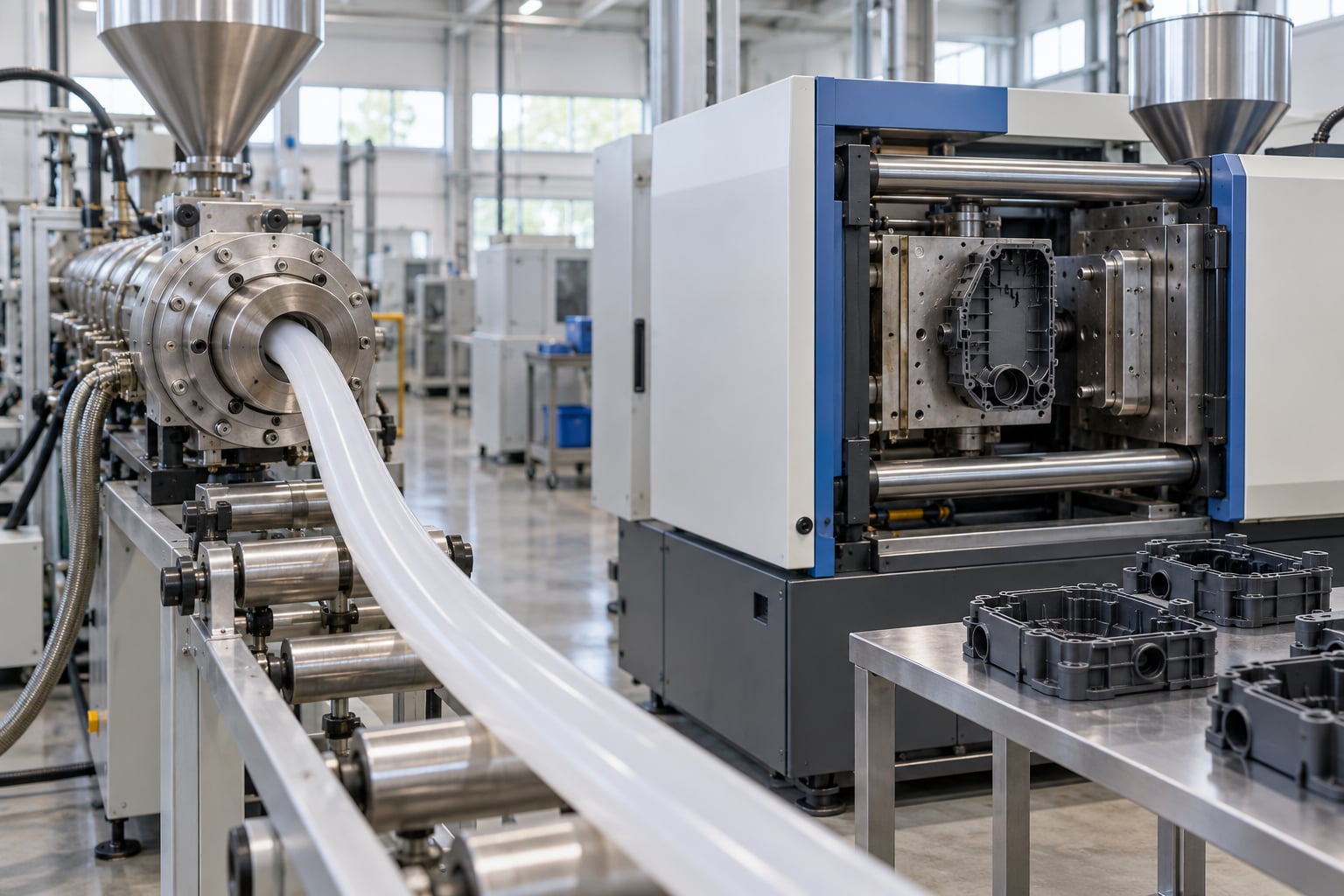
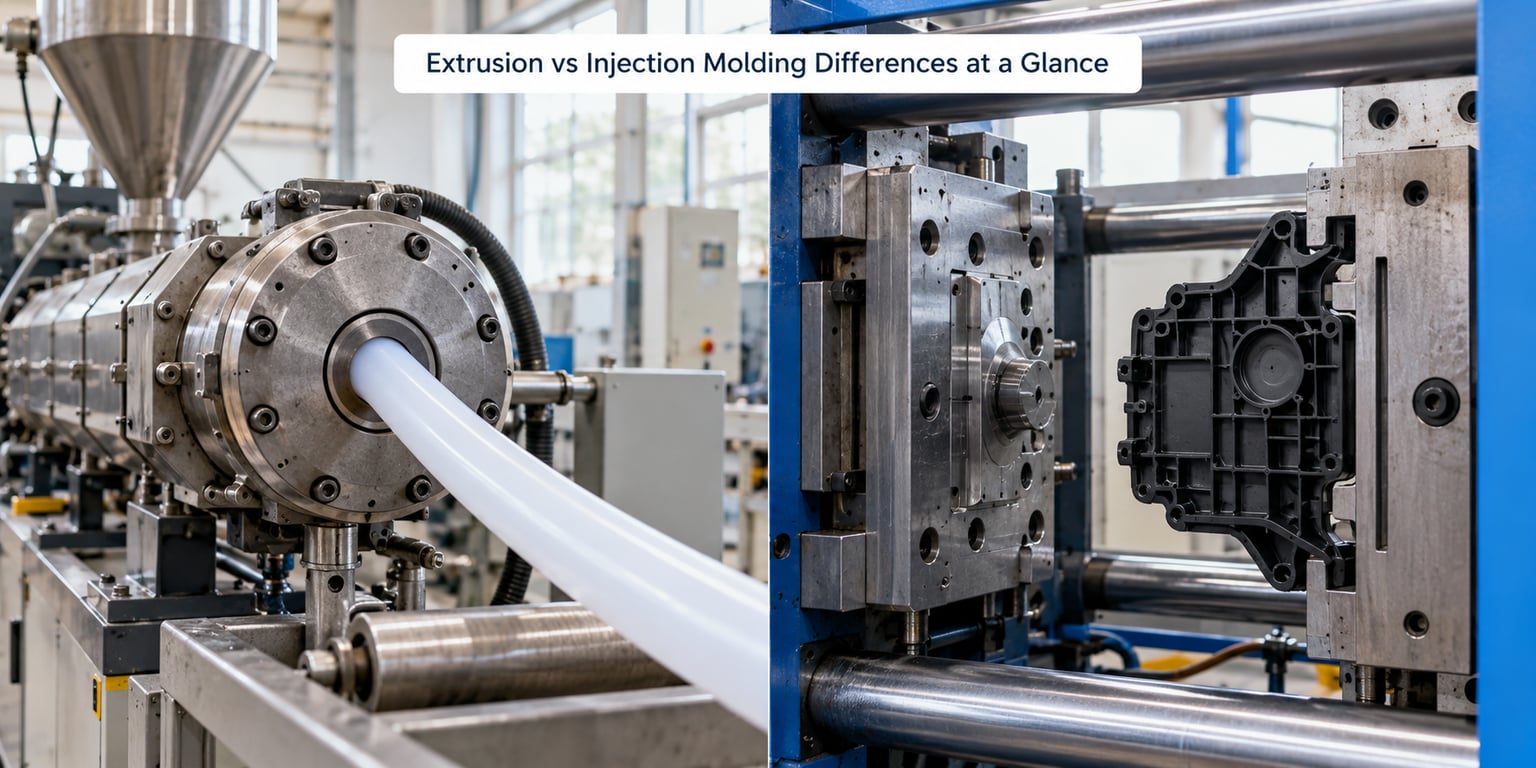
The single biggest difference between extrusion and injection molding is what comes out of the machine. Extrusion pushes molten thermoplastic through a die and makes a continuous profile of constant cross-section — tube, sheet, channel, weatherstrip. Injection molding fills a closed cavity with plastic, lets it cool, and ejects a discrete three-dimensional part every cycle — a housing, a cap, a bracket. Geometry decides the process. Volume and tolerance decide the rest.
That answer is short. The engineering underneath it is not, and engineers who guess wrong pay for it twice: once in tooling that never made a saleable part, and again in a redesign six months later. This guide walks through how each process actually works, what each one is good at, and where the cost math flips.
Table of Contents
- Extrusion vs Injection Molding Differences at a Glance
- What Is Plastic Extrusion?
- What Is Injection Molding?
- How Do the Molding Processes Differ?
- Which Part Shapes Can Each Method Make?
- Extrusion vs Injection Molding: Tooling and Setup
- Materials, Surface Finish, and Dimensional Accuracy
- Cost, Production Volume, and Unit Economics
- Quality, Testing, and Manufacturing Considerations
- Which Should You Choose?
- Frequently Asked Questions
- What are the key differences between extrusion and injection molding?
- What materials can be extruded?
- What are the different types of injection molding machines?
- Is plastic extrusion expensive compared to injection molding tooling?
- Can the same material be used in both extrusion and injection molding?
- Which process is better for high-volume production?
- Conclusion: Start with Part Geometry and Volume
Extrusion vs Injection Molding Differences at a Glance
| Factor | Extrusion | Injection Molding |
|---|---|---|
| Output | Continuous profile, cut to length downstream | Discrete part per cycle |
| Geometry | Constant cross-section, two-dimensional or hollow | Detailed 3D, variable walls, ribs, bosses, inserts |
| Tooling | Die, usually machined steel, fixed bore | Mold with cavity, core, runners, ejectors |
| Tooling lead time | Short, often a few weeks | Long, frequently 6 to 12 weeks |
| Cycle | Continuous, output measured in feet per minute | Discrete, seconds per shot including cooling |
| Process pressure | Thousands of psi through the die | Tens of thousands of psi at the gate |
| Material waste | Low, minimal runner scrap; start/stop purge | Runners and sprues regrind and remelt |
| Tolerances | Typically plus or minus 0.010 to 0.030 inch on critical dims | Often plus or minus 0.002 to 0.005 inch on critical dims |
| Economic sweet spot | Long runs of one profile | Thousands to millions of parts |
| Typical parts | Pipe, tubing, film, sheet, weatherstrip, window and door profiles, cable jackets | Housings, caps, containers, clips, gears, automotive interior trim, medical device shells |
Read the first two rows again. Everything else in the table follows from them.
What Is Plastic Extrusion?
Extrusion is a continuous process that turns resin pellets into a finished shape of fixed cross-section. The pellets drop into a hopper, a rotating screw inside a heated barrel melts and mixes them, and the melt is pushed through a die that carries the profile.
Once the shape exits the die, it is not finished. It is still soft and oversized in places, so it passes through a calibration sleeve or vacuum tank while cooling, then a haul-off device sets the pull speed and holds the profile to size.
The parts that come out of this process are familiar: PVC water pipe, HDPE conduit, LDPE film, sheet, window and door profiles, weatherstripping with a soft seal attached, and the colored jacket on an electrical cable. Common resins here include PVC, HDPE, LDPE, PP, ABS, polycarbonate, and TPE.
There are two broad types worth naming. TUBE EXTRUSION forms hollow pipe and tubing, sometimes with multiple small bores in one part. PROFILE EXTRUSION forms solid or semi-rigid shapes like channels, angles, and trim. Some fabricators also run sheet and film lines, where the die is a wide flat slot rather than a shaped bore.
What Is Injection Molding?
Injection molding makes one discrete part per cycle by filling and emptying a closed mold. The same rotating screw melts the resin, then instead of feeding a die, it retracts and accumulates a metered shot of melt in front of the screw tip.
The screw then drives forward and injects that shot through a sprue and runner system into the cavity at high speed. Pressure is held while the part cools to compensate for shrinkage, the mold opens, ejector pins push the part out, the mold closes, and the whole sequence repeats in seconds.
What you get is a part with geometry no die can produce: side actions, snap-fit arms, hollow cores, threads, thin ribs to stiffen a wall, and metal inserts molded in place. That is why housings, bottle caps, containers, clips, and medical device shells come out of this process rather than an extrusion line.
Machine size is described by clamping force, in tons. A small precision machine might hold 50 to 100 tons; a large structural part machine can hold several thousand tons. Tool design feeds back into that number, which is why the same part designed differently can need a very different machine.
How Do the Molding Processes Differ?
Flow and pressure behave differently in each
In extrusion, melt moves continuously through one opening. Steady pressure is the goal, and any fluctuation shows up directly as a variation in cross-section — a thin spot, a bulge, or an oval pipe.
In injection molding, melt moves for a short burst, then stops. That surge and stall is what fills thin sections far from the gate, and it is why gate placement and mold flow analysis matter so much before steel is cut.
Cooling works differently
Extruded profiles are often cooled in air or water once they leave the die, with the internal geometry of the die doing most of the sizing. Wall thickness in the die is what sets the finished wall.
Injection molded parts cool inside the mold under clamp force, and cooling time is usually the largest single chunk of the cycle. Long cooling also means mold steel that carries channels near the cavity, which raises tooling cost and maintenance.
Automation looks different on the floor
An extrusion line is essentially one continuous process with a cut-off saw or a coiler at the end. Operators manage output rate, cooling, and haul-off tension.
An injection molding cell has a short cycle, so automation concentrates on feeding, part removal, and inspection, often with a robot on the machine. High-volume cells are often lights-out, running unattended between scheduled checks.
Which Part Shapes Can Each Method Make?
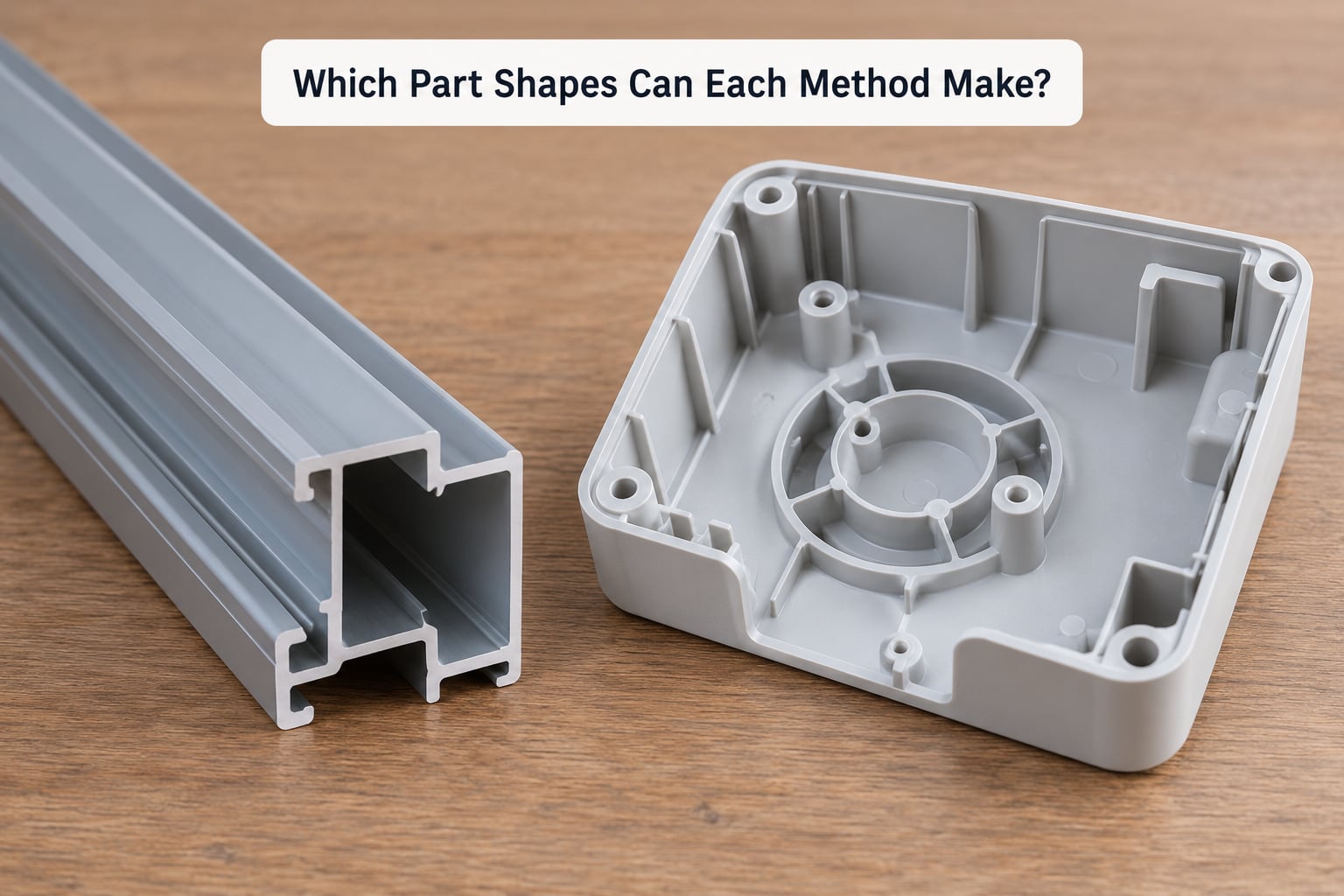
Extrusion makes parts whose cross-section never changes along their length. If you can draw the shape in two dimensions and repeat it for fifty feet, a die can carry it. That covers solid profiles, hollow tubes, multi-bore conduit, and sheet.
Injection molding makes parts that change along every axis. Ribs add stiffness without adding resin. Bosses locate a screw or a bearing. Draft angles on sidewalls let the part release from the core without a lifter. Slide cores form undercuts. Any of these push the geometry past what a fixed die bore can produce.
Thickness control is the quiet divider. An extruded wall is set by the die land and is nearly uniform along the profile, while a molded wall can vary in thickness within a single part.
A common surprise: extrusions can carry inserts that a die cannot hold, such as a bulb in weatherstripping or a steel strip in a window profile. Those are added continuously in a coextrusion or laminating line. If you need inserts, ask which process handles them, and how.
Extrusion vs Injection Molding: Tooling and Setup
Extrusion tooling is a die with a fixed opening. Often it is a solid machined steel billet with drilled and shaped flow passages, though hardener inserts and hollow designs are used for larger profiles. Long-run dies are hard chrome plated to resist abrasion from filled resin.
The die is relatively quick to make, often three to six weeks, and the changeover is usually a line change rather than a tool swap. Once the profile is dialed in, adjustments are small and incremental.
Injection molding tooling is an assembly, not a single block. It includes the mold base, cavity and core inserts, cooling channels, heater bands, the sprue and runner layout, gate inserts, ejector pins, slides, and whatever inserts the part carries. Six to twelve weeks is a realistic range for production steel.
Because that tool has to open, close, and eject cleanly thousands of times a day, maintenance is scheduled work rather than a reaction. That is worth reading in more detail if you own the equipment — our guide to a mold maintenance schedule for injection molding covers the interval side.
Die design on the extrusion side is its own engineering discipline, and we walk through the sizing and flow logic in extrusion die design basics explained for engineers.
Materials, Surface Finish, and Dimensional Accuracy
The resin lists overlap heavily. PVC, HDPE, LDPE, PP, PS, ABS, polycarbonate, nylon, POM, TPE, and TPU all run in both processes. So the material alone rarely decides the process — geometry does, and the material then decides the process settings.
What does differ is the output surface. An extruded profile carries die lines, and the visible face is usually as good as the die finish without secondary work. A molded part carries gate marks where melt entered, plus a parting line where the mold halves met, and ejector pin marks where pins pushed it out. Texture can be added in the tool to hide all of that.
On dimension, extruded critical dimensions commonly hold plus or minus 0.010 to 0.030 inch on a well-run line, with cross-section controlled by cooling and haul-off tension. Injection molded parts routinely hold plus or minus 0.002 to 0.005 inch on critical features once the process has settled. If your drawing calls for anything tighter than an extrusion line can hold, that is the end of the extrusion discussion.
Extrusion profiles must also be cut to length cleanly and stay flat and square afterward. Heavy, thick-walled profiles can bow if internal stress is not relaxed, and buyers need to know how they are stored. Our piece on profile extrusion tolerances explained for buyers sets out what is normally specified and measured.
Cost, Production Volume, and Unit Economics
Extrusion spreads its tooling cost thin because the die is one tool that can run indefinitely and the downstream cuts are cheap. Resin is the dominant per-unit cost, and scrap is mostly purge material at start-up and changeover.
Injection molding starts with a much larger capital outlay for steel, then reaches a much lower per-unit cost at volume. Runners and sprues are reclaimed and remelted, so that material comes back — but it does not come back as a clean, consistent stream, and some parts and materials cannot reground at all.
The practical break-even rule: if the part has one cross-section and you need more than a few thousand linear feet, extrusion wins on unit cost. If you need a discrete complex part and you will repeat the order for tens of thousands of units or more, injection molding wins.
Cycle time deserves its own line in any quote, because it is the lever that decides per-part cost at volume. A cycle that is 40% shorter is roughly a 40% cheaper part once labor and overhead are spread over shots. Get the cycle time in writing before you compare suppliers.
Quality, Testing, and Manufacturing Considerations
Extrusion problems show up as flow and sizing issues. Die swell makes the profile larger than the die bore because the melt expands as it leaves the die, so the die is cut undersize to compensate. Other recurring issues are weld lines where separated melt fronts rejoin, uneven wall thickness from poor flow balance, dimensional drift as the line pulls, and post-extrusion bowing in heavy profiles.
Injection molding problems are well catalogued. Short shots from inadequate melt volume or a slow shot speed. Flash from too much pressure or a parting-line mismatch. Sink marks on thick walls where material keeps shrinking after the gate freezes. Weld lines where flow fronts split around a hole and rejoin. Warpage from uneven cooling or fiber orientation.
Control in practice means different instruments. On an extrusion line, operators watch gauge points, take profile samples, and cut weighed lengths to check output rate. On a molding cell, first-article inspection of a few shots is followed by in-cycle monitoring of cavity pressure and dimensional checks on a schedule.
Both processes need the same front-end discipline: a written material specification, drying controls for hygroscopic resins such as nylon and polycarbonate, and traceability back to resin lot. A part that meets its drawing but has inconsistent material lots will still generate complaints.
Which Should You Choose?
Choose extrusion when the part is a constant cross-section: pipe, conduit, tubing, sheet, film, cable jacket, weatherstrip, window and door profiles, structural channel, or trim. Also choose it when the run is long in length rather than high in part count, or when a soft seal or second material has to be co-extruded onto a rigid profile in one step.
Choose injection molding when the part is a discrete three-dimensional shape: housings, caps, containers, clips, gears, handles, automotive interior components, or medical device shells. Choose it when tolerance on critical features is tighter than an extruded profile can hold, when you need metal inserts molded in place, or when the design includes snap fits, side actions, or thin ribs for stiffness.
For prototypes and very low volume, neither is usually the cheapest route. 3D printing and CNC machining get you parts in days without any tooling at all, and they also produce a physical sample to check fit before anyone commits to a die or a mold.
One more option sits between them. Extruded profile can be cut and welded into a welded frame, and sheet can be thermoformed. If a part is borderline, ask a fabricator to price all three — sometimes the honest answer is a combination, such as an extruded body with molded end caps.
Frequently Asked Questions
What are the key differences between extrusion and injection molding?
Extrusion pushes molten plastic through a fixed die to make a continuous profile of constant cross-section, such as pipe, sheet, or tubing. Injection molding fills a closed mold cavity, lets the part cool, and ejects a discrete three-dimensional part each cycle. Extrusion runs continuously with lower tooling cost; injection molding costs far more in tooling but holds tighter tolerances and allows complex geometry.
What materials can be extruded?
Most thermoplastics can be extruded, including PVC, HDPE, LDPE, polypropylene, polystyrene, ABS, polycarbonate, nylon, POM, and TPE. Fillers such as glass fiber or talc are commonly added to structural profiles. The resin must be able to hold a melt temperature high enough to flow but low enough to stay stable in the barrel, which rules out some thermosets and most crosslinked grades.
What are the different types of injection molding machines?
Injection molding machines are described by clamping force, in tons, and by screw size. Common configurations include general-purpose toggle machines, hydraulic direct-drive machines, electric machines for clean rooms and medical work, high-speed machines for thin-wall packaging, and large-tonnage machines for structural and automotive parts. Machine choice is usually dictated by the part’s projected area and the material being molded.
Is plastic extrusion expensive compared to injection molding tooling?
No. Extrusion tooling is far cheaper and faster to build because a die has no cavity, no runners, and no ejector system, so lead times are often a few weeks. An injection mold is a multi-part assembly with cooling channels and slides, and production steel commonly takes six to twelve weeks. Extrusion still has real per-foot costs for resin, haul-off, and cutting, but its capital entry point is much lower.
Can the same material be used in both extrusion and injection molding?
Usually yes. PVC, HDPE, LDPE, PP, ABS, polycarbonate, nylon, POM, TPE, and TPU all run in both processes. The resin list overlaps heavily, so material choice rarely decides the process. Geometry does, and then the same resin simply needs different barrel temperatures, pressures, and cooling times for the process you pick.
Which process is better for high-volume production?
Both scale well, but they scale differently. Injection molding reaches a very low per-part cost once a multi-cavity tool is running hundreds of thousands of cycles, which makes it the right choice for discrete complex parts. Extrusion is better for very long continuous runs of a single profile, where output is measured in feet per minute rather than shots per hour.
Conclusion: Start with Part Geometry and Volume
Start with geometry, because that is the one decision the process cannot negotiate. Constant cross-section and long continuous lengths point to extrusion. Discrete three-dimensional parts, tight tolerances, and inserts point to injection molding.
Then check volume against tooling. Short runs and prototypes usually deserve neither process. Get cycle times and scrap rates in writing from two or three fabricators, and compare cost per usable part rather than cost per machine hour.
Ask them one more question before you sign: what tolerance are you holding on which dimension, and how will you measure it? That answer tells you more about the supplier than any brochure. Once geometry, volume, and tolerance are written down, the extrusion vs injection molding differences stop being a judgment call.