
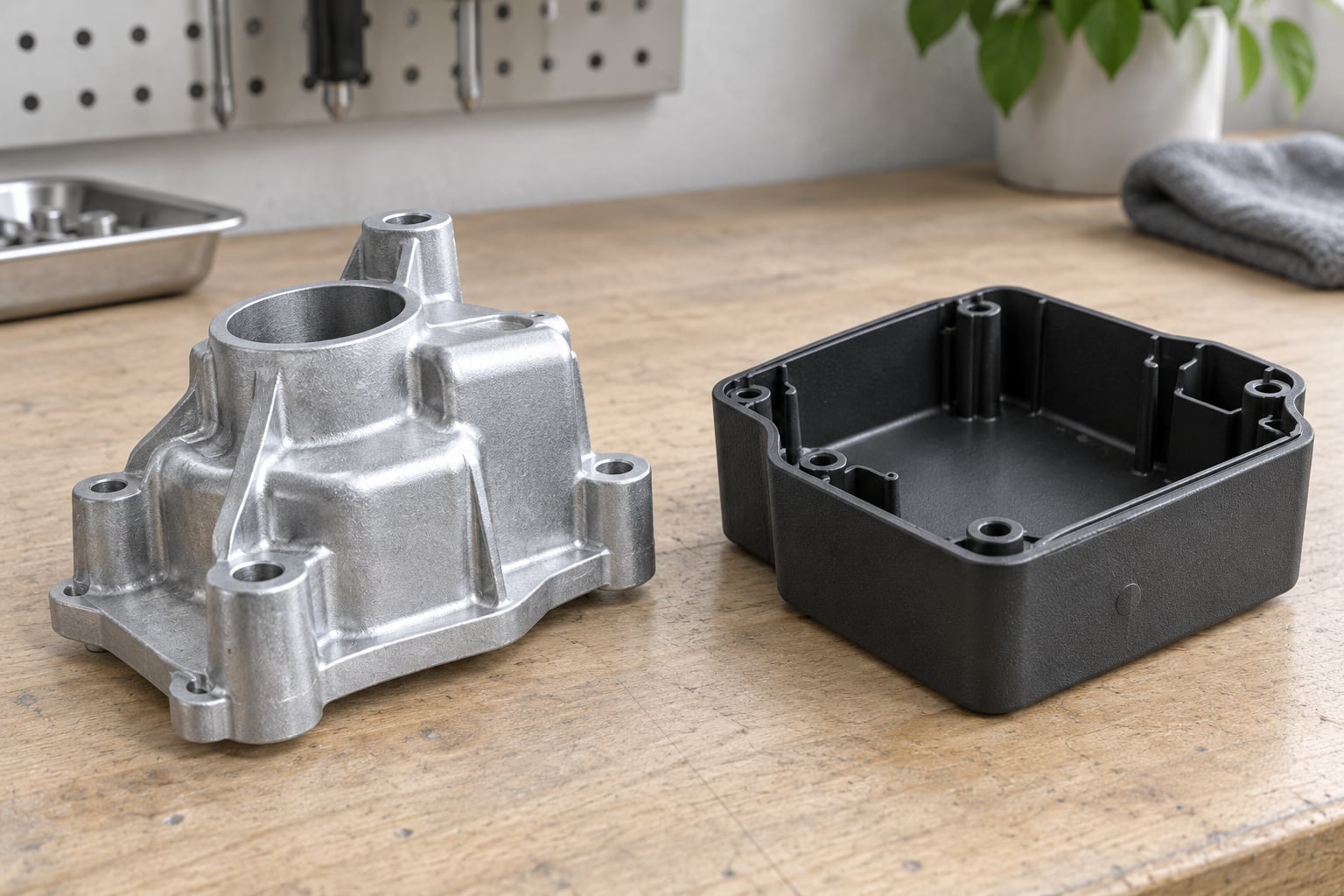
Die casting forces molten non-ferrous metal into a hardened steel die under high pressure, while injection molding melts polymer pellets and injects the melt into a hardened steel mold. The machines look related and the cycles rhyme, but the two processes optimize for opposite things: die casting for rigid metal parts that carry load and shed heat, injection molding for lightweight, detailed, cosmetic polymer parts at very high volume.
Pick the wrong one and you pay for tooling you cannot use, a material that fails in service, or a per-unit cost ten times what it should be. This guide compares the two processes on materials, tooling, cycle time, cost, tolerances and volume so you can make the call before a mold steel quote lands on your desk. Figures below are typical US manufacturing benchmarks for 2026, and they move with part size, geometry and annual volume.
If your real question is money rather than process, the two names get tangled fast. The honest version: there is no single crossover number, because the processes make different materials. What there is a rule for is how fast tooling amortizes, and that is where most sourcing mistakes actually happen.
Table of Contents
- Die Casting vs Injection Molding at a Glance
- What Is Die Casting?
- What Is Injection Molding?
- Materials and Part Design
- Tooling, Setup, and Production Scale
- Cycle Time, Throughput, and Finishing
- Cost, Tolerances, and Quality Control
- How to Choose Between Die Casting and Injection Molding
- Which Should You Choose?
- Frequently Asked Questions
- Conclusion: Start With the Part Requirements
Die Casting vs Injection Molding at a Glance
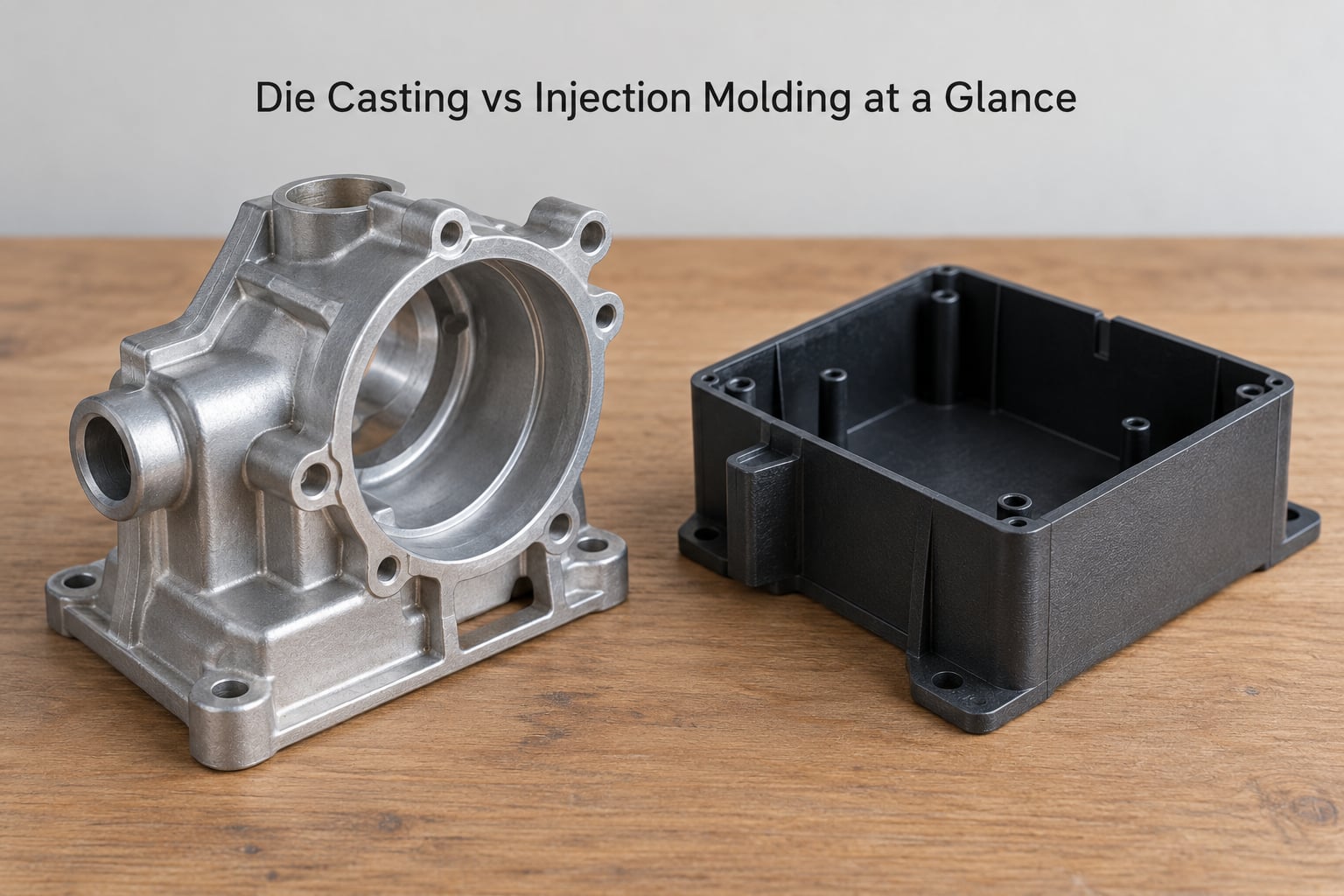
The table below is the short version of the die casting vs injection molding comparison. Read the tooling rows carefully: most people assume plastic tooling is automatically cheaper, and that assumption is wrong in both directions.
| Criterion | Die casting | Injection molding |
|---|---|---|
| Material | Non-ferrous metal: aluminum, zinc, magnesium, and some bronze | Thermoplastic or thermoset polymer: ABS, nylon, polycarbonate, polypropylene, PEEK |
| Melt temperature | Approximately 600-700C for aluminum, 380-420C for zinc | Approximately 200-300C depending on polymer |
| Tooling material | Heat-resistant hot-work steel such as H13, H13S or 3Cr2W8V | P20, S7 or 4140 pre-hardened tool steel, often nitrided |
| Typical tooling cost | Roughly USD 10,000 to over USD 100,000 for a production die | Roughly USD 2,000 to 20,000 for a simple single-cavity mold, USD 5,000 to 100,000+ for complex multi-cavity tools |
| Cycle time | About 1-5 minutes per shot on larger machines | About 15-60 seconds per shot |
| Clamping force | Several hundred to several thousand tons | Tens to a few thousand tons, set by projected part area |
| Dimensional tolerance | Approximately plus or minus 0.1 to 0.2 mm on critical features | Approximately plus or minus 0.05 to 0.1 mm on critical features |
| Surface finish | Approximately Ra 1.6-3.2 micrometers as-cast | Approximately Ra 0.8-3.2 micrometers, better on polished cavities |
| Minimum wall thickness | About 1.0-1.5 mm, down to 1 mm with high-speed thin-wall machines | About 0.8-1.0 mm, with 0.5 mm possible around delicate features |
| Draft angle | Typically 1-3 degrees minimum | Typically 0.5-1 degree on textured surfaces, 1-2 degrees on polished ones |
| Scrap rate | Often 10-20% because of porosity, flash and dimensional drift | Often 1-5%, higher on cosmetic parts or tight-tolerance runs |
| Economic volume | Hundreds of pieces per year upward | A few thousand pieces upward, often 10,000 and beyond |
| Typical uses | Automotive brackets, housings, heat sinks, hardware, appliance parts | Electronics enclosures, connectors, packaging, medical devices, automotive interiors |
Three differences do most of the deciding work. Melt temperature sets the tooling cost, because a die facing molten aluminum needs steel that survives thermal shock. Cycle time sets labor and machine cost, and die casting cycles run several times longer. Material class sets part performance, and that is the one you cannot engineer around later.
What Is Die Casting?
Die casting melts metal in a furnace, doses it into a shot sleeve, and injects it into a closed die held shut by clamping force. The metal fills the cavity in milliseconds, then a controlled holding pressure packs the part as it solidifies. What you pull out is a near-net-shape casting with runners, sprues and flash still attached.
Aluminum is the workhorse: ADC12 and its A380 equivalent are cheap, light, and cast cleanly. Zinc alloys like Zamak 3 and Zamak 5 fill thinner sections and hold finer detail, and they take plating well. Magnesium alloys such as AZ91D are light enough for handheld and laptop housings.
Two machine families do the work. Hot chamber machines hold the melt furnace right next to the injection mechanism, so the metal travels through a short heated tube into the sleeve. That setup suits low-melting-point alloys like zinc, which would otherwise solidify in the passage.
Cold chamber machines keep the furnace separate and ladle metal into the sleeve before each shot. Aluminum and magnesium run cold chamber because their melt temperatures would destroy a hot chamber gooseneck and its submerged plunger.
Because the part solidifies inside the die, the cycle depends heavily on section thickness. A thick casting stays hot far longer than a thin one, which is why large die castings run longer cycles than the small parts people picture in factory videos.
What Is Injection Molding?
Injection molding melts pellets in a heated barrel with a rotating screw, then rams a metered shot into the mold cavity. The screw doubles as a pump and a back-pressure valve, which is what makes plasticization so repeatable from one shot to the next.
Three things happen in order: injection fills the cavity, the packing phase holds pressure to compensate for shrinkage as the polymer cools, and then cooling time lets the part stiffen enough to eject. Ejector pins push the part off the core, a robot takes it, and the cycle restarts.
The economics are dominated by cavities. A four-cavity tool on a 15-second cycle produces four usable parts every 15 seconds, where a single-cavity tool on a 60-second cycle produces one. Cavity count is the single biggest lever on per-unit cost in plastic molding, and it is limited by how evenly the melt fills the cavity set.
Thermoplastics such as ABS, nylon, polycarbonate and polypropylene are re-melted and recycled. Thermosets cure chemically and generally do not. If your part has to survive heat, load and repeated impact, the polymer list narrows fast.
Materials and Part Design
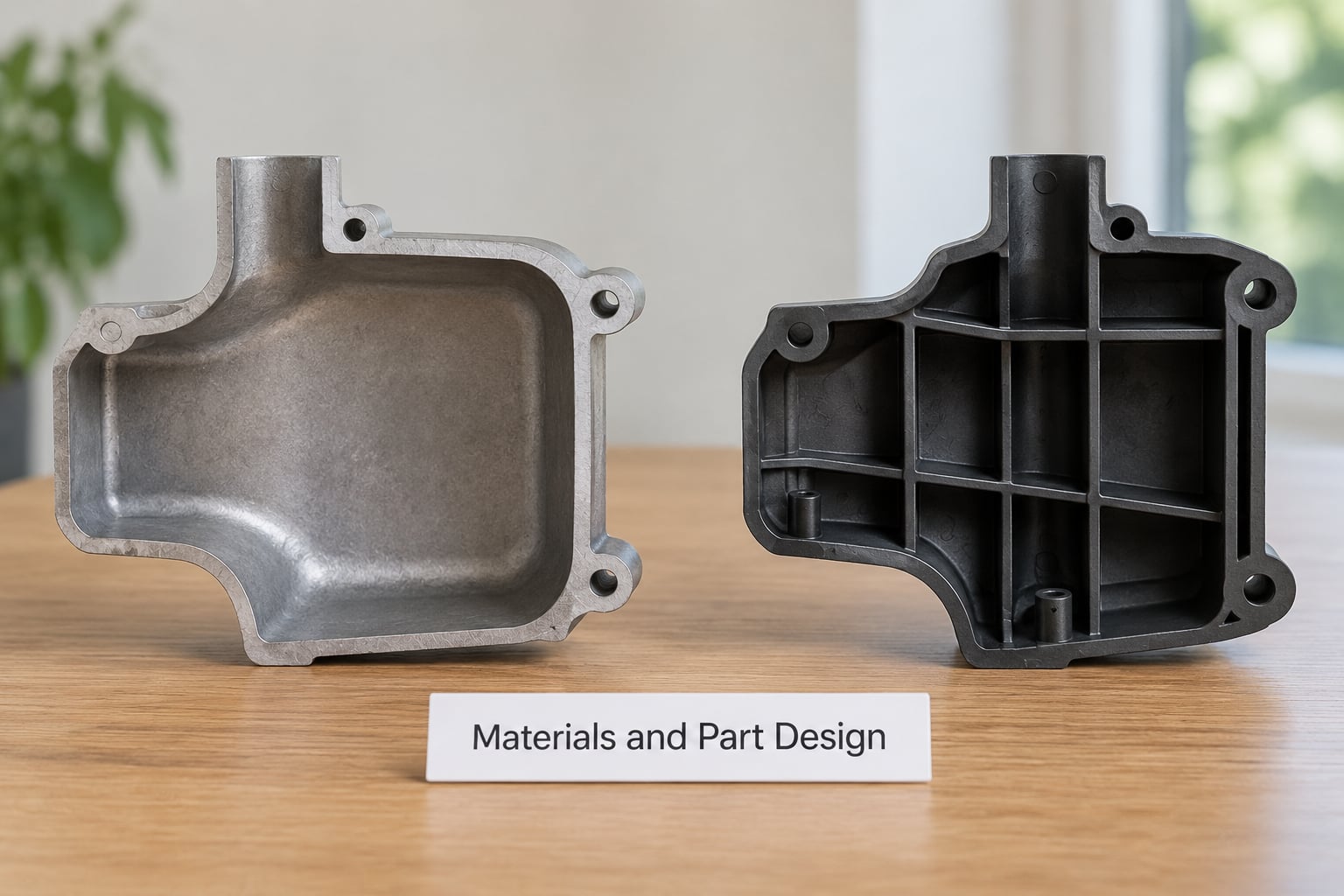
The material decision usually makes the process decision for you. Aluminum cannot be injection molded as a conventional bulk part, and an ABS housing cannot be cast in metal, so the two lists barely overlap. What overlaps is the design language, and that is where design-for-manufacture rules matter.
Wall thickness is the biggest structural difference. Plastic parts stay flat across a wide area only because the material is stiff in tension and the part is ribbed. A flat plastic wall a few millimeters thick will deflect; the same wall with a rib pattern behind it will hold. Die cast parts are thick by default, and coring them out for stiffness actually weakens the casting in ways the process does not model well.
Draft is where both processes get unforgiving. Every surface that pulls away from a core needs taper, usually 1-3 degrees on metal and 0.5-2 degrees on plastic. Underdraft on a die casting usually shows up as a scrapped part and a rough, torn surface. The same error in plastic shows up as a drag mark and short shot.
Inserts and overmolding work in both processes, and both handle them well. Overmolding a soft grip onto a rigid plastic core is routine. Insert molding a metal bushing into a plastic housing is standard practice. Die casting can carry pre-placed inserts too, though the thermal load means the insert has to survive repeated molten metal contact.
Metal threads, sharp holes and zero-radius internal corners are all design mistakes. Steel and aluminum do not cut threads well and cannot hold a sharp internal corner without a stress riser. Molding in a plastic boss with a threaded insert or a snap fit is simpler and lighter.
Corrosion behavior separates the two materials more than strength does. Aluminum handles weather and moisture without coating; zinc is even better but more expensive per kilo. Most engineering polymers need UV stabilization, and glass-filled grades absorb moisture, which shifts dimensions after molding.
Tooling, Setup, and Production Scale
Tooling is where the two processes diverge most, and it is where I see the most bad assumptions from buyers. A die casting die must survive molten aluminum hitting it a few thousand times an hour, so it uses hot-work steel such as H13, is machined with thermal expansion clearance built into every parting surface, and carries runner systems sized for heavy metal flow. That is an expensive tool to build and an expensive tool to maintain.
An injection mold uses pre-hardened tool steel like P20, S7 or 4140, usually nitrided, running at temperatures a fraction of die casting levels. Injection molds are lighter, easier to machine and easier to re-cut, which is why small single-cavity plastic tools land in the low thousands of dollars while a comparable die casting die lands well above that.
That comparison breaks at the top end. A large multi-cavity plastic tool with hot runners, sliders and cavity inserts can reach USD 100,000 and beyond. Forum buyers report quotes of USD 5,000 to 15,000 for a simple small part mold and closer to USD 48,000 all-in for a multi-part project. So the rule is not that plastic tooling is cheap; it is that plastic tooling is cheap when the geometry is simple.
Mold life works the same way in both processes. Well-maintained plastic tools commonly run 200,000 to 500,000 shots before significant rework. Die casting dies typically deliver 100,000 to 1,000,000 shots depending on alloy, cycle time and how well the machine is maintained. Hot chamber zinc dies outlast aluminum dies, because zinc melts at a much lower temperature.
Maintenance is the quiet cost. Die casting dies need runner and vent maintenance, and thermal-fatigue cracks at the sprue show up as flash long before anyone plans for it. Injection molds need cooling channel cleaning, ejector pin resets and gate wear checks on every scheduled interval. If you are planning the maintenance budget, how to calculate injection molding tooling cost covers the numbers most shops quote from.
Volume is where the tooling starts to pay itself back. Below a few hundred pieces a year, neither tool makes sense and CNC machining or a soft tool is the rational choice. A few thousand pieces a year starts to justify a plastic mold. Tens of thousands of pieces a year is where multi-cavity injection molding and multi-cavity die casting both settle into a low per-unit cost. Beyond that, the constraint is usually capacity and lead time rather than unit economics.
The lock-in point deserves emphasis. Switching from die cast aluminum to injection molded plastic invalidates every dollar of the existing die. Same for switching alloys within metal. Tool for the material you are actually going to run.
Cycle Time, Throughput, and Finishing
Die casting cycles run roughly 1-5 minutes, injection molding roughly 15-60 seconds. That difference matters more than it first appears, because die casting machines are usually sold with fewer automated cells and more operator attention per shot. Lower labor content per part is one reason plastic molding scales so cleanly past 10,000 pieces a year.
Cooling behavior sets the throughput ceiling in both. Plastic releases heat quickly and uniformly, so cooling time is predictable and scales with wall thickness. Metal transfers heat much faster into steel, but it has to cool all the way through, so a thick casting with a hot core becomes the bottleneck in the cycle.
Both processes leave runners, sprues and flash behind. Plastic runners are lightweight and trim out cleanly, sometimes leaving a visible gate mark that matters on cosmetic parts. Metal runners are heavier and need a trimming operation, though zinc’s lower density makes trimmings lighter than aluminum.
Secondary operations differ in character. Die cast parts often need flash deburring, plus machining of critical bores and threads, plus painting, powder coating or plating. Plastic parts usually need gate removal and nothing else, though overmolding and inserts are common. A die casting that saves secondary machining is a genuine advantage when your design has several tight-tolerance features.
Scrap behaves differently too. A scrapped plastic part is light and mostly recycled back into the process. A scrapped die casting is a solid metal chunk that is frequently remelted, so the material loss is less severe. The bigger cost is the scrap rate itself, which tends to run higher in metal because porosity and flash are harder to control.
Cost, Tolerances, and Quality Control
Tooling, material, cycle time, labor, secondary operations and inspection all feed the real number, and people who quote only machine time tend to be optimistic. Metal costs more per kilo and the machines are bigger, so die casting carries more material cost per part. Plastic tools are often cheaper, but cosmetic requirements and secondary operations can erase that saving.
Amortized totals by volume are the comparison that matters. The figures below are typical US benchmark ranges for a mid-sized part, not quotes, and your geometry will move them.
| Annual volume | Die casting, all-in per piece | Injection molding, all-in per piece |
|---|---|---|
| 50 | Roughly USD 40-120 | Roughly USD 25-80 |
| 500 | Roughly USD 12-35 | Roughly USD 8-30 |
| 5,000 | Roughly USD 4-12 | Roughly USD 2-8 |
| 50,000 | Roughly USD 1.50-5 | Roughly USD 0.60-3 |
These are not directly comparable lines, because the two processes are not making the same thing. The useful takeaway is the slope: tooling-heavy processes fall off a cliff early and then flatten out, which is exactly why low-volume programs keep people guessing about break-even. People argue online about whether that point sits at 1,000 pieces or 5,000 or 10,000, and they are all arguing about a different part. State your volume, your geometry and your annual commitment first, then compute. If the part is a simple enclosure, the slope is steep; if it is a structural casting, it is shallow.
Tolerances run tighter in plastic. Critical features on an injection molded part are commonly held to plus or minus 0.05 to 0.1 mm, while the same features in die cast aluminum typically land around plus or minus 0.1 to 0.2 mm. If your part is largely non-functional and cosmetic, that gap rarely matters. If it is a bearing seat or a sealing face, plan for machining after casting.
Defect vocabulary is worth learning, because your supplier will use it. In metal you will hear about porosity from gas entrapment, shrinkage cavities, cold shuts where two metal fronts fail to fuse, flash from worn tooling, and warpage from uneven cooling. In plastic the list is shorter: short shots from inadequate melt or pressure, sink marks around thick bosses, warpage from uneven packing, flow lines at gate entry, and warpage induced by fiber orientation.
Inspection follows from that. Metal needs X-ray or dye penetrant checks when internal porosity matters, plus CMM work on trimmed features. Plastic inspection is mostly first-article dimensional reporting plus visual sorting for cosmetic defects, which is one reason plastic scrap rates stay low.
Recyclability cuts both ways. Aluminum is one of the most recycled materials in industry and remelt scrap loses little value. Most engineering plastics are recyclable in principle, but in practice mixed, colored and glass-filled grades are rarely recycled, so scrap usually goes to energy recovery. If a sustainability target is part of the brief, that changes the weighting.
For a broader view of plastic process economics, the thermoforming vs injection molding cost comparison is worth a read even if thermoforming is not in your plan.
How to Choose Between Die Casting and Injection Molding
Work through these questions in order. The first three usually decide it on their own.
What does the part have to do?
Structural load, impact, heat dissipation or corrosion exposure point to metal. Weight reduction, complex geometry, snap fits, cosmetics or electrical insulation point to plastic. Nothing else in this list matters if you get this one wrong, because the material sets the process.
What is your honest annual volume?
Under a few hundred pieces a year, buy machined parts. A few hundred to a few thousand, look seriously at die casting for metal and soft tooling for plastic. Above roughly 10,000 pieces a year, multi-cavity tooling in either process is almost always the right answer.
How tight do the dimensions need to be?
Critical features under plus or minus 0.1 mm push toward plastic or toward machined features on a cast part. Everything else can live with casting tolerance.
Does the design have deep geometry or thin walls?
Deep cores, slides and undercuts work in both, but metal cores lose heat and cool the flow, so extreme undercut depth in a casting is harder on the process than in plastic. Thin walls below 1 mm favor high-speed thin-wall die casting machines or plastic.
What happens if the design changes later?
Plastic molds are easier and cheaper to modify, and the material can change without touching the tool. A die casting die modification usually means new steel. If your design is likely to move, that is a real argument for polymer.
Is this a prototype or a production program?
For prototypes, neither process is right. CNC machining or additive manufacturing gets you parts in days. Tooling before demand is validated is the most common expensive mistake in this industry. When volume is uncertain, when to use urethane casting instead of molding is the question to answer first.
Two processes you should know about sit in the gaps. Metal injection molding, a binder-assisted sintering process, makes small complex metal parts with detail die casting cannot reach and at volumes above several thousand per year. Investment casting handles larger, more complex metal geometry in lower volumes. If your part is small, intricate and metal, metal injection molding is often the answer both sides of this comparison ignore.
Which Should You Choose?
Choose die casting when the part is structural, rigid, thermally conductive or exposed to weather, and when you need the stiffness-to-weight ratio that metal gives you. Engine brackets, gearbox housings, heat sinks, LED housings, motor housings and appliance bodies all belong here. It is also the right pick when the design is finalized and the volume is steady, because the die cost is recovered quickly and the part stays rigid for a decade.
Choose injection molding when the part is lightweight, detailed, cosmetic or electrically insulating, and when the volume is high enough to fill several cavities. Electronics enclosures, connectors, packaging, medical device bodies, interior automotive trim and appliance panels live here. It is also the right pick when the design will change, when you need inserts or overmolding, or when corrosion and galvanic contact rule metal out.
The exceptions are worth naming. A large, heavy casting with thin walls is a bad die casting candidate. A deep, load-bearing part with tight tolerance and low volume is a bad molding candidate, and CNC may serve you better. And a part that is metal in the load path but cosmetic in the housing is often best split across both processes, with metal where it carries and plastic where it shows.
One more exception catches people: the die casting versus injection molding comparison is sometimes framed as if you are choosing one process for a whole product. Most assemblies use both. That is normal, and it is why the decision belongs at part level rather than program level.
Frequently Asked Questions
Is die casting the same as injection molding?
No. They share a machine layout and a basic idea, injecting material into a reusable steel tool under pressure, but they differ in nearly every practical respect. Die casting pushes molten metal at 600-700C into a heat-resistant die and runs cycles of 1-5 minutes. Injection molding melts polymer at 200-300C with a screw and runs cycles of 15-60 seconds. Metal is rigid and conductive; polymers are light, cosmetic and often cheaper at volume. Metal injection molding is a third process that sits between the two and uses a binder plus sintering.
Why are injection molds so expensive?
The steel is a real cost, but it is not the main one. A simple tool uses common P20 or 4140 pre-hardened steel, which is not exotic. What drives price is the machining hours: precision CNC work, hand finishing, polish time on cosmetic cavities, hot runners, sliders, cavity inserts and lifter mechanisms, plus hours of engineering, DFM review, tryout and rework. Add multiple cavities and a complex parting scheme and a simple-looking part can easily double the price. Shipping, mounting plates and the first article all add cost too.
What is the lifespan of a die casting mold?
A well-maintained die casting die typically delivers 100,000 to 1,000,000 shots, and the alloy matters more than anything else. Cold chamber aluminum dies sit at the shorter end because of the thermal load. Hot chamber zinc dies run considerably longer since zinc melts at a much lower temperature. Cycle time, alloy chemistry, venting quality and preventive maintenance all shift that number. Nitriding the cavity surfaces and scheduling runner and vent maintenance is what separates a die that hits 500,000 shots from one that fails at 150,000.
How much does an injection mold or die casting die cost?
Injection molds commonly run from about USD 2,000 to 20,000 for a simple single-cavity tool, and from USD 5,000 to over 100,000 for complex multi-cavity production tooling. Die casting dies generally start higher because of the heat-resistant steel, larger plates and thermal expansion clearance, and often land between USD 10,000 and over 100,000. Part size, cavity count, complexity and annual volume drive the final number. Always compare quotes on the same scope, with the same number of cavities and the same warranty.
What are the downsides of die casting?
The main drawbacks are porosity from trapped gas, shrinkage voids, flash from worn tooling, and warpage from uneven cooling. Scrap rates commonly run 10-20 percent, higher than plastic molding. Die casting also carries long cycles, significant die cost and a real post-processing burden for deburring, machining and coating. Parts cannot be reworked easily because the metal is not ductile enough, and small design changes usually require new steel. Thin walls below 1 mm are difficult without high-speed machines.
At what volume does injection molding become cheaper than die casting?
There is no clean crossover, because the two processes make different materials. The practical framing is amortization. Below a few hundred pieces a year neither tool pays off and CNC is usually cheapest. A few hundred to a few thousand pieces a year starts to justify a plastic mold, and die casting becomes viable for structural metal parts in that same range. Above roughly 10,000 pieces a year, multi-cavity tooling in either process produces a low per-unit cost, and the decision is driven by material requirements rather than price.
Conclusion: Start With the Part Requirements
The die casting vs injection molding decision comes down to what the part has to do, not which process sounds more advanced. Metal for load, heat and corrosion. Polymer for lightness, detail, cosmetics and design flexibility. Volume decides whether tooling is sensible at all.
Before you request quotes, write down four things: the material requirement, the geometry with its tightest dimensions, the honest annual volume, and the service conditions the part must survive. Send that sheet to two suppliers in each process if the choice is genuinely close. The quote conversation becomes far more useful when both sides are pricing the same part instead of guessing what you mean.