
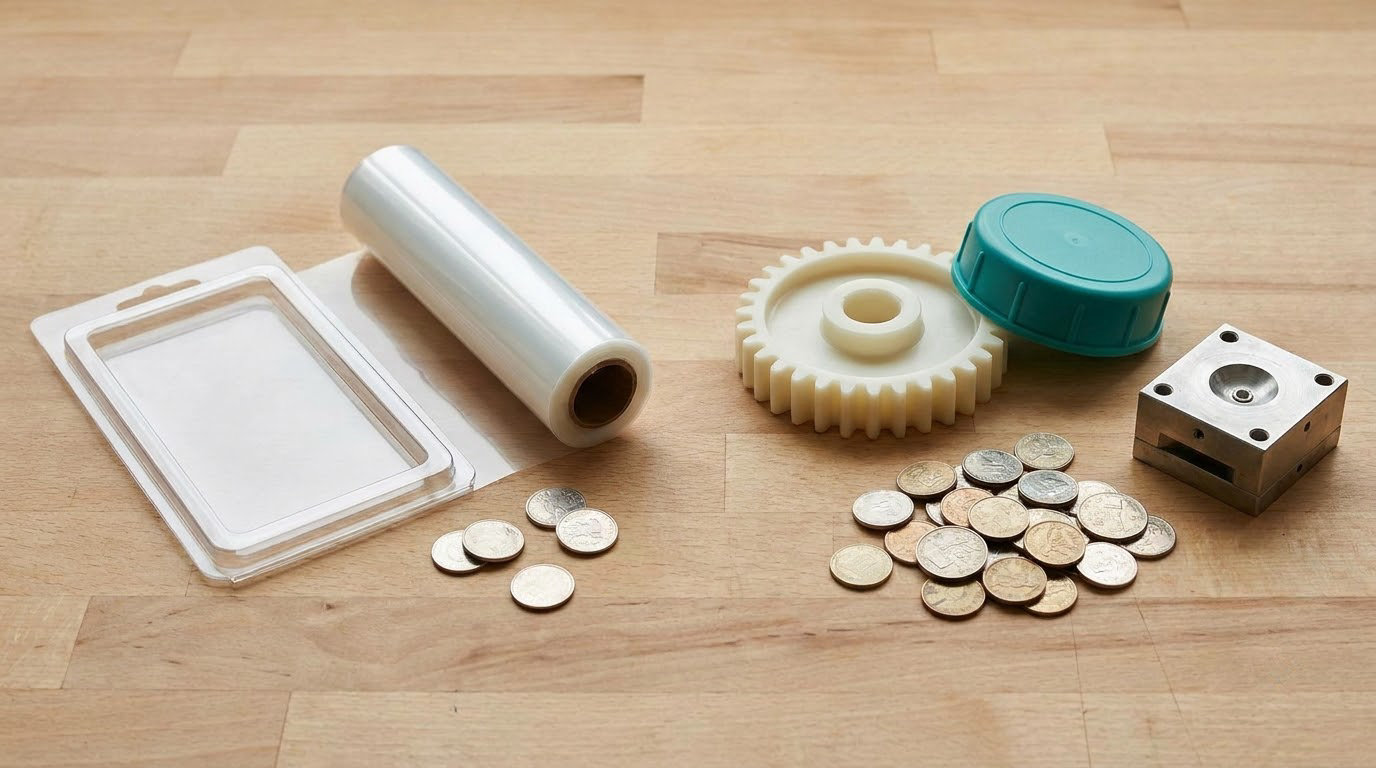
Thermoforming is cheaper to tool and cheaper to change, injection molding is cheaper per part once volume arrives. A thermoforming mold for a typical enclosure runs about USD 3,000 to 15,000 against USD 25,000 to 100,000 and up for an injection mold, but the injection part itself can cost a fraction of the thermoformed one. The two cost curves cross somewhere between a few thousand and tens of thousands of parts a year, and where yours crosses depends on part size, wall thickness, geometry and how long the program runs.
This guide is written for engineers and sourcing teams who need total program cost, not the piece price in a quote. Nothing here comes from a mold maker’s marketing department, and there is no lead-capture form at the end. Every range is stated with the volume and mold type it applies to, because a tooling number without those qualifiers is close to meaningless.
One warning before the numbers: tooling quotes are notoriously hard to compare, because vendors quote different cavity counts, steel grades, finish levels and trial runs inside the same lump sum. Two suppliers can price the same part three times apart and both be honest. The fix is a request format, and it is in the cost estimation section further down.
Table of Contents
- Thermoforming vs Injection Molding Cost at a Glance
- What determines thermoforming vs injection molding cost?
- Tooling and setup costs: thermoforming vs injection molding
- Per-unit production costs at different volumes
- Material, part size, and design effects on cost
- Which process has lower labor and finishing costs?
- Quality, consistency, and capability differences
- How to estimate total cost for your part
- Which should you choose?
- Frequently Asked Questions
Thermoforming vs Injection Molding Cost at a Glance
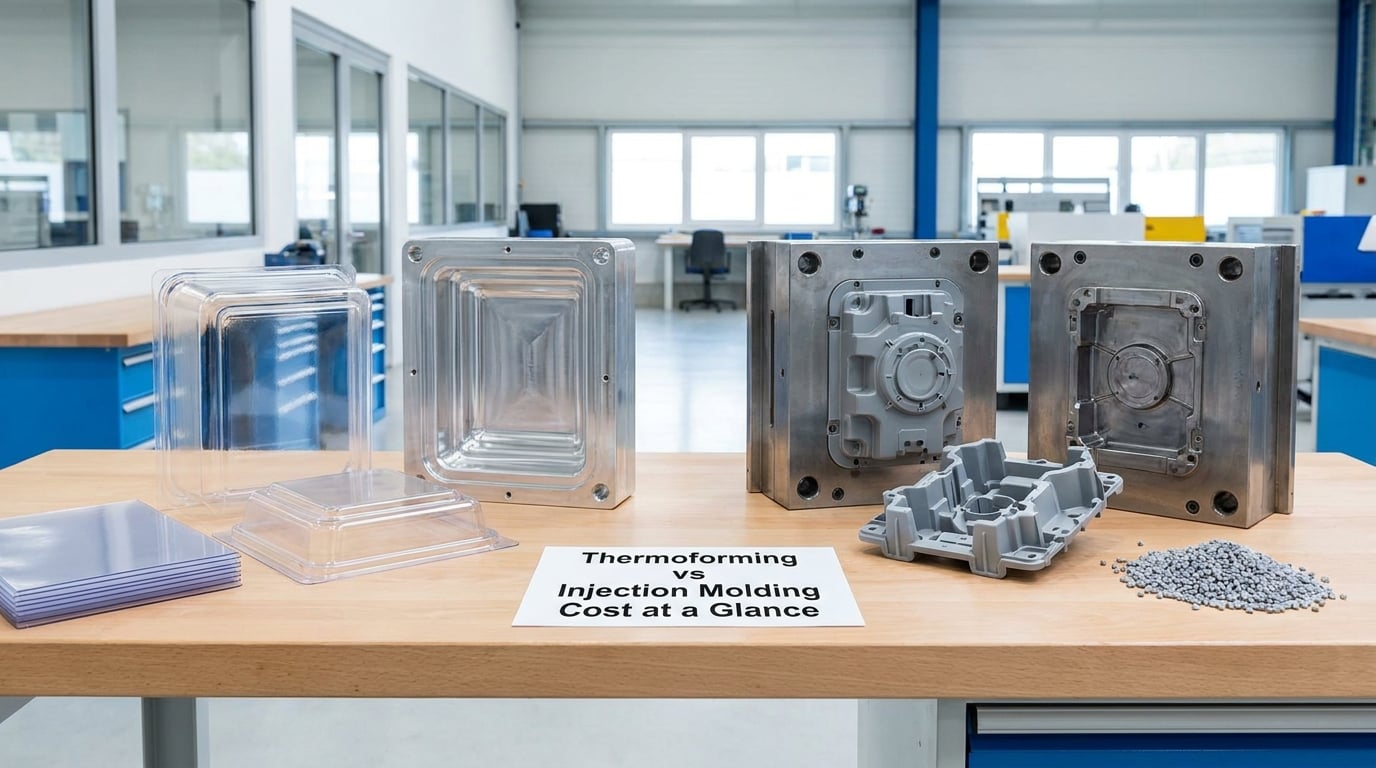
| Cost factor | Thermoforming | Injection molding |
|---|---|---|
| Tooling cost, typical part | USD 3,000 to 15,000 | USD 25,000 to 100,000 and up |
| Tooling cost, simple small part | USD 1,500 to 5,000 | USD 2,000 to 15,000, single cavity |
| Tooling lead time | 2 to 4 weeks | 6 to 12 weeks |
| Machine capital cost | USD 30,000 to 250,000 by platen size | USD 60,000 to 400,000 and up by tonnage |
| Machine hourly rate | USD 45 to 150 | USD 55 to 200 |
| Cycle time, comparable shell | 20 to 60 seconds, plus cooling | 25 to 60 seconds, cooling is 60 to 70 percent |
| Material cost per part | Higher, whole sheet is bought | Lower, runners are recycled |
| Scrap rate | 10 to 50 percent on heavy gauge sheet | 2 to 10 percent with a balanced runner |
| Design change mid-program | USD 500 to 3,000 | USD 5,000 to 25,000 |
| Dimensional tolerance | Plus or minus 0.25 to 0.75 mm | Plus or minus 0.05 to 0.20 mm |
| Largest practical part | Several meters, wall 1.5 to 12 mm | Roughly 600 mm, wall 1 to 4 mm |
| Best fit | Large, thin-walled, low to mid volume, changing designs | Small to medium, complex, high volume, stable design |
Read that table twice, because the two columns describe different problems. Thermoforming is a sheet-and-draw process with a cheap mold and a labor-heavy cycle. Injection molding is a precision process with an expensive mold and a fast automated cycle, and it keeps getting cheaper per part the more you run.
What determines thermoforming vs injection molding cost?
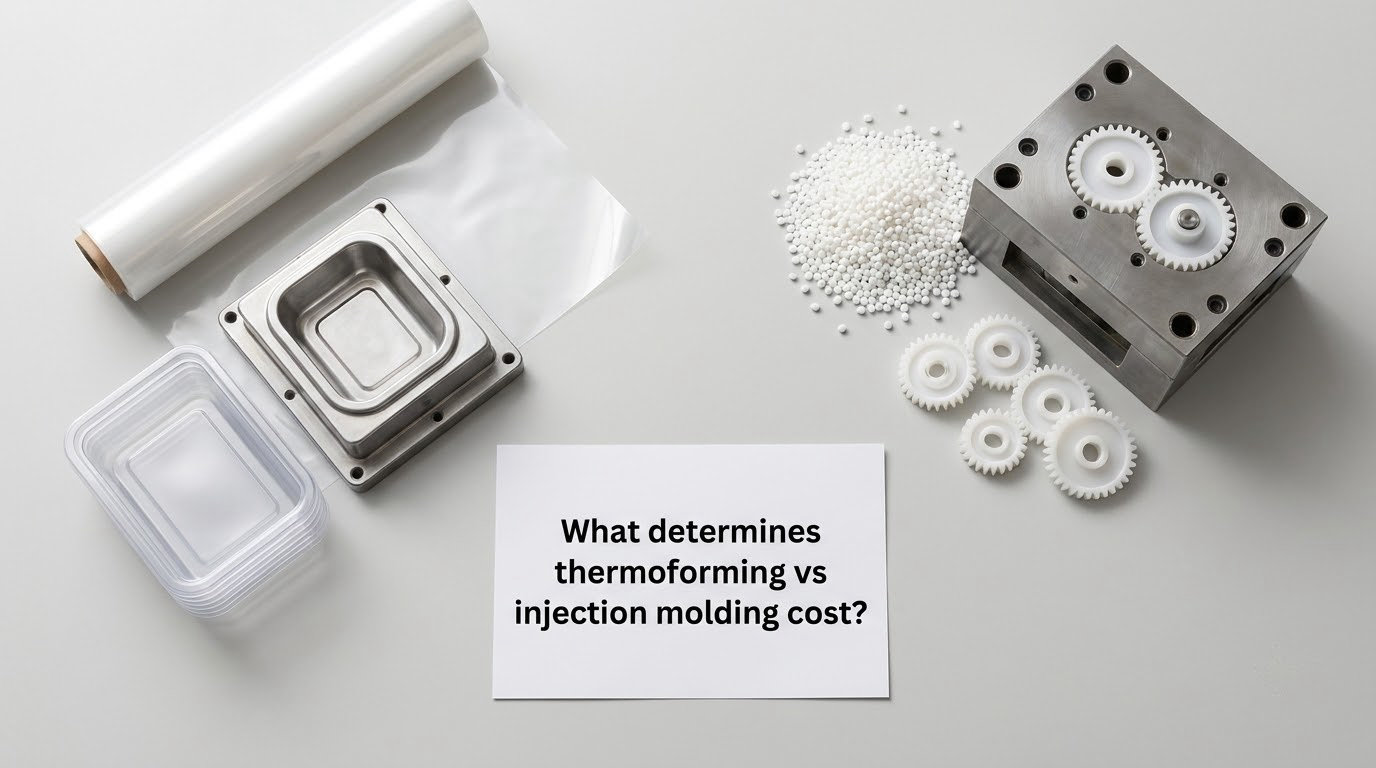
Five inputs drive almost all of the difference, and they stack into one line item: cost per good part equals tooling amortized over volume, plus material, plus machine time, plus labor and finishing, plus freight and packaging.
Tooling amortized over volume
One-time mold cost divided by the number of good parts it produces. This term is what makes injection molding look absurd on a 500-part launch and unbeatable at 100,000 parts. It is the single biggest driver of the whole comparison.
Material and yield
Thermoforming buys a sheet and forms one part from it, so every drop that gets trimmed off is bought twice over. Injection molding pays for pellets by weight and grinds its runners back in, so a well-balanced runner wastes perhaps a quarter of the shot weight. For large parts this term is decisive; for small parts it is noise.
Cycle time and machine rate
Machine time is the hourly rate multiplied by cycle time divided by output per hour. Injection presses charge more per hour but often produce several parts per cycle through multi-cavity tooling, and a hot runner can push that further. Thermoformers pull the sheet, heat it, draw it and cool it, then a person trims the flash off.
Labor and secondary operations
Loading, unloading, trimming, inspection, assembly, printing, painting and welding. Both processes need some, and the honest comparison applies the same list to both sides rather than counting finishing only against injection molding.
Volume and program life
Volume decides how far tooling spreads. Program length decides whether the mold survives long enough for that spreading to matter, and whether a redesign in year two costs you a few hundred dollars or a new steel tool.
Tooling and setup costs: thermoforming vs injection molding
Injection molding tooling costs more because the tool has to hold injection pressure of 10,000 to 30,000 psi, survive clamping force measured in tons, and release a surface finish tight to plus or minus 0.05 mm without pocketing. Thermoforming tools see roughly 14.7 psi of vacuum or up to about 60 psi in pressure forming, so a cast or machined aluminum mold is enough for most work.
That is why vendors quote thermoforming tooling at roughly 10 to 33 percent of injection tooling for the same part. TWI, the UK’s welding and joining research organization, puts simple molds at 1,000 to 5,000 USD and very large or complex ones as high as 80,000 USD, and most engineers treat TWI as the sanity check against a quote.
Machine capital cost: injection press vs thermoformer
Nobody on the buying side ever needs the sticker price, but everybody ends up negotiating a machine hourly rate, so here is the shape of it. A 200-ton injection press, the size that handles parts around 20 to 30 cm, typically lands in the USD 60,000 to 120,000 range new, with bigger hydraulic or electric presses running into the several hundred thousands. A heavy-gauge thermoformer with a platen big enough for a large enclosure runs roughly USD 30,000 to 250,000 depending on platen area, heater zones and whether it is pressure or vacuum.
Two takeaways. First, the capital difference is nowhere near as large as the tooling difference, so buying a press is never the reason to pick a process. Second, a low hourly rate is not automatically a good deal, because a slow press with a cheap rate can cost more per part than a fast one with a higher rate.
Mold life, maintenance and mid-program design changes
An injection mold in P20 pre-hardened steel typically runs 300,000 to 500,000 shots; in hardened H13 or S136, one to two million. Thermoforming aluminum molds for a short program may last a few hundred thousand pulls and then need a new face. Rule of thumb for maintenance is 5 to 10 percent of original tooling value per year, which is small money but not zero.
The bigger lifecycle item is redesign. Changing a thermoform tool is a CNC cut and a weld, so 500 to 3,000 USD. Changing injection mold geometry means steel removal, a new insert or a new core, so 5,000 to 25,000 USD and weeks of downtime. If your product will change twice before it retires, that difference alone can outrun several years of per-part savings.
Per-unit production costs at different volumes
Here is the crossover formula, and it is worth keeping because it makes the decision arithmetic instead of tribal:
Crossover volume = (injection tooling – thermoforming tooling) divided by (thermoformed part cost – injection part cost)
Worked example for a 400 mm equipment enclosure, 3 mm ABS, single-cavity mold, 3,000 part annual program, tooling quoted at 9,000 USD for the thermoform tool and 60,000 USD for the injection mold. At steady state the thermoformed part lands at 2.60 USD: 1.40 material, 0.60 machine time, 0.40 trimming and inspection labor, 0.20 packaging. The injection part lands at 1.20 USD: 0.55 material, 0.30 machine time, 0.15 automated handling, 0.20 packaging. The tooling gap is 51,000 USD and the per-part gap is 1.40 USD, so the curves cross at 36,400 parts a year. Below that, thermoforming wins; above it, injection molding wins.
You will also see 3,000 to 8,000 parts a year quoted as a typical crossover band, and that is not wrong. It shows up when the tooling gap is narrow, for example a simple single-cavity mold against a simple vacuum tool, or when the part is thin and injection per-part cost collapses hard at volume. Do not treat any band as a default. Run your own numbers through the formula with your own quotes, because the sensitivity is entirely in the two terms you supply.
Three volume bands in practice
Below about 1,000 parts, tooling is most of the budget. A 60,000 USD mold spread over 400 parts is 150 USD per part before anyone makes a single part, which is why prototypes and pilot runs go to vacuum forming or CNC. Between 1,000 and 10,000 parts, both processes are viable and the decision turns on part size, tolerance and how much labor you can automate. Above 50,000 parts, injection molding almost always wins on unit cost, and hot runner systems start to make sense somewhere between 50,000 and 200,000 parts.
Two cost claims come up constantly in forums and both need the volume attached. The lowest tooling quote does not give you the lowest program cost, because cheap tools use lower steel grade, fewer hardened inserts and simplified cooling that bites you with unplanned downtime later. And a per-part quote that excludes secondary operations, paint, packaging and freight is not a per-part quote.
Material, part size, and design effects on cost
Part size is the fastest way to know which process you are in. Around 600 mm is the practical crossover for enclosure-type parts: above it, injection molding runs out of clamp and shot size, and above roughly 400 to 500 mm in the longest dimension thermoforming is usually the only sensible route anyway.
Wall thickness follows the same logic. Thermoformed heavy gauge parts run 1.5 to 12 mm sheet and tolerate plus or minus 10 percent variation, which is fine for a bin or a cover. Injection molded parts typically run 1 to 4 mm and hold thickness far more evenly, but a thick injection part needs cooling time that eats the cycle, and cooling is 60 to 70 percent of it.
Draft angle is free money. One to three degrees of draft lets a thermoformed part release from the mold and an injection part release from the core. Parts designed at zero draft cost trimming labor in forming and risk damage in molding, and that trimming labor is usually the second largest thermoforming cost after material.
Resin choice shifts the material term rather than the process decision. ABS, PC and PEEK all work in both processes, but engineering grades such as PEEK run far higher per kilogram, and at that point material dominates the cost model and tooling matters less. Heavy gauge amorphous sheet also behaves differently under draw, so heavy wall parts in PC need more careful heating and more pressure forming than a thin ABS tray.
Geometry decides capability more than cost. Undercuts, snap fits, threads and living hinges belong to injection molding. A formed shell has to be trimmed to shape, so a deep draw with a sharp corner either tears the sheet or forces a radius that changes the design intent. If your part needs a hinge or a threaded boss, the process decision is already made.
Which process has lower labor and finishing costs?
Injection molding usually wins on labor, and by more than most buyers expect, but only after you count the trimming. A thermoformed part comes off the machine as a sheet-shaped shell with flash, so somebody cuts it out, usually on a 3 or 5-axis CNC router, and a second operation usually deburrs and taps it. An injection part arrives complete with its gate mark and is either accepted or scrapped.
Apply the same add-on list to both processes and the honest totals come out closer than the piece prices suggest. Paint and Class-A coating run roughly the same per part on either process, since the coating line does not care how the shell was made. Pad printing, ultrasonic welding and hot staking are the same operations on both sides. Insert molding and overmolding exist only in the injection world, and if your assembly needs them, add that cost to the injection column and it is not a fair fight to begin with.
Quality control is where the gap narrows and then flips. Thermoformed parts vary more, so inspection labor and scrap go up unless you design for a stable wall. Injection molded parts repeat for hundreds of thousands of shots, so sampling replaces inspection. Automated handling is the biggest lever on the injection side and the biggest unclaimed cost on the thermoform side, where the cycle is often short enough that a person is standing there regardless.
Quality, consistency, and capability differences
Picking a process on cost alone is how programs get stuck with a part nobody can assemble. Injection molding holds plus or minus 0.05 to 0.20 mm and repeats that part all day. Thermoforming holds plus or minus 0.25 to 0.75 mm and drifts as the sheet heats and cools, which is fine for a pallet lip and a problem for a mating flange.
Surface finish follows the same split. Injection tooling can be polished to a Class-A or SPI-A1 finish and holds it indefinitely, while a thermoformed surface is the skin of the sheet, improved by good tool surface finish but never matching a polished steel cavity. A visible consumer part on the outside of a device is an injection part, even when the economics argue otherwise.
Then there is consistency across a program. A single thermoform tool can be duplicated by another shop with a copy of the same model if yours breaks, which is a real resilience argument. An injection mold is a one-off; if the shop closes, your program is over until a new tool is cut. For a discontinued product with a long tail that matters, and for a critical part it is a reason to consider specifying a family mold or holding a duplicate cavity.
How to estimate total cost for your part
Here is a fill-in model you can paste your own numbers into, in the order a cost engineer would work.
- Define the part and the volume band. Part dimensions, wall thickness, material grade, cosmetic surfaces and the annual volume for the next three years. Quote at a volume band, not a single number, because price breaks are steep.
- Get comparable tooling quotes. Specify cavity count, mold steel, finish level, number of trial runs and lead time in the request so that two vendors are answering the same question. Ask for the line-item breakdown: steel, machining, assembly, texturing, trials.
- Price the material with a yield factor. Material per part equals part weight plus trim or runner weight, divided by one minus scrap, times price per kilogram. If a vendor quotes material per part at 100 percent yield, the quote is wrong.
- Add machine time. Cycle time in seconds times output per hour, multiplied by the machine hourly rate. For injection, remember cooling is 60 to 70 percent of the cycle and a multi-cavity tool divides that cost by the cavity count.
- Add labor and finishing on both sides. Trimming, inspection, printing, painting, welding, assembly, packaging and freight. List each one rather than accepting an all-in figure.
- Divide tooling by the real part count. Use good parts, not gross parts, and add planned maintenance at 5 to 10 percent of tooling value per year.
- Compare total cost per good part, not piece price. Then run the crossover formula on your two totals to see how much the decision would have to shift before it flips.
Ask suppliers the same seven questions in the same order and the quotes become comparable: what volume band is this priced for, what is the cavity count, what steel, what finish, how many trial runs are included, what is the lead time, and what is explicitly excluded. Engineers who ask for a line-item breakdown consistently get a better read on program cost than those who accept the first number, and the vendors who object to the question are telling you something useful.
Which should you choose?
Choose thermoforming when the part is large, hollow and thin-walled, when volume is under a few thousand a year, when the product is a prototype or a short lifecycle item, or when you expect the design to change more than once. Prototyping in simple vacuum tooling and proving the market before cutting production tooling is the pattern experienced practitioners keep repeating, and it is the cheapest insurance available in manufacturing.
Choose injection molding when the part is under roughly 600 mm, needs tight tolerance, a Class-A surface, snap fits, threads or living hinges, when volume is high and stable, and when the design is essentially frozen. Once a program is running tens of thousands of parts a year with a fixed design, nothing beats it on cost per part.
Choose the hybrid when a product has a real launch curve: thermoform the first run to serve early demand, then migrate to injection molding once volume proves the design. It costs more in engineering time and two sets of tooling, and it is often the right answer for a product with a fast first year and a long tail.
And when the decision is genuinely close, pull a total cost of ownership review that includes freight, duty, inspection and inspection travel. Offshore injection molding cuts machine rates by roughly 40 to 70 percent while adding 5 to 15 percent in freight and duty, and that arithmetic shifts several borderline programs back onshore.
Frequently Asked Questions
Is thermoforming cheaper than injection molding?
Yes for tooling and for low volume, no for the part itself at scale. A thermoforming mold for a typical enclosure runs about 3,000 to 15,000 USD against 25,000 to 100,000 USD and up for an injection mold. The thermoformed part then costs more per piece, because you buy the whole sheet. Injection molding wins once volume amortizes the mold.
At what volume does injection molding become cheaper?
For most OEM enclosure programs the crossover sits between 3,000 and 8,000 parts a year, and closer to 30,000 for parts with a wide tooling gap. The honest answer comes from the formula: divide the tooling difference by the per-part cost difference. Below the crossover, tooling dominates and thermoforming wins; above it, per-part cost dominates and injection molding wins.
What is the average cost of an injection mold?
A simple single-cavity mold for a small part runs 2,000 to 15,000 USD. Complex multi-cavity molds for precise parts run 30,000 to 100,000 USD and beyond, and TWI cites 1,000 to 5,000 USD for simple molds rising to about 80,000 USD for very large or complex ones. Size, cavity count, steel grade, cooling design and finish level move the number more than anything else.
How much does a 200 ton injection molding machine cost?
A 200-ton press, the size that handles parts roughly 20 to 30 cm across, typically runs 60,000 to 120,000 USD new, with larger hydraulic or electric presses reaching into the several hundreds of thousands. A heavy-gauge thermoformer for large parts runs roughly 30,000 to 250,000 USD depending on platen size, heater zones and pressure versus vacuum. The rate you pay per hour matters more than the purchase price.
How do I calculate the cost of an injection mold?
Build it from the same line items any tool quote contains: steel quantity and grade, rough and finish machining hours, cavity count, cooling design such as hot runner or conformal channels, texture and polish, assembly, and trial runs. Then divide by the number of good shots you expect to pull. Ask every vendor for the same breakdown, since a lump sum cannot be compared across quotes.
Is thermoforming the same as injection molding?
No, they are different processes with different economics. Thermoforming heats a sheet and stretches it over an aluminum mold with vacuum or pressure. Injection molding melts pellets and forces them under 10,000 to 30,000 psi into a hardened steel cavity. The practical result is a much cheaper mold on one side, and tighter tolerance, better finish and lower unit cost at volume on the other.
The first thing to do is write down your annual volume and your part size, because those two numbers eliminate half the options before anyone quotes anything. Then request tooling quotes on the same line items from two shops per process, run them through the crossover formula, and let the arithmetic pick the process instead of the habit. If the two totals land within about 10 percent of each other, decide on tolerance, finish and how often you expect to change the design, because that is where the remaining money is.