
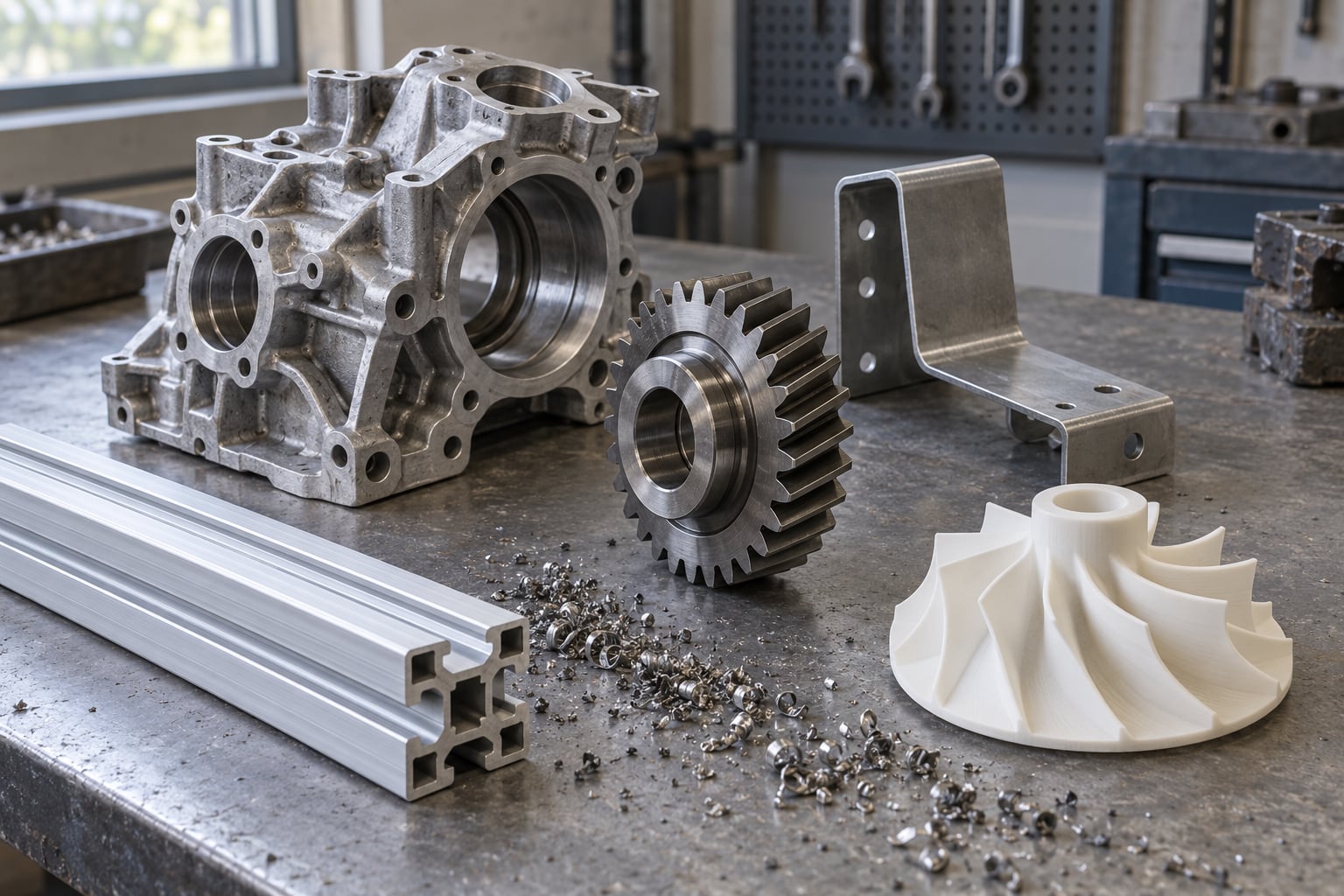
If you work with a factory, a machine shop or a product team, the phrase “types of manufacturing processes” usually comes up when someone asks how a part should actually be made. The honest answer is that there are a dozen process families that cover nearly every part on a factory floor, and each one wins under different conditions of volume, geometry, material and tolerance. This guide walks through all twelve, with the materials each one handles, the volumes it suits, and the parts it typically produces.
I’ve spent enough time around production lines to know the wrong process choice is expensive long before anyone sees the part. A decision made on unit price alone can quietly add six weeks of tooling lead time. What follows is organized so you can jump to the processes you care about, compare them side by side, and then apply a selection framework that mirrors what a manufacturing engineer actually does.
Table of Contents
- Types of Manufacturing Processes at a Glance
- 1. Casting: One of the Types of Manufacturing Processes for Complex Shapes
- 2. CNC Machining: A Subtractive Manufacturing Process
- 3. Injection Molding: A High-Volume Plastic Manufacturing Process
- 4. Extrusion: A Continuous Manufacturing Process for Constant Profiles
- 5. Sheet Metal Forming: Bending, Stamping, and Deep Drawing
- 6. Additive Manufacturing: Layer-by-Layer Production
- 7. Powder Metallurgy: Sintering and Pressing Metal Powders
- 8. Forging: Shaping Metal With Compression
- 9. Welding and Joining: Connecting Components Permanently
- 10. Heat Treatment and Material Processing: Changing Performance Properties
- 11. 3D Printing and Rapid Prototyping: Fast Iteration Before Production
- 12. Assembly and Kitting: Turning Components Into Finished Products
- Frequently Asked Questions
- What is the best manufacturing process for prototypes?
- What manufacturing process is best for high-volume production?
- What is the difference between casting, forging, and machining?
- How do I choose between injection molding and CNC machining?
- Which manufacturing process works best for metal parts?
- Can one product use several types of manufacturing processes?
- Conclusion
Types of Manufacturing Processes at a Glance
The table below sorts the twelve processes by what they do to the material. Some remove material, some shape it, some add it layer by layer, and some simply connect pieces together. Every manufacturing process in the list falls into one of those four behaviors.
| Process | Family | Best materials | Typical volume | Main advantage | Main limitation | Representative parts |
|---|---|---|---|---|---|---|
| Casting | Formative | Cast iron, steel, aluminum, bronze | Medium to very high | Complex internal shapes in one piece | Porosity and rough surfaces | Engine housings, valves, hardware |
| CNC machining | Subtractive | Aluminum, steel, stainless, brass, plastics | Prototype to medium | Tight tolerance and repeatable accuracy | Material removal and chip waste | Gears, shafts, aerospace brackets |
| Injection molding | Formative | Thermoplastics, thermosets, rubber | Very high | Fast cycle times and complex geometry | High tooling cost and long lead time | Housings, clips, containers, dashboards |
| Extrusion | Formative | Aluminum, polymers, rubber, composites | Very high | Constant cross-section at high throughput | Profile shape only | Pipes, tubing, window profiles, wire insulation |
| Sheet metal forming | Formative | Steel, aluminum, stainless sheet | High to very high | Enclosures and brackets at low piece cost | Thin walls and limited depth | Cabinets, brackets, appliance panels |
| Additive manufacturing | Additive | Thermoplastics, resins, metals, ceramics | Prototype to low volume | No tooling and internal channels | Slow per part and limited material options | Prototype shells, turbine blades, implants |
| Powder metallurgy | Formative | Steel, stainless, copper, aluminum powders | High to very high | Fast cycles at high part counts | Size limits and porosity control | Gears, bearings, electrical contacts |
| Forging | Formative | Carbon steel, alloy steel, aluminum | Medium to very high | Grain flow raises fatigue strength | Dimensional accuracy from the die | Crankshafts, fasteners, hand tools |
| Welding and joining | Joining | Most metals, plastics, and composites | Prototype to high | One part instead of several | Distortion and inspection burden | Frames, tanks, structural weldments |
| Heat treatment | Property change | Ferritic and alloy steels, some alloys | Any volume | Hardness and wear resistance without shape change | Distortion and dimensional growth | Hardened shafts, gears, cutting tools |
| 3D printing and rapid prototyping | Additive | PLA, ABS, nylon, photopolymers, metals | Prototype to low volume | Days instead of weeks to a physical sample | Layer lines and anisotropic strength | Fit checks, appearance models, fixtures |
| Assembly and kitting | Secondary | All of the above | Any volume | Converts parts into a shippable product | Labor content and error rate | Appliances, electronics, vehicles |
1. Casting: One of the Types of Manufacturing Processes for Complex Shapes
Casting is the oldest mass-production method still in heavy use. Molten metal is poured, injected or centrifugally forced into a cavity, allowed to solidify, and then the part is knocked out and cleaned. Because the shape comes from a cavity rather than a tool path, a single casting can include internal passages, ribs and draft angles that would take hours to machine.
Sand casting suits anything from a few pieces to thousands, uses a cheap expendable mold, and handles large castings well. Its tolerances are loose, often a few millimeters, and the surface carries a coarse texture from the sand grain.
Investment casting, sometimes called lost-wax casting, wraps a wax or printed pattern in a ceramic shell, burns out the wax, and pours metal into the shell. It delivers smooth surfaces and tight tolerances with almost no parting line, which is why it shows up in turbine blades and orthopedic implants. Die casting pushes molten metal into a reusable steel die under high pressure, and that pressure is what makes cycle times short enough for mass production.
How types of manufacturing processes differ by molding route
You can identify the right casting route from two things: whether the mold survives the run, and whether anything pushes the material in. Gravity-fed processes pour and wait. Expendable molds are destroyed to release the part, which keeps the tool cheap but stops you reusing it. Permanent molds are machined steel and last tens of thousands of cycles. Pressure-assisted routes, like die casting and squeeze casting, force material in fast enough to fill thin sections and trap fewer gas bubbles.
Typical defects tell you where you went wrong: gas porosity from moisture or trapped air, shrinkage cavities from pouring too hot, cold shuts where two streams met before fusing, and misruns when the metal froze mid-fill.
2. CNC Machining: A Subtractive Manufacturing Process
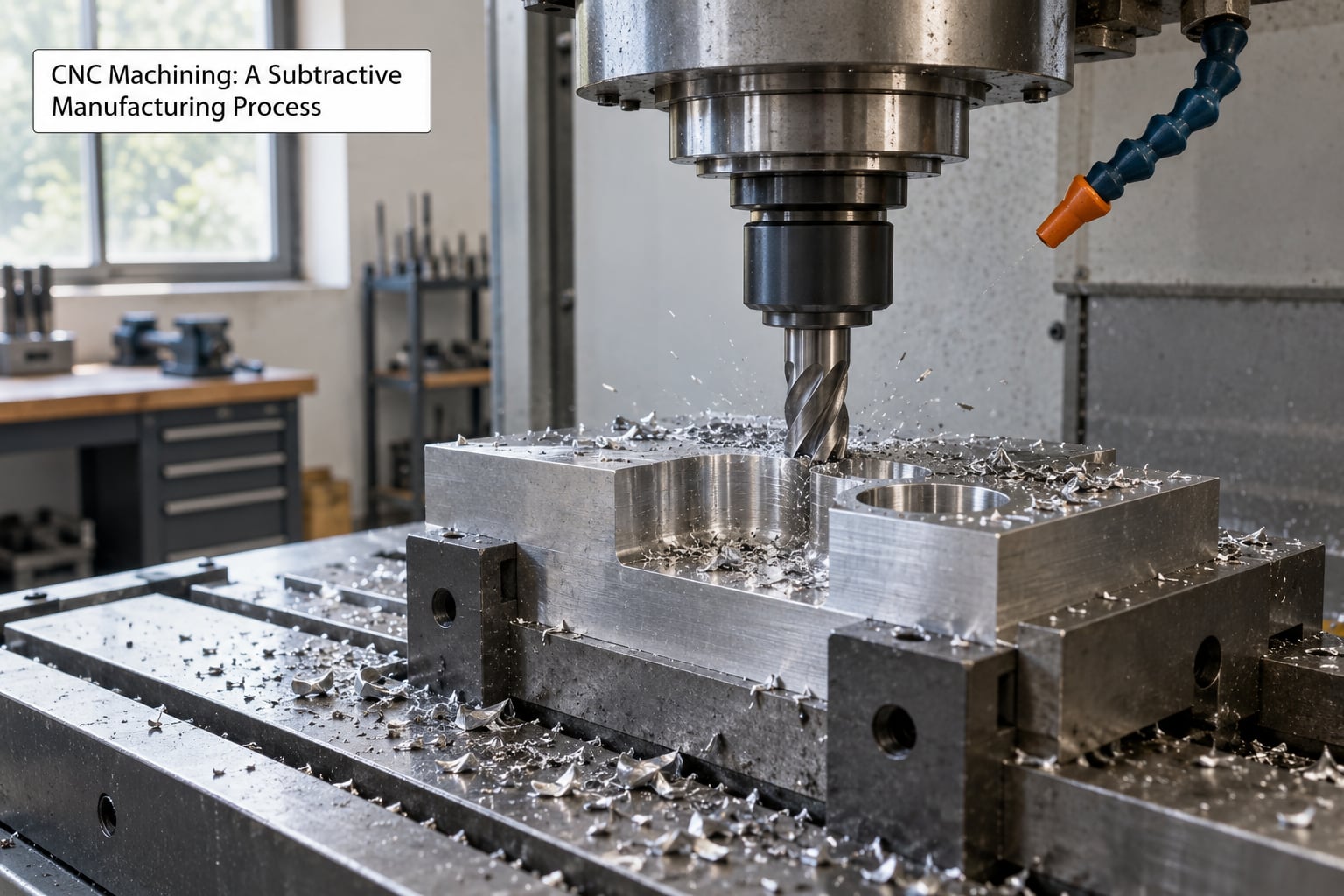
CNC machining removes material from a solid blank to leave the finished part behind. A computer reads the toolpaths from the CAD model and commands the motions, which is why a three-axis mill running unattended at 2 a.m. produces the same part as one running at 9 a.m.
Milling cuts features on prismatic parts, turning shapes round parts on a lathe, drilling makes holes, and grinding removes small amounts with a very fine finish. Five-axis machining tilts the workpiece or the spindle so complex surfaces can be cut in fewer setups. When a tool cannot reach or the material is too hard to cut, electrical discharge machining burns the shape with a controlled spark instead of contact.
Machining holds the tightest tolerances of any major process here, often 0.01 mm or better on a capable machine, and it accepts materials that would destroy a forming die, from hardened tool steel to titanium. The cost lands in three places: toolpath time, tool consumption, and material thrown away as chips. On high-volume work the chips and the cycle time both hurt, and that is exactly the point where a forming process takes over. Watch for chatter marks from a tool that is vibrating, built-up edge from a worn insert, and burrs left at every break in the surface.
3. Injection Molding: A High-Volume Plastic Manufacturing Process
Injection molding melts a thermoplastic, injects it into a steel mold at high pressure, holds it under clamping force until it cools, then ejects the part and repeats. The whole cycle on a small part runs 20 to 60 seconds, so a single machine can turn out thousands of parts a day once it is running steadily.
Everything about the economics sits on the mold. A simple single-cavity tool for a modest part may take weeks to cut and costs far less than a multi-cavity tool, but it exists to amortize over volume. As volume rises, multi-cavity tools spread that same fixed cost across more pieces per cycle, and the piece cost drops hard.
Design rules matter more in molding than almost anywhere else. Uniform wall thickness prevents uneven cooling; thick sections shrink more than thin ones and create sink marks; parting lines, ribs and draft all affect both fill and warpage. Inserts let a molded part carry a metal thread or a label, though they slow the cycle. If you want the numbers behind how resin moves through a tool, our guide to material handling systems for resin walks through drying, conveying and feeding.
4. Extrusion: A Continuous Manufacturing Process for Constant Profiles
Extrusion pushes material through a shaped die and keeps going as long as the billet lasts. A hot end runs a container of molten or softened material, a die defines the cross-section, and a puller or roller sets the speed that determines how much stretch the profile sees. Past that, sizing, cooling and cut-to-length are all that remain.
The constraint is geometry: the cross-section has to stay the same from start to finish. Anything with holes that vary along its length, moving features or varying wall thickness has to be machined or formed afterward. In return, extrusion is extremely fast and the material cost per pound stays low, which is why pipe, conduit, tubing, window and door profiles, rubber seal strip and wire insulation all come out of it this way.
Aluminum extrusion presses billets under high pressure, sometimes with the container itself deforming, which forces out the internal porosity that plagues castings. Thermoplastic extrusion heats granules in a barrel-screw machine, and composites come through as pultruded profiles with continuous fiber along the length.
5. Sheet Metal Forming: Bending, Stamping, and Deep Drawing
Sheet metal forming starts with flat material and makes it three-dimensional. Press brake bending folds a panel between a punch and a die over a narrow line. Stamping separates parts from a coil by cutting operations, and progressive dies chain several stations together so one coil feeds straight out. Deep drawing pulls a blank over a punch so the sheet stretches into a cup shape, which is how every can and most appliance pans begin.
Bending is the slow, flexible option, with setup measured in minutes and tooling measured in hundreds of dollars. Stamping is the opposite: the press is already installed, a die can run hundreds of thousands of strokes, and setup may take hours. Deep drawing sits between them, since a draw die is substantial but the parts come out fast.
The real limit is the material itself. Steel stretches roughly five percent before it tears and aluminum stretches around 25 percent, so a deep steel draw that aluminum handles easily will split. Springback, where a bent part relaxes after the tool releases, means you compensate in the tooling rather than in the operator’s head. Expect wrinkles in the flange, tearing at the punch radius, and edge cracking on parts with sharp bends.
6. Additive Manufacturing: Layer-by-Layer Production
Additive manufacturing, or 3D printing, builds a part one thin layer at a time from a digital model. No tool touches the material, so internal channels, curved undercuts and lattice infill are simply a matter of what the software decides to print.
The main families are worth distinguishing. Fused filament fabrication melts plastic filament through a nozzle. Vat photopolymerization cures liquid resin with a laser or projector, which buys better resolution and surface finish than FDM but ties up a whole vat of resin. Selective laser sintering or selective laser melting fuses polymer or metal powder in a bed with a laser. Binder jetting sprays liquid binder onto powder, and material jetting cures droplets of photopolymer the way an inkjet printer lays down ink.
Add up the layers and you get two properties people forget. Because each layer is bonded to the one below it, strength differs by direction. Parts are strongest in Z and weakest between layers, so load paths need to run with the layers. Print orientation can also make the part taller than the machine, which quietly adds a build plate. Printing is fast to start and expensive per piece, which makes it a natural fit for prototypes and complicated low-run parts and a poor fit for thousands of identical simple components.
7. Powder Metallurgy: Sintering and Pressing Metal Powders
Powder metallurgy takes metal powders, presses them into shape in a die under high pressure, then heats the compact below the melting point in a controlled atmosphere so the particles bond. That heating step is sintering, and it is the step that turns loose powder into a usable part with real mechanical properties.
The press cycle is short and the furnaces run many parts per load, so the per-piece cost at volume is hard to beat. Complex geometries come out of the die in one press, and oils can be pressed into the part at the same time, which is how self-lubricating bearings get made. Common parts include gears, bearings, sprockets, structural components, electrical contacts and the small mass of metal in a car.
Material choice is the limiting factor: each alloy needs its own qualified powder and its own process parameters, so an alloy that works in machining or casting may not be available in a qualified powder. Parts also grow slightly during sintering, so sizing operations follow, and porosity from the pressing stage remains a concern in highly loaded applications.
8. Forging: Shaping Metal With Compression
Forging squeezes a heated or room-temperature billet between dies so the material fills a shaped cavity. The metal does not simply conform; it flows, and the grain follows the flow. That grain structure is the whole reason forgings survive cyclic loading where castings of the same alloy would crack.
Closed-die forging makes a near-net-shape part with flash around the edge and is the workhorse of automotive and hardware production. Open-die forging works a billet between flat dies or dies with simple profiles, so it suits very large parts like crankshafts and shafts. Impression forging forms the same visible shape that the die impression carries, and cold forging at room temperature produces accurate dimensions with exceptional hardness, which is how nails, screws and some wire are made.
Cost comes from the press, the dies and the heat handling, and die life is finite because the dies wear under load. Tighter forgings also mean more flash and closer tolerance limits, so critical surfaces still get machined afterward. Watch for laps, where the metal folds on itself against the die wall, and for cracking if the grain gets torn during a badly sequenced operation.
9. Welding and Joining: Connecting Components Permanently
Joining processes exist because one part is often worse than several. Welding fuses two pieces with a filler and heat, which is permanent, strong and invisible once finished, but it can distort the assembly and leave a heat-affected zone with different properties from the parent metal.
MIG and wire-feed welding are the everyday workhorses for structural steel. TIG gives cleaner, more controlled results on thinner sections and is common in stainless and aerospace work. Laser welding focuses tightly and keeps the heat-affected zone small. Resistance welding passes current through the joint itself, which makes spot and seam welding fast and clean for sheet metal and vehicle bodies. Friction welding generates heat through friction at the contact face instead of an arc, and ultrasonic welding handles thin plastics and films. Structural adhesive bonding spreads load across a whole surface without heat, and brazing uses a lower-melting filler than the parent parts, so the base metal never melts.
Joint design decides how it goes. Fillet welds are forgiving; full penetration groove welds take more prep and pay off in strength. Expect burn-through on thin material, undercut along an underfilled bead, distortion from uneven heating, and porosity where moisture got into the joint.
10. Heat Treatment and Material Processing: Changing Performance Properties
Heat treatment does not change the shape of a part. It changes how the material behaves by rearranging its internal structure, which is why it applies to gears, shafts and cutting tools after they are already machined.
Annealing heats a part and cools it slowly to relieve internal stress and soften it for the next operation. Normalizing gives a finer, more uniform grain and is often the final step for structural steel. Quenching locks in a hard structure and is always followed by tempering, which trades a little hardness back for toughness. Case hardening hardens only the outer layer, so a part gets a wear-resistant skin over a tough core. Precipitation hardening pulls dissolved atoms out of solution to form fine particles that block dislocation movement, and it is what aluminum alloys rely on.
Each treatment moves a different property. If a part is wearing out, look at hardness and case depth. If it keeps snapping, look at toughness and residual stress. If it needs to be machined easily, check the annealed condition, and our guide to hardness testing for plastics explains how a plant measures that property on polymer parts, which follow different rules than metal.
11. 3D Printing and Rapid Prototyping: Fast Iteration Before Production
Rapid prototyping describes a purpose rather than a machine: getting a physical sample in days so a team can test fit, form and function before committing to production tooling. The printer matters less than the question the sample answers.
For fit and clearance checks, a fast FDM print in PLA or PETG answers the question in an afternoon. For surface finish, fit against mating parts, or anything optical, a resin print in SLA is worth the extra steps. For functional testing under load, SLS in nylon gives you a finished part with no layer-line weakness in the way FDM has, and metal powder-bed processes handle real mechanical testing and certified production parts.
The handoff decision is usually the same three questions. How many do you need? Past a few hundred identical pieces, injection molding or a forming process wins on cost and consistency. How tight does it need to be? Printed parts vary with orientation and machine calibration, while a machined or molded part holds its dimensions run after run. And can the process handle the material? A printed prototype in nylon proves the geometry, not the fatigue life of the metal the real part needs. Prototyping pays for itself when it saves one tooling revision.
12. Assembly and Kitting: Turning Components Into Finished Products
Assembly is where a bin of finished components becomes a product someone can use. Kitting comes first, pulling exactly the right quantities of each part and its hardware into a kit so the line is never missing a component mid-build. Then the build itself proceeds from work instructions, fixtures and fasteners.
Manual assembly suits low volume and high variation, with a person handling every step. Semi-automatic stations combine a powered tool or a fixture with an operator feeding parts. Fully automatic lines use robotic cells and pick-and-place systems for repetitive inserts, screwdriving and dispensing. In electronics, surface-mount placement is the automated equivalent for board assembly. Error-proofing matters more than speed here: poka-yoke fixtures that physically will not load the wrong part, torque-limiting drivers that stop an over-tightened fastener, and scanned barcodes that reject a missing or wrong component before the product moves on.
Every station ends in inspection and packaging. Final inspection checks the assembly rather than a single part, and the record of that check travels with the product. Where resin arrives as bulk material and components arrive as discrete pieces, the two halves of assembly meet at the same line, and getting material to the machine is a discipline of its own.
Frequently Asked Questions
What is the best manufacturing process for prototypes?
For fit and form checks, a fast FDM or resin 3D print wins, because you get a sample in hours with no tooling. For prototypes that must prove strength, fatigue life or material behavior, machine the part or print it in a metal powder-bed process. Additive manufacturing stays the right answer whenever the shape is complex and the quantity is low, since there is no die cost to recover.
What manufacturing process is best for high-volume production?
High volume rewards tooling, so the answer is usually a mold-based process: injection molding for polymers, die casting for aluminum and zinc, and stamping or deep drawing for sheet metal. Beyond roughly a few thousand identical pieces, the fixed cost of the tool spreads thin enough that piece cost drops sharply. Machining and 3D printing rarely win at volume because their cost scales with every part made.
What is the difference between casting, forging, and machining?
Casting melts the material and lets it solidify in a mold, which handles complex shapes but can leave porosity. Forging heats or works a solid billet under compression, so the grain flows with the shape and fatigue strength rises. Machining removes material from a solid blank to reach exact dimensions, giving the tightest tolerance at the highest material waste. Casting shapes, forging strengthens, machining sizes.
How do I choose between injection molding and CNC machining?
Choose injection molding once your volume is high enough to recover the mold, your part is polymer, and geometry can be designed around uniform wall thickness and draft. Choose CNC machining for prototypes, low-volume or one-off parts, tight tolerances, thin sections and materials like aluminum, stainless steel or composites. Prototype in machining and transfer to molding only after the geometry is frozen.
Which manufacturing process works best for metal parts?
It depends on what the part has to survive. Pick casting for complex housings and shapes, forging for fatigue-critical parts such as crankshafts and fasteners, stamping for flat sheet components, powder metallurgy for small high-count parts, and machining when tolerance and finish drive the design. Most metal components combine processes, such as a cast housing machined on its bearing surfaces.
Can one product use several types of manufacturing processes?
Almost always, and that is normal factory practice. A motor might use a die-cast housing, a forged shaft, machined bearing seats, powder-metallurgy gears and a winding process, then get assembled and painted. Each family handles what it is best at, and the finished cost depends on how well those individual steps line up.
Conclusion
Pick a manufacturing process in a fixed order, not by preference. Define the geometry and the material first, since they rule out entire families instantly. Then set the quantity, because quantity decides whether tooling pays for itself. Next check tolerance and surface finish against what each process can hold without extra finishing. Finally price the tooling, the lead time and the expected scrap, then build one representative part and measure it.
That last step still surprises people. A sample tells you things a datasheet never will about fit, distortion and finish. When you request quotes, a line-item breakdown is worth reading closely, and our guide to how to evaluate manufacturing quotes fairly shows what to look for when a supplier hands you a number with no detail behind it.