
Direct labor is the hands-on work that physically builds your product, and it can be traced to a specific job, work order or unit. Indirect labor is everything that keeps the plant running around that work — supervision, maintenance, quality assurance, scheduling and material handling — and it cannot be traced to one product without an allocation method. That single test, traceable or not, decides whether the cost lands in cost of goods sold as direct labor or in manufacturing overhead as indirect labor, and it shapes every product margin you report.
In practice the distinction is where most of the arguing happens on a plant floor. A quality inspector who checks parts on the line versus one who audits finished-goods paperwork gets classified differently, and a supervisor who loads machines most days is not the same accounting question as one who only runs the schedule. The rules behind direct vs indirect labor in manufacturing have not changed in decades, but the timekeeping software most plants now use makes those rules easier to apply, and easier to break.
What follows is the working classification most manufacturers use, the costing treatment that follows from it, and the practical method for settling the roles that fall between the two categories.
Table of Contents
- Direct vs Indirect Labor in Manufacturing at a Glance
- What Is Direct Labor in Manufacturing?
- What Is Indirect Labor in Manufacturing?
- How Direct and Indirect Labor Differ
- Examples of Direct and Indirect Manufacturing Labor
- How Labor Costs Are Recorded
- Which Labor Should Manufacturers Measure More Closely?
- How to Classify Labor Correctly in a Manufacturing Plant
- Which Type of Labor Should You Choose?
- Frequently Asked Questions
- Conclusion
Direct vs Indirect Labor in Manufacturing at a Glance
| Criterion | Direct labor | Indirect labor |
|---|---|---|
| Definition | Work that physically transforms materials into the product | Work that supports production without touching the product itself |
| Typical jobs | Machine operation, assembly, welding, molding, part inspection, packing finished units | Supervision, maintenance, quality assurance, production scheduling, material handling, plant administration |
| Cost treatment | Charged directly to the job or process as a product cost | Pooled in manufacturing overhead, then allocated |
| Allocation method | None needed; cost follows the work order | Direct labor hours, machine hours, headcount, or activity-based drivers |
| Overtime treatment | Charged to the job that was running when the hours were worked | Absorbed in the overhead pool regardless of which job caused it |
| Time tracking | Clocked against a job number or work order center | Clocked to a department or support cost center |
| Operational purpose | Convert scheduled hours into finished units | Protect capacity, quality and uptime across all jobs |
| Cost behavior | Largely variable with production volume | Often fixed in total, rising in discrete jumps as volume grows |
The table is the whole argument in one view. Everything below is just that same traceability test applied to real plants, with the accounting and reporting consequences spelled out.
What Is Direct Labor in Manufacturing?
Direct labor is the labor cost you can trace to a specific product, job, batch or work order without guessing. The worker changes the physical state of the material, and the hours show up against that job on the time record.
On an injection molding line, the operator who loads the hopper, runs the cycle, removes the part and packs it into a tote is direct labor. So is the assembler who bolts the housing to the board, the welder joining brackets on a frame, and the operator who inspects parts at the machine and signs off on them. The common thread is that you could name the job and the units involved.
Direct labor enters cost of goods sold when the job is completed. For job order work it accumulates in work in process on the job cost sheet. For process work it flows into the cost of the process as units move through, so it lands in the same accounts either way.
Direct labor does not have to be productive in every hour. Waiting on a machine because a mold needs cooling is still direct labor if the operator is clocked to that job, and the idle time belongs in the job’s variance rather than in some overhead bucket. Many plants also pay a setup operator, and setup before a specific run is normally treated as direct labor for that run.
What Is Indirect Labor in Manufacturing?
Indirect labor is the labor that keeps production possible but does not attach to any one product. One maintenance technician services every machine in the building. One scheduler releases work to all three shifts. Neither can be charged to a specific part without first deciding how to split the cost.
Common indirect roles include production and shift supervisors, maintenance and tool-room staff, quality assurance and lab personnel, schedulers and production planners, warehouse and material handlers who stage raw materials for the whole plant, plus plant administration, safety and security.
These costs are collected in a manufacturing overhead pool. At the end of the period, the pool is allocated to products using an agreed base, and only then does indirect labor reach cost of goods sold. Until that allocation runs, the cost sits in overhead, which is exactly why the choice of allocation base changes reported margins so much.
One thing worth stating plainly: both kinds of labor are real plant payroll. The distinction is about cost accounting, not about how the worker’s paycheck is funded. Benefits, payroll taxes and overtime premium apply to both.
How Direct and Indirect Labor Differ
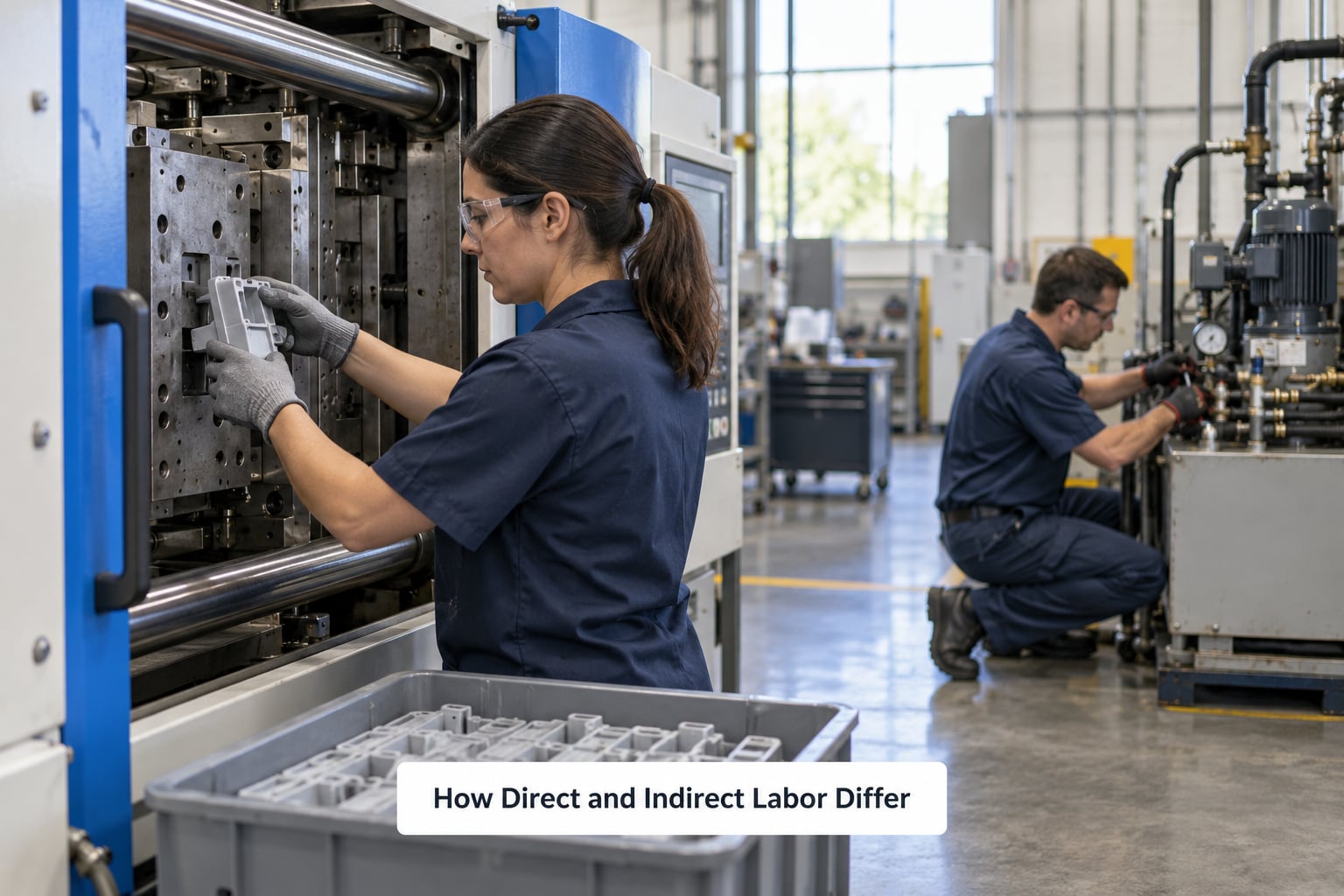
The differences come down to six things: traceability, where the cost lands, the operational role, how the cost behaves as volume changes, how you measure performance, and which decisions the data supports.
Traceability and cost treatment
Direct labor is traced; indirect labor is allocated. A job cost sheet carries the operator’s hours and wage rate straight onto the job. Indirect hours go into a department account, and the finance team spreads that account across jobs using a base like direct labor hours or machine hours.
Operational role and cost behavior
Direct labor exists to convert hours into units, so it scales roughly with the schedule. Indirect labor protects capacity and quality, so it stays fairly flat month to month as volume moves inside the plant’s practical range, then steps up when you add a shift, a second maintenance crew or a third shift of inspection.
Performance measurement and management decisions
Direct labor hours give you efficiency measures, whether a job ran to standard. Indirect labor tells you about capacity and support load, whether maintenance spend is climbing faster than assets or if the QA function is outgrowing the defect rate it was built to control. Pricing, make-or-buy and product profitability decisions lean on the first; staffing and capacity decisions lean on the second.
How direct vs indirect labor in manufacturing affects product cost
Because indirect labor arrives at the product only through allocation, the allocation base decides how much of it lands on each unit. Allocate on direct labor hours in a labor-intensive plant and the product with the highest manual content carries the most overhead. Switch the plant to machine hours after an automation project and overhead shifts toward the capital-heavy product, even though total plant overhead has not changed by a dollar.
That is the practical risk in this whole topic. A plant can report a healthy product margin purely because of its allocation choice. If you want the make-or-buy conversation to be honest, run the sensitivity: what does each product’s fully absorbed cost look like under the alternative base?
Examples of Direct and Indirect Manufacturing Labor
The same floor produces both kinds of labor in the same hour, so examples land better than definitions. Here are the pairings most plants recognize.
- Plastics molding: the operator running the press and trimming flash is direct; the tool-room technician regrinding the die and the maintenance crew changing the screw are indirect.
- Assembly: the line worker fastening components into a finished unit is direct; the line leader balancing stations and coordinating with the feeder is indirect.
- Quality: an inspector verifying parts against the drawing at the machine is direct; a quality engineer writing the control plan or running a process capability study across the plant is indirect.
- Packaging: the worker counting units into cartons and stacking pallets to a customer order is direct; the clerk who prints labels for every line and manages packaging inventory is indirect.
- Warehousing: the picker assembling a work order’s material kit and delivering it to the line is direct when the kit is tied to that job, and indirect when receiving and staging is done for the whole plant.
- Plant support: shipping finished goods on a customer order is often direct to that order, while the night-shift security guard and the sanitation crew are always indirect.
The pattern in every row: direct work has a destination attached to it, indirect work has a department attached to it. Test the destination, not the job title.
How Labor Costs Are Recorded

Recording starts at the clock, not at the ledger. Each employee clocks into a cost center tied to a job number or a support department, and the system separates those hours at the payroll-to-GL step.
Direct labor hours land on the job cost sheet, multiplied by the standard or actual wage rate for that skill level, and they accumulate in work in process until the job ships. Indirect labor hours land in their department accounts and roll into the manufacturing overhead pool, where they join indirect materials, utilities and equipment costs.
Three controls keep the numbers honest. Standard labor hours per unit, agreed with engineering, let you separate a rate variance from an efficiency variance; without a standard you can still measure cost per piece, but you cannot tell a wage change from a productivity gain. A documented allocation policy tells everyone which base the plant uses and why. And periodic review of borderline job codes catches the drift that happens when someone quietly starts doing two jobs.
Applying an allocation base mechanically is where plants lose money quietly. If you spread maintenance across jobs by direct labor hours, a line running mostly automated work shifts its share of maintenance cost to products that barely use the machines. Methods like activity-based costing, which assign maintenance cost by number of setups or maintenance calls, cost more to set up and often tell a truer story in plants with varied products. If your cost data feeds quote reviews, get the definitions straight before comparing numbers — our guide on how to evaluate manufacturing quotes fairly walks through that.
Which Labor Should Manufacturers Measure More Closely?
Measure direct labor tightly, because that is where unit cost lives, and measure indirect labor for capacity, not per piece. A handful of numbers covers both.
- Direct labor hours per unit against standard, by job, to catch efficiency loss early.
- Total labor cost per unit, direct plus allocated indirect, for pricing and product mix work.
- Indirect labor as a share of conversion cost, watched over time for a trend rather than a single month.
- Overtime hours by department, since overtime on a support function usually signals a scheduling problem upstream.
- Support workload per machine or per production hour, which shows whether indirect headcount is scaling with output.
Track those in the same system so the ratio between them stays honest. Plants that run indirect labor numbers separately from job data tend to discover the mismatch at year end, when the allocation reshuffles margins that were already reported. More and more operations now pull both streams into the same model, and the shift toward model-based simulation makes the allocation assumption a variable you can test rather than a habit you inherit. Our explainer on digital twin in manufacturing explained covers how that simulation layer usually gets set up.
How to Classify Labor Correctly in a Manufacturing Plant
Classification settles fast when you ask the right question in the right order. Here is the method that works.
- Ask what the purpose of the work is. If it changes the physical state of the product, it looks like direct labor.
- Ask whether you can trace the hours to a specific job, batch or work order without an assumption. If yes, direct labor.
- Write down your accounting policy and stick to it. Consistency matters more than which base you pick, because changing bases every year breaks the trend.
- Map each role to a job code in the timekeeping system, so the choice is enforced at the clock instead of argued at month end.
- Review borderline roles on a schedule. QC, setup, material handling and supervisors drift, usually because the plant added automation or shifted staffing.
Two habits help more than the rules themselves. Have operations and finance agree on borderline roles in writing before you need the answer, and revisit the list every time you add a cell, a shift or a machine.
Which Type of Labor Should You Choose?
Classify production work as direct labor when the hours trace cleanly to a job and move with volume, since that gives you the efficiency signal that drives costing. Classify shared support work as indirect, because trying to force it onto jobs produces allocations nobody believes.
Where a support role is genuinely consumed by one product line, a hybrid arrangement works better than either pure approach: keep the role in the overhead pool, then apply a driver-based allocation such as setups, changeovers or machine hours so the cost follows actual consumption.
The practical test is simple. If a customer auditor asked you to prove the cost belonged on that product, could you? If the answer is a time record, it is direct. If the answer is an allocation policy, it is indirect.
Frequently Asked Questions
Is indirect labor part of cost of goods sold?
Indirect labor is originally recorded as manufacturing overhead, not as a direct product cost. It reaches cost of goods sold only after the overhead pool is allocated to products, usually using direct labor hours or machine hours. So it is part of the cost of goods sold, but only by way of an allocation estimate rather than a traceable job record. That distinction matters when you analyze product margins, because the allocated portion depends entirely on the allocation base you choose.
Is direct labor an overhead cost?
No. Direct labor is a direct manufacturing cost, not an overhead, and it is traced to the job or process that consumed the hours. A small share of a worker’s time can still land in overhead, such as breaks, training or safety meetings, but the hours spent producing on a specific job stay direct. The practical consequence is that direct labor rate and efficiency variances are computed directly, while overhead variances are computed after allocation.
How do you calculate direct labor cost per piece?
Take the standard direct labor hours per piece for the job, multiply by the standard wage rate for that skill level, and you have standard cost per piece. For actual cost, divide the total direct labor dollars charged to the job by the number of good pieces produced. Comparing the two tells you whether a job ran efficiently or not, and the gap breaks into a rate variance and an efficiency variance. Add allocated overhead afterward for a fully absorbed cost per piece.
Is quality control direct or indirect labor in manufacturing?
Both, depending on the task. An inspector checking parts against a drawing at the machine, against a specific job, is direct labor. A quality engineer building a control plan, running capability studies or investigating defects across several lines is indirect. The deciding questions are whether the inspection traces to one job and whether the hours move with that job’s volume. Write the answer into your policy so the same role is coded the same way every month.
How do you allocate indirect labor to products?
Collect indirect labor in a manufacturing overhead pool for the period, then divide it across products using an agreed allocation base. Direct labor hours work in labor-intensive plants, machine hours in automated ones, and activity-based drivers such as setups or maintenance calls where products consume support very differently. Document the base and the reason for it, then test at least one alternative base each year, because the choice shifts reported product margin without changing a single payroll dollar.
Can a production supervisor be direct labor?
Usually not, since supervisors are charged to a support department that serves the whole plant, which makes them indirect labor. The exception is a working supervisor who spends most of their shift on a defined production job, such as a lead hand setting up and running a specific line and logged to that job. Keep the rule simple: clock the supervisor’s hours to the job only when the job and the hours can be evidenced from a time record, and code the rest to the department.
Conclusion
The whole topic turns on traceability. Work you can attach to a job, a batch or a work order is direct labor and goes into cost of goods sold; work that supports the plant as a whole is indirect labor and reaches products only through a documented overhead allocation. Neither is more important, and neither is more real, but only one of them tells you how efficient a job actually ran.
Start by pulling your job descriptions and your time records side by side and checking whether the coding matches the work people actually do. Then write down your allocation base and the reason behind it, so the next person to ask why one product looks more expensive has an answer ready.