
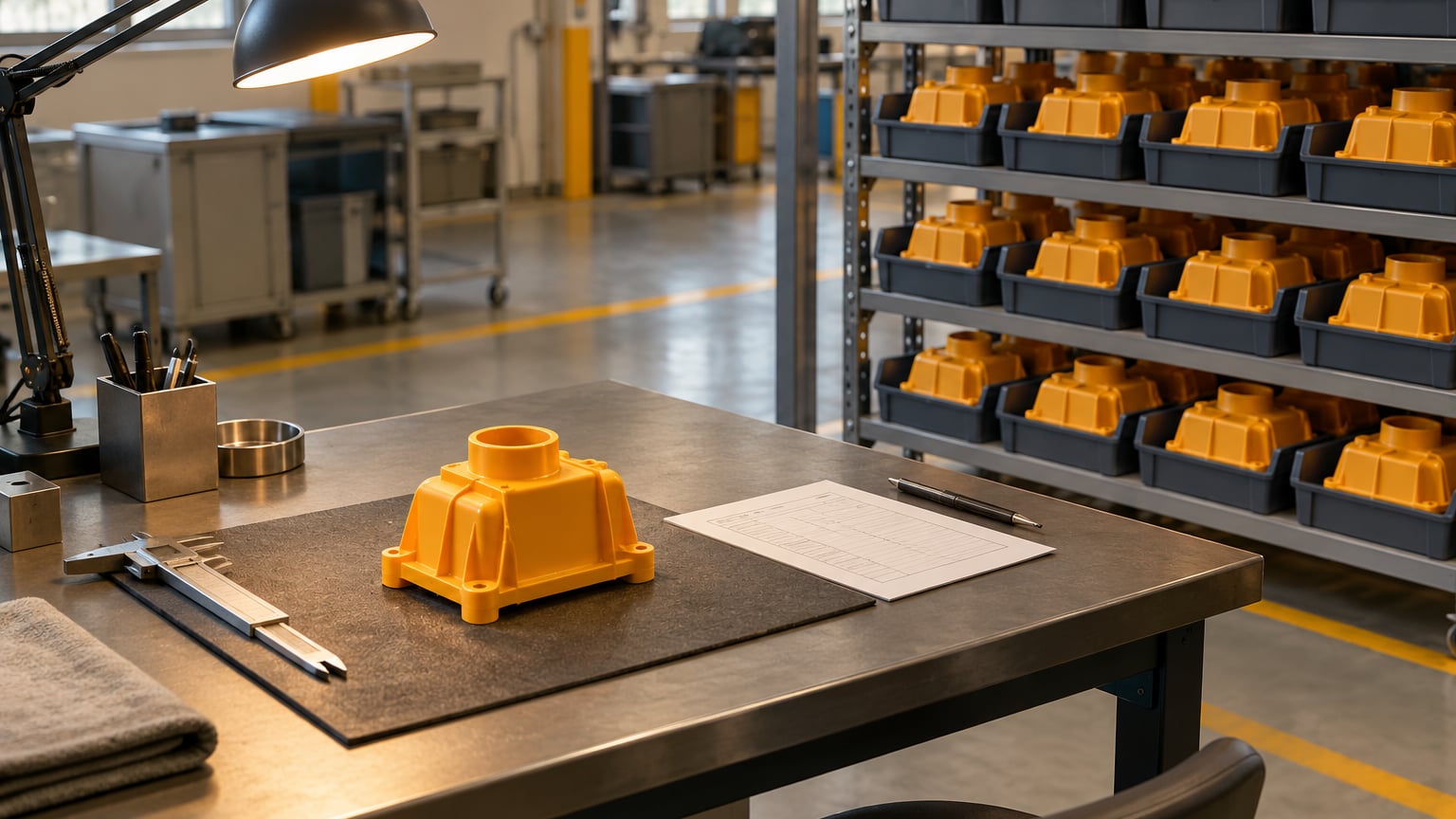
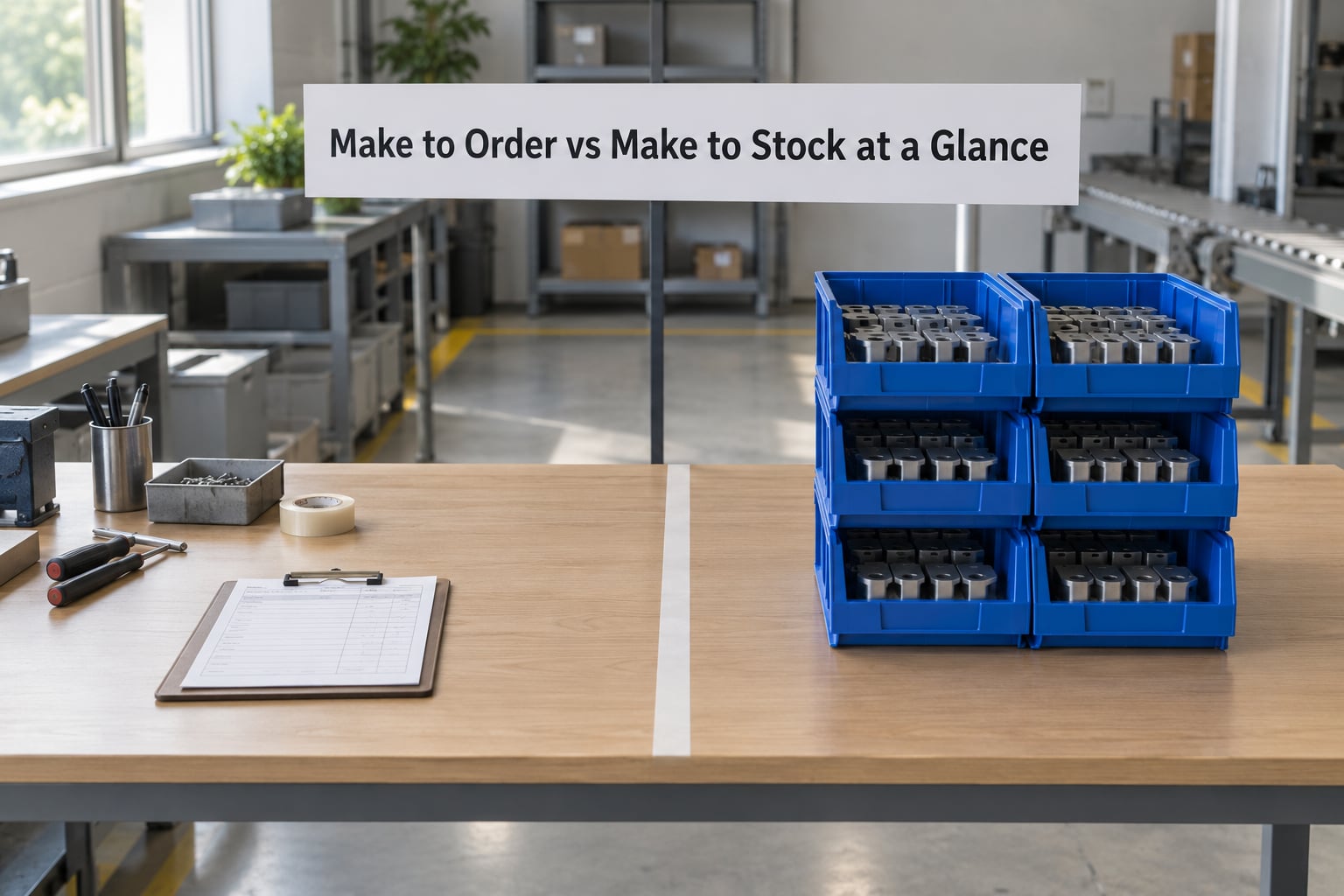
Make to order starts production only after a customer order is confirmed, while make to stock builds goods ahead of demand from a forecast and holds them in the warehouse until they sell. Make to order wins for custom, high-value, uncertain-demand products; make to stock wins for standard parts with steady, predictable demand. Most real plants run both at once.
That sounds obvious until you sit in the planning meeting. Someone wants a 40 percent margin on a one-off mold, someone else wants a 48-hour delivery promise on a component you sell 2,000 units of a month, and the ERP has one planning calendar.
This guide walks through what each model actually does inside a plant, where the money goes, how the two behave when a forecast goes wrong, and how to decide item by item rather than company by company. Figures below are typical US manufacturing ranges, and they shift with resin prices, labor markets and shipping lanes.
Table of Contents
- Make to Order vs Make to Stock at a Glance
- What Is Make to Order?
- What Is Make to Stock?
- How Do Lead Times and Cash Flow Compare?
- How Do Inventory Risk and Demand Change the Decision?
- How Do Customization and Production Volume Affect the Choice?
- What Are the Quality and Supply Chain Tradeoffs?
- Make to Order vs Make to Stock: Which Should You Choose?
- Can Manufacturers Use a Hybrid Approach?
- Frequently Asked Questions
- What is an example of make-to-order?
- What is a make-to-order strategy?
- What are the differences between make to stock, make to order, and assemble to order?
- Which is cheaper, make to order or make to stock?
- How can MTO and MTS be combined for a hybrid approach?
- How do you switch from make to stock to make to order?
- Bottom Line
Make to Order vs Make to Stock at a Glance
| Criterion | Make to Order | Make to Stock |
|---|---|---|
| Production trigger | Confirmed customer order | Demand forecast and reorder point |
| Supply chain logic | Pull | Push |
| Finished goods held | Almost none, usually zero | Weeks to months of stock |
| Customization | Wide, per order | Limited to standard options |
| Customer lead time | Typically 2 to 12 weeks depending on the item | Hours to a few days from stock |
| Cost per unit | Higher on small batches | Lower through economies of scale |
| Setup and changeover | Frequent, per order | Infrequent, per campaign |
| Main risk | Losing impatient buyers during the wait | Overstock, obsolescence, deadstock |
| Dependency on forecasting | Low | High |
| Cash cycle | Cash out after the order is in hand | Cash out months before revenue |
| Storage footprint | Small, raw material only | Large, racks of finished goods |
| Supplier relationship | Flexible, more frequent orders | Contracted volume and bulk buys |
| Scalability | Limited without scheduling investment | Strong once capacity exists |
| Quality and traceability | One unit, one record, easy to trace | Batch records across the campaign |
| Typical products | Molds, fixtures, ducts, housings, large pipe | Pallets, totes, caps, trays, fasteners |
The table is the fastest read on the whole argument. Everything below it is detail on the rows that decide the money: lead time, cash and forecast exposure.
What Is Make to Order?
Make to order, usually shortened to MTO, means manufacturing begins only after a customer order is confirmed. Nothing moves on the floor for your item until a sales order exists, which means no finished goods sit in a rack waiting for a buyer to appear.
The mechanics run in four steps. The customer order comes in, the system creates a work order from the bill of materials, materials get allocated to that specific job, and the finished part ships directly to the customer.
That single-unit-per-order flow changes the economics. You lose batch efficiency, so changeover and setup costs hit every part. You also gain something quieter: near-zero finished goods inventory, so you are not paying to store parts that may never sell.
Here is a concrete plastics example. A custom injection molder receives a purchase order for 60 flow-control manifolds for a skid package. The resin is standard ABS, but the mold inserts, gate location and a threaded boss are specific to that customer’s piping layout. MTO means one work order, one cavity set of 60 shots plus whatever remolding the qualification requires, and a first article inspection before the batch runs. The customer waits, and in exchange gets a part nobody else can use off the shelf.
That trade is right when the part is expensive to hold, expensive to spec wrong, or worthless to anyone but the buyer. It is wrong when the customer compares your quote against a distributor’s shelf price while deciding.
What Is Make to Stock?
Make to stock, or MTS, produces goods before any order exists. Planners convert a demand forecast into manufacturing and purchase orders, run the batches, and put the finished parts into inventory where an order can be filled the same day.
The economics are the mirror image. Batch sizes are large, so setup costs amortize across hundreds or thousands of units and resin gets bought at bulk terms. What you pay for with that efficiency is cash sitting in a rack, plus exposure to forecasts that turn out wrong.
Take a common plastic component: a standard 20-liter stacking tote in a single resin grade and one color. Demand is flat, tooling is amortized over years, and the part is interchangeable across customers. A plant like this will build to a reorder point and safety stock, hold weeks of coverage, and ship in a day. Nobody pays for a mold, and nobody waits three weeks for a pallet.
The critical dependency is forecast accuracy. Practitioners repeatedly point out that demand forecasting accuracy, not production capacity, decides whether make to stock works or quietly turns into a warehouse full of deadstock.
How Do Lead Times and Cash Flow Compare?
Lead time is the promise, not just the cycle
MTS ships from stock, so the customer lead time collapses to picking, packing and transit, usually one to five days domestically. MTO lead time is the sum of engineering, material procurement, molding, finishing, inspection and freight. For a custom part that lands at four to twelve weeks; for a repeat part on stocked resin it can be closer to two.
The failure mode is not the long lead time itself. It is quoting a lead time you cannot repeat. Customers conditioned by next-day delivery rarely accept a nine-week wait without a status plan, so quote the range, name the date you will confirm the build slot, and give them a milestone rather than silence.
Cash goes out before revenue arrives
This is where the models separate most sharply. Under MTS you pay for resin, labor and overhead months before anyone pays you, and that money sits in finished goods until it sells. Under MTO the order funds the build, so working capital per order is far smaller.
Holding cost is usually expressed as a percentage of inventory value per year, and 20 to 30 percent is a common planning range covering space, insurance, shrinkage and capital. Apply that to a quarter of finished goods sitting in the rack and the storage and financing bill becomes visible on the income statement.
The same math decides replenishment size. If you can compute how much to order and when, the economic order quantity method, covered in our guide to economic order quantity for buyers, gives you a defensible batch size instead of a gut feeling. Run it for your MTS items and compare the carrying cost against the extra setup cost MTO would add.
Batch size decides who pays for changeover
Injection molding changeover on a multi-cavity tool typically runs 30 minutes to a few hours, plus purge material and first-article checks. Do that for a single order and the setup cost can exceed the material cost on a small part. Do it once for 5,000 units and it nearly vanishes.
That is the whole argument in one line: MTS spreads fixed setup across volume, MTO avoids paying for volume you never sell.
How Do Inventory Risk and Demand Change the Decision?
Demand shape decides the model more than product category does. An item with 95 percent forecast accuracy and a stable reorder cycle can be made to stock safely. An item with 60 percent accuracy, a 60-day replenishment lead time and a 45-day shelf life cannot.
How the two models behave in an uncertain demand week
Under MTO, an uncertain week means fewer orders and longer queues between them. Capacity sits idle on Tuesday and stacked on Friday. You feel it in utilization, not in the balance sheet.
Under MTS, the same uncertain week means a stockout if you guessed low or dead inventory if you guessed high. Because of that exposure, planners size buffers deliberately. Our walkthrough on how to calculate safety stock levels covers how much coverage to hold when demand and lead time both vary.
Four conditions push firmly toward make to order: long replenishment times, short product shelf life, high obsolescence risk, and demand that has never been forecastable. Short shelf life is the cleanest case, because freshness cannot be forecast, which is why food, chemical and pharmaceutical batches are pulled from customer demand rather than pushed from a schedule.
Seasonality is different. Seasonal goods can still be make to stock if you can commit to the season’s demand, but the peak must be built before the peak is known. That is a risk decision, not a planning decision, and it belongs with the owner, not the MRP run.
How Do Customization and Production Volume Affect the Choice?
Customization is the strongest signal for MTO. The more a customer can vary color, dimensions, labeling, ports or packaging, the less useful a stocked variant becomes. Ten stocked variants of one part is not a service level, it is a forecasting problem multiplied by ten.
Volume is the second signal. A practitioner’s rule of thumb from the field: MTO wins when the order quantity is small and customized, and MTS wins when demand is stable and repeatable. Low volume high mix pushes toward MTO, and it is the hardest operating model to run well because scheduling, not molding, becomes the constraint.
Product families blur the line in a useful way. Build a common set of subassemblies in MTS, then finish them to order. That is assemble to order, and it is the practical middle ground most plants end up at without naming it.
What Are the Quality and Supply Chain Tradeoffs?
Quality control behaves differently under each model. MTO gives you a single unit with a single record, which makes root-cause work straightforward when a customer reports a problem. MTS produces in campaign batches, so a defect can affect hundreds of units and your traceability runs on batch and serial records rather than one work order.
Material availability separates them just as sharply. MTO buys resin against a specific order and can often use whatever grade is on the shelf. MTS locks you into a contracted material and a scheduled buy, which is where bulk pricing and, equally, bulk exposure comes from.
Supplier coordination is the underrated risk in both. Under MTS you gain bargaining power on price and lose flexibility if a supplier misses a campaign date. Under MTO you keep flexibility and lose bargaining power, because no supplier prioritizes a single small order during their busy season.
Capacity planning is the last piece. MTS loads the calendar with scheduled campaigns that are easier to sequence. MTO fills the calendar in order-arrival sequence, so a rush order displaces three others and your promise dates move all week. If you are considering the move, read our guide to make or buy decision analysis first, because buying the shortage is often cheaper than re-tooling the whole schedule.
Make to Order vs Make to Stock: Which Should You Choose?
Use these five cases. They cover the majority of real catalogs.
Custom, high-value parts: choose make to order. A stainless manifold, a fixture, a large duct run or a mold. Nobody stocks these, holding cost would be brutal, and the buyer’s need is specific.
Standard, fast-moving components: choose make to stock. Pallets, totes, caps, trays, fasteners, common brackets. High interchangeability plus stable demand means speed wins.
Seasonal products: split the difference. Stock the evergreen core, make to order the seasonal specials or the long-tail colorways.
Low-volume, high-mix items: lean make to order, but invest in scheduling before you commit. Without a workable finite-capacity schedule, a queue of one-off jobs turns into late deliveries for everyone.
Uncertain demand with a long replenishment cycle: make to order for the finished part. You can still stock the components, which is where hybrid saves you.
A useful tiebreaker: if two customers would accept the identical part, make to stock is probably available to you. If either customer would reject it, make to order is the only honest answer.
Can Manufacturers Use a Hybrid Approach?
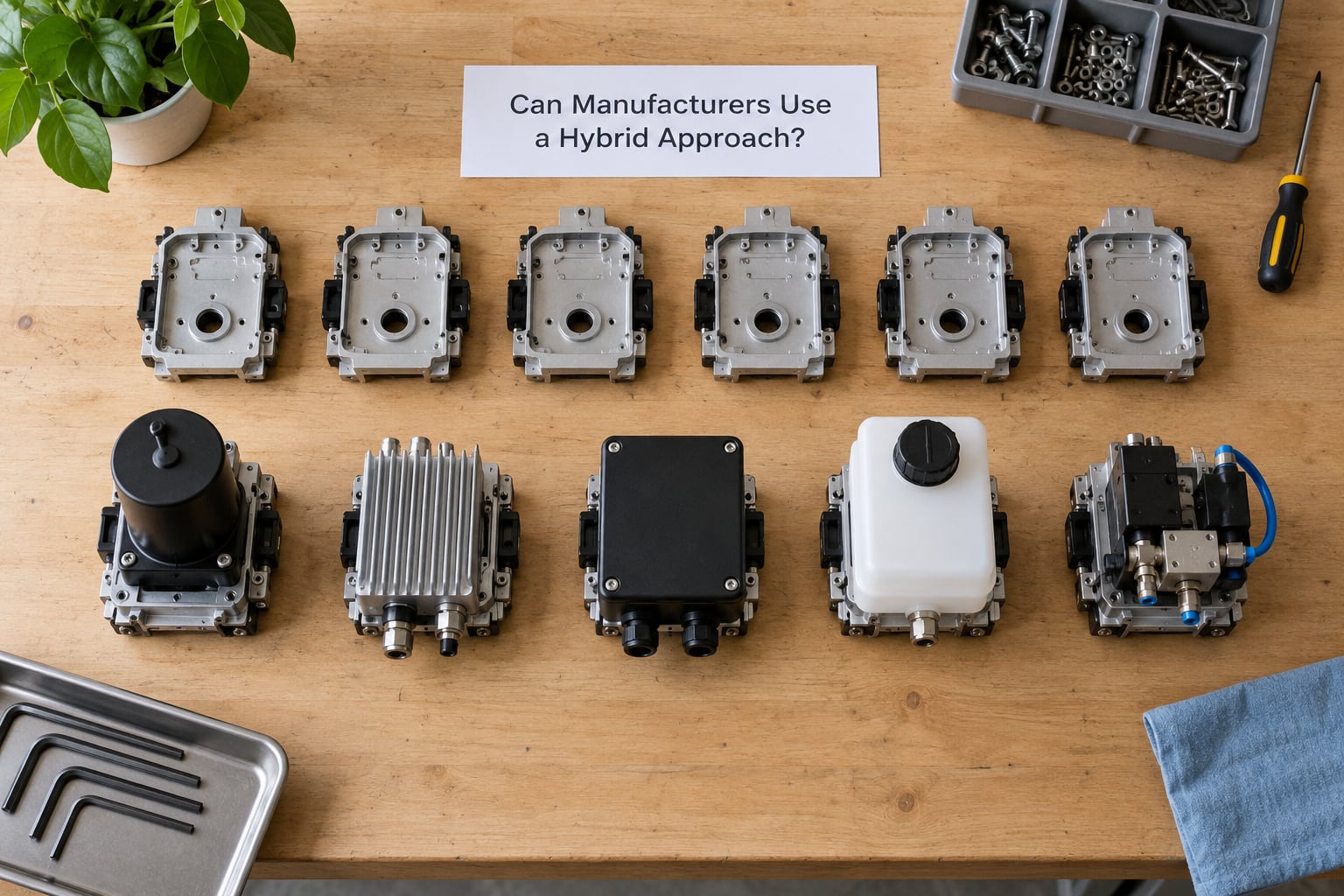
Yes, and most competent plants already do it. The practical levers are postponement, modular assembly, common components and MTS subassemblies. Each one moves the customization point closer to the customer while keeping the expensive part of the process batched.
Postponement means holding an item in a semi-finished state until real demand exists, then finishing it quickly. Modular assembly means designing parts so shared modules handle most of the work and only a small configurable piece changes per order. Common components mean one subassembly serves many finished products, so you can stock it and still sell variety.
MTS subassemblies are the workhorse: stock the molded housing, make the label, decal and harness to order. Dual sourcing adds another layer of protection, since a second qualified supplier on the bottleneck resin removes the single biggest failure point in either model.
The rule that keeps hybrids from drifting into confusion is deciding the split point explicitly. Which items are MTO, which are MTS, who owns the buffer, and what the customer is promised. Most small manufacturers that land here are not choosing a philosophy, they are answering those four questions per item.
Frequently Asked Questions
What is an example of make-to-order?
A custom injection-molded flow-control manifold built for one skid package is a make-to-order example. The mold inserts, gate location and thread pattern match that customer’s piping layout, so production starts only after the purchase order arrives. Custom aerospace brackets, ship hull sections, made-to-measure furniture and configured servers all work the same way. The common thread is that the finished part has little or no resale value to anyone except the buyer.
What is a make-to-order strategy?
A make-to-order strategy is a production model where manufacturing begins only after a customer order is confirmed, rather than in advance of demand. It is a pull system: the order creates a work order, materials are allocated to that job, the part is made and it ships without entering a finished goods rack. MTO suits custom, high-value and hard-to-forecast products, and it keeps working capital and storage costs low at the price of longer customer lead times.
What are the differences between make to stock, make to order, and assemble to order?
Make to stock builds finished goods from a forecast and sells from inventory, so it delivers fast but ties up cash. Make to order builds nothing until an order lands, so it is flexible but slower and more expensive per unit. Assemble to order sits between them: components are stocked in advance and the final assembly happens after the customer orders. The right choice depends on how much of the product you can safely build before knowing which variant the customer wants.
Which is cheaper, make to order or make to stock?
Make to stock is normally cheaper per unit, because large batches spread setup and changeover costs and let you buy resin at bulk terms. Make to order carries a higher unit cost but avoids carrying cost, which commonly runs 20 to 30 percent of inventory value per year, plus obsolescence risk. The honest answer is that MTO can be cheaper in total once slow-moving stock, storage space and write-offs are counted. Calculate both on your own numbers before deciding.
How can MTO and MTS be combined for a hybrid approach?
Most manufacturers combine them by splitting the bill of materials rather than the catalog. Stock the common, high-volume subassemblies and make the configurable pieces to order, which cuts the lead time on the customer-facing part without rebuilding from zero. Postponement, modular design and a second qualified supplier on the bottleneck material add more resilience. Write down which items are MTO, which are MTS, who owns the buffer and what the customer is promised.
How do you switch from make to stock to make to order?
Move item by item, starting with the slowest-moving, most obsolescence-prone SKUs where holding cost hurts most. Reclassify the item type and planning type in the ERP, clear or repurpose the existing stock with a run-out plan, then run a few months of parallel running before you commit. Expect quote and order-entry discipline to break first, so train sales on the new lead times and update your customer promise before the flag flips.
Bottom Line
Start with one item, not the whole plant. Pick your slowest-moving finished good, price its holding cost at 25 percent of value per year, and price its unit cost against a batch of 1,000. That one comparison usually settles the argument for that SKU and tells you which side of the line it belongs on.
Then apply the tiebreaker across the catalog: if a second customer would accept the part as built, make to stock can serve them. If not, make to order, and stock the components underneath instead. Updated for October 2026.