
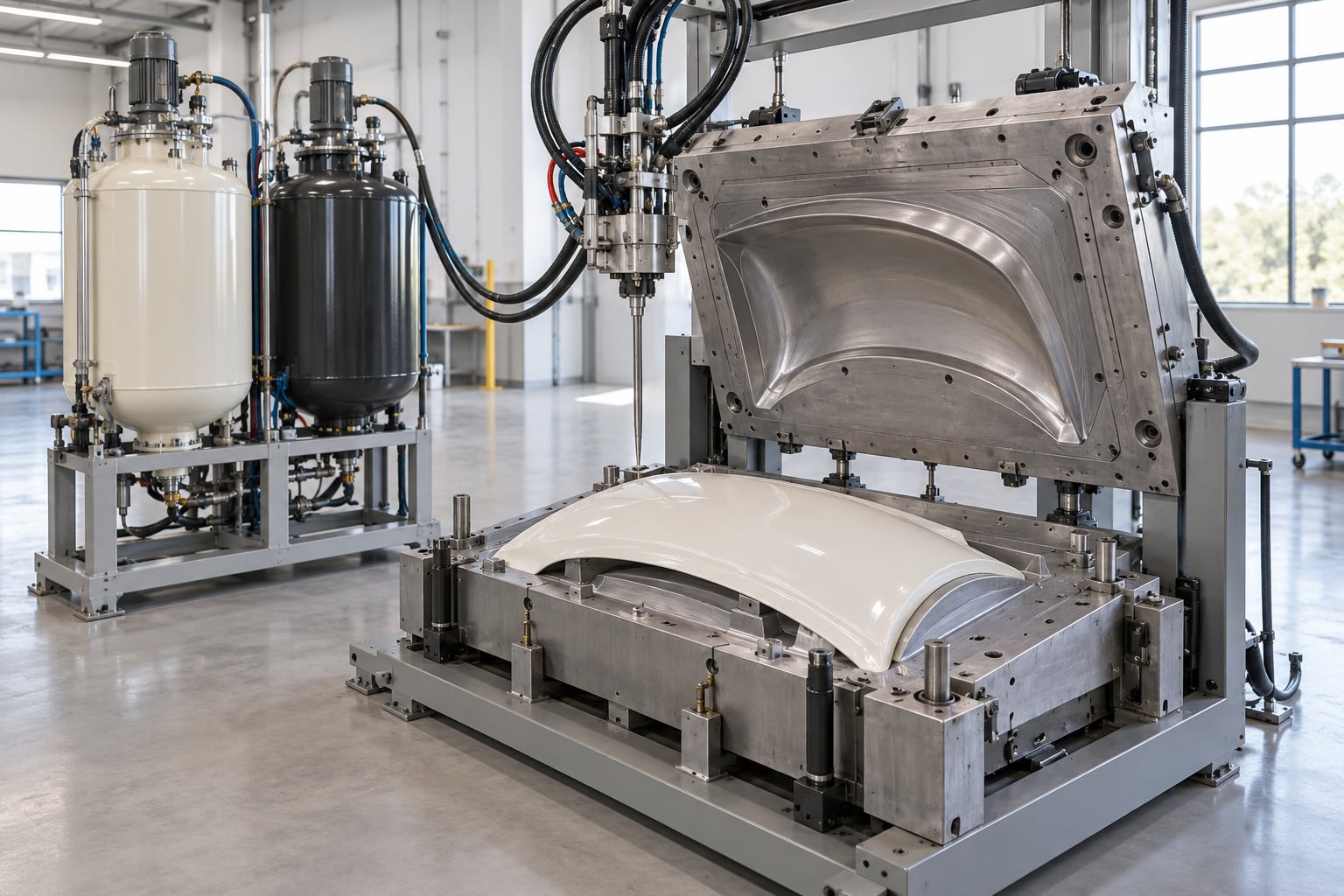
Reaction injection molding explained in one line: two liquid chemicals, usually a polyol and an isocyanate, are metered and mixed under high pressure, injected into a closed mold, and allowed to react and harden into a finished part. That reaction happens inside the mold, which is why RIM makes large, complex shapes that would be uneconomic to tool in conventional injection molding. The trade-off is a slower cycle than injection molding and a chemistry you have to control.
If you specify parts or buy them, the practical question is when RIM wins and when it quietly costs you more. A clamshell door panel, a bumper fascia, a helmet shell, a wall panel, a machine housing: those are all territory where RIM sits comfortably.
This guide walks the whole process, the materials, the tooling math and the failure modes, with the numbers engineers actually ask for.
Table of Contents
- What Is Reaction Injection Molding?
- How Does the Reaction Injection Molding Process Work?
- Reaction Injection Molding Materials and Tooling
- Reaction Injection Molding vs. Conventional Injection Molding
- What Are the Advantages and Limitations of Reaction Injection Molding?
- Where Is Reaction Injection Molding Used?
- Frequently Asked Questions
- What materials are used in reaction injection molding?
- How long does reaction injection molding take per part?
- What is the average lifespan of a RIM mold?
- Are RIM tolerances tighter or looser than injection molding?
- Is RIM cheaper than injection molding?
- What is the difference between RIM, SRIM and RRIM?
- Conclusion
What Is Reaction Injection Molding?
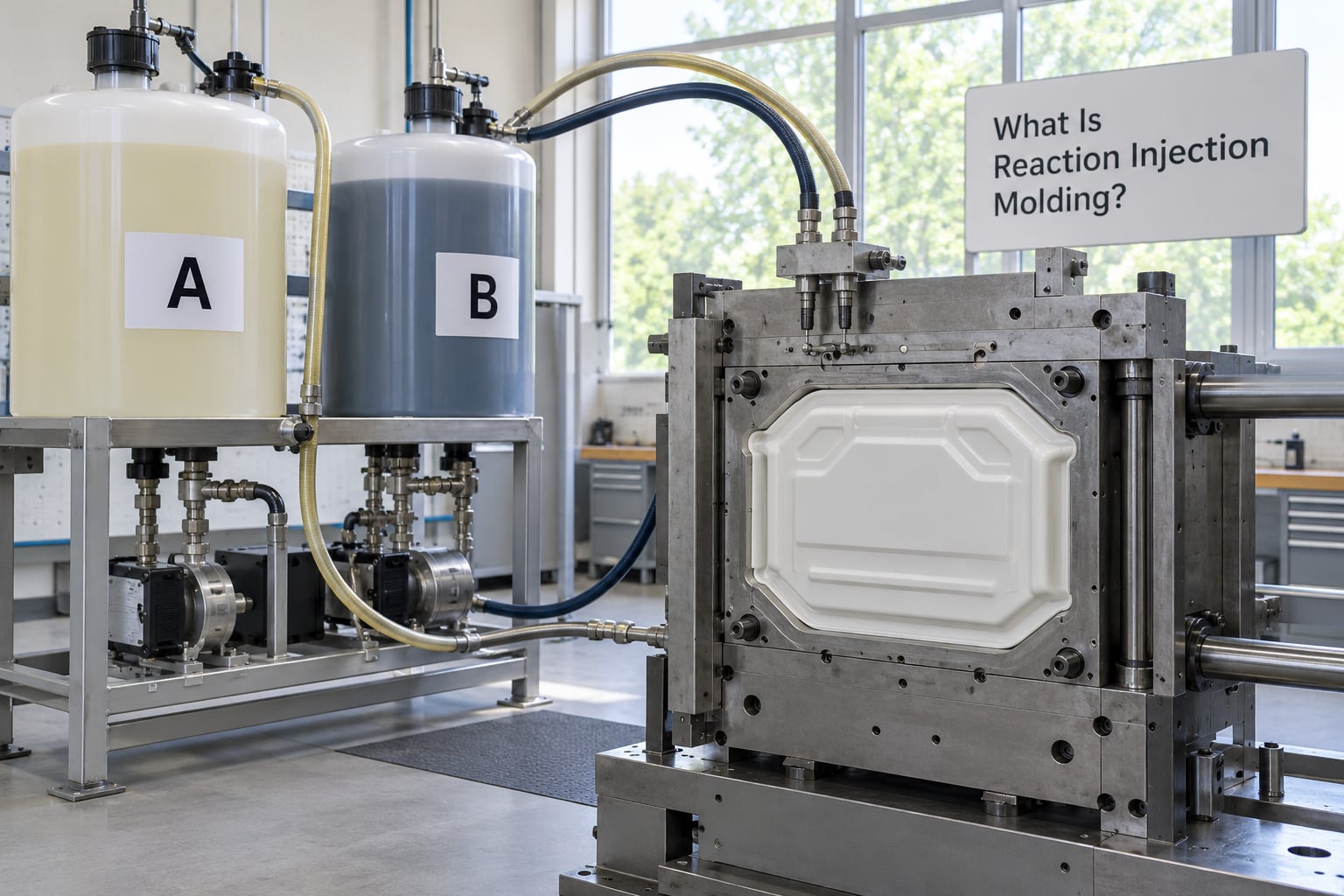
Reaction injection molding (RIM) is a thermoset forming process. Instead of melting plastic pellets and forcing them into a mold, you pump two low-viscosity liquid reactants into a mixing head, combine them at a controlled ratio, and inject the blend into a closed tool. The chemistry does the rest: the two liquids polymerize in the cavity and cure into a solid part that is then ejected.
Because the material is a liquid at the moment it enters the mold, the pressure needed to fill the cavity is a fraction of what injection molding requires. A RIM cavity fills at roughly 10 MPa of injection pressure, while a conventional thermoplastic mold is clamped in the hundreds of bar. That low pressure is the whole reason RIM exists.
Because there is no molten melt being pushed through a gate and frozen against a cold wall, RIM parts generally carry lower internal stress than injection-molded parts. It also means you can vary wall thickness across a single part, combine thick and thin sections, and mold in inserts, without fighting the flow and freeze-off problems that limit injection molding.
Thermoset or thermoplastic: the cleanest way to frame RIM
Injection molding heats a thermoplastic above its melting point, fills the cavity, then cools the part until it solidifies. The shape is frozen by temperature change, and the process can be repeated indefinitely as long as the resin stays above its degradation point.
RIM forms the part by an irreversible chemical reaction. Once the polyol and isocyanate have polymerized, they will not be melted again. You get a thermoset polyurethane, and the mold must be built to survive repeated shots of a fast exothermic reaction, with enough venting and temperature control to keep the part within tolerance.
How Does the Reaction Injection Molding Process Work?
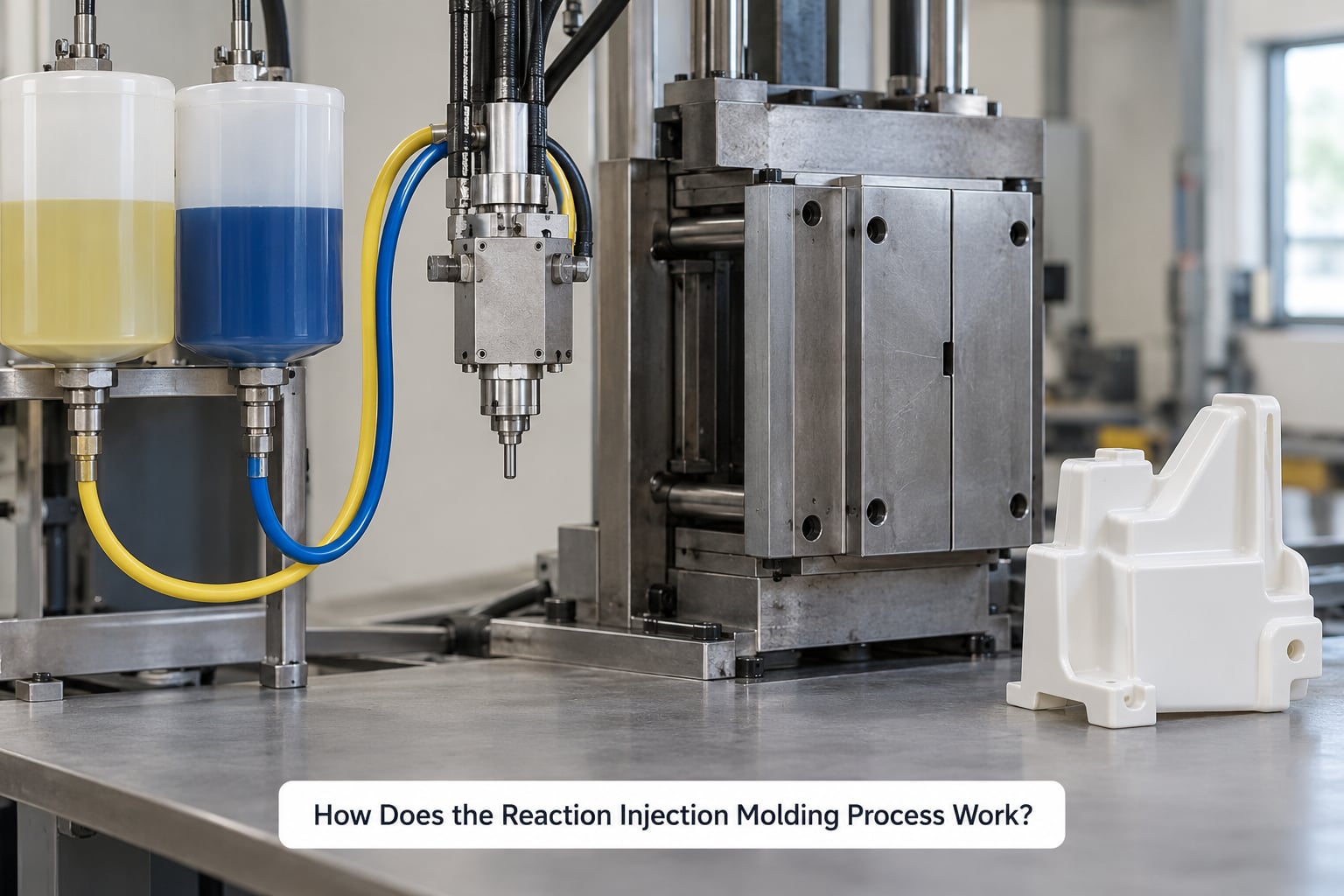
There are six stages, and the first two are the ones most people skip over when they read about RIM. Metering and mixing are a chemical operation, not a plasticizing one, and the ratio between the streams decides whether the part works.
- Material preparation. Polyol and isocyanate sit in separate temperature-controlled tanks. Both are recirculated and degassed, because moisture in either stream reacts with the isocyanate and produces carbon dioxide, and carbon dioxide becomes bubbles in your part.
- Metering and mixing. High-pressure pumps push each stream to a multi-stream mixing head. The head imparts enough shear to blend the two liquids thoroughly in a fraction of a second, at a metering accuracy typically held within plus or minus 1 percent.
- Injection. The blend travels through the mold inlet at a flow rate on the order of 600 g/s, filling the cavity at low pressure. The cavity is nearly full when the shot ends, which is why RIM walls can change thickness along their length.
- Exothermic reaction. Once the streams meet, the polyurethane chemistry releases heat. That self-generated heat is what drives the polymerization forward, not an external heater.
- Curing and solidification. The part holds in the mold until it has enough green strength to eject without deforming, typically below 40°C at demold. Many programs add a post-cure of two to four hours at around 80°C to complete the reaction and stabilize dimensions.
- Finishing. The part is demolded, trimmed of flash at the parting line or gate area, and often coated or painted. In-mold pigmentation puts color in during the shot, which removes a whole paint step for many programs.
Typical RIM process parameters
| Parameter | Typical range | Why it matters |
|---|---|---|
| Injection pressure | About 10 MPa (roughly 100 bar) | Low pressure is what allows large parts and light tooling |
| Flow rate | Around 600 g/s | Sets fill time; too slow and the mix starts reacting in the head |
| Metering accuracy | Plus or minus 1 percent or better | A ratio error changes properties, not just color |
| Cycle time | Roughly 15 to 30 minutes for a typical program | Mold dwell, reaction time and cooling dominate |
| Demold temperature | Below 40°C | Ejecting warm parts causes distortion |
| Post-cure | 2 to 4 hours at about 80°C | Completes polymerization and stabilizes the part |
| Wall thickness | About 1/8 inch for solid parts; up to 1/2 inch achievable | Thick sections trap heat and cure unevenly |
| Production band | About 100 to 20,000 units per year | Outside this band the economics move to another process |
Common RIM defects and what causes them
Almost every RIM quality complaint traces back to air, ratio, wall thickness or release chemistry. A practical failure-mode exercise for a molded part program works well here; the format is the same one we use for FMEA for injection molding processes, with different failure modes.
| Defect | Likely cause | Corrective action |
|---|---|---|
| Air pockets and voids | Trapped air, moisture in the raw materials, or insufficient venting | Degas both streams, add or clear vents at the last-to-fill points, verify tank temperatures |
| Splay marks | Moisture reacting with the isocyanate, or air at the flow front | Dry the polyol, tighten metering ratio tolerance, slow the fill slightly |
| Incomplete fill | Uneven or too-thick walls, cold mold, poor venting | Rebalance wall thickness toward uniform sections and warm the mold |
| Warpage | Residual stress from the exothermic cure, strongest in thick areas | Reduce section thickness variation, extend post-cure, control mold temperature, support the part during cooling |
| Insert or overmold adhesion failure | Incompatible substrate, contaminated bond line, or mold release agent migrating onto the insert | Specify surface treatment and a compatible release system for the insert material |
Reaction Injection Molding Materials and Tooling
Polyurethane dominates RIM for good reasons. It cures fast, it bonds to inserts, it can be rigid, flexible or foamed from the same basic chemistry, and the same mixing equipment handles all three. A handful of other reactive systems exist, including polyureas, polyesters, polyepoxides, phenolics and polyamide systems, but most production RIM shops run polyurethane.
Polyol and isocyanate: the two streams
The polyol side is a hydroxyl-bearing resin. It carries the bulk of the mass, the filler when there is filler, and often the pigment. The isocyanate side is the reactive linker, most often methylene diphenyl diisocyanate (MDI) or toluene diisocyanate (TDI), blended with a catalyst and blowing agent when the part is foamed.
Because the two streams meet only at the mixing head, most of the factory floor stays clean. There is no melt, no dryer, no purge material and no regrind to handle. The waste volume is also genuinely small: what comes out of the mix head before the shot is a controlled slug, not a purging cycle.
RIM, SRIM and RRIM: the three variants
Planners use these labels loosely, so it helps to pin them down. Standard RIM uses an unfilled polyurethane, which gives good impact resistance and low internal stress. Structural RIM (SRIM) is a high-modulus formulation, often glass-fiber reinforced, built for load-carrying and dimensionally stiff parts. Reinforced RIM (RRIM) adds mineral or glass filler to a solid polyurethane to raise stiffness and reduce shrinkage. Foamed RIM, sometimes sold under trade names such as Baydur, injects a blowing agent that produces a dense skin over a microcellular core, giving a stiff, light part with good sound deadening.
Aluminum or steel: choosing the mold material
Aluminum alloy molds are easy to machine, cost less and are the right answer for short runs and prototype volumes. Steel molds cost more and last far longer, tolerate automated ejection and repeated thermal cycling, and resist abrasion from short-fiber-filled and composite formulations.
The rough rule suppliers use: resin tooling up to roughly 100 parts, ABS tooling up to about 300, and aluminum alloy tooling above roughly 1,000 parts per year. Real mold cost is driven by the number and type of hydraulic slides, the surface finish tooling, part depth and complexity, and the tolerances you demand.
Mold lifespan follows the same logic. An aluminum mold in a low-volume program may be retired after a few hundred shots, while a steel mold on a long automotive program runs into the hundreds of thousands. If you want the maintenance side of that relationship, our mold maintenance schedule for injection molding covers the discipline that keeps tooling alive, and most of it transfers directly to RIM tooling.
Where RIM tooling genuinely competes with other processes is on low-tonnage equipment. We broke that comparison down in thermoforming vs injection molding cost comparison, and RIM lands in the same low-pressure corner: cheaper press, cheaper tool, lower energy per part.
Reaction Injection Molding vs. Conventional Injection Molding
This is the decision engineers get wrong most often, so here it is as a table rather than a paragraph. The short version: RIM wins on part size, wall variation and tooling cost; injection molding wins on cycle time, dimensional precision and unit cost at volume.
| Criterion | Reaction injection molding | Conventional injection molding |
|---|---|---|
| Mold pressure | About 10 MPa injection pressure; light clamping | High clamping force, commonly hundreds of tons on large tools |
| Material form | Two low-viscosity reactive liquids, polymerized in the mold | Thermoplastic pellets melted before injection |
| Cycle time | Roughly 15 to 30 minutes plus post-cure | Seconds, often well under a minute |
| Part size | Very large parts practical; single-shot dimensions up to roughly 2000 mm | Limited by machine capacity and flow length |
| Tooling | Lower cost, aluminum viable, no need for a large press | Higher cost, steel standard, requires major tonnage |
| Wall thickness | Variable thickness within one part is straightforward | Uniform walls strongly preferred; thick-to-thin transitions are hard |
| Tolerances | Broader; threads, snap-fits and mating faces need real clearance | Tighter and highly repeatable |
| Surface finish | Class A achievable with good mold surface and release control | Good, but texture and gloss depend heavily on tooling finish |
| Typical volumes | About 100 to 20,000 units per year | Tens of thousands and up |
| Typical applications | Bumpers, fascias, body panels, spoilers, panels, helmets, housings | Small to medium precision parts, containers, electronics, medical components |
What Are the Advantages and Limitations of Reaction Injection Molding?
The advantages
The case for RIM is strongest on large, complex parts at moderate volume. Low clamping pressure means cheaper presses, lighter tools and lower energy use. Variable wall thickness lets a single part carry ribs, flanges and thin cosmetic skins without fighting flow. Internal stress stays low, so large flat panels distort far less than their injection-molded equivalents. And Class A surfaces come from the tool and the release system, not from a paint pass.
Design freedom is the quieter advantage. Undercuts, inserts, threads, overmolding and multi-cavity layouts are all practical because the material is liquid on arrival. Pigmentation goes in during the shot, so a black bumper comes out of the mold finished rather than primed and painted.
The limitations
Slow cycles are the honest headline drawback. A 15 to 30 minute cycle against a 30-second injection molding cycle changes the economics fast, and it is the reason RIM programs usually top out around 20,000 units per year. Post-cure adds hours, though it is often batched on a rack rather than occupying the machine.
Material cost is the second. Polyol and isocyanate systems cost more per kilogram than commodity thermoplastics, and a bad ratio is not recoverable.
Tolerances are broader than injection molding, and this is where programs get into trouble. Threads, snap-fits and mating faces designed to tight CAD tolerances will fail after the parts arrive. Specify clearance deliberately and validate on real RIM samples, not on CAD.
Thickness variation is the fourth problem. Practitioners describe thickness trouble as one of the two most cited real-world failure themes, and it drives expensive slides and complicated tooling that erode RIM’s low-tooling advantage.
Finally, warpage from residual stress is a real control problem, concentrated in thick sections, and chemistry is unforgiving: bad metering, cold material or a contaminated bond line shows up weeks later as scrap.
When RIM is the wrong choice
Skip RIM if you need true mass-production volume, if the part is small and feature-tight, if you depend on tight positional tolerances in metal-to-plastic mating, or if cycle time dominates your unit cost. For those programs, injection molding or, at low volume, vacuum casting is the better fit. Vacuum casting is the usual low-volume fallback, with the widely cited limit of 10 to 50 pulls from a silicone mold against roughly 1,000 shots from a RIM mold.
Where Is Reaction Injection Molding Used?
Automotive is the anchor application and has been since RIM matured in the 1960s. Bumper fascias, body panels, door panels, air spoilers and dashboard components all share the same requirements: large area, Class A surface, low weight, impact resistance, and a production volume that sits right in the 100 to 20,000 band.
Construction uses it for insulated wall and roof panels and noise barriers, where a single large part with a foam core replaces assemblies of smaller pieces.
Electronics and business machines take RIM housings because the process molds in bosses, ribs and inserts in one shot, and because the lower internal stress helps with sealed housings.
Sports and safety equipment is a natural fit for helmets and protective pads, where a tough elastomeric or foamed structure absorbs impact and can be produced in a moderate run.
Furniture and appliances use RIM for larger structural and decorative elements that would be heavy in solid thermoplastic. Prototyping is the sixth: RIM molds yield around 1,000 shots, so a real production tool can serve an entire development program and the first production run, which is unusual in molding.
Frequently Asked Questions
What materials are used in reaction injection molding?
Almost all production RIM uses polyurethane. Two liquid streams are metered and mixed: a hydroxyl-bearing polyol and an isocyanate, most commonly MDI or TDI, with catalysts and blowing agents added as needed. Foamed and fiber-reinforced versions add filler or a blowing agent to the polyol side. Polyureas, polyesters, polyepoxides, phenolics and polyamide systems also exist, but most shops standardize on polyurethane for its cure speed and insert bonding.
How long does reaction injection molding take per part?
A typical RIM cycle runs roughly 15 to 30 minutes, and that number is dominated by mold dwell and cure time rather than injection, which takes seconds. Many programs add a post-cure of two to four hours at around 80°C to complete the polymerization and stabilize dimensions, usually batched on a rack rather than occupying the machine. Compare that against injection molding cycles measured in seconds, which is the main reason RIM volumes top out lower.
What is the average lifespan of a RIM mold?
It depends almost entirely on mold material and cycle count. Aluminum alloy tooling suits short runs and may see a few hundred to a few thousand shots; steel tooling on a long automotive program can run into the hundreds of thousands. Fillers shorten life because glass and mineral fibers abrade the cavity, and every thermal cycle counts. Rather than a single number, match the tool to your volume: resin tooling up to roughly 100 parts, ABS up to 300, aluminum alloy above about 1,000 parts per year.
Are RIM tolerances tighter or looser than injection molding?
Looser. RIM tolerates broader dimensional variation than injection molding, and this is the single most common surprise for engineers moving a CAD design into a RIM program. Threads, snap-fits and mating faces that worked in the model will need real clearance, and uneven wall thickness makes the variation worse. Build clearance into the design and validate on molded samples before committing to a production run.
Is RIM cheaper than injection molding?
It depends on the part size and the annual volume. For large, complex parts at roughly 100 to 20,000 units per year, RIM usually wins, because the tool is cheaper, the press is smaller and less energy is consumed per part. Below that band, vacuum casting is cheaper. Above it, injection molding wins decisively, because RIM’s 15 to 30 minute cycle and higher material cost per kilogram eventually outweigh the tooling savings.
What is the difference between RIM, SRIM and RRIM?
All three are polyurethane reaction injection molding, differing mainly in formulation. Standard RIM uses unfilled polyurethane and offers impact resistance with low internal stress. Structural RIM, or SRIM, is a high-modulus formulation, often glass-fiber reinforced, for load-carrying parts that must hold their shape. Reinforced RIM, or RRIM, adds mineral or glass filler to solid polyurethane to raise stiffness and reduce shrinkage. Terminology is used loosely in the supply chain, so confirm the formulation in writing.
Conclusion
Evaluate six things in this order. Part geometry: is it large, complex and does it need variable wall thickness or Class A surfaces? Production volume: does it sit between roughly 100 and 20,000 units per year? Material performance: does the part need flexible, foamed or reinforced polyurethane rather than a stiff thermoplastic? Mold investment: aluminum or steel? Cycle time: can the program absorb 15 to 30 minutes plus post-cure? And required finish: can the design survive broader tolerances with deliberate clearance?
If the answer is yes to the first two, RIM is usually the right process and the numbers above will make the argument for you. Updated for 2026, this guide is built around process data that has been stable for decades, so re-check any supplier’s specific numbers before you commit tooling.