
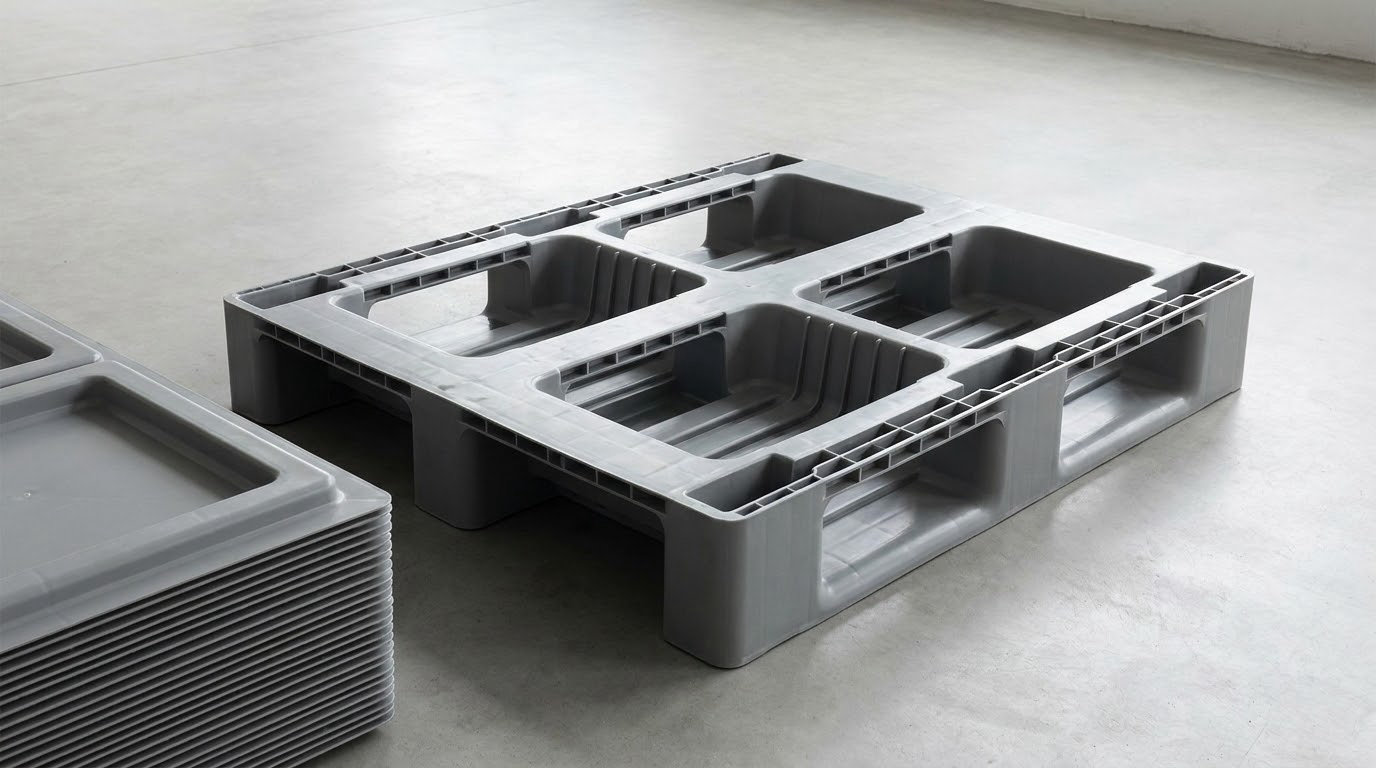
Twin sheet thermoforming applications cover almost any hollow plastic part that has to carry load, hold fluid, or stay rigid without weighing a lot: fuel tanks, plastic pallets, totes, appliance housings, control cabinets, bathtubs, aircraft interior panels. The process exists because one sheet of plastic bends where two fused sheets stay stiff, and that simple trade is worth a lot once a part is bigger than a shoebox.
This guide is written for the engineer or buyer who has to specify the part, not promote the process. It covers how the two sheets actually join, where twin sheet wins, which polymers to pair, what breaks in production, and when a different process is simply the better call.
Table of Contents
- What Is Twin Sheet Thermoforming?
- How Does the Twin-Sheet Thermoforming Process Work?
- What Are Twin Sheet Thermoforming Applications?
- Which Materials Work Best for Twin Sheet Thermoforming?
- How Do Engineers Design for Twin Sheet Thermoforming?
- What Quality and Production Considerations Matter?
- When Is Twin Sheet Thermoforming the Best Manufacturing Choice?
- Frequently Asked Questions
- What products are commonly made with twin sheet thermoforming?
- Is twin sheet thermoforming waterproof?
- What materials can be used for the face and back sheets?
- How many parts can be produced economically with twin sheet thermoforming?
- Can twin sheet thermoforming parts be recycled?
- Is twin sheet thermoforming better than injection molding?
- Conclusion
What Is Twin Sheet Thermoforming?
Twin sheet thermoforming is a process in which two sheets of thermoplastic are heated, formed against a pair of matching molds, and then fused at their edges into one sealed hollow part. The two walls sit parallel to each other with trapped air between them, so a given weight of plastic is far stiffer than a single-wall shell made from the same material.
Because the cavity between the walls is sealed rather than solid, you get stiffness, impact resistance and insulation in one part, with no ribs, no core and no fasteners. That is the whole reason engineers pick it for tanks, pallets and housings instead of a single-wall vacuum-formed cover.
How Does the Twin-Sheet Thermoforming Process Work?
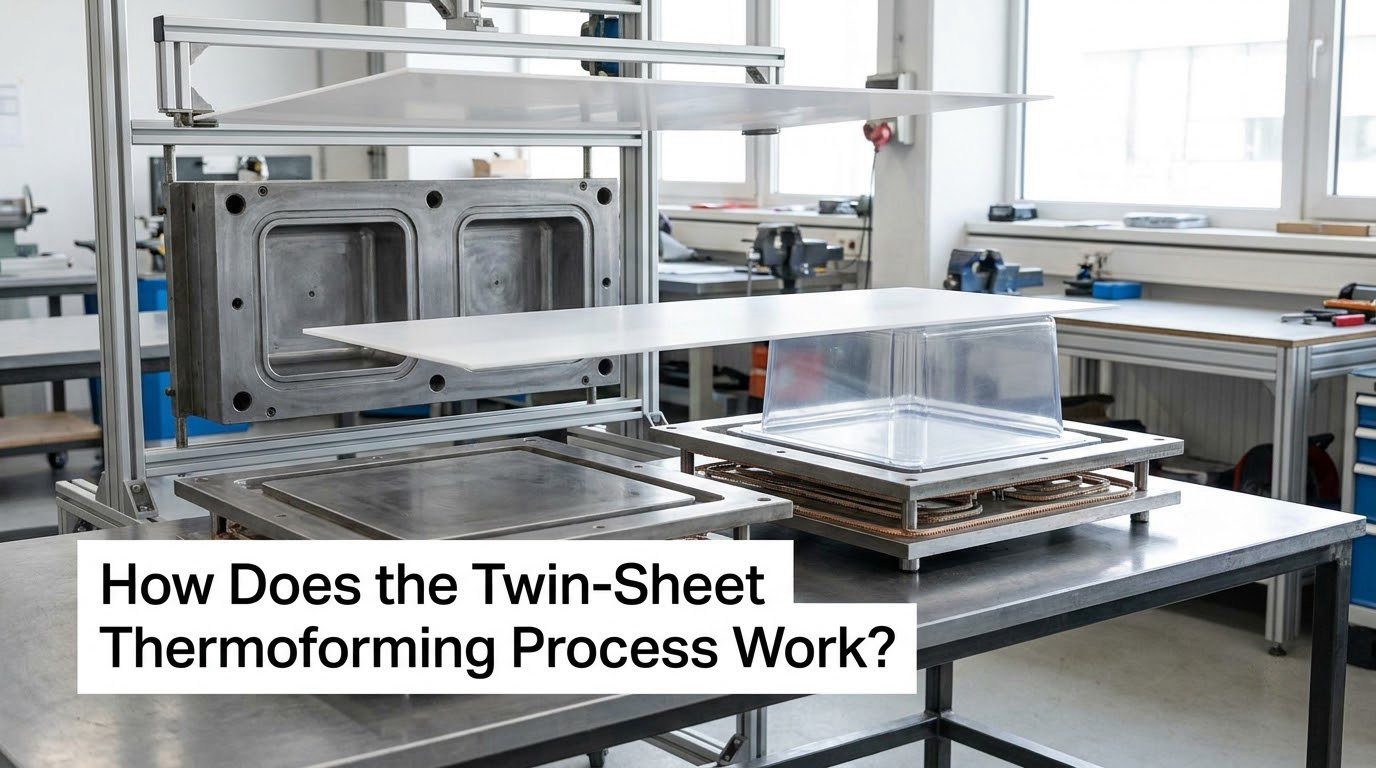
The cycle is short and highly repeatable, which is part of why the process scales well. Six stages cover almost every production line.
- Sheet preparation and loading. Two blanks are cut, one per mold half, and each is clamped in its own frame. Frame tension matters more than most operators expect: a loose sheet sags before it reaches forming temperature and the finished walls come out mismatched.
- Heating. Both sheets heat together, usually with infrared or hot-plate elements, until they are soft enough to stretch. Heating rate and uniformity decide whether you get even walls or a panel that is thick on one side and paper-thin on the other.
- Pre-blow and forming. A blow pipe between the sheets injects air, and both sheets inflate outward into their mold halves. Pressure forming pushes against the sheet with a matched upper tool, which gives sharper detail and better thickness control than pulling with vacuum alone.
- Sealing and fusing. The mold edges close, trapping air inside the part and melting the softened rims into a single continuous weld seam. That seam is the structural and sealing feature of the whole part, so seal width and closing pressure are prime tooling variables.
- Cooling. The part cools under pressure, usually with an air knife or water mist. Cooling under constraint is what controls warpage; letting the part relax before it has set locks in distortion.
- Trimming and secondary operations. The frame and flange come off, then holes, inserts, threads and labels go on. This is where a part becomes a finished assembly rather than a shell.
Two terms you’ll hear from any machine builder. The forming area is the size of sheet the frame can hold, and the weld flange is the land around the perimeter that the two rims press against. Machines built for thin packaging work and machines built for heavy-gauge industrial parts look nothing alike, even under the same product name.
What Are Twin Sheet Thermoforming Applications?
The useful way to sort twin sheet thermoforming applications is by what the part has to do, not by industry. Every application below boils down to one of four jobs: resist impact, hold a fluid, insulate, or stay stiff over a large unsupported span.
| Application category | Preferred use | Useful material pairing | Key advantage | Main design consideration |
|---|---|---|---|---|
| Protective enclosures | Control boxes, instrument covers, machine guards | ABS or HIPS face, ABS or PC back | Flat face plate with a ribbed structural back | Mounting bosses need inserts, not self-tapping threads |
| Automotive fluid systems | Fuel tanks, filler assemblies, ducts | HDPE or cross-linked PE, both walls | Fuel and chemical resistance with no metal | Seam integrity and vapor handling come first |
| Material handling | Pallets, totes, bulk bins, returnable cases | HDPE or PP throughout | Load-bearing double wall at low weight | Stacking load and fork entry drive the geometry |
| Refrigeration and appliances | Door liners, crisper drawers, ice trays, machine tubs | HIPS or ABS face, HIPS or PS back | Insulating air gap plus a smooth cleanable face | Food contact rules restrict which polymers qualify |
| Sanitaryware | Bathtubs, shower bases, hot tubs, sinks | Acrylic or ABS face, ABS or PP back | Insulated wall holds water temperature | Large parts need even cooling to stay flat |
| Aerospace and rail interiors | Interior panels, seat shells, stowage bins | PC or ABS face, matching back | Stiff thin panels with low weight | Flame rating and smoke density come first |
| Agricultural and outdoor | Planters, troughs, irrigation tanks, housings | UV-stabilized HDPE or PP | UV and weather resistance across a hollow wall | Wall thickness variation from solar heating |
| Recreational products | Kayaks, coolers, dive boards, towable floats | HDPE or LLDPE, or ABS skins | Rounded, buoyant, dent-resistant shells | Surface finish carries the product’s appeal |
Twin Sheet Thermoforming Applications for Protective Enclosures
Enclosures are where the double wall earns its keep in a way you can measure. A control box face plate wants to be flat, presentable and easy to wipe down, while the back wants to be structural, ribbed and drilled for standoffs. A single sheet has to compromise between those two jobs. Two sheets do not.
On electrical housings and portable instrument cases, the front sheet is usually a cosmetic grade material while the rear sheet is chosen purely for stiffness. Both get the same texture and paint treatment so the part reads as one object. Machine guards follow the same logic, with the back wall carrying the bolt pattern and the front wall staying optically clean.
One recurring constraint: bosses and threaded features. Plastic threads strip quickly in a hollow back wall, so molded-in metal inserts or captured hex nuts are close to mandatory. Plan for them in the CAD model, not as an afterthought on the production floor.
Twin Sheet Thermoforming Applications for Automotive and Transportation Parts
The most demanding twin sheet thermoforming applications sit here. Fuel tanks and fuel system components need chemical resistance, low permeability and a seam that will not fail under road vibration, and they have to be lightweight enough to mount under a vehicle. HDPE handles the chemistry well, and the sealed weld seam does the structural work.
Transport equipment leans on the double wall for stiffness at low weight: interior storage bins, seat and trim components, lighting housings, aerodynamic shrouds and underhood covers. For any of these, wall thickness variation translates directly into fit problems, so tooling and cooling discipline matter more than the nominal gauge.
Simulation work published in the early 2000s on automotive fuel tank forming, along with the patent activity around twin-sheet fuel tank plants, shows how established this application is. It is not experimental. It is a solved production process with a well-understood failure surface.
Twin Sheet Thermoforming Applications for Material Handling and Packaging
Pallets, totes, returnable cases and bulk bins are the clearest example of twin sheet paying for itself. A single-wall tote is either too light to stack or too heavy to move. The double wall spreads floor load across a much wider footprint, so a lighter part carries the same stack weight.
Impact resistance matters just as much. Repeated handling means a forklift corner, a dropped tote and a conveyor lip all land on the same wall. A sealed cavity gives the wall somewhere to go when it’s struck, which is why twin sheet totes survive drop tests that flatten single-wall versions.
Nesting and stackability are design requirements as much as marketing features. If the tote does not stack, an empty-nesting layout in the warehouse, you pay for air in every shipment. Decide the stacking pattern early; it constrains draft angles, rim geometry and the wall thickness budget.
Which Materials Work Best for Twin Sheet Thermoforming?
Material choice in twin sheet thermoforming is usually a pairing decision, not a single choice. The face sheet handles appearance and contact, the back sheet handles structure, and the two have to fuse cleanly at the seam. Mismatched pairs that bond well separately can still weld poorly together.
| Polymer | Key properties | Typical twin sheet use | Watch for |
|---|---|---|---|
| ABS | Tough, paintable, good chemical resistance | Enclosures, housings, vehicle trim | Heating is slow; cycles run longer than PS |
| HIPS / PS | Rigid, low cost, easy to form, good surface | Refrigeration liners, retail displays, trays | Brittle; not for impact or UV exposure |
| Polycarbonate (PC) | Very high impact strength, heat resistant, clear | Machine guards, safety covers, lighting | Expensive; can be difficult to trim cleanly |
| PVC / rigid PVC | Chemical resistant, durable, self-extinguishing | Industrial covers, ducting, chemical handling | Heat sensitivity limits cycle time |
| TPU | Flexible, abrasion resistant, tough | Impact bumpers, protective liners, guards | Soft sheet is harder to hold to tight radii |
| PET | Stiff, clear, good barrier, lightweight | Food trays, packaging, clear housings | Crystallization complicates finishing |
| HDPE | Chemical and fuel resistant, tough, weldable | Fuel tanks, pallets, totes, agricultural tanks | Frosted surface; not paintable without treatment |
| Polypropylene (PP) | Fatigue and chemical resistant, semi-rigid | Returnable packaging, totes, crates | Creep under sustained stack load |
Two gauge thresholds come up in nearly every supplier conversation. Thin gauge is under about 1.5 mm and is the packaging world: blister packs, trays, lightweight covers. Thick gauge is over about 3 mm and is the industrial world: tanks, pallets, housings. Everything between the two is where a spec written for packaging gets quoted into a structural job and disappoints everyone.
Recycled content belongs in the same conversation. Post-consumer HDPE is common in pallets and totes, where the end-of-life path is mechanical recycling, though wall thickness holds up better when recycled material is blended rather than used neat. Clear face sheets are the hardest recycle story because mixed clear grades down the stream quickly.
How Do Engineers Design for Twin Sheet Thermoforming?
Twin sheet parts are drawn differently from injection molded ones, mostly because walls are the product. The five things that decide whether a part forms cleanly on the first tool are wall thickness, radii, draft, rib placement and shrink allowance.
- Wall thickness. Specify both walls and their minimums, not just a nominal. A part drawn at a single thickness will vary from that number across the cavity, and the thinnest spot is where impact testing fails.
- Radii. Generous radii let the heated sheet stretch rather than stretch-thin. Sharp internal corners are where wall thickness collapses and where stress concentrates after forming.
- Draft. Every surface that releases from a tool needs draft. Because two sheets must release together and stay aligned, twin sheet tolerates less draft slop than single-sheet forming.
- Rib placement. Ribs belong on the back wall only, and they must not run all the way to the weld flange. Ribs that reach the seam stiffen the part and weaken the seal at the same time.
- Shrink and insert allowance. Molded parts shrink measurably as they cool. Add the allowance where threads, snap fits and mating hardware have to line up, and leave room for inserts rather than drilling them into a finished shell.
Surface texture goes in the drawing too, along with a clear statement of which areas are cosmetic. Texturing the face sheet is easy; texturing deep inside a narrow cavity is where cosmetic rejects start.
The most common design mistakes follow a pattern: zero-radius corners, walls specified at a nominal with no minimum, threaded features cut directly into the back wall, and snap fits that assume a solid wall. Every one of those is fixable in CAD for free and expensive on the floor.
What Quality and Production Considerations Matter?
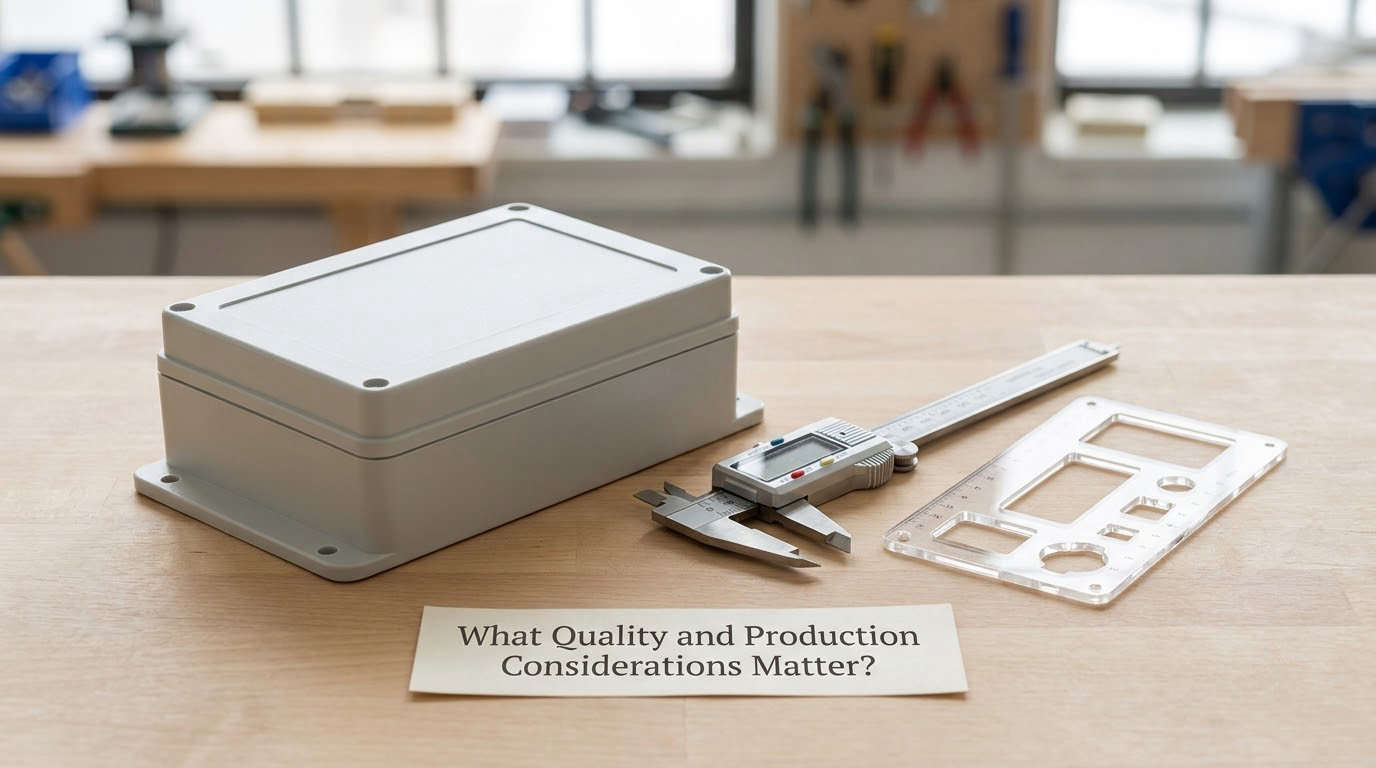
Cycle time is the number that decides whether a part is economic, and it is mostly a function of sheet gauge, wall thickness and material. Thick HDPE parts run considerably slower than thin polystyrene trays because heating and cooling dominate. That sets the volume at which the process makes sense, and it is worth getting quoted in parts per hour rather than cycle seconds, since setup and changeover are part of real output.
The defects worth building inspection around, in rough order of how often they show up:
- Warpage. The part releases and relaxes after cooling. Usually traced to uneven cooling, insufficient hold pressure, or material stress in the sheet.
- Seam failure or blowout. The weld flange is too narrow, the closing pressure is wrong, or contamination sits in the seal area. This one is structural, not cosmetic, and it is not a repairable condition.
- Uneven wall thickness. Caught by heat distribution or by a sheet that was not held taut. Always visible as a thin spot, and always where impact testing fails first.
- Incomplete forming or webbing. Air trapped in a corner, or a mold face that is not fully perforated, leaves a flat patch the tool should have shaped.
- Flash and cold flow. Melt at the flange that did not stay inside the seal land, often from a mismatch between tool closure and the sheet’s melt strength.
- Dimensional drift. Parts that measure correctly when warm and out of tolerance when cold. Allow for shrink in the drawing rather than fighting it at inspection.
Good practice is to inspect the first-off and then a sampling plan on a fixed interval, checking the critical dimensions that mating hardware or sealing depends on. Dimensional capability on critical features should be agreed before the first production run, not after a lot has already been rejected.
When Is Twin Sheet Thermoforming the Best Manufacturing Choice?
Twin sheet is the right process when the part is hollow, larger than about a shoebox, and needs to be either structurally stiff, impact resistant, insulating or fluid-tight. It is strongest where the wall is a load path, and weakest where you need tight tolerances, many small features or an integral hinge.
| Process | Wall structure | Size and geometry fit | Tooling and cost profile | Volume fit |
|---|---|---|---|---|
| Single-sheet vacuum forming | One wall, easy to draw | Flat to shallow, small to medium parts | Lowest tooling cost | Prototypes to medium volume |
| Pressure forming | One wall, sharper detail | Deeper single-wall parts, tight detail | Low tooling, two matching tools | Low to medium volume |
| Twin sheet | Two sealed walls | Large hollow parts, complex internal volumes | Higher tooling, fast cycle per part | Medium to high volume |
| Blow molding | One continuous wall, hollow | Bottles and closed containers, necked shapes | Low to moderate tooling | Very high volume |
| Rotational molding | One thick wall, seamless | Large parts, complex shape, heavy walls | Low tooling, slow cycle | Low volume, large parts |
| Injection molding | Solid, fully detailed | Small complex parts, tight tolerances | Highest tooling, lowest unit cost at scale | Very high volume, small parts |
The comparison engineers actually ask about is twin sheet against blow molding and rotational molding for tanks, pallets and totes. Blow molding is excellent for bottles and closed containers at very high volume, but it produces a single wall, so load-bearing tanks and pallets need a different process. Rotational molding gives seamless heavy-walled parts and cheap tooling, but the cycle is measured in minutes rather than seconds, which rules it out once volume climbs. Twin sheet sits between them: cheaper per part at volume than rotomolding, far better structurally than blow molding for load-bearing shells.
Against injection molding, the trade is tooling cost versus unit cost. Injection molding wins on small, complex, high-volume parts with tight tolerances. Twin sheet wins on large hollow parts, medium-to-high volume, and any design where a double wall replaces ribs, cores and assembly steps. If your part is under about a hundred parts a year and mostly flat, twin sheet tooling will never pay back — single-sheet forming or fabrication is the honest answer.
Worth asking a supplier about recycled content and end-of-life recovery as part of the same quote. For HDPE parts in material handling, the recyclability question often has a clean answer, and it belongs in the specification conversation early rather than at the recycling audit.
Frequently Asked Questions
What products are commonly made with twin sheet thermoforming?
The common products are large hollow parts that need to be stiff, tough, insulated or fluid-tight: automotive fuel tanks and filler assemblies, plastic pallets, industrial totes and bulk bins, refrigeration and appliance housings, bathtubs and shower bases, control boxes and machine guards, aircraft interior panels and stowage bins, agricultural tanks, and returnable transport cases. Packaging trays and blister packs are the thin-gauge end of the same process.
Is twin sheet thermoforming waterproof?
Yes, for practical purposes. The two sheet rims are pressed together while soft, fusing into a continuous weld seam, and the cavity between the walls is sealed. That makes twin sheet parts suitable for water tanks, chemical handling and outdoor equipment. Seams are the limiting factor rather than the sheet itself, so seal land width, closing pressure and contamination control determine whether a part is truly leak-tight.
What materials can be used for the face and back sheets?
Common choices include ABS, HIPS, polystyrene, polycarbonate, rigid PVC, TPU, PET, HDPE and polypropylene. Face sheets are usually picked for surface quality, clarity and contact safety; back sheets for stiffness and impact strength. The pairing still has to fuse cleanly at the weld flange, and the two sheets should have similar melt behavior so the seam forms evenly across the whole perimeter.
How many parts can be produced economically with twin sheet thermoforming?
Economics turn on cycle time and tooling, not on a fixed quantity. Thin-gauge packaging runs fast and pays back tooling at modest volume; heavy-gauge industrial parts run slower and need steady volume to justify the die. As a rough rule, twin sheet covers the medium-to-high range where single-sheet forming is too weak and injection molding tooling cannot be justified. Quote the process in parts per hour, including changeover, rather than in cycle seconds.
Can twin sheet thermoforming parts be recycled?
It depends on the material. HDPE and PP parts are mechanically recyclable, and post-consumer content is already used in pallets, totes and agricultural tanks, often blended rather than used neat so wall thickness holds. Clear PET and clear ABS face sheets are harder to recycle because mixed grades contaminate the stream. End-of-life recovery depends on whether the two walls are the same polymer, so specify matching materials when recycling is a requirement.
Is twin sheet thermoforming better than injection molding?
Neither is better in general. Injection molding wins on small, complex, high-volume parts needing tight tolerances, because it produces a solid, fully detailed part at a very low unit cost once the tool is paid for. Twin sheet wins on large hollow parts at medium-to-high volume, where a sealed double wall gives stiffness, impact resistance and insulation that would otherwise need ribs, cores and extra assembly. Below roughly a hundred parts a year, twin sheet tooling rarely pays back.
Conclusion
Twin sheet thermoforming applications work because two fused sheets behave nothing like one sheet of the same weight. The process is a short, repeatable cycle: clamp, heat, pre-blow, fuse, cool, trim. What you get back is a sealed hollow part with real structural stiffness, which is why the method carries fuel tanks, pallets, totes, housings and sanitaryware that single-sheet forming cannot handle.
Before requesting quotes or committing to tooling, write down five things: the part geometry and size, the loads it must carry, the environment it lives in, the annual volume, and the material requirements for the face and back sheets. Send that to two or three twin sheet houses. You will learn more from the pushback you get on those five items than from any process brochure.