
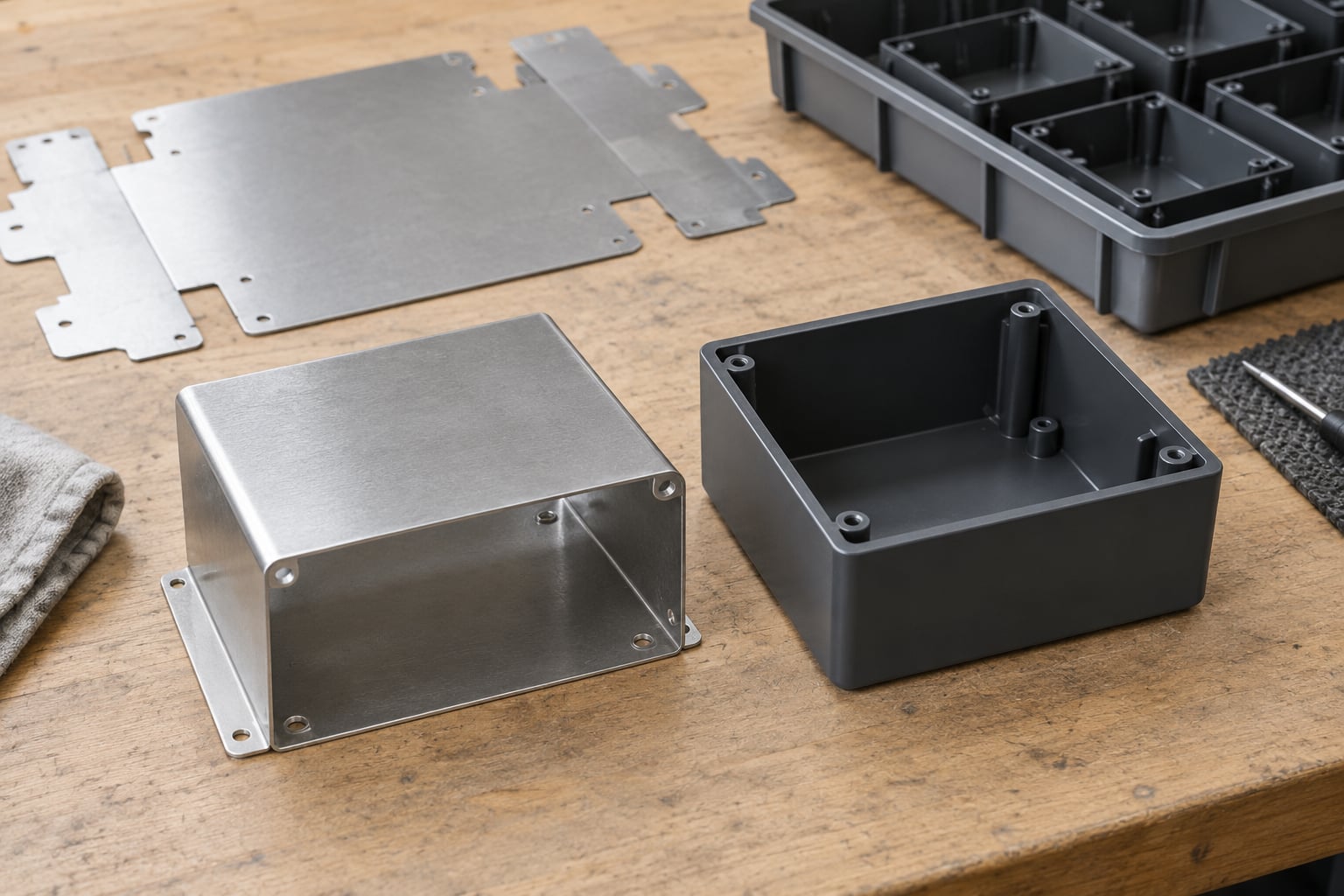
Sheet metal is cheaper below roughly 500 to 1,000 pieces a year, and injection-molded plastic is cheaper per piece above that. Tooling decides most of it: a stamped bracket die typically costs 2,000 to 10,000 USD, while an injection mold for the same bracket runs 1,000 to 80,000 USD with an average near 12,000 USD. Heat, load and tolerance requirements can override the volume answer entirely.
That opening answer is where most cost comparisons go wrong, because they stop there. Material price per pound tells you very little when one route needs a press brake setup and the other needs a hardened steel mold built over ten weeks.
What follows is the total-cost framework I use when a team asks whether a part should be metal or plastic: what drives cost in each process, how tooling amortizes, what each volume band really costs, and how to run a comparison that two suppliers can actually quote against each other.
Table of Contents
- Sheet Metal vs Plastic Parts Cost Comparison at a Glance
- What Determines the Cost of Each Part?
- Sheet Metal Part Costs
- Plastic Part Costs
- Tooling and Upfront Investment
- Unit Price at Different Production Volumes
- Tolerances, Geometry, and Structural Performance
- Finishing, Assembly, and Secondary Operations
- Freight, Packaging, and Total Cost of Ownership
- How to Run a Fair Cost Comparison
- Which Should You Choose?
- Frequently Asked Questions
- Is sheet metal cheaper than plastic for small production runs?
- What production volume usually makes injection molding cheaper than sheet metal?
- How much does injection mold tooling cost compared with sheet metal tooling?
- Are plastic parts cheaper to ship than sheet metal parts?
- Which material is better for outdoor or high-temperature parts?
- How should I compare supplier quotes when the parts have different functions?
- Conclusion: Start With Total Cost, Then Validate the Design
Sheet Metal vs Plastic Parts Cost Comparison at a Glance
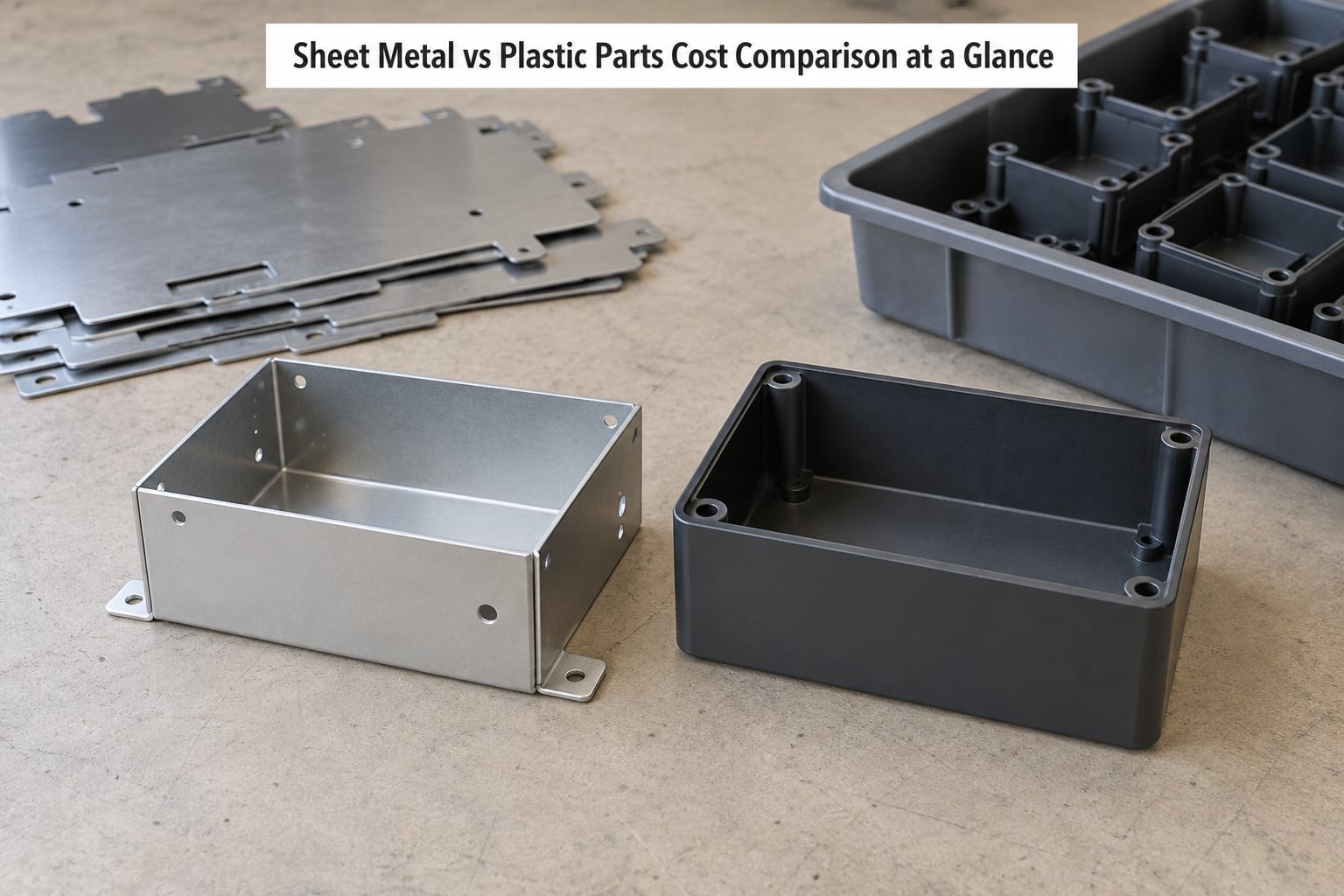
No material is universally cheaper. The table below compares the two routes across the criteria that actually move the number on a purchase order, using typical US production practice rather than a best-case part.
| Criterion | Sheet metal part | Injection-molded plastic part |
|---|---|---|
| Upfront tooling | 2,000 to 10,000 USD typical die; forming fixtures extra | 1,000 to 80,000 USD; average near 12,000 USD |
| Unit cost at 100 pieces | Usually lower | Usually higher once tooling is counted |
| Unit cost at 10,000 pieces | Competitive on flat, simple parts | Usually lower once tooling is amortized |
| Unit cost at 100,000 pieces | Loses on labor and cycle time | Clearly lower |
| Achievable tolerance | About 0.005 to 0.015 inch on formed features | About 0.003 to 0.008 inch, minus shrink variation |
| Weight | Aluminum 2.7 g/cm3, mild steel 7.85 g/cm3 | Most thermoplastics 0.9 to 1.4 g/cm3 |
| Stiffness | Young’s modulus about 69 GPa aluminum, 190 to 210 GPa steel | 1 to 5 GPa unfilled; glass-filled nylon climbs into the 10s |
| Joining | Rivet, screw, weld, adhesive | Snap fit, screw, overmolding, adhesive |
| Typical finishing | Powder coat, paint, plating, passivation, brushed finish | As-molded texture, paint, pad print, plating |
| Lead time to first article | 4 to 10 days prototype; 8 to 16 weeks for a stamped program | 6 to 14 weeks for a production mold |
| Geometry | Flat panels, bends, welds, deep drawn features | 3D ribs, channels, snap fits, thin walls, complex curves |
| Typical applications | Chassis panels, brackets, housings, heat shields, cabinets | Enclosures, clips, handles, gearboxes, integrated assemblies |
Read that last two rows together. The crossover volume moves with geometry: a flat bracket with four bends crosses early, while a deep drawn box with welded seams can stay cheaper in metal well past 10,000 pieces.
What Determines the Cost of Each Part?
Both routes have the same cost skeleton. What changes is how big each line is and which ones exist at all.
The eleven lines worth modeling for every part are material, tooling, cycle time and machine burden, direct labor, finishing and secondary operations, assembly, packaging, freight, quality loss, inventory, and lifecycle cost.
Material is the line buyers quote first, and it is usually the smallest. In a molded plastic part, resin often accounts for a modest share of the piece price; cycle time, cavity count and amortization do more to move the number. In sheet metal, raw sheet can be significant on thin, large panels and negligible on small stamped features.
Cycle time is the quiet advantage of molding. A single-cavity plastic tool can run 25 to 45 second cycles and keep producing with minimal labor between shots. A press brake setup has to stop for a changeover every time a new part comes off the nest, and labor is measured in minutes per piece rather than seconds.
Quality loss is the line nobody puts on the quote. A flash mark or a short shot in plastic is a scrapped part plus a restart. A weld that fails inspection in metal is the same story with extra labor. Effective cost per good piece is the honest number, and it is always higher than quoted cost per piece.
Inventory cost rarely appears in a factory quote, yet for a buyer it can be the largest single line. Holding 20,000 molded pieces ties up cash and warehouse space that 2,000 metal brackets do not.
If you want a formal method rather than a checklist, our guide on calculating total cost of ownership for a part walks through the same eleven lines with the math laid out.
Sheet Metal Part Costs
A sheet metal part price is a stack of well-known operations. Here is the usual order of magnitude for a mid-sized stamped bracket or formed panel in US production.
Raw sheet and coil is purchased by weight or area, and buyers tracking commodity exposure know this line moves on its own schedule. A team tracking roughly 25,000 USD a year of one-eighth inch acrylic described exactly this problem on r/manufacturing: the material line is a live variable, not a fixed number.
Cutting and piercing run through laser, plasma or punch. Laser is fast and clean on sheet up to about half an inch, and the cost scales with perimeter and pierce count more than with area.
Bending on a press brake adds a setup charge and a per-hit time that grows with thickness and bend count. Each bend adds about 0.4 seconds of handling, and every additional bend adds another tool setup on the brake, so a part with fourteen bends is a different cost object from one with four.
Stamping moves the geometry into a die and drops the per-piece cost sharply above several hundred pieces. The die itself runs 2,000 to 10,000 USD for a typical bracket, and above that point stamping is what makes high-volume sheet metal competitive at all.
Welding is where sheet metal quietly becomes expensive. A single welded bracket needs fixture time, weld time, inspection and cleanup, and those hours dwarf the material cost. Fewer welds, or self-fastening and riveted joints, keep the part in the cheap column.
Machining adds features that forming cannot make: tapped holes, precision bosses, flatness-critical surfaces. Expect a quoted rate per machine hour plus setup, and treat every machined feature as a candidate for redesign into a formed or stamped one.
Surface treatment covers powder coating, wet paint, anodizing, plating and passivation. Powder coat on a small bracket commonly lands in the low single digits per piece and includes masking, cure and handling, so consolidating parts that can share a coating rack matters more than it looks.
Hardware and assembly add fasteners, rivets, inserts and labor. Metal parts tend to carry more fastener count than molded plastic, which is one reason part consolidation is so common in conversion projects.
Minimum order quantity is where metal loses its biggest advantage. Most sheet metal shops will cut one piece from a print and ship it. That flexibility is genuinely valuable at ten pieces and irrelevant at ten thousand.
Plastic Part Costs
Plastic is not one process, and treating it as one is the most common modeling error. Injection molding, compression molding and thermoforming have different cost curves, and so do machined and printed plastic parts.
Injection molding is the baseline most comparisons use. Its cost lines are resin by weight, the melt volume in the shot, cycle time, machine hourly rate, cavity count, mold amortization, gate and vestige cleanup, inserts, and assembly.
Compression molding suits thermosets and some filled thermoplastics. Cycle times run longer than injection but scrap rates are lower and the tools can be simpler, which changes the break-even math for medium-volume jobs.
Thermoforming uses a sheet and a matched set of heated tools. Tooling sits well below a production injection mold, so it holds its own from roughly 500 to a few thousand pieces and is often the honest answer for a short run of a simple cover.
Two features carry most of the hidden cost. First, gate vestige: the scar where resin entered the tool needs to be trimmed or hidden, and that trimming is a real secondary operation that shows up as a surprise line on the invoice. Second, shrink variation, which forces wider tolerances on anything that mates with another part, and that in turn pushes assembly labor up.
Inserts and overmolding change the economics deliberately. A metal insert captured in a plastic body replaces a separate bracket and its fasteners in one shot, which is how part consolidation usually pays for a mold.
The hardest plastics to argue against are the engineering grades. PEEK, PEI and PPS hold up at temperatures where ABS fails, and glass- or carbon-filled nylon closes much of the stiffness gap with metal. Our breakdown of should-cost modeling is useful here, because resin choice changes both material price and cycle time.
Tooling and Upfront Investment
This is the section that decides most comparisons, so it is worth being blunt about the numbers.
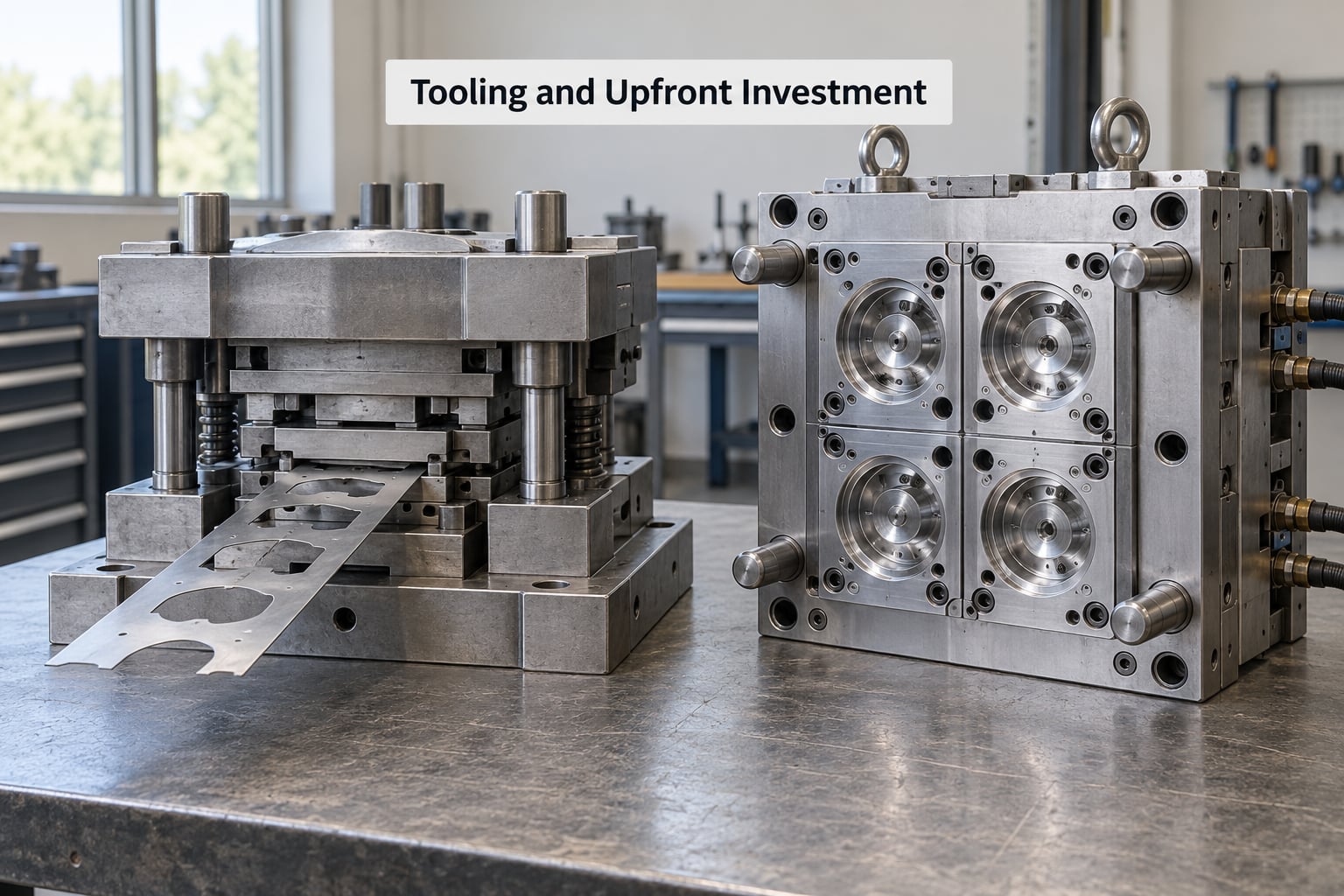
A stamping die for a typical bracket runs 2,000 to 10,000 USD depending on size, steel, and how many operations run per stroke. Hardening, EDM detail work and multi-station designs push past that. Forming fixtures and nesting for laser cutting add on top.
An injection mold for the same part runs 1,000 to 80,000 USD, with an average near 12,000 USD. A four-cavity aluminum mold for a simple part sits at the low end; a hardened steel tool with sliders, lifters and multiple slides sits at the high end. One r/InjectionMolding user reported quotes of roughly 16,000 and 19,000 USD for the same part from two shops, and no way to tell which was padded.
Cavity count is the lever that changes a mold quote most. Doubling cavities roughly halves the tooling cost per piece, and the molder should be quoting per piece at your volume, not a single piece price.
Amortization is simple arithmetic, and it is the part of these comparisons that usually gets waved at instead of shown. For a 12,000 USD mold:
| Pieces produced | Tooling cost per piece (12,000 USD mold) | Tooling cost per piece (6,000 USD die) |
|---|---|---|
| 100 | 120.00 USD | 60.00 USD |
| 500 | 24.00 USD | 12.00 USD |
| 1,000 | 12.00 USD | 6.00 USD |
| 10,000 | 1.20 USD | 0.60 USD |
| 100,000 | 0.12 USD | 0.06 USD |
At 100 pieces, tooling is 60.00 USD per piece against the die. No one runs a molded program there. At 100,000 pieces, the mold costs about 0.12 USD per piece and the material plus cycle time becomes the entire story.
Two rules follow. Ask any supplier to quote NRE and piece price as separate lines, because suppliers that bundle tooling into the piece price make volume comparisons impossible. And check mold life against your program: a production mold commonly runs 150,000 to 500,000 shots, so a program that ends at 20,000 pieces has paid most of the tool and thrown it away.
Unit Price at Different Production Volumes
The table below is illustrative US production scenario data for a mid-sized bracket-scale part, clearly labelled as such. Your real numbers come from quotes, but the shape of the curves is stable across parts. Treat every figure as a typical US range rather than a quote: metal and resin prices move, so re-check them when you build the budget in 2026.
| Annual volume | Sheet metal, stamped or formed (USD/piece) | Injection-molded plastic (USD/piece, tooling included) | Usually cheaper |
|---|---|---|---|
| 1 to 10 | 40 to 250 | Not practical; use machined plastic or printing | Sheet metal or a prototype process |
| 100 | 8 to 25 | 20 to 60 | Sheet metal |
| 500 | 4 to 12 | 8 to 20 | Close call; geometry decides |
| 1,000 | 3 to 9 | 4 to 10 | Parity for simple parts |
| 10,000 | 2 to 6 | 1.50 to 4 | Plastic on most geometry |
| 100,000 | 1.50 to 5 | 0.60 to 1.50 | Plastic |
The metal row falls more slowly than the plastic row, and that difference in slope is the whole argument. Metal tooling is cheaper, so metal starts lower; metal labor and cycle time do not fall as far, so it stays there.
How tooling amortization changes sheet metal vs plastic parts cost
At low volume, tooling is a large share of both prices and the metal advantage is mostly tooling. At high volume, tooling is a rounding error for both and the advantage shifts to cycle time, labor and material yield.
That is also why part count moves the answer more than material choice. Reducing a ten-piece metal assembly to one molded part can cut total program cost far more than negotiating resin pricing, and practitioners on r/MechanicalEngineer repeat the same lesson: commonizing parts beats arguing about metal versus plastic.
Tolerances, Geometry, and Structural Performance
Cost cannot be separated from what the part has to do, because several requirements rule a process out before price ever enters the conversation.
Tolerance: formed and stamped sheet features commonly hold about 0.005 to 0.015 inch. Injection molding can hold about 0.003 to 0.008 inch on many features, but shrink variation of roughly 0.3 to 2.0 percent depending on resin and fiber content eats into that, and the real limit is the stack across mating features.
Geometry: plastic wins outright on ribs, internal channels, snap fits, thin uniform walls, undercuts with slides and curved three-dimensional forms. Metal wins on deep drawn cups, flanges, louvres, formed stiffening beads and anything that relies on a bend for stiffness.
Stiffness and deflection: steel at 190 to 210 GPa and aluminum near 69 GPa will deflect far less than unfilled plastic at 1 to 5 GPa for the same section. If the part is a load-bearing bracket, wall thickness becomes the design variable and thickness costs money in both materials, but far more in plastic.
Heat, creep and chemicals: plastics creep under sustained load and soften in heat. PEEK, PEI and PPS extend the usable range considerably, but a part sitting next to a heat source or under UV exposure usually stays metal.
Impact and vibration: unfilled plastics can be brittle, while rubber-modified grades and glass-filled formulations trade impact for stiffness. Metal is forgiving here, which is why it persists in equipment and vehicle structures.
In short, this sheet metal vs plastic parts cost comparison only holds when both routes are technically feasible for the function. If only one is feasible, the price comparison is a formality.
Finishing, Assembly, and Secondary Operations
The operations that follow forming or molding are where quotes diverge most, and they are also where buyers most often get surprised.
Metal finishing options include powder coating, wet paint, passivation, zinc and nickel plating, electropolishing, brushed or grained finishes, and clear anodizing. Each adds masking labor, rack handling and cure time. Plating in particular carries both a per-piece cost and a minimum lot charge that hurts small runs.
Plastic finishing options include as-molded texture from the tool, spray paint, pad printing, plating, and in-mold decoration. A texture in the tool costs nothing per piece and looks better than paint; changing texture later means new tooling or a secondary operation on every part.
Deburring applies to both. Metal edges from laser cutting and punched holes need attention before handling, and molded parts need gate vestige trimmed and flash removed.
Assembly differs in character. Metal assembly is usually screws, rivets and welds. Plastic assembly leans on snap fits and overmolding, which can remove assembly entirely but push work into the tool. That is the pattern to look for: an operation that vanishes from the part quote because it moved into tooling.
Rework risk follows the same split. Metal rework is often repairable with a weld or a shim. Plastic rework usually is not, because a cracked or warped part is scrap. For buyers, that means a plastic program needs a tighter first article and PPAP process, and that inspection cost belongs in the comparison.
Freight, Packaging, and Total Cost of Ownership
Delivered cost is where the sheet metal versus plastic picture changes again, because freight is priced by weight and volume.
An aluminum part weighing a fraction of its steel equivalent moves more pieces per pallet and less often. For dense metal parts shipped repeatedly, weight can be a real line, and the same applies to air freight on any part.
Packaging favors metal in one respect: nested sheet metal parts stack tightly with almost no dunnage. Molded plastic parts need more protective packaging because of cosmetic surfaces and because stacking ribs can mark the piece below.
Damage and rework in transit hit metal harder. Dents and bent flanges on a stamped panel are scrap. A scuffed plastic housing may be cosmetically rejectable but rarely functionally broken.
Inventory and lead time favor metal early and plastic later. Metal lets you hold 200 pieces and respond to demand; molded plastic means committing to a lot, which is efficient when demand is steady and painful when it is not.
The practical rule is to compare landed cost per good piece at the receiving dock, not the ex-works piece price. For a formal version of that model, see our thermoforming versus injection molding cost comparison, which handles the case where a simple cover does not need a production mold at all.
How to Run a Fair Cost Comparison
Most bad comparisons fail on process, not arithmetic. Here is the sequence I would use with any two quotes in front of me.
1. Define the function before the material. Write down load, temperature, environment, tolerance on mating features, and how the part is assembled. If a route cannot meet the function, drop it.
2. Normalize the volume. Ask both suppliers for a price at the same piece counts, for example 100, 1,000, 10,000 and 100,000. A quote given only at one volume tells you nothing about the curve.
3. Demand separate NRE and separate piece price. If a supplier bundles tooling into the piece, ask for it in writing as two numbers. Buyers report this as the single biggest source of confusion when comparing quotes.
4. Specify the quote boundary. State material grade, thickness, tolerance class, finish, and whether hardware is included. A cheaper quote that omits powder coat is not a cheaper quote.
5. Model labor and yield, not just cycle time. Include setup, changeover, inspection, and the scrap rate for each process. Effective cost per good piece is the only number worth comparing.
6. Include finishing and assembly explicitly on both sides. Watch for work that migrated into tooling on the plastic side or into secondary fixtures on the metal side.
7. Test with prototypes before committing tooling. A handful of machined plastic or printed parts plus a few formed metal samples will expose fit and assembly problems far cheaper than a tool revision will.
8. Calculate landed cost. Add packaging, freight by weight, duty if imported, and inspection to both sides.
9. Run sensitivity analysis. Move resin, metal, labor and freight by 20 percent each way. Whichever route survives the pessimistic case is the safer program.
10. Check the program length against tool life. If the program will end well before the mold’s expected shot count, the amortized tooling cost per piece is higher than your calculation assumes.
Which Should You Choose?
Use the matrix below as a starting point, then let function override it.
| Situation | Recommendation | Why |
|---|---|---|
| Under 200 pieces a year | Sheet metal, or machined plastic for prototypes | Tooling never amortizes; metal shops accept tiny orders |
| 200 to 1,000 pieces | Sheet metal for flat parts; thermoforming or soft tooling for covers | Metal tooling is cheaper and lead time is shorter |
| 1,000 to 10,000 pieces | Run both quotes; geometry decides | Parity zone; part consolidation tips it |
| Over 10,000 pieces | Injection molding | Cycle time, no welding, no finishing |
| Complex 3D geometry, ribs, channels | Injection molding | Forming features one at a time is uneconomic |
| Continuous heat above about 120 C, or UV and flame exposure | Sheet metal | Creep and UV limit plastics even in engineering grades |
| Load-bearing, stiffness-critical bracket | Sheet metal, or glass-filled nylon if load is moderate | Deflection, not strength, usually sets thickness |
| Corrosion, electrical insulation, or RF shielding needed | Plastic, or plated metal | No coating to chip; metal needs passivation or plating |
| Weight-driven freight cost | Plastic | Freight is priced by weight |
Two practical exceptions are worth carrying into any decision. When a part combines a metal load path with plastic features, insert molding captures a stamped or machined insert inside a molded body and removes the separate fastener assembly. And when demand is uncertain in the 100 to 2,000 range, off-the-shelf molded enclosures can beat custom parts of either material, which is exactly what one r/manufacturing user found sourcing low-volume PA6 components.
If you want the honest mid-volume answer, it is that neither process is obvious. Say so early in the project instead of forcing a decision the volume does not support.
Frequently Asked Questions
Is sheet metal cheaper than plastic for small production runs?
Yes, below roughly 500 to 1,000 pieces sheet metal is usually the cheaper route. Metal tooling for a stamped bracket runs about 2,000 to 10,000 USD against 1,000 to 80,000 USD for an injection mold, and most metal shops will cut a single piece from a print. The gap closes somewhere between 500 and 1,000 pieces depending on how simple the geometry is. Below about 100 pieces, machined plastic or printed prototypes often cost less than either.
What production volume usually makes injection molding cheaper than sheet metal?
Roughly 1,000 pieces is the common crossover for simple bracket-scale parts, and it moves earlier for flat or thin parts and later for deep drawn or welded parts. The reason is slope, not starting point: metal tooling is cheaper so metal starts lower, but metal labor and cycle time fall slowly while molded plastic falls steeply once its mold is paid off. Complex geometry pushes the crossover much lower.
How much does injection mold tooling cost compared with sheet metal tooling?
Sheet metal dies for a typical bracket run about 2,000 to 10,000 USD. Injection molds for the same part range from 1,000 to 80,000 USD, with an average near 12,000 USD. Cavity count, hardened steel, sliders and lifters drive the high end. At 12,000 USD, the mold adds 120.00 USD per piece at 100 pieces but only 0.12 USD per piece at 100,000 pieces.
Are plastic parts cheaper to ship than sheet metal parts?
Usually, because freight is priced by weight and most thermoplastics weigh about a third of what aluminum or steel equivalents do. Two cautions: nested sheet metal parts stack with very little dunnage, while molded parts need protective packaging and can mark each other in transit. Also compare damage rates, since a dented metal panel is scrap while a scuffed plastic housing may still be functional. Compare landed cost at the dock, not ex-works price.
Which material is better for outdoor or high-temperature parts?
Sheet metal wins for sustained heat above roughly 120 C, direct flame, and heavy UV exposure, because plastics creep and embrittle even in engineering grades such as PEEK, PEI and PPS. Plastic still wins for many outdoor applications below that temperature, especially where corrosion, insulation or low weight matters. UV stabilizers help but do not remove the limit, so decide by peak temperature and exposure time rather than by material name.
How should I compare supplier quotes when the parts have different functions?
Ask both suppliers to quote the same piece counts, then separate NRE from piece price in writing and define the quote boundary: material grade, thickness, tolerance class, finish, and hardware. Add the same labor, finishing, inspection and freight lines to both sides, and compare effective cost per good part after scrap. If a supplier cannot break the quote into those lines, you cannot compare it against anyone else, and that is worth knowing before you place the order.
Conclusion: Start With Total Cost, Then Validate the Design
Sheet metal wins below roughly 500 to 1,000 pieces a year and wherever heat, load, UV or dimensional stability rules plastic out. Injection-molded plastic wins above that volume, on complex geometry, and whenever lighter freight or fewer secondary operations matter.
Here is what to do first. Write down your annual volume, the load and temperature the part must survive, the tolerance on every mating feature, and how the part gets assembled. Then request comparable landed-cost quotes from both routes with NRE, piece price, finishing, inspection and freight on separate lines.
Do that before anyone opens a CAD model to argue about the material. The volume and the function will pick the process for you in most cases, and you will save the tool money you were about to spend proving it.