
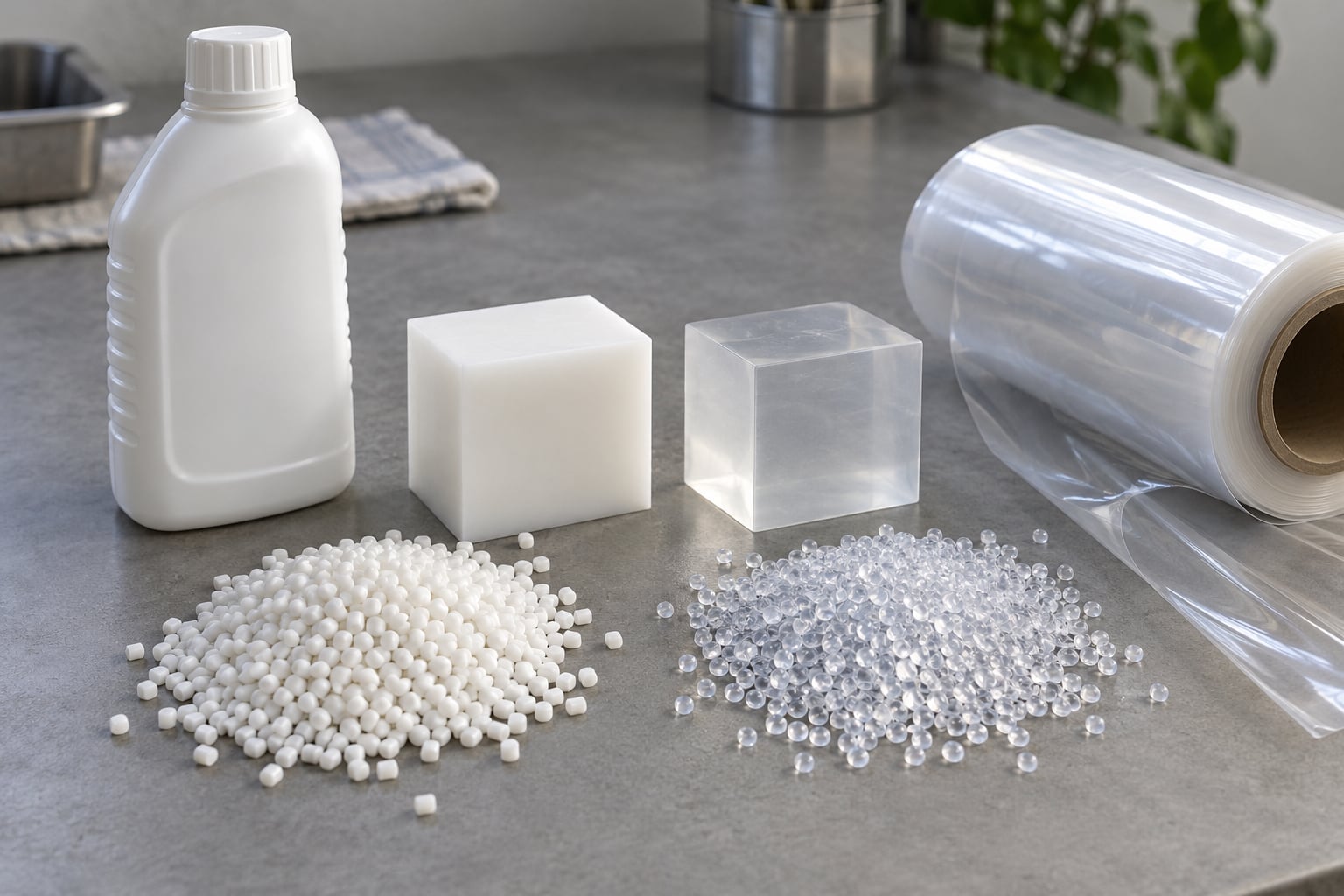
The main difference between high density polyethylene (HDPE) and low density polyethylene (LDPE) is the shape of the polymer chain. HDPE packs its chains tightly, so it comes out rigid, strong and opaque; LDPE has branched chains that resist packing, giving a softer, more flexible, semi-transparent material. Pick HDPE for stiff, load-bearing parts such as bottles, caps and pipe. Pick LDPE for film, bags and liners that need to stretch, seal and survive impact.
Those two grades are not interchangeable just because both are polyethylene, and the hdpe vs ldpe differences and uses run deeper than a density number on a certificate. Swapping one for the other changes wall thickness, melt temperature, tooling wear, sealing behavior and even which recycling stream the part ends up in. I have watched buyers treat the resin name as the whole specification, then find the part is 20 microns too heavy or a liner splits at a notch.
What follows is the practical breakdown: density, structure, strength, barrier performance, processing, applications, recycling, and how to choose between them. Values come from standard datasheet ranges and published material references rather than from a single supplier’s marketing sheet, because grades within each family vary more than the family labels suggest.
Table of Contents
- HDPE vs LDPE Differences at a Glance
- What Are HDPE and LDPE?
- HDPE vs LDPE Differences in Density and Structure
- Strength, Flexibility, and Impact Resistance
- Chemical, Moisture, and Barrier Resistance
- Processing and Manufacturing Differences
- HDPE and LDPE Uses: Where Each Material Fits
- Recycling, Sustainability, and Regulatory Considerations
- How to Choose Between HDPE and LDPE
- Which Should You Choose?
- Frequently Asked Questions
HDPE vs LDPE Differences at a Glance
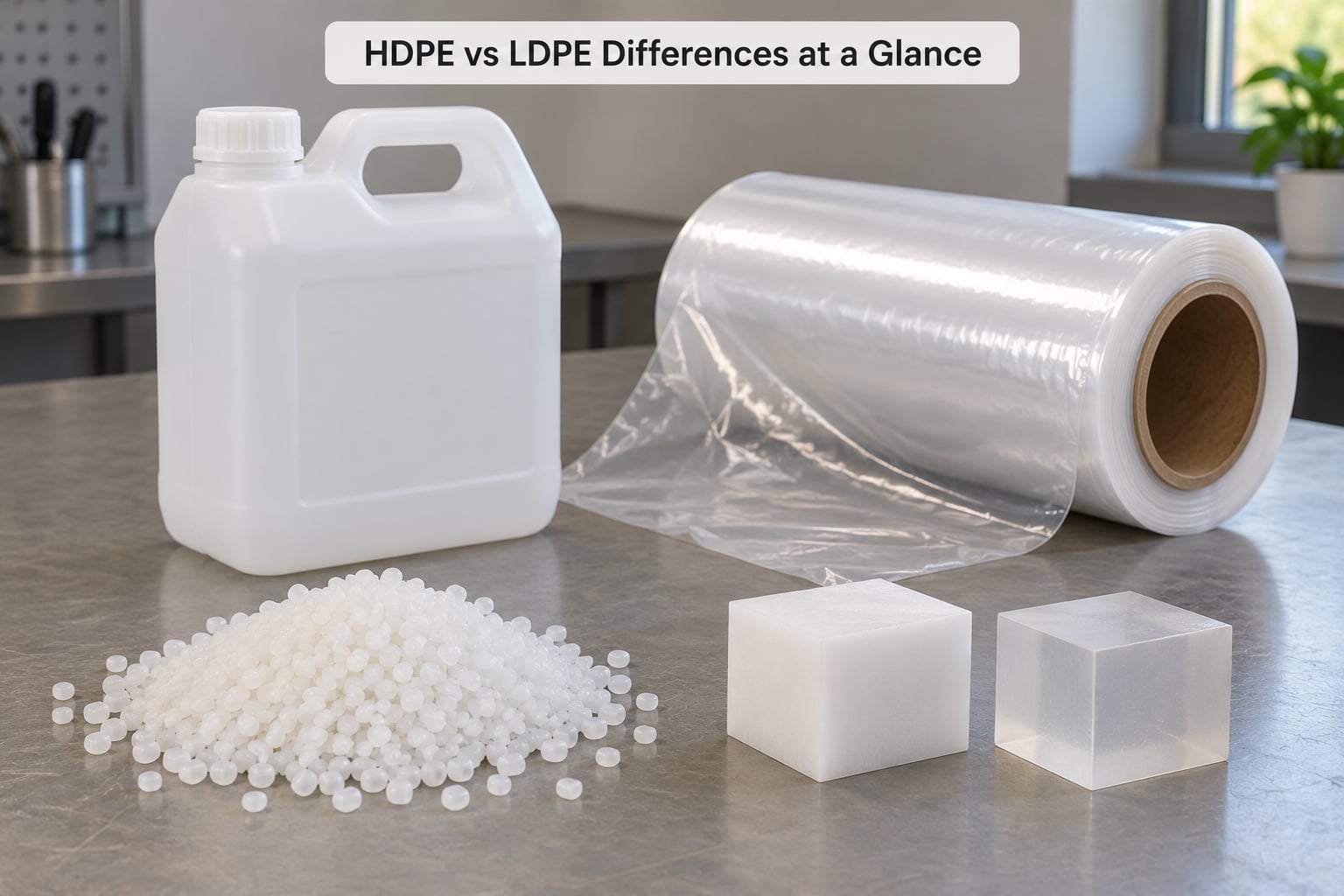
This table is the fast version. Every value below is a typical range for general purpose grades, not a specification for your exact resin.
| Property | HDPE (high density) | LDPE (low density) |
|---|---|---|
| Density | 0.941 to 0.965 g/cm3 | 0.910 to 0.940 g/cm3 |
| Polymer structure | Linear or lightly branched, high crystallinity | Heavily short-chain branched, lower crystallinity |
| Tensile strength (ASTM D638) | about 4000 psi (25 to 45 MPa) | about 1400 psi (8 to 25 MPa) |
| Elongation at break | roughly 200 to 600% | roughly 100 to 1000% |
| Melting range | about 120 to 137 C | about 105 to 115 C |
| Appearance | Opaque, sometimes waxy, milky white when pigmented white | Clear to semi-transparent, frosty when heavily drawn |
| Flexibility | Rigid, low flexibility, can be bent cold only in thin sections | Soft, pliable, high elongation, easy to stretch and fold |
| Impact behavior | Good for rigid parts, more notch and stress-crack sensitive | Excellent, tends to distort before it breaks |
| Puncture resistance | Good in thick sections, weaker at equal gauge | Good, and forgiving in thin blown film |
| Moisture barrier | Very good, essentially no water absorption | Very good, essentially no water absorption |
| Gas barrier | Poor to moderate, better than LDPE at equal thickness | Poor, high oxygen and carbon dioxide transmission |
| Typical film gauge | about 6 to 30 microns | about 20 to 100 microns |
| Main processing routes | Injection molding, blow molding, pipe extrusion, film blowing, rotomolding | Blown film, cast film, injection molding, coating and lamination |
| Heat sealing | Good, higher seal temperature | Excellent, wide sealing window, low seal temperature |
| Recycling code | 2 (HDPE) | 4 (LDPE) |
One myth worth clearing up before anything else: HDPE is not automatically stronger, cheaper or more chemical-resistant than LDPE. Strength depends on grade, gauge and part geometry as much as on density. A 25 micron blown HDPE film and a 25 micron LDPE film have very different tear behavior, and a 15 micron HDPE bag can replace a 30 micron LDPE bag in many grocery applications because it carries strength differently, not because the resin is “stronger”.
What Are HDPE and LDPE?
Both are polyethylene, a thermoplastic polymer built from ethylene monomers. Because they share that base chemistry, they share a lot: they are chemically inert to water and most household chemicals, they weld and heat seal, they are electrically insulating, and they can be pigmented, filled or reinforced.
HDPE was developed in the 1950s using a low branching route, which produces a linear chain with very little branching along the backbone. LDPE comes from high pressure, high temperature polymerization, which introduces short and long chain branches onto the same backbone.
That branching is the whole story. Side branches stop chains from stacking into tight crystalline regions, so LDPE has more free volume, lower density and a lower softening point. HDPE chains pack into dense crystalline domains, which is where its stiffness, strength and temperature resistance come from. A third grade you will hear about, linear low density polyethylene (LLDPE), sits between the two with linear chains plus short branches, and it exists precisely because the middle ground is often the right answer for film.
HDPE vs LDPE Differences in Density and Structure
Density is the cleanest way to tell the two apart, and it is also the reason for most of the property differences. Standard HDPE grades sit around 0.941 to 0.965 g/cm3, while standard LDPE grades sit around 0.910 to 0.940 g/cm3.
Density is not just a number on a certificate. It controls how much material you need for a given part volume, how the melt behaves in the die, and how the finished part feels in the hand. A rigid container wall at 1.0 g/cm3 average density needs less mass to hold the same shape than a low density film wall of the same thickness, which is one reason HDPE wins on weight-managed parts.
Crystallinity also drives optics. HDPE’s high crystallinity scatters light, so a thick HDPE part is opaque and a thin HDPE film looks milky white. LDPE has less crystallinity, so the same part in LDPE is translucent and you can often see a shadow through it. That optical difference is not a quality level. It is a packing result, and it changes line speed, gauge control and how the part is perceived on a shelf.
Strength, Flexibility, and Impact Resistance
HDPE wins on tensile strength and stiffness. Typical high density grades run about 4000 psi in tensile with elongation at break in the few-hundred-percent range, while LDPE is closer to 1400 psi with elongation that can run from a few hundred percent to as high as 1000% depending on grade.
That elongation number is the practical takeaway. LDPE stretches, folds and distorts before it tears, which is exactly what you want in a bag that has to survive being snagged on a forklift. HDPE at the same gauge is stiffer and holds its shape, which is what you want in a bottle that has to stack under its own weight.
Stiffness has a cost. HDPE is more sensitive to notches and sharp corners, and it is the resin most often involved in environmental stress cracking. Detergents, isopropyl alcohol, lubricants, some oils and certain household cleaners act as stress cracking agents. A stressed HDPE part in constant contact with one of those can craze and then crack, sometimes a year after it went into service. Design practice is to round internal corners, keep residual stresses low, and avoid sustained loading in the presence of surfactants.
LDPE is the more forgiving material in that respect, but it has its own weakness: it softens earlier. Service temperature guidance commonly puts HDPE at about -50 C on the low end and 60 C or above continuous on the high end, while LDPE is often quoted around 80 C continuous and 95 C intermittent. If a part sees boiling water, hot fill or a dishwasher cycle, HDPE gives you more headroom.
UV exposure is where HDPE parts disappoint people. Natural polyethylene degrades under sunlight, becoming brittle and chalky, and thermal cycling outdoors can make a flat molded panel warp. Black pigment loaded at a high enough level slows this dramatically, which is why outdoor furniture, playground equipment and agricultural black film are nearly always black or dark. Color, not resin grade, is the main variable here.
Chemical, Moisture, and Barrier Resistance
Both resins are essentially waterproof and absorb no measurable water, so moisture barrier performance is rarely the deciding factor. If you are choosing on that basis, the gauge and the sealing of the part matter more than HDPE versus LDPE.
For chemicals, both stand up well to dilute acids, alkalis, water, salts and many oils. HDPE generally has better resistance to a wider set of organic solvents, but the honest version is that solvent resistance is grade-specific for both, and compatibility data for the specific fluid at the specific temperature is the only reliable answer. Neither resin handles strong oxidizing acids well.
Gas barrier is where a real difference shows up. LDPE transmits oxygen and carbon dioxide at rates high enough that it is a poor choice for long storage of oxygen-sensitive goods unless the film is coated or laminated. HDPE improves on that at equal thickness, but it is still not a foil substitute. For anything oxygen sensitive, structure matters more: multi-layer and co-extruded structures can put the barrier in a different resin entirely, which is worth understanding alongside blown film vs cast film differences.
Processing and Manufacturing Differences
HDPE runs hotter and shrinks more. Typical melt temperatures sit in the 190 to 230 C range for HDPE versus roughly 160 to 200 C for LDPE, and HDPE’s higher crystallinity means higher mold temperatures, longer cooling and a larger shrink rate, typically on the order of 1.5 to 3% depending on wall and packing. Undershoot the pack pressure and a large HDPE part sinks and warps in ways LDPE never would.
Injection molding favors HDPE for rigid parts: caps, closures, housings, buckets, crates and drums. LDPE also molds, but flow is easier and the softer melt suits thin-wall parts, overmolds and inserts. If your part is a snap-fit or a living hinge that has to flex, check insert molding vs overmolding differences before settling on a resin.
Blow molding is the shared home of the classic detergent and milk bottle, and that is HDPE’s strongest application. LDPE shows up in squeeze bottles, flexible cosmetic containers and tubes, where the wall needs to collapse.
Film extrusion divides the two more sharply. LDPE dominates blown film, cast film, heavy-duty bags, pallet stretch wrap, shrink film, garment bags and agricultural greenhouse film, because it runs wide and thin, seals at a lower temperature, and stretches around whatever it is wrapping. HDPE blown film is used where you need a stiffer, more tear-resistant film at lower gauge, such as grocery T-shirt bags, produce bags and some shrink blends.
The gauge economics drive real purchasing decisions. A 15 micron HDPE bag often replaces a 30 micron LDPE bag in grocery-style use, cutting resin consumption roughly in half, which usually beats any small per-kilogram price difference. That is downgauging, and it only works when the converter validates the new structure on the actual filling line. Seal strength, filling speed and print registration all shift when the film gets thinner.
Thermoforming and printing deserve a mention too. LDPE film thermoforms cleanly into sleeves and trays. LDPE is easier to print because its softer surface accepts ink, while HDPE needs surface treatment or corona treatment for good adhesion. A converter who ignores that step ends up with a print that rubs off.
HDPE and LDPE Uses: Where Each Material Fits
Application mapping is more reliable than any adjective. Here is where each grade earns its place.
| End use | Typical resin | Reason |
|---|---|---|
| Milk, juice and detergent bottles | HDPE | Rigid wall, stacking strength, opaque, good chemical resistance |
| Injection molded caps and closures | HDPE | Tight dimensions, stiffness, low creep under torque |
| Water, gas and irrigation pipe | HDPE | High tensile strength, low density, long service life |
| Drums, tanks and chemical containers | HDPE | Broad chemical compatibility, impact toughness in thick walls |
| Playground and outdoor furniture | HDPE or LLDPE | UV stabilized, colorable, tough; often a blend |
| T-shirt vest bags and produce bags | HDPE | Stiffness at low gauge, tear resistance |
| Ziplock and flat bags | LDPE | Stretch, low seal temperature, easy tear opening |
| Garment bags and overwrap | LDPE | Clarity, softness, high elongation |
| Pallet stretch and shrink wrap | LDPE or LLDPE blends | Elongation and cling around irregular loads |
| Agricultural mulch and greenhouse film | LDPE, LLDPE or blends | Long runs of film, downgauging economics |
| Squeeze bottles and tubes | LDPE | Collapsible wall |
| Wire and cable jackets | LDPE | Electrical insulation and flexibility |
| 3D printing filament | HDPE common, LDPE blends | Layer adhesion and machinability |
If your application is a rigid container rather than a film, the shortlist often widens. Our guide to hdpe vs pp which plastic to use for containers is worth a read if you are still comparing polyethylene against polypropylene rather than within the polyethylene family.
How to tell HDPE and LDPE apart in the plant or on the job
Finished parts often arrive with no label and no resin marking, so a physical check beats guessing. Work through these in order.
- Read the print code first. Look on the seam, the bottom or the carton for the resin identification symbol. A 2 means HDPE, a 4 means LDPE, and the triangle with a number inside is the whole symbol.
- Do the crinkle test on film. Squeeze a sample firmly in your hand. LDPE crackles loudly and clearly, almost like a crisp packet. HDPE bends with a dull or muted sound. For a thin film, hold it to light while you fold it, which makes the noise easier to hear.
- Do the stretch test. Pull a strip of film with both hands. LDPE stretches several times its original length before tearing, and HDPE resists, then tears sooner and more sharply.
- Check stiffness by hand on a cut section. A 2 to 3 mm plaque that springs back straight and resists bending is HDPE. One that flexes readily and feels rubbery is LDPE.
- Run the water displacement test for a density read. A sample that floats is LDPE, one that sinks is HDPE, since HDPE density exceeds water at room temperature. A graduated cylinder and a kitchen scale gives you a real number: divide dry mass in grams by displaced volume in cubic centimeters.
- Use a melt point test as a confirmation. HDPE melts in the region of 120 to 137 C and LDPE in the region of 105 to 115 C, so a controlled heating strip or a hot needle separates them, though the two ranges are close enough that this works best with a thermometer.
None of these is a substitute for a resin certificate. Field methods are for confirming a material quickly; a datasheet or a supplier’s compliance document is what you put on the file.
Recycling, Sustainability, and Regulatory Considerations
Both resins are thermoplastic and mechanically recyclable, which is the main reason both codes exist. The practical difference is collection. Code 2 HDPE bottles are the single most collected plastic packaging stream in most curbside programs in the US. Code 4 LDPE film is a different story: soft film wraps around sorting equipment, contaminates other bales and is excluded by many programs, so a great deal of LDPE film ends up landfilled rather than recycled.
That gap has commercial consequences for converters and brand owners, and it is worth raising with any customer asking for recycled content. Post-consumer HDPE is widely available in bale and pellet form. Post-consumer LDPE film exists but in smaller, less consistent volumes, and a recycled LDPE stream often carries odor and color variation that limits it to less critical applications.
Recycled resin also changes processing. Recycled HDPE is still weldable and moldable and is widely used for non-food-contact parts like planters, pallets and cable drums, but melt flow index shifts between batches, so a production set-up tuned on virgin resin may need adjusting. If your process is sensitive to melt flow index (MFR, tested under ASTM D1234), qualify the recycled grade rather than assuming interchangeability.
For food contact and regulated uses, check the specific grade’s compliance documentation rather than the family name. US food contact rules are 21 CFR 170 to 199, and industrial or defense specifications such as MIL-DTL-12647 for film and ASTM D1234 for flow rate apply to particular grades. A resin supplier’s declaration of compliance names the grade, the additives and the conditions of use, which is the document to request before you buy.
How to Choose Between HDPE and LDPE
Start from the part, not the resin. Walk these questions in order and the answer usually falls out.
- Is the product a rigid structural part or a flexible film or bag? Rigid part points to HDPE, film points to LDPE.
- What loads does it see? Tension, stacking loads and pressure favor HDPE. Flexing, stretching and impact on a thin section favor LDPE.
- What is the temperature and chemical exposure? Hot fill, boiling water or solvents narrow the choice toward HDPE, with compatibility data as the final check.
- What process runs the part, and can the equipment hold the melt temperature and shrink rate? HDPE needs more heat and more cooling time than LDPE.
- What gauge do you need, and can you downgauge? If a thinner HDPE film passes your line trials, the resin savings can outweigh any per-kilogram difference.
- What end-of-life does the customer expect? If a printed recycling code or a recycled content claim is part of the brief, verify the collection stream exists in the customer’s market.
Before you substitute one resin for another in an existing part, plan for more than a material swap. Expect different melt temperature, different pack pressure, different shrinkage, different tooling wear and different surface treatment for printing. Run a short trial on real production tooling and test the aged part, not just the fresh one. A part that passes at day one and cracks at month six is usually an environmental stress cracking problem that a fresh-part test will never reveal.
Which Should You Choose?
Choose HDPE when the part is rigid, load-bearing, hot or chemically exposed, and you want the lowest gauge that still holds its shape. Choose LDPE when the product is film, a bag, a liner or a collapsible container that needs to stretch, seal at a low temperature, or survive impact without splitting. Neither is better in the abstract; the use case decides it, and a validation run on your own part decides it for certain.
Frequently Asked Questions
What is the main difference between HDPE and LDPE?
HDPE has linear, minimally branched polymer chains that pack into dense crystalline regions, giving it higher density, higher tensile strength and a higher melting point. LDPE has many short chain branches that interrupt packing, so it is softer, more flexible, more transparent and seals at a lower temperature. Density is the usual first checkpoint: roughly 0.941 to 0.965 g/cm3 for HDPE versus 0.910 to 0.940 g/cm3 for LDPE.
Is HDPE stronger than LDPE?
In tensile strength per material, yes: typical HDPE grades test around 4000 psi against roughly 1400 psi for LDPE. In practice, strength also depends on gauge, grade and geometry, so a thin HDPE film can fail sooner than a heavy LDPE one. HDPE is also stiffer and more notch sensitive, while LDPE stretches far more before breaking, which is why bags favor LDPE and rigid parts favor HDPE.
Can HDPE and LDPE be used for food containers?
Both can, as long as the specific grade carries the required food contact declaration for the country and the conditions of use. In the US that means compliance with the relevant parts of 21 CFR 170 to 199, and for films, specific rules on sealing, extraction and maximum use temperature. Buy food contact grades with a current declaration of compliance, and check that any pigment, masterbatch or recycled content is also covered by it.
Which is better for bags, film, or liners?
LDPE is the usual answer for bags, overwrap and liners because it stretches widely, seals at a lower temperature and runs at wider gauges. HDPE film is preferred where you want stiffness and tear resistance at a thinner gauge, such as T-shirt vest bags and produce bags. For heavy-duty stretch wrap, converters often run LLDPE or an LDPE and LLDPE blend, since that sits between the two on stiffness and elongation.
Can HDPE and LDPE be recycled?
Both are thermoplastics and both are mechanically recyclable, carrying resin codes 2 for HDPE and 4 for LDPE. Collection is what differs. Rigid HDPE bottles are the most widely collected plastic packaging stream in US curbside programs, while LDPE film is excluded by many programs because soft film tangles in sorting equipment, so a large share of it is landfilled. Post-consumer LDPE film supply also exists but is smaller and less consistent.
How can I identify HDPE versus LDPE in a manufacturing project?
Start with the resin identification code printed on the part, then confirm physically. Film crackles loudly when squeezed if it is LDPE and stays quiet and stiff if it is HDPE. A water displacement test settles it: LDPE floats and HDPE sinks, and dividing dry mass by displaced volume gives a real density number. A melt point check between about 105 and 115 C versus 120 and 137 C confirms it, though a supplier certificate is the document to file.
Start with the geometry. Rigid part that carries load, sees heat or holds chemicals, and you are specifying HDPE. Film, bag, liner or anything that must stretch and seal, and you are specifying LDPE. Then confirm it with a density check on a real sample and a short production trial, because gauge and part design change the answer faster than the resin name does.