
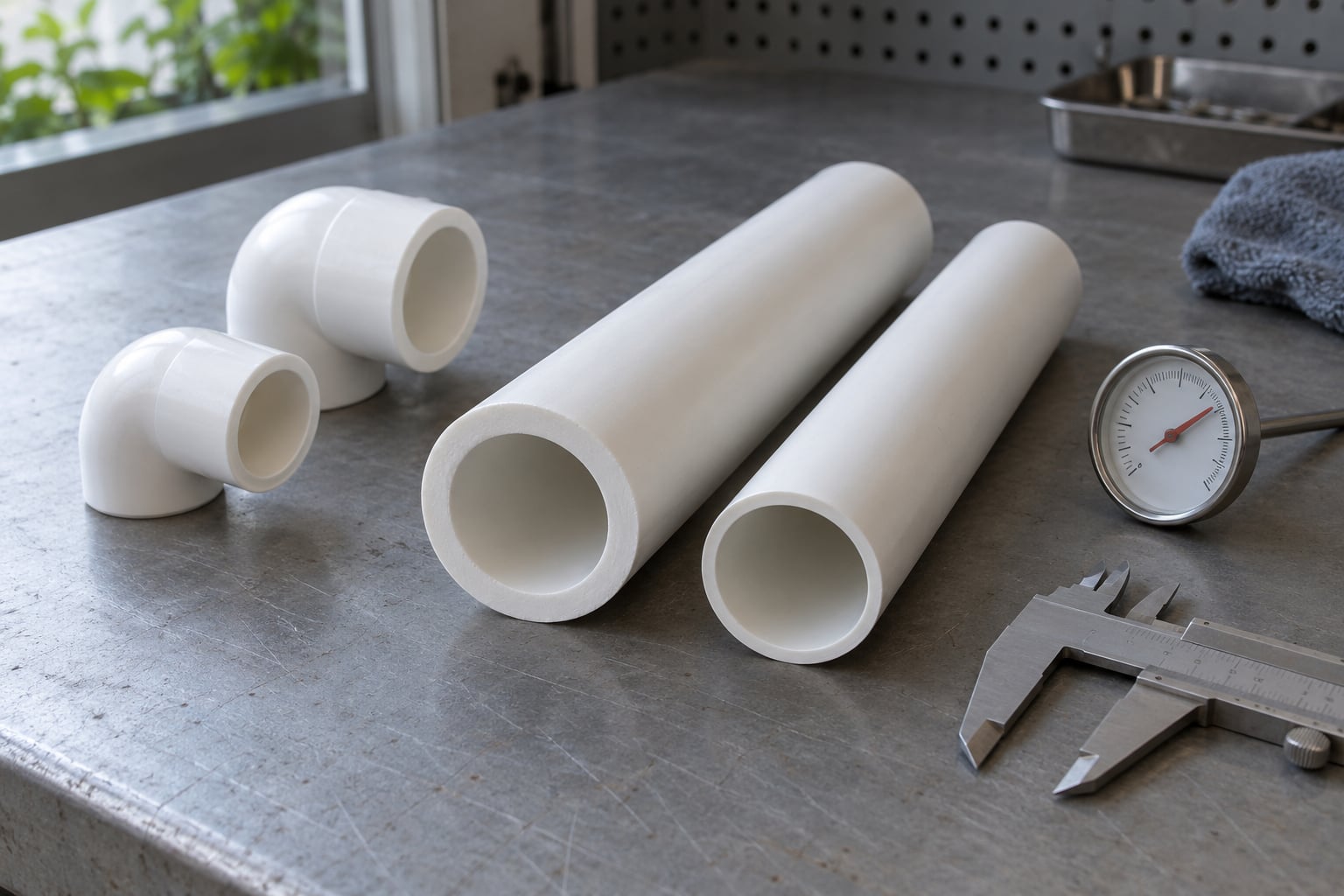
The core difference between PVC and CPVC pipe is how much chlorine is in the resin. CPVC starts as ordinary polyvinyl chloride, then gets an extra chlorination pass that raises its chlorine content from roughly 56-57% by mass to about 63-67%. That extra chlorine raises the service temperature ceiling, tightens dimensional stability under heat, and improves resistance to certain chemicals. Everything else buyers usually argue about, solvent cement, sizing, color, pressure ratings, follows from that one processing difference.
For routine cold-water, drainage, irrigation and general utility work, PVC is usually the cheaper, easier and more widely available choice. For hot-water distribution, fire protection, and demanding chemical service, CPVC earns its material premium. This guide walks through the PVC vs CPVC pipe differences that actually decide a purchase, and where you need to check the manufacturer’s data sheet rather than a generic table.
Table of Contents
- PVC vs CPVC Pipe Differences at a Glance
- What Are PVC and CPVC Pipe Made Of?
- PVC vs CPVC Pipe Differences: Temperature and Pressure
- PVC vs CPVC Pipe Differences: Chemical and Environmental Resistance
- PVC vs CPVC Pipe Differences: Installation, Joining, and Durability
- PVC vs CPVC Pipe Differences in Cost and Applications
- Which Should You Choose?
- Frequently Asked Questions
- Conclusion: Start With the Service Conditions
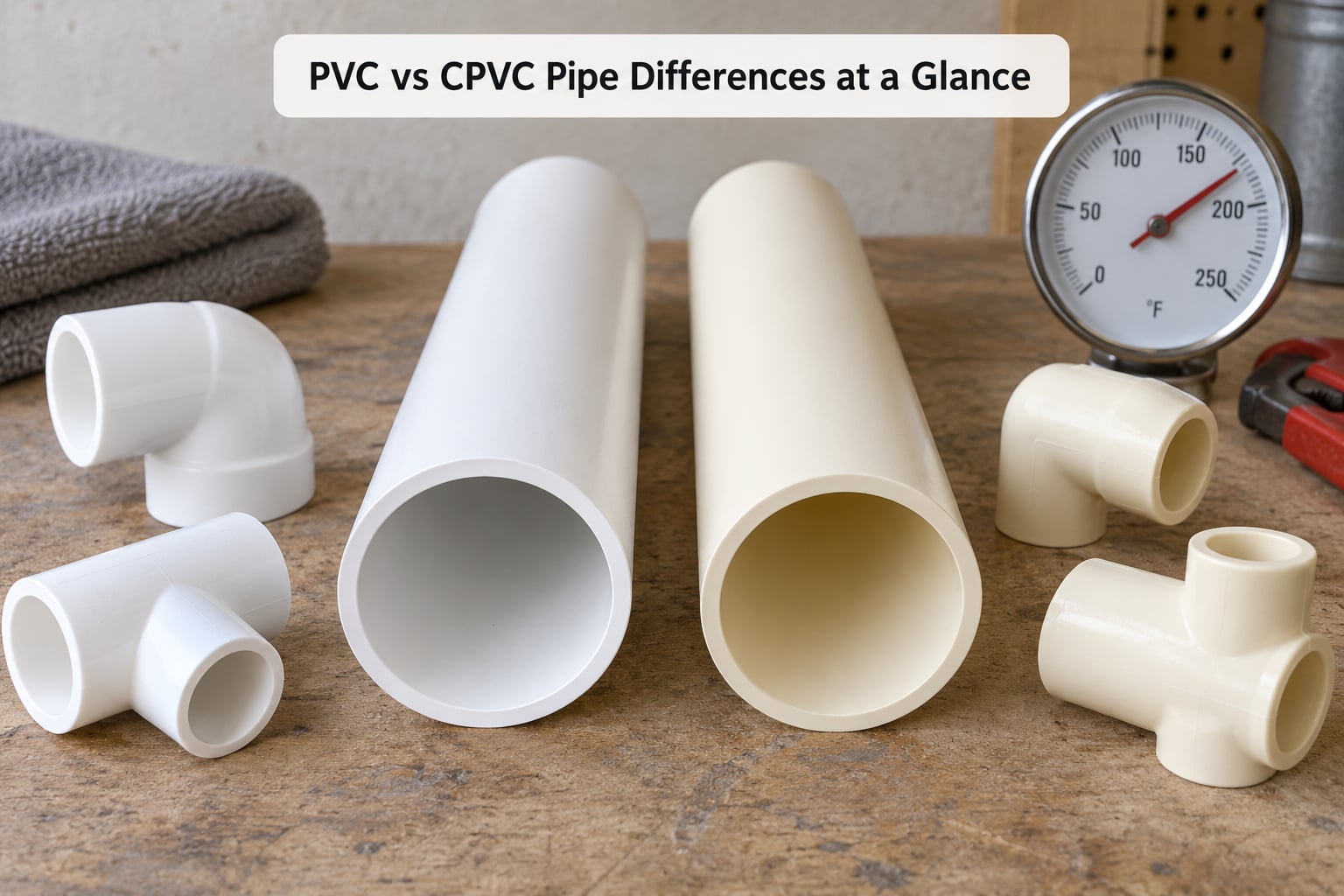
PVC vs CPVC Pipe Differences at a Glance
| Property | PVC | CPVC |
|---|---|---|
| Full name | Polyvinyl chloride | Chlorinated polyvinyl chloride |
| Approximate chlorine content | 56-57% by mass | 63-67% by mass |
| Maximum service temperature | About 140°F at typical working pressures | About 180°F continuous, up to 200°F at reduced pressure, depending on the product line |
| Typical sizing convention | Nominal pipe size (NPS) with a schedule or SDR wall control | Copper tube size (CTS), a true outside-diameter control |
| Common wall control | Schedule 40 and Schedule 80, or SDR series | SDR 11 and SDR 13.5 for pressure service, SDR 17 and above for DWV |
| Solvent cement standard | ASTM D2564 for potable and DWV, D2535 for hot water | ASTM F493, with F656 also listed for hot water in some jurisdictions |
| Typical color | White for potable, dark gray and light gray for DWV, purple or blue for reclaimed water | Off-white, cream, beige or pale yellow; often printed with a colored stripe |
| Chemical resistance | Strong against acids, alkalis, salts and household wastewater; vulnerable to solvents, ketones, esters and some hydrocarbons | Broader resistance overall, notably better with oxidizing chemicals and chlorinated water; still attacked by strong solvents and incompatible sealants |
| Low-temperature behavior | Becomes brittle below roughly 40°F | More tolerant of sub-freezing conditions and impact at low temperature |
| Best used for | Cold water, DWV stacks, drain and waste, irrigation, pools, general utility and non-pressure service | Hot and cold water distribution, fire sprinkler risers, hydronic and HVAC piping, higher-temperature process lines |
| Strongest reason to choose it | Lower material cost, the deepest supply availability, the widest fitting range from any distributor | About 60°F more usable temperature headroom in a pressure-carrying system |
One row deserves emphasis. The two materials are not the same size in a given nominal number, which is the single most common mix-up on this topic and the reason so many field joints fail to line up.
What Are PVC and CPVC Pipe Made Of?
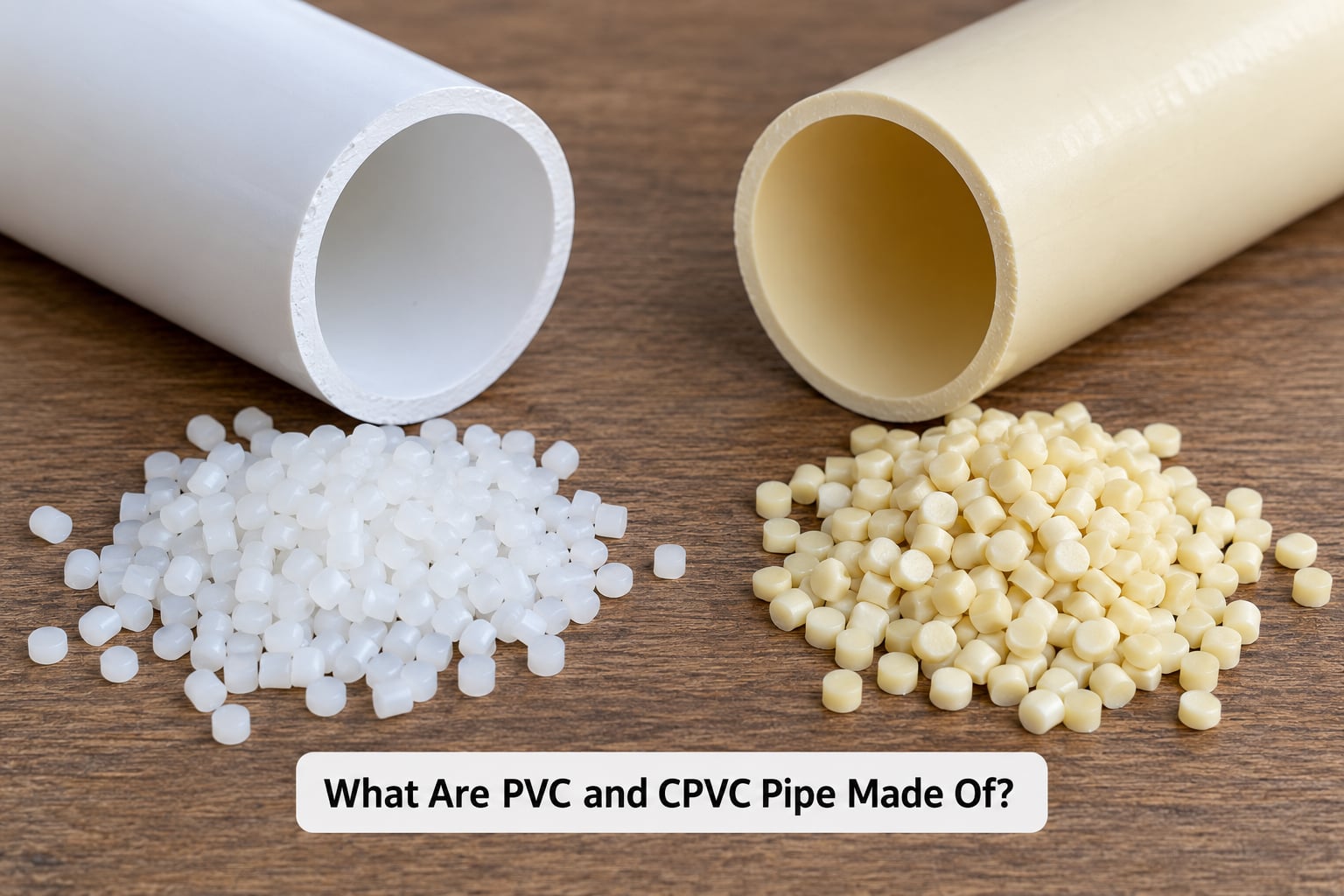
Both are thermoplastics built from the same backbone. Vinyl chloride monomer is polymerized into polyvinyl chloride, and because PVC is rigid on its own, the resin is blended with additives: stabilizers to resist heat during processing, lubricants, and in many formulations a plasticizer or impact modifier.
CPVC goes one step further. Polymerized PVC resin is reacted with additional chlorine in a fluidized bed, replacing some of the hydrogen atoms along the carbon chain with chlorine. More chlorine means a higher glass transition temperature, the temperature at which the material shifts from a rigid glassy solid to a softer, rubbery state. For CPVC that shift sits above 100°C; for ordinary PVC it happens in the 80°C range.
That single shift explains most of what buyers care about. Higher heat resistance, better dimensional stability under pressure at temperature, and typically a lower coefficient of thermal expansion over the working range. CPVC also tends to hold shape better around fittings and shows less long-term creep under sustained internal pressure, though all plastic pipe is viscoelastic and rated for a long-term hydrostatic pressure, not a short-term burst value.
It also explains the confusion over a term that gets used loosely. Schedule 40 PVC is a pressure-rated pipe defined by a wall-thickness table. Schedule 40 CPVC exists too, but CPVC manufacturers usually sell pressure pipe as an SDR series instead, because a constant outside diameter with a controlled wall ratio is a cleaner way to guarantee pressure capability. If a spec says Schedule 40, check the wall thickness on the submittal rather than assuming it matches the PVC table.
PVC vs CPVC Pipe Differences: Temperature and Pressure
Temperature is where the two materials separate most clearly, and it is the first question worth asking about any line. PVC pipe is rated for a maximum service temperature of about 140°F for potable and pressure service, and even at lower temperatures its allowable working pressure drops as the water gets warmer. CPVC carries a higher ceiling, commonly quoted as 180°F for continuous hot water with some product lines rated to 200°F, again with pressure derating above roughly 100°F.
Why higher chlorine content raises the temperature ceiling
The mechanism is simple enough to be useful when you are reading a data sheet. PVC softens as the polymer chains gain mobility from heat. Chlorine atoms are larger than hydrogen atoms and tie the chain together differently, so a higher chlorine content raises the temperature at which the polymer loses stiffness. Once that softening point sits above your water temperature, the pipe keeps its shape and its joint integrity.
There is a second effect that matters just as much in a pressure system: the allowable stress of the material. Both plastics lose strength as temperature rises, so a 100°F rating at 73°F is not a 100°F rating at 180°F. CPVC starts from a higher base stress and holds more of it, which is why it stays dimensionally tight at operating temperature instead of creeping outward under sustained pressure.
How to read a pressure rating at temperature
Manufacturers publish a derating factor or a pressure-temperature curve, and that curve, not the headline number, is what you should size against. The rule of thumb most vendors use for CPVC pressure service is roughly one percent loss of allowable pressure for every 1°F above 73°F, so a 200 psi pipe at 73°F lands close to 100 psi at 180°F. PVC follows a similar shape but starts from a much lower ceiling, which is why a continuous hot-water line in PVC is generally limited to 140°F and below, and why many codes restrict it further.
Two practical notes. First, the ratings apply to the pipe at a specific temperature, and joining methods change the story: a solvent-welded joint in Schedule 80 wall can carry more than the same pipe in Schedule 40. Second, ratings assume proper support spacing. A line that sags between hangers develops bending stress that eats into the pressure capability the datasheet promises.
Both materials lose strength when they freeze. Water expands roughly nine percent when it freezes, and a rigid plastic pipe in an unheated crawlspace or an exterior wall cavity does not flex enough to relieve that. Neither PVC nor CPVC should be relied on to survive a freeze event without protection.
PVC vs CPVC Pipe Differences: Chemical and Environmental Resistance
Both materials are non-corrosive and non-conductive, which is the reason either one got specified over copper or cast iron in the first place. The difference shows up at the edges of the chemical chart rather than in the middle.
PVC handles dilute acids, alkalis, salts, and typical household wastewater very well, and it is the standard choice for drain, waste and vent lines. Its weaknesses are organic solvents: ketones such as acetone, esters, some aromatic and aliphatic hydrocarbons, and certain plasticizers. A line that handles a dilute caustic stream in PVC can be quietly damaged by a trace of solvent in the same stream.
CPVC is generally more resistant across the board, and the improvement is most practical in three places. Chlorinated water is the big one: municipal systems dosing heavily chlorinated water are harder on some plastics, and CPVC tolerates that exposure better, which is a reason it appears in reclaimed water and industrial water treatment lines. CPVC also resists oxidizing chemicals better than PVC and holds its properties further into the solvent range, though it is not solvent-proof and manufacturers still publish exclusion lists.
Environmental stress cracking is the failure mode that catches experienced installers. It happens when a chemical that the pipe can handle at low stress attacks a joint or a section under constant strain, or when a flexible or plasticized rubber seal, an adhesive, or a nearby cable or conduit carries an incompatible chemical into contact. The crack appears months later with no obvious cause. The mitigation is unglamorous: check the manufacturer’s chemical exclusion list for the specific products in the stream, avoid letting solvent-weld cement or primer splash onto an installed line, and use an expansion loop rather than forcing a branch line tight against a structure.
For outdoor and above-ground runs, both materials need help. Unstabilized PVC and CPVC degrade under ultraviolet exposure, embrittling and fading until the pipe loses impact strength. Schedule 40 PVC is sometimes rated for sunlight exposure for a limited period; CPVC generally tolerates UV somewhat better but is not a sunlight pipe either. Buried, painted, or continuously shaded runs are fine. Exposed runs want shielding, a UV-stabilized formulation, or a painted coating after pressure testing and before backfill.
PVC vs CPVC Pipe Differences: Installation, Joining, and Durability
Both pipe systems are solvent welded, which means the joint is made by softening and fusing the pipe and fitting surfaces together. The procedure looks the same. The cement does not, and this is the most safety-relevant difference between the two.
What happens if you use PVC cement on CPVC pipe
Use the cement listed for the material. PVC pressure joints use a cement referenced to ASTM D2564, and CPVC pressure joints use a cement referenced to ASTM F493, usually with a primer the manufacturer has approved and paired with that cement. A cement approved only for PVC is not approved for CPVC, and some of the solvents in it are exactly the kind of aggressive chemical that produces environmental stress cracking in CPVC.
The result of mixing them is a joint that looks fine on the day it is made and fails later, sometimes years later, with no warning. The failure has appeared in plumbing forums repeatedly, usually as a homeowner who reused leftover purple primer and orange CPVC cement from the same toolbox. There are dual-labeled cements and transition cement sold for exactly this situation, and the transition fitting itself is the correct answer when a genuine PVC-to-CPVC connection is required. Confirm the fitting is listed for the joint, use primer and cement in the order the manufacturer states, and keep a can open for a single job rather than a season.
A related trap: the joint is only as strong as the fit. Both pipe and fitting must be the same size system. PVC nominal sizes and CPVC copper tube sizes do not match, which is covered next.
Sizing: NPS versus CTS is not optional knowledge
PVC pressure and DWV pipe is sold by nominal pipe size, which is a historical system where the stated number never matched the actual diameter. CPVC is sold by copper tube size, a true outside diameter system. The consequence is concrete: three-quarter inch CPVC has the same outside diameter as three-quarter inch copper tubing, not as three-quarter inch PVC, which is meaningfully larger. Substitution on paper translates into a fitting that will not seat.
Markings printed on the pipe settle it. PVC DWV usually carries Schedule 40 or Schedule 80 and an ASTM D1785 reference; CPVC pressure pipe carries SDR, CTS, an ASTM F493 reference, and often the certified plumbing listing such as NSF/ANSI 61 for potable lines.
How to identify PVC and CPVC on an existing installation
Color is the first clue and the least reliable one. PVC is bright white where it is new, gray for many drain and waste lines, and purple or blue in reclaimed water systems. CPVC is usually off-white, cream or beige, sometimes with a printed stripe, and it is often identified by branding such as FlowGuard Gold. That stripe and marking layout vary by brand and region, so treat any stripe as a prompt to read the print, not as proof.
Then use physical cues. CPVC is noticeably stiffer and thinner-walled for a given pressure rating than Schedule 40 PVC. PVC pipe becomes quite brittle in cold weather and can shatter or crack under a wrench, while CPVC usually deforms before it breaks. Where nothing is legible, cut a small coupon: PVC from a potable line typically cuts smoothly enough with a hand saw, while CPVC leaves a slightly more rubbery edge. The honest caveat is that paint, dirt, UV fading and age can erase every visual cue, which is the main reason a plumber’s coupon test or a borescope is the reliable method.
Support spacing, cure times, and expansion
Support spacing follows local code and the pipe size, and it is often a maximum of a few feet for either material. CPVC needs closer attention on expansion because it is stiffer and will transfer more force into its joints over a long run. Both materials need a restrained expansion loop or an expansion joint at risers and at any section longer than roughly 50 feet.
Cure time before pressure testing is material and climate dependent. Solvent weld develops most of its strength quickly and continues to gain strength over a period measured in hours, and CPVC commonly requires a longer wait than PVC, with cold weather extending it further. Both are sensitive to the same common mistakes: cutting square and reaming the bore, cleaning and drying both surfaces, inserting fully and holding to the mark, not over-rotating the fitting, and testing only after the specified cure time has passed rather than whenever the day gets around to it.
Longevity is where owner experience and published design life diverge. Both materials carry long design lives under continuous rated service, and properly installed lines of either material routinely outlast the structures they serve. The concern that circulates in homeowner discussions is older CPVC hot-water systems, some installed in the 1980s and 1990s, that have become brittle, particularly where high chlorine levels, high water temperatures and operating stress combined. Brittle CPVC also cracks rather than deforms when struck, which is why a lawn mower or a shovel finds it. Above-ground CPVC deserves more impact protection and a closer look at its condition than buried or concealed pipe, and aged brittle pipe is a sound reason to replace rather than repair.
PVC vs CPVC Pipe Differences in Cost and Applications
CPVC costs more per length than PVC, and anyone comparing pipe on a per-foot basis will land on that conclusion every time. The useful comparison is installed cost over the life of the system.
Three offsets routinely erase the premium. On hot-water lines, PVC either cannot be used or forces insulation, a tempering valve or a recirculation design change to stay inside its temperature ceiling; CPVC usually runs without any of that. On wet-barrel fire protection, CPVC removes the need to buy and install a metal piping system. And where a lower-rated material leads to a system that has to be redesigned or replaced later, the material saving at the start stops being a saving.
Availability is the other half of cost. PVC sits on the shelf at nearly every supply house, in long lengths, in nearly every diameter and in multiple wall thicknesses. CPVC is well supplied in North American pressure markets and much harder to source in regions where CPVC pressure piping has never been part of the accepted code set. In markets where CPVC pressure pipe is not listed for the local application, no discount on the pipe makes it a legal choice.
On applications, the split is fairly clean. PVC handles cold water, drain waste and vent, irrigation, pool and spa piping, utility trenches, and non-pressure service. CPVC handles hot and cold potable distribution where code allows, fire sprinkler systems, hydronic radiant heating, chilled water, and industrial chemical and process piping that stays within its exclusion list. CPVC is also the usual pick for reclaimed water lines and any potable application where NSF/ANSI 61 certification is required, because the certification comes attached to the pipe and fittings as a system rather than to the material in general.
Worth noting for anyone weighing CPVC against PEX: PEX won whole-house repipe arguments for flexibility and install speed, and it sweats less than CPVC because its material properties and layout differ. The same installers who sell PEX will often tell you CPVC is obsolete, and the reverse is equally true of CPVC-only shops. Neither claim survives contact with a local code, a water chemistry and a service temperature. Decide on those three, not on the brand the installer stocks.
Which Should You Choose?
Pick the material by asking four questions in order, and stop at the first one that decides it.
- What temperature will the fluid actually reach? If it stays at or below 140°F and the line is pressure-rated, PVC is the economical answer. If it runs hotter, CPVC is the only one of the two that stays within its rating.
- What is in the stream? Household wastewater, dilute acids, alkalis and salts are fine in either. Chlorinated water, oxidizers and aggressive process streams point to CPVC. Any solvent, ketone, ester or unidentified hydrocarbon rules out both until the exclusion list says otherwise.
- Is there a code or certification requirement? Potable water needs NSF/ANSI 61 on the system. Fire protection needs an approved wet-barrel CPVC system and does not permit CPVC in dry systems. Local codes and the listing on the submittal outrank any general article, including this one.
- What does the installed system cost? Add the material, the fittings, any insulation or heat tracing, the required listing, the expected service life and the rework risk. That number, not the price on a length of pipe, is the number that matters to a procurement decision.
Two default rules hold up well. PVC is the default for cold and drainage work anywhere the codes allow it, because it is cheaper, more available and easier to install. CPVC is the default when temperature, chlorine exposure or a code listing pushes you past what PVC can do, because switching to PVC at that point usually means redesigning the system, not saving money on it.
Frequently Asked Questions
Can CPVC pipe be used for hot water?
Yes. CPVC is one of the few rigid plastics approved for potable hot water distribution, typically rated for continuous service near 180°F, with some product lines rated to 200°F at reduced pressure. PVC is generally limited to about 140°F, which is why it cannot substitute. Check the local code and the certification marking on the exact pipe and fittings.
Can PVC and CPVC pipe be joined together?
Only with a fitting and cement system designed for that transition. The two are solvent welded with different cements, and a PVC cement is not approved for CPVC because its solvents can cause environmental stress cracking that shows up months later. Use a listed transition fitting with the manufacturer-approved cement and primer for each material, or use mechanical fittings where the listing permits them.
Which pipe is cheaper, PVC or CPVC?
PVC is cheaper as raw material, and it is also far easier to get hold of locally. The gap often narrows or reverses on installed cost once you account for hot-water limitations, fire protection approvals and the fittings each system needs. Compare the complete system, including listing requirements, rather than the price per length.
Is CPVC better than PVC for chemical resistance?
Generally yes, especially against oxidizing chemicals and chlorinated water, which is why CPVC is common in water treatment and reclaimed water lines. PVC already handles acids, alkalis, salts and household wastewater well, so the upgrade matters only when the stream is demanding. Neither material resists strong solvents, so check the manufacturer exclusion list either way.
Can PVC or CPVC pipe be used outdoors?
Yes, with protection. Unstabilized pipe of either material degrades under ultraviolet exposure and eventually loses impact strength, and PVC turns brittle in cold weather. Use a UV-stabilized formulation, shield the pipe, or paint it after pressure testing. Buried and permanently shaded runs need no special treatment, and above-ground lines should be protected from impact.
Which material is required for fire-protection systems?
CPVC is the one that gets approved, and only for wet-barrel fire sprinkler systems under NFPA 13 and the applicable local code. It is not permitted in dry systems, and the pipe, fittings and cement all have to carry the fire-protection listing as a system. PVC has no fire sprinkler approval at all. Verify the listing and the local amendments before specifying anything.
Conclusion: Start With the Service Conditions
Choose PVC for routine utility work: cold water, drainage, irrigation and general service where the fluid stays under its temperature ceiling and codes permit it. Choose CPVC when the water runs hot, the stream is chlorinated or aggressive, or a listing such as a fire protection system or NSF/ANSI 61 potable distribution makes it the only compliant option. The extra material cost is usually recovered in the system design it saves you from having to change.
Before you order, confirm four things in writing: the local plumbing code, the manufacturer data sheet including schedule or SDR and the derating curve, the pressure and temperature rating for your actual service conditions, and the cement and primer the manufacturer pairs with that exact product. Those four documents answer every PVC vs CPVC pipe differences question better than any general comparison can.
Getting the material comparison right also matters at the manufacturing end. If you are producing the resin, the fittings or the finished pipe, the differences between these two polymers drive the whole design: how the line runs, how the tooling is set, and which trim and scrap streams you end up with. Two related explainers on this site walk through that side of the work — blown film versus cast film differences and insert molding versus overmolding differences.