
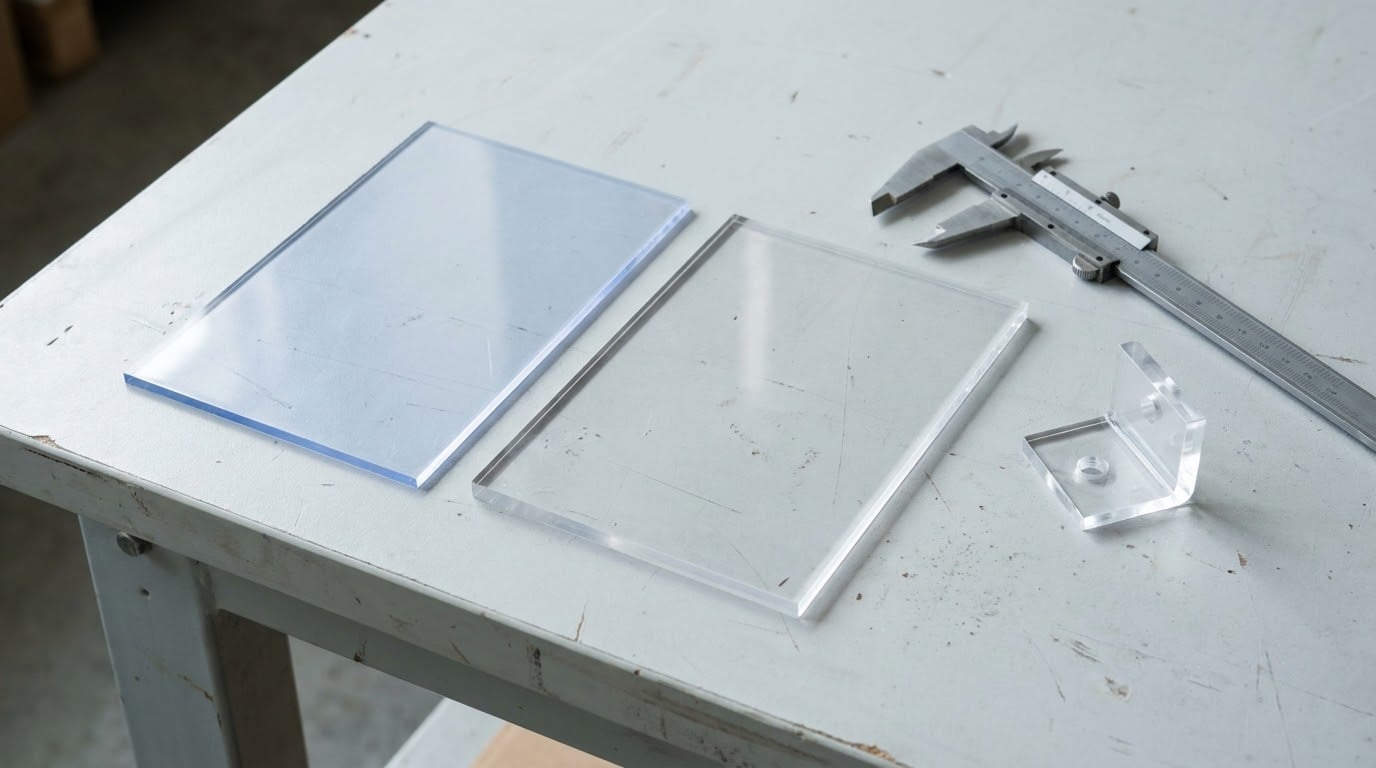
If you’re choosing between polycarbonate and acrylic sheet for a job, the decision is usually a trade between toughness and finish. Polycarbonate is the pick when breakage, impact, forming and heat drive the design. Acrylic wins on optical clarity, scratch resistance, edge polish and cost, as long as the part will not take a hard hit.
Both are amorphous thermoplastics sold as flat sheet, and the gap between them is bigger than most product pages admit. One bends around a curve and takes a hammer blow; the other holds a crisp polished edge and a flat surface for years, then snaps along a drilled hole if you tighten a screw too far.
The rest of this guide walks through the properties that actually change a decision, then the fabrication behaviour, then a selection process you can run in ten minutes. Figures below are typical published values for general-purpose grades; always confirm against the datasheet for the specific grade you’re ordering.
Table of Contents
- polycarbonate vs acrylic sheet which to use at a Glance
- What Are Polycarbonate and Acrylic Sheets?
- Impact Resistance and Durability
- Clarity, Appearance and Surface Finish
- UV, Weathering and Outdoor Performance
- Heat, Chemical and Electrical Performance
- Fabrication, Machining and Forming
- Cost, Weight and Availability
- How to Choose Polycarbonate or Acrylic Sheet
- Which Should You Choose?
- Frequently Asked Questions
- Conclusion
polycarbonate vs acrylic sheet which to use at a Glance
| Property | Polycarbonate (PC) | Acrylic (PMMA) |
|---|---|---|
| Light transmission | About 88% clear grades | About 92% clear grades |
| Haze | Lower, good optical grade available | Very low, easy to polish |
| Notched Izod impact | Roughly 9 to 14 kJ/m2 typical grades | Roughly 1 to 2 kJ/m2 typical grades |
| Behaviour on hard impact | Flexes, absorbs blow, very hard to crack through | Brittle, cracks or shatters, especially near edges and holes |
| Scratch resistance | Soft surface, marks easily, needs a hard coat in service | Harder surface, holds a polish, better abrasion behaviour |
| UV and weathering | Standard grades yellow; UV-stabilised grades resist it | Excellent UV stability, generally will not yellow |
| Heat deflection temperature | About 130 to 145 C depending on grade | About 85 to 105 C depending on grade |
| Continuous service temperature | Roughly -40 C to 100 C general grades | Roughly -40 C to 70 C general grades |
| Thickness for equal stiffness | Thinner section needed, so lighter parts | Thicker section needed |
| Cold bending | Bends to a tight radius, may craze if over-bent | Cracks or whites out; must be heated |
| Machining | Tough, gummy, heat-sensitive at the tool | Cuts clean and fast, polishes at the tool edge |
| Laser cutting | Yellows and burns at the edge, needs an extract | Polished edge straight off the machine |
| Joining | Screws, bolts, adhesives; solvent cementing poor | Solvent cementing, welding and polishing work well |
| Relative material cost | Higher, commonly 30 to 50 percent over acrylic | Lower, the budget clear-sheet default |
| Best fit | Guards, helmets, marine windows, formed parts | Displays, lenses, signage, enclosures, machined parts |
What Are Polycarbonate and Acrylic Sheets?
Acrylic is polymethyl methacrylate, abbreviated PMMA. Suppliers sell it as acrylic, Perspex, plexiglass or Acrylite, and those names describe the same family of material. You will find it as cast sheet, extruded sheet, or as a liquid resin poured into a mould for formed parts.
Polycarbonate is usually abbreviated PC and sold under trade names like Lexan and Makrolon. It arrives as extruded sheet, and because it is a flexible polymer it also gets roll-formed or thermoformed into curved panels.
The practical difference between them comes down to molecular structure and what that does to behaviour. PMMA is rigid and hard. It resists scratch and holds an edge finish beautifully, but it has no give, so an impact or a point load turns into a crack. Polycarbonate is tough and slightly flexible. It absorbs a blow by flexing, which is why it ends up in helmets and machine guards, and why it is the harder of the two to cut cleanly.
Cast versus extruded acrylic, and why it matters to buyers
Cast acrylic is poured into a mould, so it has higher molecular weight, better chemical resistance, better optical quality and more consistent machining behaviour. Extruded acrylic is rolled through a die, so it is cheaper, thicker sheets become available more easily, and it machines well in one direction but can vary across the sheet.
For anything you are cutting, routing or milling, cast is usually the safer bet. For large flat panels where cost and thickness matter most, extruded is hard to argue with.
Impact Resistance and Durability
Polycarbonate is roughly five to ten times tougher than acrylic on notched impact strength, and the gap widens on thin sections. That difference is the single biggest reason to pick it. A 2 mm polycarbonate guard that takes a flying part bends and stays on the machine; the same guard in acrylic is scrap.
Acrylic fails in a brittle way, with cracks that run from the point of impact outward. It also fails around holes, not just faces. Drill a row of holes close to a sheet edge or a cut line and you will get crazing, then a crack that finishes the job on its own schedule.
Users comparing the two for windows make the same point from the other direction. On cruisersforum.com, one builder put it plainly: “Polycarbonate is much, much stronger and resistant to cracking. Well worth the extra money over acrylic.” Someone on turbodieselregister.com added the fabrication caveat: “Polycarbonate is tougher but not as hard as Acrylic. Polycarbonate is easier to drill, mill, saw etc. without the fear of cracking.”
The catch with polycarbonate is abrasion, not impact. It is a soft surface, so it picks up scuffs and swirl marks quickly. On overclockers.com, a desk-surface thread captures it: “Polycarbonate is tough, but it’s not abrasion resistant.” If a part lives in a high-traffic area where people touch it, that matters more than the impact rating.
Clarity, Appearance and Surface Finish
Clear acrylic transmits about 92 percent of visible light. Clear polycarbonate sits around 88 percent and carries a faint blue-green tint that some people notice across a large panel. For a display lens or a shop window, acrylic reads cleaner.
Acrylic also polishes. Flame polishing, buffing and solvent vapour polishing all leave a glass-like edge that hides the tool marks entirely. Polycarbonate cannot be polished to the same result; the surface is too soft and too stress-prone, so edges are usually left flame-treated, filed, or covered by a trim profile.
Colour and surface treatment are where the gap narrows. Both come in tinted, frosted, anti-glare and hard-coated versions. A hard coat adds a thin silica layer that resists abrasion, and it changes the feel of the surface dramatically, but it can chip at an exposed corner and it must be kept out of solvents.
UV, Weathering and Outdoor Performance
Acrylic is the better outdoor material of the two. It holds its colour and clarity under ultraviolet exposure for years without protection, which is why it dominates greenhouses, skylights and exterior signage.
Standard polycarbonate yellows. Not catastrophically, not always quickly, but steadily, and the yellowing accelerates on parts cut from the sheet because freshly machined edges expose unstabilised material. One user on thegrumble.com made the point after choosing polycarbonate for a toughness reason: “It also scratches easier than acrylic and will in a relatively short amount of time yellow.”
Three options exist if you need polycarbonate outdoors. Order a UV-stabilised grade sold for outdoor use, apply a UV-resistant hard coat, or design the part so the sheet is shaded by a frame and gasket. Ask the supplier which grade you are getting, because “polycarbonate” on its own says nothing about stabiliser content.
Heat, Chemical and Electrical Performance
Polycarbonate handles heat better across the board. Its heat deflection temperature runs about 130 to 145 C, versus roughly 85 to 105 C for acrylic, and continuous service temperatures are typically -40 to 100 C versus -40 to 70 C. Any part near a hot engine bay, a light fixture or a sunlit enclosure pushes you toward PC.
Acrylic is the better dimensional performer. Its lower thermal expansion means large flat panels stay flatter over seasonal temperature swings, while polycarbonate panels bow and cup more readily if the mounting allows it. If you have installed a large clear panel that visibly distorted, the material was often the right call and the fix was in the mounting.
On chemicals, cast acrylic handles most oils, detergents and weak acids well. Avoid strong solvents, and take care with ammonia-based glass cleaners on coated parts. Polycarbonate resists impact better but is vulnerable to stress cracking from aromatic solvents, so avoid solvent cementing on PC entirely.
Both are good electrical insulators with similar dielectric performance, so this is rarely a deciding factor. Acrylic is a bit more hygroscopic, so it holds moisture slightly more and needs longer drying before critical optical work.
Fabrication, Machining and Forming
Cutting and drilling is where the two feel most different on the shop floor. Acrylic cuts fast, produces clean chips and leaves a matte edge that flames to a gloss. Drill with a bit suited to plastics, back the entry face with a scrap block to prevent breakout, and keep the drill on the exit side slow.
Polycarbonate tolerates aggressive feed rates and won’t snap at an edge, but it gums up and generates heat fast. Coolant matters more, and cutting it dry dulls the tool quickly. The tradeoff is that a milled polycarbonate edge stays a matte edge; you will not get the acrylic-style polish.
Routing behaves the same way. Acrylic router bits stay sharp and the cut edge can be flame-polished. On polycarbonate, expect to climb and a fuzzier edge, so plan the finishing step into the part.
Laser cutting splits the field again. Acrylic leaves a polished edge straight off the machine and is the preferred substrate for laser-cut signage and engraving. Polycarbonate yellows and burns at the cut line and gives off more residue, so it needs a strong extract and a different gas setting.
Bending and thermoforming behaviour
Polycarbonate bends at room temperature to a fairly tight radius, though pushing past the limit causes stress whitening that may or may not relax. Heat forming gives cleaner, repeatable curves. If you need a double-curvature part rather than a single-radius bend, our guide to twin sheet thermoforming applications covers where multi-layer construction pays for itself.
Acrylic cannot be bent cold: it crazes, then snaps. Heat it evenly across a line and it forms beautifully, which is how lenses and displays are made.
If the design calls for a formed part with real curvature and real impact exposure, polycarbonate wins. If it calls for a crisp formed display, acrylic wins.
How to avoid stress cracking around holes and fasteners
Stress cracking is the failure that shows up most often in the field, and it is nearly always design-driven rather than material-driven. Follow these rules and it mostly disappears:
- Leave hole clearance for thermal movement. Roughly a quarter-inch of clearance per side of a hole on a large panel is a reasonable starting point.
- Keep fasteners at least three hole diameters from any cut edge or corner.
- Never drive a screw into a hole with no washer or bushing. The screw head concentrates the load and the crack starts there.
- Torque to the fastener spec, then back off. Over-tightening is the number one cause of web-pattern cracks around mounting holes.
- Round every edge and hole, and relieve stress on large drilled holes with a counterbore.
- Choose a polycarbonate or acetal washer over a steel washer in a thermal cycle environment.
- Cut from a supported sheet. Clamp pressure during machining is a common hidden cause of later cracking.
Cost, Weight and Availability
Polycarbonate sheet commonly costs 30 to 50 percent more than acrylic at equal thickness and size, with UV-stabilised and hard-coated grades pushing that higher. Anyone quoting the exact ratio for polycarbonate vs acrylic sheet prices should be asked for the grade, thickness and test method behind the number, because supplier data varies widely.
Sheet price is also the wrong number to base the decision on. Compare cost per finished part instead, including scrap rate, machining time, polishing time, expected breakage rate and any coating. Acrylic that chips in a shipping crate can cost more over a production run than polycarbonate that arrives intact.
Weight follows from stiffness. Polycarbonate delivers roughly a third more rigidity at the same thickness, so you can often step down a gauge. Specific gravity is close between the two, around 1.2 for acrylic and 1.18 for polycarbonate, so thickness, not density, drives the part weight.
Both materials are widely stocked in the US in common thicknesses, with acrylic available in far larger sheet sizes. Polycarbonate is generally easier to find in thick, small-format stock, which suits helmets and guards more than building-sized panels.
How to Choose Polycarbonate or Acrylic Sheet
Run these eight questions in order and the material usually picks itself:
- What is the highest expected impact? If a person or a moving part could hit it, choose polycarbonate. If nothing impacts it, stay with acrylic.
- How much clarity does the part need to read as glass? Acrylic, especially if it will be flame-polished or vapour-polished.
- Will it see direct sun? Acrylic for unconstrained outdoor exposure; UV-stabilised polycarbonate only when impact forces the choice.
- What is the highest service temperature, and how long does it stay there? Polycarbonate above roughly 80 C.
- How will it be made? Acrylic for solvent cementing and welding; polycarbonate for heat forming and cold bending.
- Will people touch it? If yes, acrylic, or polycarbonate under a hard coat.
- Are there regulatory or fire requirements? Ask for the grade’s flame classification and any certification before ordering.
- What is the finished-part cost, not the sheet cost? Add coating, polishing, scrap and breakage.
Choosing thickness by span
Thickness is a function of span and stiffness, not of application labels. As a starting point for a simply supported panel, span to thickness ratio around 10 is fine for acrylic and closer to 15 for polycarbonate before visible deflection and bowing become a problem. Larger spans, point loads and fastener lines all push you up a thickness step.
What to ask a supplier before you order
Ask which grade and casting method you are getting, whether the grade is UV-stabilised, whether a hard coat is applied and by whom, what the thickness tolerance is, what test method sits behind any property claim, and whether a certificate of analysis ships with the lot. Our guide to how to read a resin spec sheet covers the datasheet fields worth checking first. Forum users report being burned by marketplace listings sold as acrylic that clearly were not PMMA, so verify the material with a simple machining test chip before committing a production order.
Which Should You Choose?
Choose polycarbonate for machine guards and safety shields, face shields and visors, helmets and head protection, marine and vehicle windows, boat hatches, security and vandal-resistant panels, greenhouse and skylight glazing where hail and impact matter, and formed or bent components that take handling.
Choose acrylic for signage and laser engraving, point-of-purchase displays and retail plinths, optical lenses and light guides, aquariums and terrariums where clarity is the point, model and prototype parts on a CNC, housings, covers and instrument panels, and interior panels where cost and finish matter more than toughness. If the part is an enclosure rather than a window, start with how to choose between ABS and polycarbonate for enclosures, because impact tolerance is usually lower there and cost dominates.
There are a few jobs where neither is right. A polycarbonate/ABS blend gives you forming ease with better impact performance for instrument housings. PET and PETG suit scratch-prone clear parts. Laminated glass still wins on long-term scratch and UV stability for architectural glazing. Choosing the third option is not a failure to decide; it is the decision.
On oakleyforum.com, a shelf discussion shows how often price settles it: “Either. I use Acrylic since it’s cheaper. Glass would probably be the best.” For a flat, interior, low-risk panel that reasoning holds up. For a hatch on a boat it does not.
Frequently Asked Questions
What is a major disadvantage of polycarbonate sheets?
The main disadvantage is surface durability and UV stability. Polycarbonate is softer than acrylic, so it scratches and scuffs far more easily and usually needs a hard coat in high-traffic service. Standard grades also yellow outdoors over time unless you order a UV-stabilised grade or apply a UV-resistant coating.
Why not use acrylic for windows?
You should not rule acrylic out of windows, but the tradeoff is clear. Acrylic gives better clarity, a better edge finish and lower cost, yet it is brittle and cracks from impact, vibration or an over-tightened fastener. Polycarbonate bends instead of cracking, which is why marine, vehicle and security glazing usually specify it.
Will polycarbonate yellow in the sun?
Standard polycarbonate grades will yellow in direct ultraviolet exposure, and freshly machined edges tend to discolour faster than the original face. UV-stabilised outdoor grades slow this dramatically, and a UV-resistant hard coat helps further. Acrylic is the more weather-stable of the two and generally keeps its colour.
Which is better for boat windows, acrylic or polycarbonate?
Polycarbonate is the better choice for most boat windows because it flexes rather than cracks under spray, vibration and awkward knocks, which matters where a shattered pane ends up in a cockpit. Acrylic is still worth considering for low-traffic interior or companionway panels where maximum clarity and a polished edge matter more than impact resistance.
Which thickness of polycarbonate sheet is best?
Pick thickness from the span, the load and the mounting rather than from a fixed rule. As a starting point, keep the span-to-thickness ratio near 15 or lower for polycarbonate before deflection and bowing become visible, and go thicker for fastener lines, point loads or large unsupported panels. Ask your supplier for the grade’s deflection data before finalising.
Can acrylic and polycarbonate be recycled?
Both are thermoplastic, so clean scrap can be recycled in principle, and in practice most offcuts and dust get landfilled or passed to specialist regrinders. The practical obstacle is sorting: contaminated, coated or mixed-material regrind changes properties, so most closed-loop recycling happens inside the manufacturer’s own plant. Check local rules rather than assuming curbside acceptance.
Conclusion
The rule is simple. If the part can be hit, bent, heated or dropped, polycarbonate is the safer specification. If the part needs to look like glass, stay flat, take a polish and cost less to make, acrylic is the better answer.
Before ordering a sample, write down five numbers: the highest expected impact, the required clarity, the maximum service temperature, the fabrication method and the target finished-part cost. Those five answers settle polycarbonate vs acrylic sheet in about the time it takes to make coffee.
Properties on this page reflect general-purpose sheet grades and were verified for 2026. Confirm every figure against the datasheet for the specific grade, thickness and test method your supplier is quoting.