
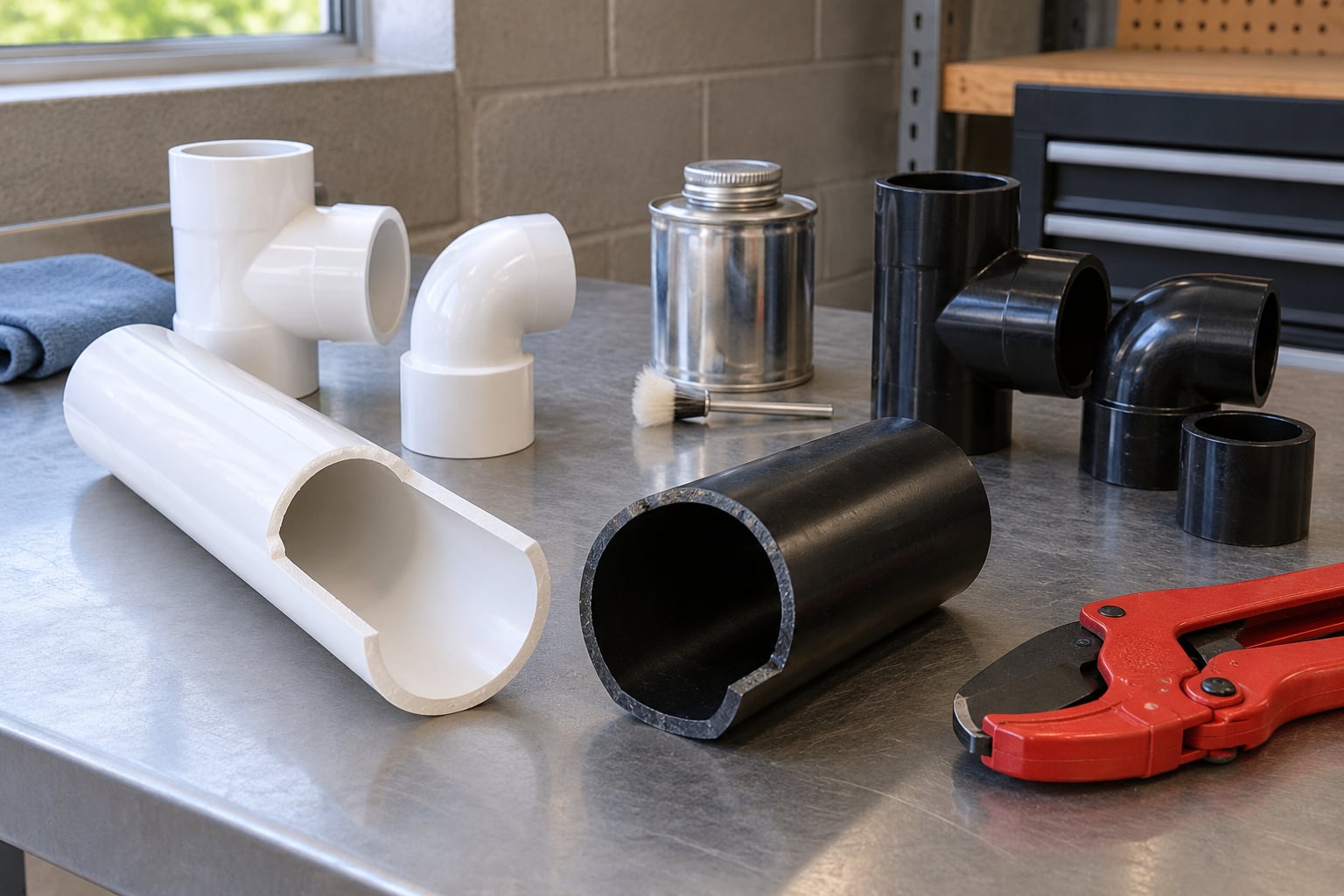
For drain, waste and vent lines, ABS and PVC do the same job, so the choice usually comes down to what is already in the wall, whether noise matters, and how rough the pipe will get handled during and after installation. PVC is the quieter, lighter and cheaper option for indoor and above-ground runs. ABS takes impact better and is the standard pick for buried and cold-exposed lines.
If the question you are actually asking is PVC vs ABS pipe which to use for one specific line, this guide breaks both materials down by pressure, temperature, chemicals and joining method. That decision should take a couple of minutes, not a trip back to the counter.
I have watched both materials get installed on the same job many times over, and the honest truth is that a correct choice of schedule and application matters more than the choice of resin.
Table of Contents
- PVC vs ABS Pipe at a Glance
- PVC vs ABS Pipe: Material, Strength and Durability
- PVC vs ABS Pipe: Temperature and Pressure Performance
- PVC vs ABS Pipe: Chemical and Corrosion Resistance
- PVC vs ABS Pipe: Installation, Joining and Maintenance
- Which PVC vs ABS Pipe Should You Choose?
- Frequently Asked Questions
PVC vs ABS Pipe at a Glance
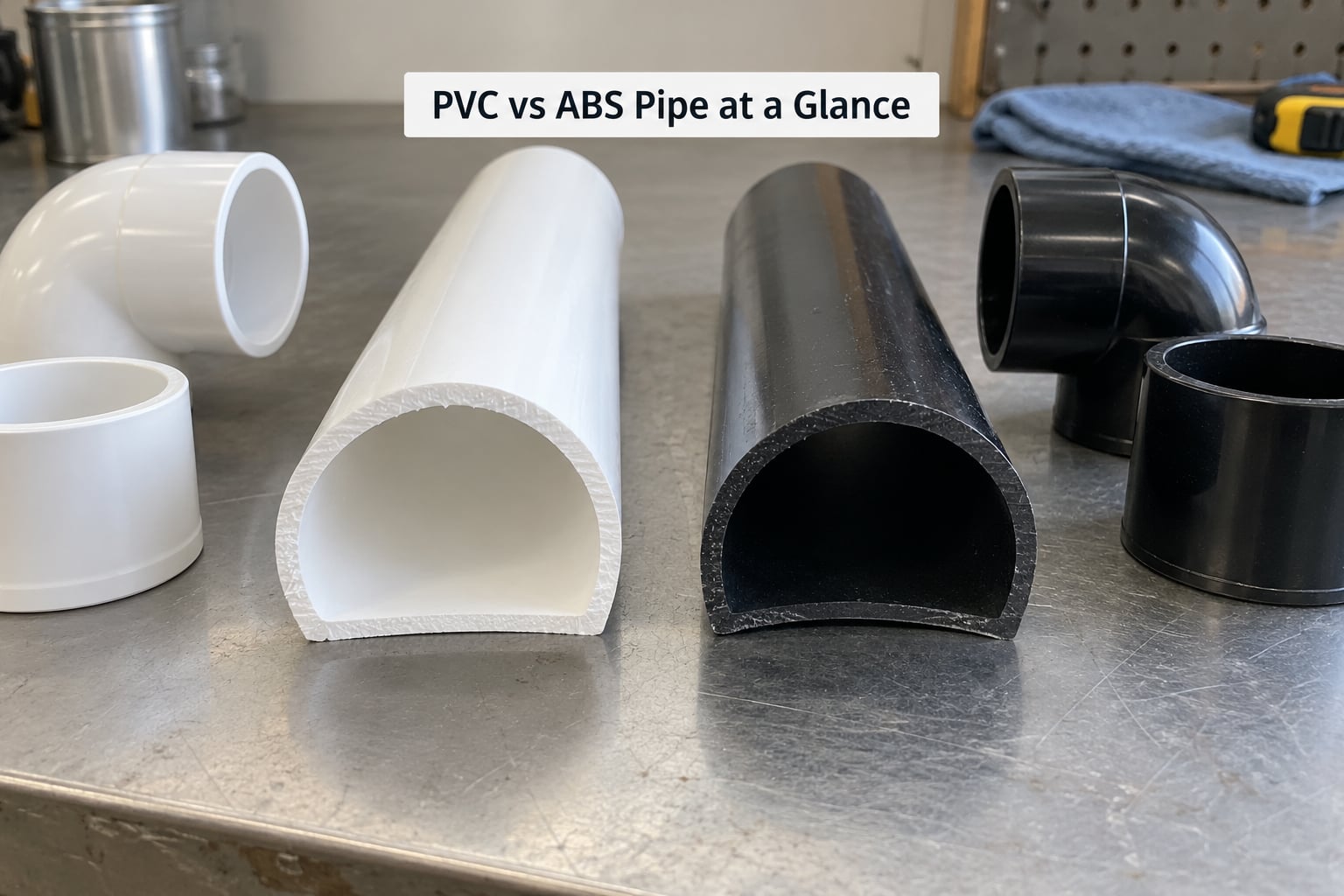
| Factor | PVC pipe | ABS pipe |
|---|---|---|
| Typical colour | White for drain and waste, grey for electrical conduit | Black |
| Main applications | Drain, waste and vent, irrigation, electrical conduit, cold water where marked | Drain, waste and vent, buried sewer, cold and impact-prone runs |
| Joining method | Primer plus PVC solvent cement, two steps | One-step ABS solvent cement |
| Primer required | Yes, almost always | No, unless the product label says otherwise |
| Impact and rough handling | Good, stiff, more likely to crack when cold or struck hard | Very good, rubbery, forgiving of drops and settlement |
| Cold temperature behaviour | Stiffer and more brittle below roughly 40°F | Stiffens too, but fractures far less readily |
| Typical service temperature | Up to about 140°F for DWV and irrigation grades | Up to about 140°F for DWV grades |
| Sunlight exposure | Degrades slowly, needs shielding on long exposed runs | Degrades faster, black surface absorbs heat |
| Noise | Noticeably quieter, the usual choice near bedrooms | Louder, more prone to water hammer |
| Thermal expansion | Low, roughly 3.4 × 10⁻⁵ in/in per °F | Higher, roughly 5.5 × 10⁻⁵ in/in per °F |
| Chemical resistance | Strong against acids, alkalis, salts and clean water | Strong against acids, alkalis and salts, weaker with oils and solvents |
| Relative cost | Lower per foot in every common size | Higher per foot in every common size |
Schedule matters alongside the material. Schedule 40 has a standard wall for gravity drain and general service, while Schedule 80 has a noticeably thicker wall for pressure, burial depth and higher load.
PVC vs ABS Pipe: Material, Strength and Durability
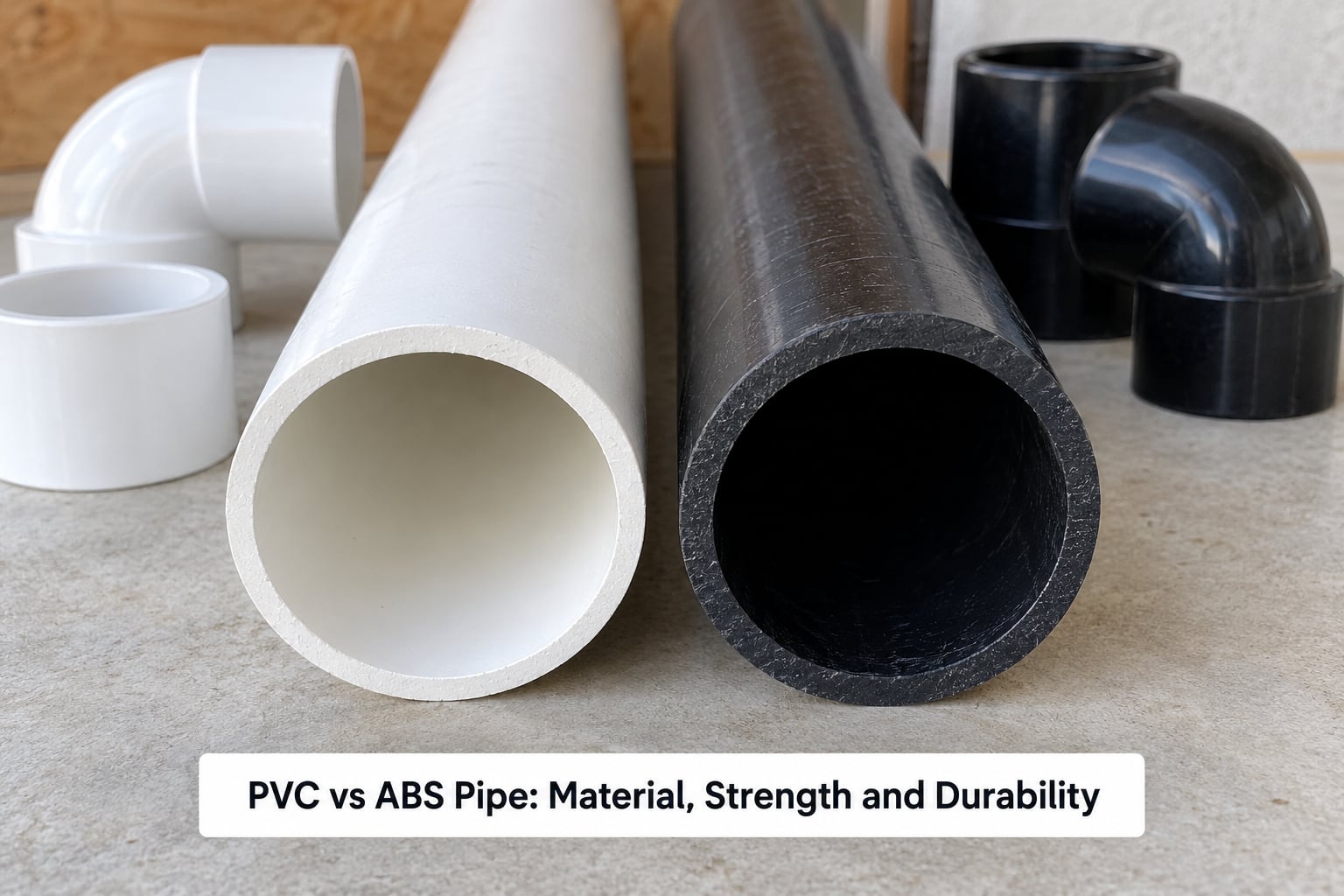
What ABS pipe is made of
ABS is acrylonitrile butadiene styrene, a copolymer built from three monomers. The styrene and acrylonitrile give it rigidity and a surface that resists chemical attack, and the butadiene phase behaves like a fine rubber network suspended inside the hard matrix.
That rubber phase is the whole reason ABS survives being dropped off a truck bed or leaned on during a backfill. It absorbs the energy of an impact instead of passing it straight through to a crack. ABS DWV pipe is commonly made to ASTM D1527, and the fittings are usually moulded from the same family of resin.
What PVC pipe is made of, and why the markings matter
PVC is polyvinyl chloride. Unplasticised PVC is rigid and chemically inert, which is excellent for drain work, but it is a brittle base resin, so most pipe compounds add chlorinated polyethylene impact modifiers along with stabilisers, lubricants and processing aids to hold it together under stress.
Here is the part most online comparisons get wrong: the word PVC on its own tells you almost nothing about what a pipe may be used for. A white pipe printed as DWV, a grey pipe printed as electrical conduit and a beige pipe printed for potable water are all PVC, and they are not interchangeable. Read the printed line on the barrel before anything else.
Formulation is also how material selection differs at the engineering level. When you compare high-temperature engineering resins such as PEEK vs ULTEM for high temperature parts, the same logic applies: the base polymer sets the ceiling, and the additive package decides how close you get to it.
How to tell ABS and PVC apart in ten seconds
- Look at the printed markings along the pipe barrel. Size, schedule, material code, standard and certification marks are all printed there.
- Check for a where permitted stamp if the pipe will do anything other than plain drain and waste.
- Use colour as a last confirmation only: black is almost always ABS, white is usually PVC DWV, grey usually means electrical conduit.
- Look at the fittings. PVC DWV fittings carry a socket whose wall matches pipe outside diameter, and electrical conduit fittings are smooth and non-socketed.
- Tap the pipe. ABS rings slightly and PVC sounds flatter and denser, though this is a confirmation, not a test.
If a pipe has no readable markings, treat it as unidentified and do not load it into a system where code compliance matters.
PVC vs ABS pipe strength: rigidity is not toughness
The honest answer to which pipe is stronger is that it depends on how you load it. PVC has slightly higher stiffness, so a supported span between hangers holds its shape better and shows less sag. ABS has higher impact resistance and fracture toughness, so it shrugs off a hammer blow, a settlement or a freeze event that would split PVC.
Temperature flips the comparison. PVC impact performance drops noticeably in cold conditions, and a pipe that is fine in July can crack in January if it is struck or flexed during a freeze. ABS also stiffens in the cold, but it fractures far less often, which is why it remains the default for unheated spaces, crawlspaces and northern climates.
PVC vs ABS Pipe: Temperature and Pressure Performance
Neither material belongs in a pressurised hot water line, and that is where the temperature question usually leads. Standard PVC and ABS DWV pipe is rated for service up to roughly 140°F, and both lose stiffness as they approach that limit. For potable hot and cold water supply, the correct choices are CPVC or PEX, not DWV pipe of either colour.
On pressure, both materials are limited by the schedule rather than the resin. Schedule 80 wall thickness is what carries higher internal pressure and external burial load, and it is available in PVC across the common residential sizes while ABS pressure-rated stock is harder to source in small quantities. That makes PVC the simpler choice when pressure ratings actually matter.
Thermal expansion is the other number worth knowing. PVC expands less than half as much as ABS for the same temperature change, so a long above-ground ABS run in direct sun needs more care with expansion loops and support spacing. On a buried line the ground holds the temperature steady and the difference largely disappears.
For chemical process lines or anything operating above ambient temperature, check the marked pressure and temperature rating on the specific product class rather than assuming it from the colour.
PVC vs ABS Pipe: Chemical and Corrosion Resistance
Both materials resist corrosion completely, which is their main advantage over the cast iron and galvanised steel they replaced. Neither is attacked by clean water, dilute acids, alkalis, salts or sewage, and both survive burial in most soils without the external corrosion protection steel pipe needs.
They diverge on the organics. ABS is a rubber-modified thermoplastic and tolerates many oils and fats well, but it is vulnerable to a wide range of solvents including many ketones, esters and aromatics. PVC is more resistant to those solvents and is commonly used for chemical waste lines, but it is attacked by aromatic and chlorinated solvents too, so neither material is universally chemical-proof.
If your application is tanks and drums rather than pipe, the comparison in HDPE vs PP for containers is worth a look, since polyolefins take a different set of chemicals again.
PVC vs ABS Pipe: Installation, Joining and Maintenance
Joining is the biggest practical difference between the two. ABS uses a one-step solvent cement to ASTM D2235, and most ABS cements need no primer because the cement itself conditions the mating surfaces. PVC uses a two-step process: primer that softens and cleans the surface, then a PVC solvent cement to ASTM D2564 that fuses the joint.
Skipping the primer on PVC is the single most common cause of a dry-fit-looking joint that later fails. Primers are not optional decoration on PVC, even when the joint will be hidden behind a wall.
How to make a correct PVC-to-ABS transition
- Confirm the existing ABS is a listed DWV system before you touch it, and check the printed markings.
- Use a listed transition cement made for both materials, covered by ASTM D3138 for non-pressure service, or use a listed mechanical transition coupling such as a rubber coupling with stainless clamps.
- Never use an all-purpose or general-purpose PVC cement on an ABS joint. It is the top reported cause of failed transition joints.
- Cut square, ream the burr off the inside of the pipe, and dry fit to the full hub depth with a slight chamfer on the pipe end.
- Apply the correct cement, push to the full socket depth, hold for 20 to 30 seconds, and let it cure before the joint is loaded or the line is filled.
- Run water or air through the completed section and check for weeping before anything is closed up.
Support spacing, slope and trap configuration matter more to how a drain line performs than the resin choice. Keep the pipe supported at the spacing listed for its schedule, maintain a consistent fall, and keep cleanouts accessible where the code expects them.
Maintenance in service is light for both materials. Neither rusts, neither needs painting, and both last for decades when installed to a supported, correctly sloped system. Plastic pipe does not really get repaired, so when a joint drips the practical move is to cut it out and re-splice with new fittings rather than try to patch it.
At end of life the two are handled differently. PVC is accepted more readily by some recycling streams because of its chlorine content and the additives it carries, which is the same reason compostable plastics such as those covered in PLA vs PHA for compostable packaging get separated at the front end of a sorting line.
Which PVC vs ABS Pipe Should You Choose?
| Application | Recommended material | Why |
|---|---|---|
| Buried sewer and drain line | ABS or PVC | Both work buried; ABS takes settlement and root-adjacent disturbance better |
| Basement and interior DWV rough-in | PVC | Quieter, cheaper, more play in tight stud bays |
| Shower and tub drain | Match the existing system | Transition fittings are code-compliant but add a failure point |
| Above-ground outdoor run | PVC | Lighter to support, slower to degrade in sunlight, cheaper to run long distances |
| Unheated crawlspace or garage | ABS | Better impact and low-temperature fracture behaviour |
| Potable cold water | PVC marked for potable use, or PEX | DWV pipe is not approved for pressurised supply |
| Potable hot and cold water | CPVC or PEX | Neither standard PVC nor ABS handles hot water supply |
| Electrical conduit | PVC | ABS conduit is rarely listed for this use and offers no benefit |
| Irrigation and hydroponics | PVC | Cheaper, better UV behaviour on exposed runs, wide fitting availability |
The practical decision rule I give crews is short: match what is already installed unless there is a specific reason not to, choose PVC where noise, cost or exposure matters, and choose ABS where the pipe will be handled hard or run cold.
Two applications deserve a firm boundary. Never use DWV pipe, of either colour, as a pressurised supply line, and never use either material for furnace or flue venting unless the pipe is specifically listed for that duty and the manufacturer says so.
Code varies by jurisdiction. Some areas restrict ABS, require listing marks to be legible, or require a permit and inspection for any change to the drainage system, so read the local code before a buried run or anything behind a finished wall.
Frequently Asked Questions
Is ABS pipe stronger than PVC pipe?
It depends on the load. PVC is stiffer, so a supported horizontal span sags less between hangers. ABS has better impact and fracture resistance, so it survives drops, settlement and freezing better than PVC, which becomes more brittle in cold weather. For rough handling, buried lines and unheated spaces, ABS usually lasts longer in practice.
Can PVC or ABS pipe be used for drinking water?
Only if the pipe is marked for that use. Both materials are made in potable grades, but standard DWV pipe is not approved for pressure supply lines. Read the printed markings for a potable certification and confirm it meets the local code, because colour alone tells you nothing about approval.
Which pipe is better for hot water?
Neither standard PVC nor ABS is the right answer. Both are typically rated to around 140°F and lose stiffness near that limit. For potable hot and cold water supply, use CPVC or PEX, which are made and certified for that service. Using DWV pipe on a hot water line is a common and expensive mistake.
Can PVC and ABS pipe be connected together?
Yes, using a listed transition fitting or a cement made for both materials, such as one covered by ASTM D3138 for non-pressure service. A mechanical transition coupling with stainless clamps also works. Never use a general-purpose PVC cement on an ABS joint, because the solvent system does not match the ABS resin.
Is ABS pipe suitable for outdoor drainage?
For buried and ground-level drainage, ABS is an excellent choice because it resists impact and cold cracking. For long above-ground runs, PVC is usually easier and cheaper, and both materials degrade under prolonged sunlight, so exposed pipe should be shielded or the run kept short.
How do I choose between Schedule 40 PVC and ABS pipe?
Start with the wall thickness you need. Schedule 80 has a thicker wall for pressure, deep burial and heavier loads, and it is far easier to find in PVC than in ABS at residential sizes. Schedule 40 suits normal gravity drainage. Then pick the resin based on noise, handling and temperature at the install location.
To start, read the printed markings on whatever pipe is already there, then match it. Swap to PVC if noise, cost or sunlight exposure drives the decision, choose ABS if the line gets handled hard or runs cold, and leave both materials out of anything carrying hot or pressurised water.