
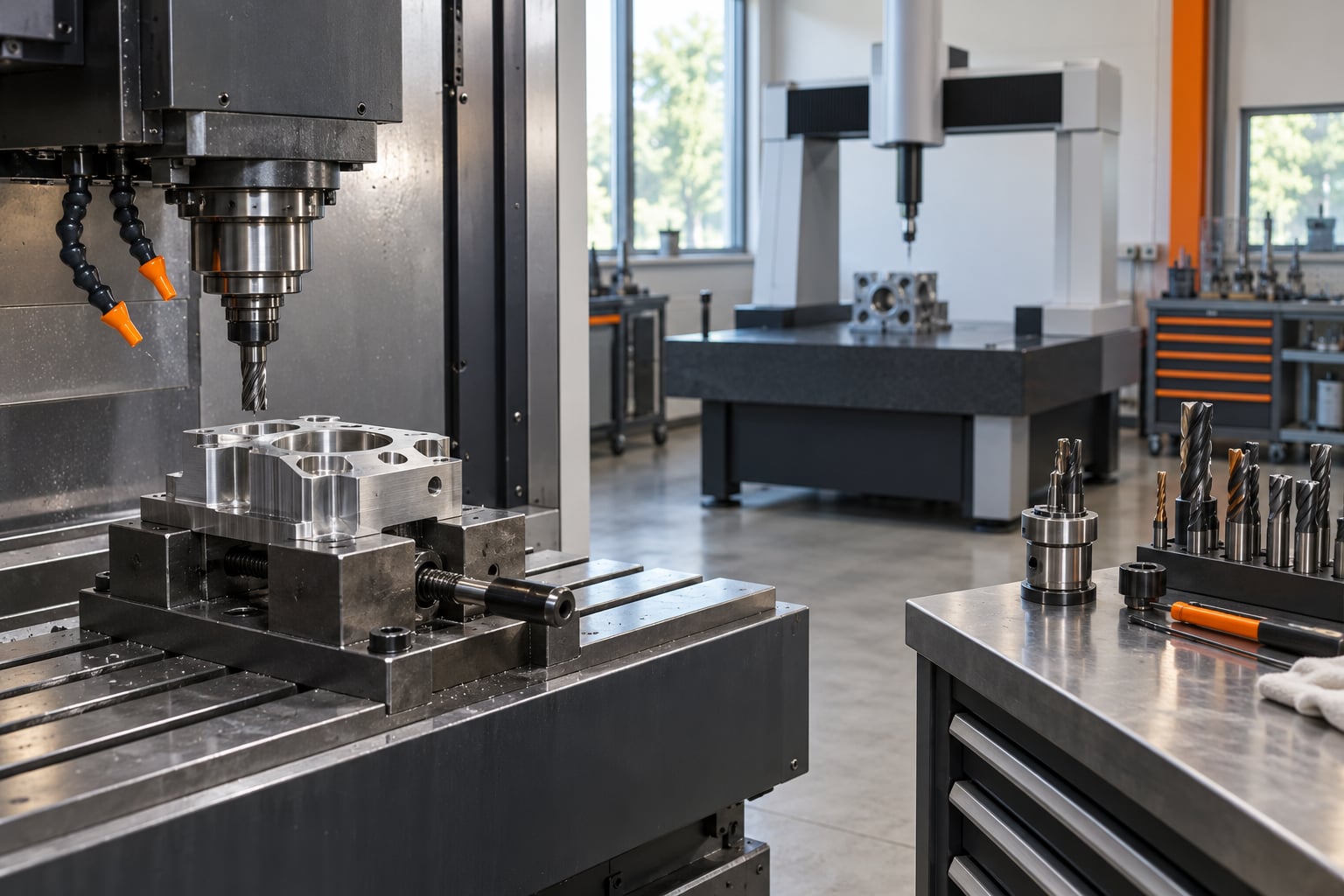
Choosing a CNC machine shop comes down to evidence. Can the shop hold your tolerances repeatably, show you inspection data instead of adjectives, and produce the same part again next quarter at the same quality? A capable shop answers with documents, numbers and a first article report you can read line by line. This guide walks through the nine-step process for qualifying a supplier for production work, from the manufacturing brief to the trial order that settles the decision.
A CNC machine shop is a manufacturing facility that cuts precision parts from metal, plastic or composite using computer-controlled milling, turning and related equipment, usually with its own programming, inspection and finishing capability in house. Engineers, product managers and procurement teams use these shops for everything from one-off prototypes to repeat production runs of tens of thousands of pieces.
The mistake most buyers make is treating supplier selection like a purchasing transaction. The shop you pick decides whether parts meet tolerance consistently, arrive when the line needs them, and can be made again next quarter without a requalification cycle. A bad choice shows up as missed launches, scrapped inventory and rework weeks after the purchase order closed.
Last updated for 2026.
Table of Contents
- What You Need
- Step-by-Step: How to Choose a CNC Machine Shop
- Step 1: Define the Part and Production Requirements
- Step 2: Verify CNC Processes and Machine Capabilities
- Step 3: Confirm Materials and Supply-Chain Expertise
- Step 4: Evaluate Quality Systems and Inspection Capability
- Step 5: Compare Total Cost and Quote Clarity
- Step 6: Test Communication and Engineering Support
- Step 7: Validate Capacity, Lead Time, and Delivery Reliability
- Step 8: Reduce Risk Before Committing to Production
- Step 9: Run a Controlled Trial and Select the Shop
- Common Mistakes
- Frequently Asked Questions
- Conclusion
What You Need
Before you contact a single shop, assemble the things that make quotes comparable. Without them you are comparing shops on vibes, and the shop that answers fastest often just guesses best.
- Drawings or 3D models. Send native CAD files (STEP, IGES, Parasolid X_T) rather than a PDF where you can, and mark the revision clearly on the print.
- A defined tolerance block. Which features are tight, and which are free to float. A tolerance of plus or minus 0.005 mm on a non-critical feature can double the price for no reason.
- Material specification. Grade, standard and any mill certificate requirement, plus whether the material must be sourced from an approved list.
- Surface finish targets. State the finish as a roughness value (Ra) rather than a loose descriptor like “as machined” or “smooth”.
- Quantity split. Prototype quantity, first production run, and expected annual volume. This drives setup amortization more than anything else in the quote.
- Inspection scope. Which dimensions get measured, on what equipment, and whether you want a first article inspection report on every lot or only the first.
- Target cost and delivery window. Even a rough range tells a shop which process route to propose.
- Compliance requirements. ISO 9001:2015, AS9100 for aerospace, ISO 13485 for medical, ITAR registration for defense-related work, NADCAP where special processes apply.
Send the identical package to every shop, in the same format, on the same day. That alone removes most of the noise from a quote comparison.
Step-by-Step: How to Choose a CNC Machine Shop
Step 1: Define the Part and Production Requirements
Turn the project into a one-page manufacturing brief before any shop sees it. Write down the geometry, material, tightest tolerance, surface finish, quantity split, target unit cost, required date and the end use of the part.
The end-use detail matters more than buyers expect. A component that sits inside a housing rarely needs the same tolerance stack as one that carries load or sees thermal cycling. Shops will ask, and a clear answer shortens the quote cycle by days.
If a drawing has features you are not sure about, mark them. “Confirm achievable” on a print is better than silence, because it gives the shop permission to push back during review.
Step 2: Verify CNC Processes and Machine Capabilities
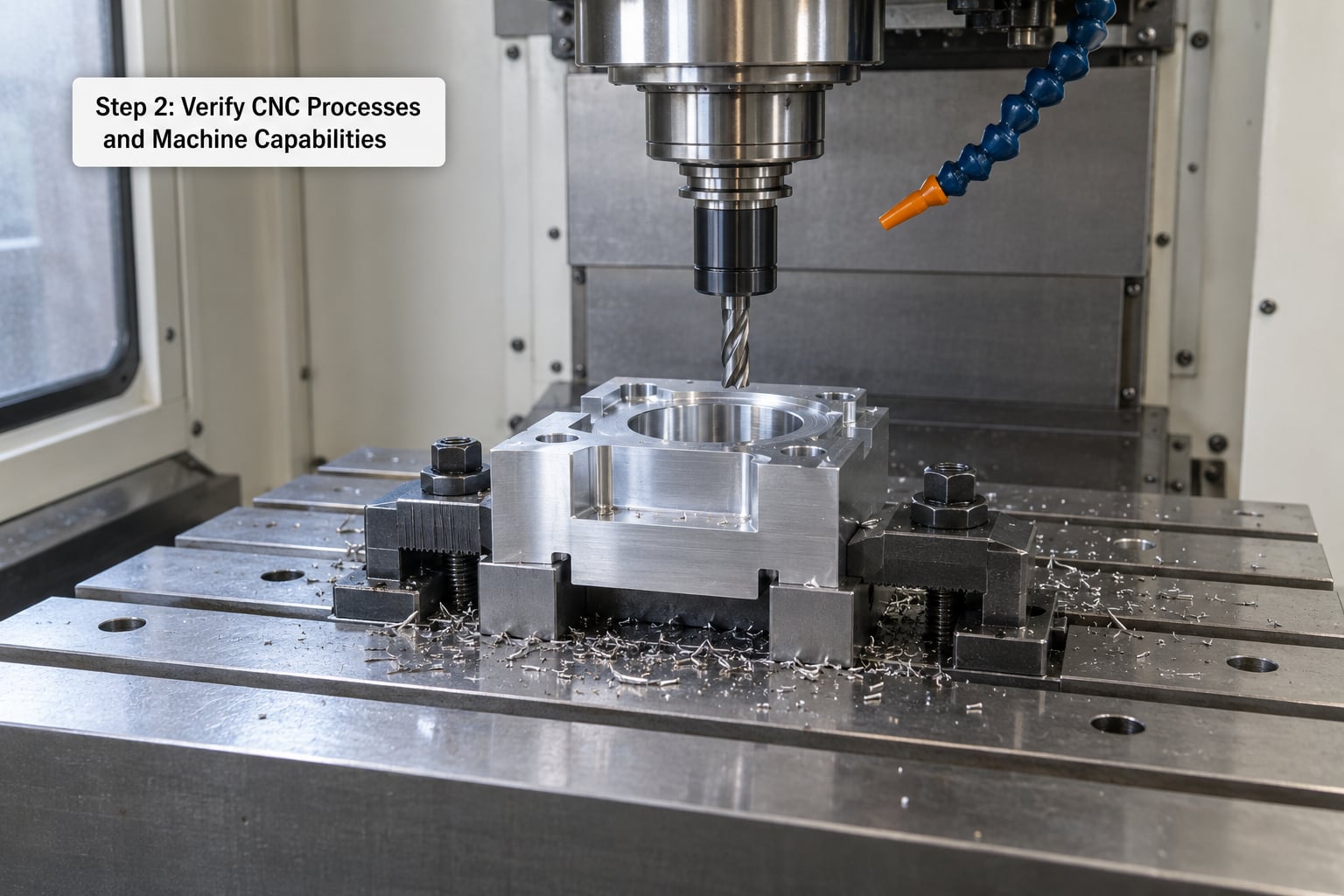
Ask which machines will actually run your part, and in which process route: 3-axis or 4-axis milling, 5-axis milling for complex geometry, CNC turning centers, mill-turning, Swiss screw machining for small turned parts, or wire EDM for sharp internal corners and hard materials.
Get the envelope numbers: maximum part size, maximum swing, and the tightest tolerance the shop holds routinely on production work rather than on one-off prototypes. If your part needs multi-axis work, ask which post processor will program it and whether that programmer is on staff or subcontracted.
One useful test: name a tolerance you are considering and ask whether the shop has run that tight on similar geometry before. Shops that answer with the machine model and a cycle time are telling you something real. Shops that answer with adjectives are not.
Step 3: Confirm Materials and Supply-Chain Expertise
Material sourcing is where a shop’s capability quietly shows. Ask where bar and plate come from, whether they can supply a mill test certificate (MTC) for traceability, and how they verify the incoming grade before it hits a spindle.
Different materials punish shops in different ways. Aluminum moves as it comes off the tool and demands stable fixturing. Stainless work-hardens during machining and changes cutting behaviour part to part. Titanium and Inconel generate heat that pushes tool life down. Engineering polymers warp or swell with clamping. A shop that machines only aluminum will tell you so if you ask what else runs on that machine.
For regulated programs, ask how material is segregated and how lots are traced to the parts built from them. If they cannot describe it, traceability does not exist in their system.
Step 4: Evaluate Quality Systems and Inspection Capability
Ask for a sample first article inspection (FAI) report on a part similar to yours, with real dimensions and instrument IDs. Ask for the calibration schedule and instrument list, including the interval for the coordinate measuring machine (CMM).
A real FAI report lists every characteristic on the drawing, the measured value, the instrument used, and a pass or fail. It is not a cover page saying the parts are good. A shop with no report to show is telling you inspection happens by eye and by caliper at the end of a run.
Then look at the process behind the report: in-process checks during machining, documented corrective action when something goes out of spec, and a root cause analysis that reaches the cause rather than the symptom. Some shops run in-process vision or probe-based checks during the cut rather than measuring finished parts; our guide to how machine vision inspection systems work explains what that looks like in practice.
Certification is a floor, not a ceiling. ISO 9001:2015 covers the quality system broadly, AS9100 adds the aerospace and defense requirements, ISO 13485 governs medical device manufacturing, and ITAR registration is about handling controlled technical data. For non-regulated commercial work, a documented system with real inspection records matters more than the certificate on the wall.
Step 5: Compare Total Cost and Quote Clarity
Unit price is the least useful number in a machining quote. Normalize each quote into the same columns before comparing: material, setup and programming hours, machining cycle time, tooling, finishing, inspection, packaging, freight and payment terms.
Understanding how a CNC quote is built helps more than it sounds. A shop prices setup and programming hours because the programmer has to model the part, choose tools, write the program, prove it and often watch the first run. Cycle time gets multiplied by a machine rate that covers labor, depreciation, tooling, overhead and margin. Break-even against conventional machining is real at low quantity for this reason, and a shop with in-house CAM and lights-out capability can push that break-even lower.
The levers you control are quantity, tolerance, material, finish and consolidation of parts onto one setup. If you want the machine hour rate math behind the quote, that article walks through how rates are built and where they vary.
Watch for charges that appear after you accept: minimum order value, setup or programming fees billed separately, expedite premiums, and packaging or freight added at invoicing. A quote that excludes them is not cheaper, only less complete.
Step 6: Test Communication and Engineering Support
Send a question that requires engineering judgment, not lookup. Something like whether a specific feature should be machined in one setup or split, and why. Then watch the response time and the depth of the answer.
Machinists on r/Machinists and The Hobby-Machinist consistently say the same thing here: a shop that gives free, fast, specific design for manufacturability (DFM) feedback is usually a better partner than one that says yes to everything. Constructive pushback on your drawing is the behavior you want, because it happens now, before the part is cut, instead of during an inspection rejection.
Also check the practical things: a named point of contact, a clear escalation path, and whether revision changes come with written change notices. Quiet shops and over-communicating shops both exist; the skill is a named contact who tells you early when something slips.
Step 7: Validate Capacity, Lead Time, and Delivery Reliability
Capability on paper is not capacity in practice. Ask what the shop’s current workload looks like, how many machines run your process family, and how scheduling works when two jobs collide.
The scale question deserves a separate conversation. Shops that look excellent on a prototype can struggle when a program grows several times over, because they may have been quoting you on one machine held by one programmer. Ask directly how your volume growth would be absorbed, and whether they run lights-out or robotic loading on their high-volume work.
On scheduling, get realistic numbers and honest expedite costs in writing. A shop that promises the original date for everything has not thought about your schedule, and you will find out later when a full queue lands in front of your order.
Step 8: Reduce Risk Before Committing to Production
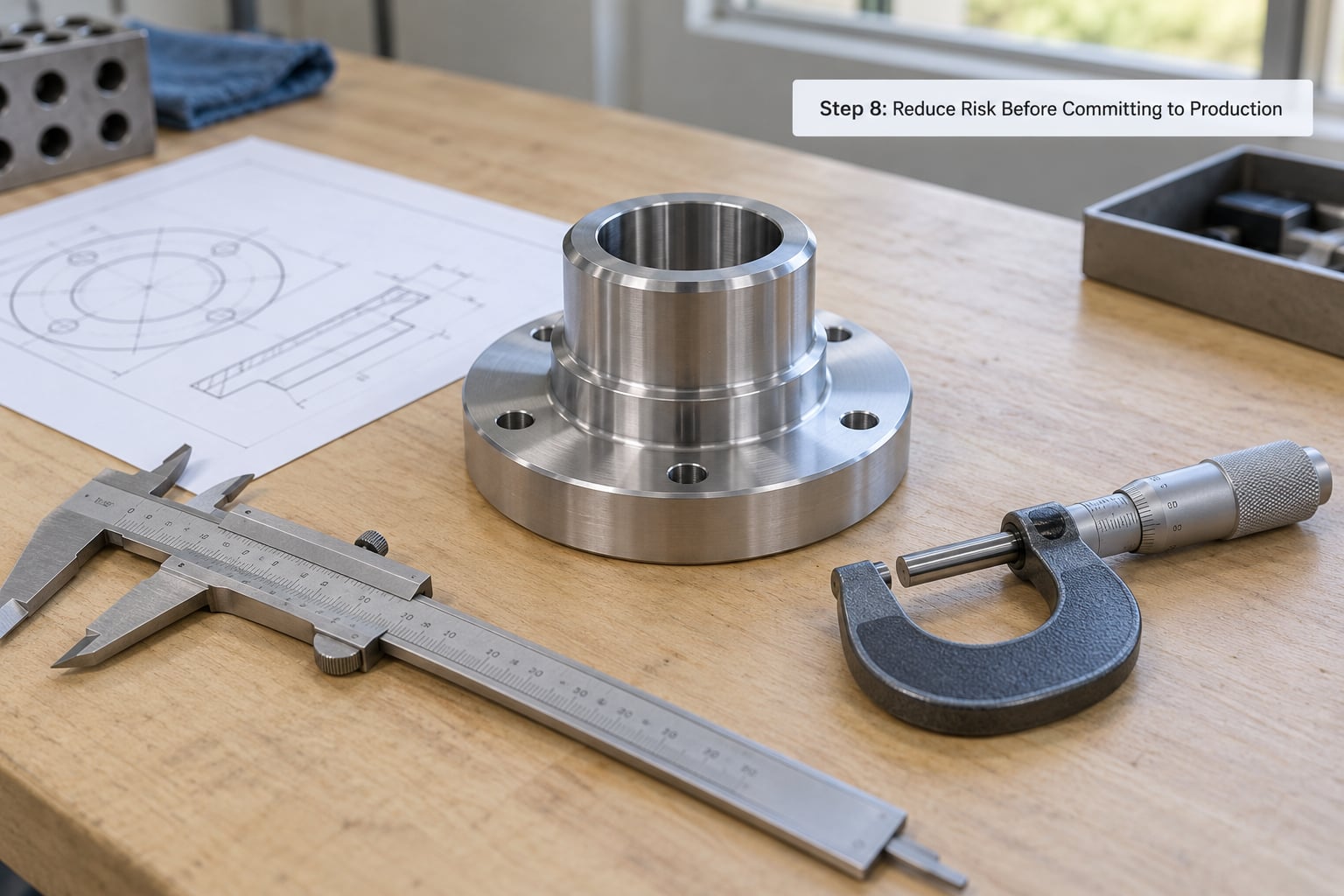
Sign an NDA before drawings go out, every time. Practitioners treat this as non-negotiable, because drawings sent to multiple shops in the clear are drawings that may turn up somewhere else.
Then get the commercial terms in writing: a stated tolerance commitment, who pays return freight for rejected parts, what happens when a lot fails inspection, warranty and rework terms, notice periods, and whether you can exit if quality slips. A supplier scorecard with a review cadence and an agreed corrective action path prevents the annual argument about whether things improved.
For critical production, ask whether you can visit. Experienced buyers rate a facility tour or a live video walkthrough of the specific machines as one of the highest-value checks available, because it reveals setup discipline and housekeeping that a capability sheet cannot. It also answers the question every buyer should ask: who actually machines the parts, and what gets subcontracted to whom.
Step 9: Run a Controlled Trial and Select the Shop
Run a paid trial order of a few parts, with an FAI report requested and a defined acceptance criterion. Three to five pieces is enough to expose setup errors, fixturing problems and a shop that cannot repeat itself.
Read that report line by line, then measure the parts yourself. Compare the result against a weighted scorecard rather than a gut feeling: capability fit, quality evidence, delivery reliability, communication, total cost and compliance. Set the weights before you look at the results, because after seeing three quotes your judgment drifts toward whichever number you liked.
For programs that outgrow a job shop, it is worth reading how to choose a contract manufacturer, since the next step up involves different ownership of tooling, quality and capacity. Then document the decision, agree production expectations, and put the trial order’s lessons into the purchase agreement.
Common Mistakes
Awarding to the lowest bid. The fix: compare landed cost including expected scrap, freight and inspection, and ask each shop what assumptions their number rests on. A tight-tolerance quote far below the others usually signals skipped inspection rather than better pricing.
Sending incomplete drawings. A print with no tolerance block, no finish callout and no quantity invites a quote on the easiest possible interpretation. The fix: complete the brief from step one before anything leaves your inbox.
Treating stated tolerance as capability. Claims are marketing; CMM reports and calibration records are evidence. The fix: ask for a sample FAI report and confirm the instrument ID appears on it.
Not verifying capacity. The fix: ask how your volume growth would be absorbed and which specific machines run the work. If the answer names one machine and one programmer, you have your risk figure.
Skipping the sample approval. Machinists across r/CNC and Practical Machinist call the small paid prototype the cheapest real capability test available, and it is. The fix: never move to production volume on a first article you have not measured yourself.
Sending drawings before the NDA. The fix: NDA first, files second, every time, including instant-quote platforms.
Trusting instant quotes with no drawing review. A number returned in minutes without a manufacturability review is usually an automated guess or a middleman, not an engineering commitment. The fix: ask which engineer reviewed it and what they changed.
Leaving inspection and delivery terms undefined. The fix: put the inspection scope, the reporting obligation, the tolerance commitment and the delay notice process in the purchase order, not in a follow-up email thread.
Two patterns from the forums are worth carrying into every evaluation. Buyers on The Hobby-Machinist say the deciding factor is rarely the machine list but whether the shop’s process is documented and repeatable rather than dependent on one talented programmer. And shop-side discussion confirms that a large share of cheap quotes come from shops that subcontract the actual machining, which is why asking who machines your parts matters so much.
Frequently Asked Questions
How do I know if a CNC machine shop is reliable?
Reliability shows up in evidence rather than claims. Ask for a sample first article inspection report with real dimensions and instrument IDs, the calibration schedule for their measuring equipment, and a written tolerance commitment. Then run a small paid order of three to five parts and measure the parts yourself. A shop that documents its process, tells you who machines the parts and repeats its results on a trial order is the one you can plan a production schedule around.
How many quotes should I request for CNC machining?
Two or three quotes for complex or regulated work, sent as identical packages on the same day. A broad request to fifteen shops rarely helps on anything with real tolerances, because you get auto-generated guesses instead of engineering-reviewed numbers. Send the same drawing, tolerance block and quantity split to each shop, then compare on normalized total cost rather than unit price.
Is a local machine shop better than an offshore supplier?
It depends on where your risk sits. Local shops cost more per part and buy you faster turns, easy physical inspection, no timezone gap and easier handling of revisions and expedite work. Offshore suppliers bring lower unit cost, more capacity and often deeper process capability, and they add language, data-handling, tariff and long-lead logistics considerations. For prototypes, low volume and tight iteration cycles, local usually wins. For stable high-volume production, offshore is often the better cost structure.
How much does it cost to get a part CNC machined?
The number comes from four things: material cost, setup and programming hours, cycle time multiplied by the machine rate, and finishing plus inspection. Setup dominates at prototype quantities and amortizes across the run, so quantity has the largest effect on unit cost of anything you control. Ask shops for a quantity break at three tiers so you can see the curve rather than a single number.
What is a first article inspection report?
An FAI report is the measured record of the first part off the machine: every characteristic on the drawing, the measured value, the instrument used and a pass or fail against the tolerance. It is how a buyer confirms the shop can hit the print before a full run is cut. Ask for one on every program, and read it yourself rather than accepting a summary, because it is also the best evidence of how their inspection process actually works.
What certifications should a CNC machine shop have?
Match the certification to the program. ISO 9001:2015 covers a documented quality system and suits commercial work. AS9100 governs aerospace and defense, ISO 13485 governs medical device manufacturing, and ITAR registration covers handling controlled technical data for defense work. For non-regulated parts, none of these is mandatory, and real inspection records plus calibrated equipment matter more than a certificate. Confirm current certification dates rather than trusting a logo.
Conclusion
Start tomorrow by writing the one-page manufacturing brief: geometry, material, tolerances, finish, quantity split, inspection scope and required date. Send that identical package to two or three qualified CNC machine shops, ask for a sample first article report and the calibration schedule, and compare quotes on total cost rather than unit price. Then run a small paid trial order and measure the parts yourself. The shop that documents its process and repeats its result on that trial is the one to sign.
Everything above comes back to one question. How to choose a CNC machine shop properly means buying evidence: capability demonstrated on a similar part, quality shown in inspection records, capacity confirmed against your real volume, and terms written down before the first production order. A shop that answers those questions in detail is worth more than one that answers them fastest.