
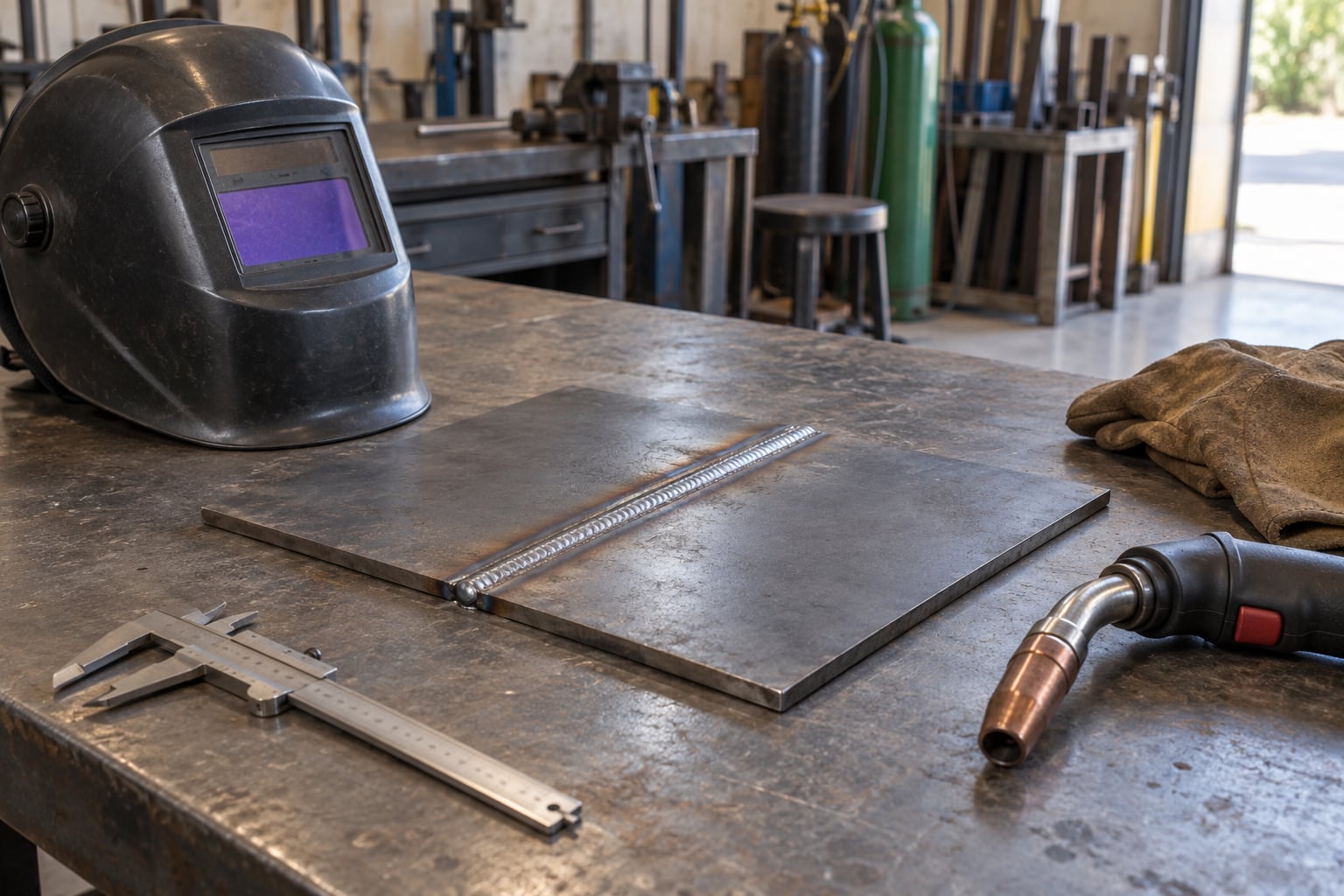
Welding is a permanent joining process that fuses two or more metal parts by melting filler metal or the base metal itself with an arc, a gas flame, an electric current, focused light or friction, then letting the joint cool into one solid piece. There are several types of welding processes, and they differ most in how the heat reaches the metal, what materials they join and how fast they run in production. This guide compares the major families so you can pick one that fits the job, the volume and the quality the part has to hold.
Worth saying plainly: there is no single best process. A thin aluminium enclosure and a 40 mm pressure vessel shell might share the same shop and almost nothing else, and a process that is perfect for one will fail on the other.
Table of Contents
- Types of Welding Processes Explained: What Is Welding?
- What Are the Main Welding Process Categories?
- Gas and Flame Welding Processes
- Resistance Welding Processes
- High-Energy and Precision Welding Processes
- How to Choose the Right Welding Process
- Welding Process Comparison: Strength, Speed, Cost, and Quality
- What Quality Controls Are Used for Welded Joints?
- Welding Process Safety and Production Considerations
- Frequently Asked Questions
- Conclusion
Types of Welding Processes Explained: What Is Welding?
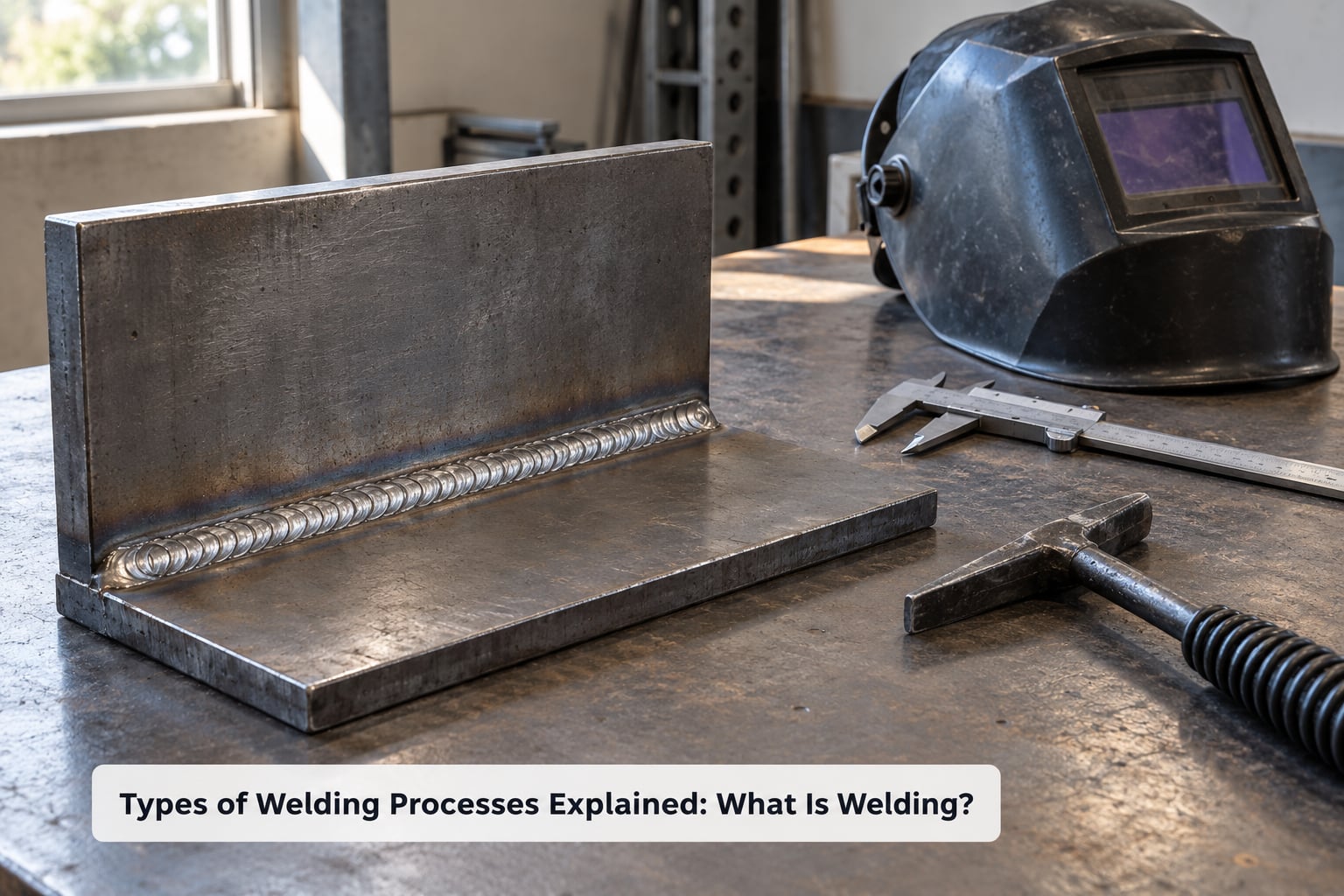
A welding process uses heat, pressure or a combination of both to create a joint that is as strong as, or stronger than, the parent metal. The heat melts the surfaces, a filler metal or the base material flows into the gap, and the pool solidifies into a continuous metallurgical bond.
That bond is what separates welding from the alternatives. Brazing and soldering do not melt the base metal; the filler melts at a lower temperature and flows into the gap by capillary action, which makes the joint weaker and unsuitable for high load or high temperature service. Adhesive bonding and mechanical fastening join parts without any metallurgical bond at all.
Most process comparisons come down to six questions: what the heat source is, what joint design the process tolerates, what base materials it handles, whether it can be done in every welding position, what the production volume looks like, and what quality level the finished joint has to reach. Everything else is a detail inside one of those six.
What Are the Main Welding Process Categories?
Search results say there are four types, five types or seven types of welding processes, and all three answers are defensible. The difference is counting method, not disagreement about the physics. Two or three categories split welding by how the joint forms; four, five or seven splits it by individual named processes.
- Fusion welding melts the base metal, filler metal or both at the joint. Almost all arc welding and gas welding sits here.
- Resistance welding generates heat from the electrical resistance of the contact area itself, with no arc and no melt pool.
- Solid-state welding joins metals by pressure at temperatures below their melting point, often using friction or an ultrasonic vibration.
- Pressure-assisted thermal welding applies force while heating, so parts collapse onto each other and consolidate without reaching a liquid pool. This is a useful fourth category if your classification calls for four.
Split the same family by individual processes and you get the common counts: gas welding, arc welding, resistance welding, laser welding, electron beam welding and ultrasonic welding give the six-process version, and splitting arc welding into shielded metal arc, gas metal arc, flux cored arc, gas tungsten arc and submerged arc gives the seven-process version. Whichever number your spec sheet uses, the categories underneath do not change.
| Family | How the joint forms | Typical materials | Best suited to | Main advantage |
|---|---|---|---|---|
| Gas and flame welding | Fuel gas burns in oxygen to melt metal | Mild steel, cast iron, copper, brass | Repair work, thin sections, tube joints | Simple, portable, no electricity needed |
| Arc welding | Electric arc melts electrode or base metal | Most steels, stainless, aluminium, nickel alloys | General fabrication, structural work, production lines | Widest material and thickness range in common use |
| Resistance welding | Current heats the contact point under pressure | Sheet metal, tube, wire, automotive panels | High-volume sheet and enclosure assembly | Seconds per joint and no filler metal |
| Laser and electron beam welding | Focused energy beam melts a small, narrow pool | Stainless, carbon steel, plastics, exotic alloys | Precision, low-distortion, sealed joints | Tiny heat affected zone and clean seams |
| Solid-state welding | Friction or vibration plus pressure below melting point | Plastics, dissimilar metals, automotive components | Plastics, mixed metal stacks, hermetic seals | Fast cycle times and minimal heat input |
Gas and Flame Welding Processes
Oxy-fuel gas welding uses a flame burning acetylene or another fuel gas in pure oxygen to melt the joint and a filler rod. It is the slowest and least precise of the common processes, but the equipment is cheap, it needs no mains power and it still earns its place for repair work, cast iron, tube joints and non-ferrous metals where an arc process is hard to control.
The two other gas-related processes people ask about are arc processes, and it is worth saying so plainly. Gas metal arc welding (GMAW), usually called MIG in North America and MAG in Europe, melts a continuously fed wire electrode and covers the pool with argon, carbon dioxide or a blend of both. Gas tungsten arc welding (GTAW, or TIG) uses a non-consumable tungsten electrode with separate filler rod added by hand, and it produces the cleanest bead of any manual arc process. Plasma arc welding (PAW) uses an ionized gas column between a non-consumable electrode and the workpiece, which concentrates more heat than a plain arc and cuts travel time on thicker plate and stainless.
Across all three, the choice is straightforward. GMAW moves the most metal per hour and suits production. GTAW gives the control needed for thin material, non-ferrous metals and joints where appearance or integrity matters. PAW sits between them, with a concentrated arc that is easier to automate than GTAW.
| Process | Heat source | Filler metal | Shielding | Advantages | Limitations | Typical use |
|---|---|---|---|---|---|---|
| Oxy-fuel gas welding | Fuel gas flame | Filler rod, optional | None | Portable, low equipment need, works on cast iron and non-ferrous | Slow, wide heat affected zone, hard on thin material | Repair, tube joints, thin-wall work |
| GMAW (MIG/MAG) | Electric arc | Consumable wire electrode | Argon, CO2 or blend | High deposition rate, easy to automate, all-position capable | Spatter on thin material, needs gas, moderate finish quality | Structural steel, sheet metal, production lines |
| GTAW (TIG) | Electric arc | Separate filler rod or autogenous | Argon or argon-helium mix | Cleanest weld, precise heat control, works on very thin and non-ferrous material | Slowest of the arc processes, highest operator skill, needs clean material | Aerospace, stainless, aluminium, thin-wall tube |
| PAW | Ionized plasma column | Consumable or separate filler | Argon, argon-helium, or nitrogen | More heat concentration than TIG, deep penetration, cut and weld capability | Torch and power source cost more than GTAW | Stainless, heavy fabrication, mechanized welding |
One cleanup factor deserves a mention because shop owners notice it immediately. SMAW and FCAW leave a slag layer that has to be chipped and brushed between passes. GMAW leaves light spatter. Autogenous GTAW leaves almost nothing. On a job with many welds, that difference adds up to real hours.
Resistance Welding Processes
Resistance welding forms the joint by passing a high current through the two clamped parts for a fraction of a second. The narrow contact area has the highest electrical resistance, so it heats first, softens and collapses under the electrode force, then solidifies into a weld nugget. There is no filler metal and no liquid pool, which is why the process is so fast and so clean by arc welding standards.
- Resistance spot welding (RSW) makes a single nugget per cycle under opposing copper electrodes. It is the highest-volume joining process in automotive body-in-white assembly.
- Resistance seam welding runs a series of overlapping nuggets along a seam using wheel electrodes.
- Projection welding uses shaped projections on the parts themselves, so current concentrates along a whole flange or a small assembly rather than at one point.
- Butt or upset welding clamps the parts face to face, heats the interface and squeezes the softened metal outward to form the weld.
Tooling is the heart of it. A fixed lower tool and a moving upper tool carry several hundred amps at several hundred cycles per minute, and the quality of the joint depends on electrode force, weld current, weld time and electrode tip diameter. A worn or contaminated tip raises contact resistance and leaves a dull, weak nugget, which is why tip dressing appears in every resistance welding maintenance schedule.
Because the parts must be conductive and relatively thin, resistance welding suits sheet metal, wire, tube and mesh. It is difficult on thick sections, it cannot reach into a deep narrow joint, and the tooling has to match the part, so it only makes economic sense where the volume runs in the thousands. Typical homes are automotive, appliance white goods, metal furniture, electronics enclosures and HVAC ducting.
High-Energy and Precision Welding Processes
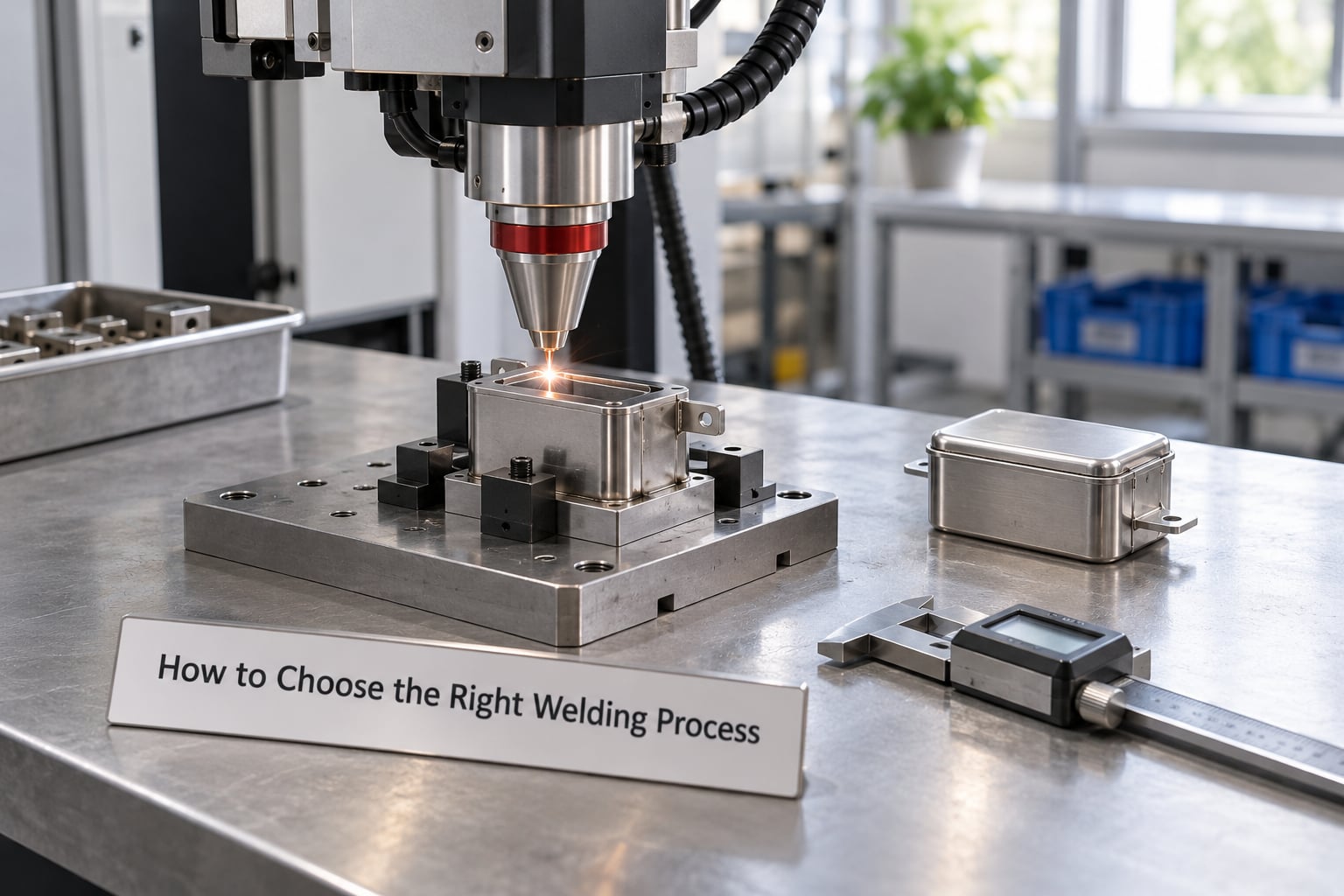
Laser beam welding concentrates a focused beam into a spot the size of a pencil eraser. The heat affected zone is narrow, the seam is smooth enough to skip finishing, and distortion stays low because the surrounding metal barely heats. Cycle times on thin sheet run well under a second, which makes laser welding the default for battery housings, medical devices and sealed electronics enclosures. The limits are equipment cost, the need for fume extraction and a good surface finish going in, and reflective materials such as aluminium that need surface treatment to control the beam.
Electron beam welding does the same thing with far more focus. In a vacuum the beam can produce a deep, narrow weld with an exceptionally small heat affected zone, which is why it appears in aerospace and other critical work. The vacuum chamber, the chamber load time and limited access to the joint keep it away from ordinary production lines.
Ultrasonic welding is different again: it applies high-frequency vibration under pressure to soften a thin metal sheet, and the same principle joins plastics through repeated energy losses in the material. Our guide to ultrasonic welding of plastics covers the plastics side in detail. Cycles are a fraction of a second and the joint is hermetic, but the process only handles thin sections and needs a tuned weld time and hold time for each material grade.
How to Choose the Right Welding Process
Start with the material, because it rules out more options than anything else. Aluminium, magnesium and copper alloys need a non-consumable electrode or a properly set alternating or pulsed current, and they are unforgiving of contamination. Stainless needs inert gas and a heat input low enough to limit sensitization. Low-carbon structural steel welds with anything.
Next come thickness and joint geometry. Sheet under about 3 mm usually goes to GMAW short-circuit transfer, laser or resistance welding. Plate above roughly 20 mm pushes you toward GMAW spray transfer, FCAW or submerged arc welding on long seams. A joint you cannot get a torch into rules out manual arc work and pushes toward fixture-mounted or robotic processes.
Then volume, distortion limit and inspection depth. If you make one prototype, setup and material cost dominate. If you make 50,000 a year, cycle time, tooling life and consumable cost dominate. If the joint carries pressure, fatigue or a code stamp, the process must be one you can qualify and document, not just one that makes a good-looking bead.
| Your job | Start with | Because | Watch out for |
|---|---|---|---|
| Thin aluminium or stainless sheet, appearance matters | GTAW or laser welding | Clean bead, low heat input, no spatter on a visible panel | GTAW is slow and sensitive to surface contamination |
| Structural steel plate, shop or field | FCAW or GMAW | High deposition rate and easy field repair with stick electrodes as backup | FCAW outdoors can need shielding gas for position control |
| Dirty, rusty or coated steel in the field | SMAW or self-shielded FCAW | No gas cylinders and tolerant of surface condition | Slag removal between passes |
| Thick plate or long seams, flat position | Submerged arc welding | Highest deposition rate of the common arc processes | Needs flux handling and a carriage or tractor |
| High-volume sheet enclosures or panels | Resistance spot welding | Two or three seconds per joint, no filler metal | Tooling cost per part shape |
| Seamless, leak-tight small components | Laser welding | Narrow heat affected zone and minimal distortion | Capital cost and fume extraction |
| Thin-wall tube or hermetic plastic parts | Ultrasonic welding | Fast, tight, low energy | Requires a separate weld time per material and geometry |
Two questions come up constantly in shop discussions, so here is the short version. On clean steel, a GMAW root pass rolls in fast and lands close to a GTAW result, which means TIG is often overstated as necessary. On thin stainless and aluminium, experienced fabricators report TIG is genuinely faster per part, because the finish needs no grinding afterwards.
Welding Process Comparison: Strength, Speed, Cost, and Quality
The table below rates each family qualitatively against the attributes that decide a process. Strength here means the strength of the joint relative to properly made code work, not a number, because a bad weld in a strong process is still a bad weld.
| Process family | Joint strength | Speed | Tooling and setup cost | Distortion control | Precision and finish | Best production fit |
|---|---|---|---|---|---|---|
| Gas welding | Moderate | Low | Low | Poor | Moderate | Repair, one-off work |
| SMAW (stick) | High | Low | Low | Moderate | Low | Site work, heavy plate |
| FCAW | High | High | Moderate | Moderate | Moderate | Structural fabrication, outdoors |
| GMAW (MIG/MAG) | High | High | Moderate | Moderate | Moderate to high | General production and job shops |
| GTAW (TIG) | High | Low | Moderate | Good | High | Thin material, non-ferrous, critical work |
| SAW | High | Very high | High | Moderate | Low to moderate | Long seams, heavy plate, tanks |
| Resistance welding | Moderate to high | Very high | High | Good | Not visible, no cosmetic face | Automotive, appliance, electronics at volume |
| Laser welding | High | High | Very high | Good to excellent | Excellent | Automated cells, sealed parts |
| Electron beam welding | High | Moderate | Very high | Excellent | Excellent | Lot-size critical aerospace work |
| Ultrasonic welding | Moderate to high | Very high | High | Excellent | Not visible, hermetic | Plastics and thin metal at volume |
Read across the row rather than down the column. A row that is weak in one column is still the right answer if your constraint lives in a different column, which is the whole point of choosing a process rather than declaring a winner.
What Quality Controls Are Used for Welded Joints?
Inspection should match the failure risk. A cosmetic panel in a display housing does not need the same evidence as a pressure boundary, and specifying the same test for both is wasted money and slow production.
- Visual inspection covers every joint first: bead shape, undercut, overlap, cracks, porosity, slag inclusion and correct heat tint.
- Dimensional checks confirm the parts still fit after welding, which is where distortion shows up.
- Leak testing with air, water or helium under pressure covers sealed and pressure-retaining parts.
- Hardness and tensile or peel testing samples welds and coupons for specification work and heat-affected-zone checks. Where polymers are involved, our primer on hardness testing for plastics covers the practical methods.
- Non-destructive testing such as ultrasonic, radiographic, magnetic particle and dye penetrant inspection finds internal flaws that no surface check will reveal.
The controlled parameters behind those checks are the same ones you set at the machine: heat input, travel speed, shielding gas and its flow rate, filler metal choice and the voltage and amperage balance. A procedure specification locks them down, a performance qualification record proves the welder can meet it, and together they are what an inspector reviews before work starts.
Codes set the bar. AWS D1.1 covers structural steel, ASME Section IX qualifies procedures and welders for pressure work, and ISO 15614 is the European standard for quality levels of fusion welds. When a drawing says a process is qualified, it means a process on a qualified range, not merely a process you have run once.
Welding Process Safety and Production Considerations
Fume is the risk that gets underestimated. Welding fume and gas contains metals such as manganese, chromium and nickel depending on the material, and the extraction has to run at the source rather than across the room. Local exhaust at the torch, or a ventilated booth with a correctly sized hood, beats a respirator every time.
Hot work controls come next: a permit, a check for flammable materials nearby, a designated area, fire watch, and gas cylinder checks on the regulators and hoses. Electrical hazards matter too, particularly with resistance welding at the amperages involved and with wet or damaged leads on any arc process. Personal protection covers helmet shade, jacket, gloves, leather footwear and eye protection for grinding and chipping.
Production preparation is a real cost line people forget. Joint faces need cleaning to the point where the base metal appears, fit-up gaps need to be controlled before any arc is struck, fixturing needs to hold the part without fighting distortion, and cooling between passes affects the metallurgy as much as the parameters do. Operators need training and re-qualification to the standard your code requires.
Treating the cell like any other piece of production equipment pays off too. Scheduled electrode and tip changes, gun alignment, parameter records and shift-start checks are the same discipline as TPM total productive maintenance applied anywhere else on the floor. Follow your site procedures, the equipment manuals, OSHA requirements and the applicable welding standard for your work; this article is a comparison guide, not a substitute for them.
Frequently Asked Questions
What are the four types of welding processes?
It depends on how you count. By mechanism there are two families, fusion welding and solid-state welding. By process family the usual four are gas welding, arc welding, resistance welding and solid-state welding. A classification that adds pressure-assisted processes, such as forge or explosive welding, makes it five. The count changes, the underlying categories do not.
What are the five main types of welding processes?
The five most commonly listed are gas welding, arc welding, resistance welding, laser or electron beam welding, and solid-state welding. Some sources swap laser and electron beam welding for thermit welding or friction welding. If you are writing a specification, name the specific process rather than the category, because gas welding and resistance welding differ far more than the number five suggests.
What is the difference between arc welding and resistance welding?
Arc welding melts a filler electrode or the base metal with an electric arc between roughly 3,000 and 3,500 degrees Celsius, and needs shielding gas or flux to protect the pool. Resistance welding passes high current through the clamped contact area, so the joint heats where the parts touch, needs no filler metal and takes a fraction of a second. Arc welding is slower and more versatile; resistance welding is faster and volume-driven.
Should I learn MIG or TIG first?
Start with MIG, which is GMAW. It feeds its own filler, forgives dirty material, works in every position and builds the wire-feed and heat-control habits you need later. Move to TIG once you control a bead on thin material, because TIG adds manual filler management on top of everything MIG already taught you. Learn stick early too, since it is the process you will have on a job site with no gas.
Is laser welding always better than arc welding?
No. Laser welding wins on precision, weld appearance, low distortion and cycle time, and it is the right answer for sealed electronics or battery housings in volume. Arc welding still wins on thick plate, field work, mixed materials in one job and anything under a few hundred parts a year. Laser also needs fume extraction, a clean surface finish and significant capital, so the economics rarely work outside a dedicated cell.
What is the difference between welding and brazing?
Welding melts the base metal and fuses it with filler or with itself. Brazing melts only the filler, which flows into the joint by capillary action at a temperature below the melting point of the base metal. That difference makes brazing easier and lower temperature, but the joint cannot carry the same load or heat as a welded joint, so it suits sealing and light-duty assemblies rather than structural work.
Conclusion
Start with the six criteria in order: base material, thickness, joint design, production volume, distortion limit and required quality level. Those six will usually narrow the field to two processes on their own. Then confirm the choice with a trial weld on real production material, check the joint against your applicable code, and write the result into a procedure specification before you buy equipment.