
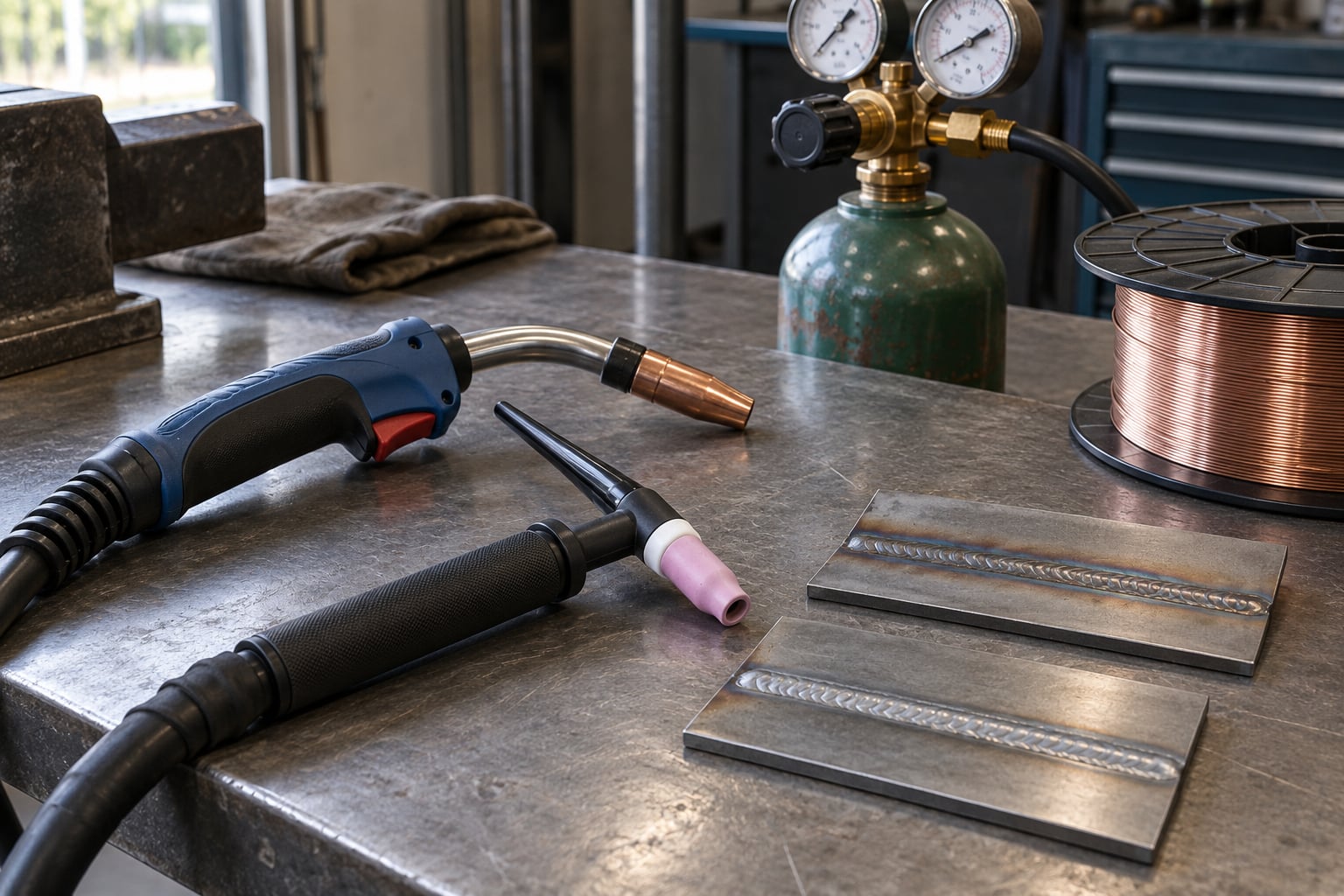
The core difference is simple: MIG welding (GMAW) pushes a continuous wire that acts as both electrode and filler metal, so you can weld one-handed and fast, while TIG welding (GTAW) holds a non-consumable tungsten rod for the arc and feeds filler rod separately with the other hand for tighter control. Choose MIG for general production work on carbon steel and thicker stock. Choose TIG for thin material, aluminum, stainless, and any weld that has to look good. Here is how the two processes actually differ, and which one fits your parts.
I have watched the same argument play out in every fab shop that has both machines: the MIG welder finishes a bracket in four minutes and the TIG welder spends twenty minutes cleaning aluminum and still takes it back to the bench to redo the bead. Neither is wrong. They are different tools for different work.
Table of Contents
- MIG vs TIG Welding Differences at a Glance
- How MIG and TIG Welding Processes Work
- Filler Metal, Electrode, and Shielding Gas
- Weld Bead Appearance and Control
- Speed, Deposition Rate, and Productivity
- Material and Part Compatibility
- Cost, Equipment, and Operating Requirements
- Safety, Skill Level, and Quality Control
- Which Welding Process Is Best by Use Case?
- Frequently Asked Questions
- Conclusion: Choose by Part, Volume, and Control
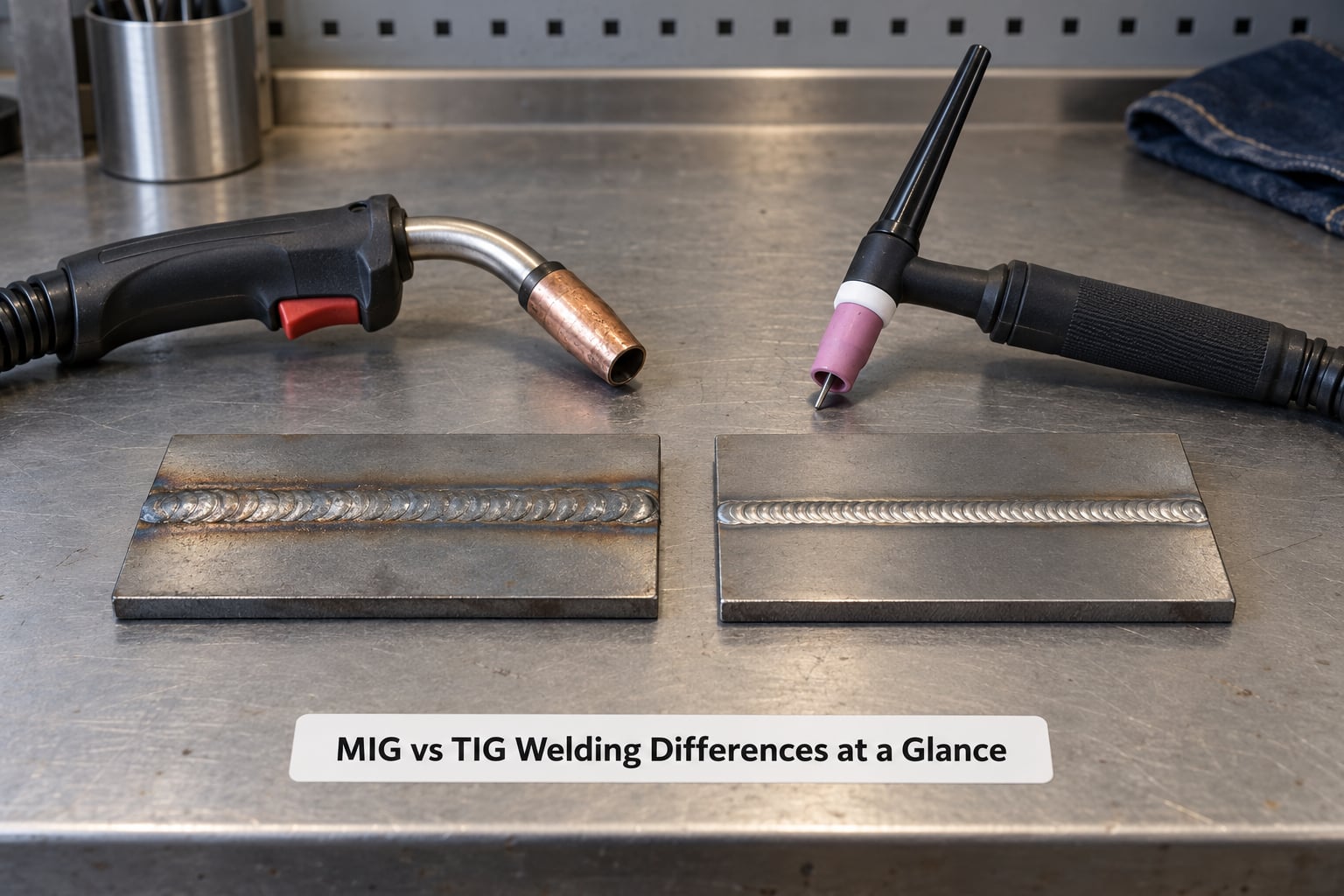
MIG vs TIG Welding Differences at a Glance
| Criterion | MIG (GMAW) | TIG (GTAW) |
|---|---|---|
| Electrode | Consumable wire, fed continuously | Non-consumable tungsten rod |
| Filler metal | Same wire as the electrode | Separate rod added by hand |
| Hands used | One hand on the gun | Two hands, torch plus filler rod |
| Shielding gas | Argon, CO2, or mixes | Argon, or argon with helium mixes |
| Deposition rate | High, continuous feed | Lower, depends on rod diameter |
| Bead appearance | Slightly convex, may have spatter | Narrow, even, fish-scale pattern |
| Control | Cold, pre-set parameters plus trigger | Foot pedal or fingertip heat control |
| Heat input | Higher for a given bead | Lower, tighter heat-affected zone |
| Thickness range | About 1/8 inch and up on carbon steel | Below 1/8 inch through heavy, including thin |
| Materials | Carbon steel, stainless, aluminum with spool gun | Carbon steel, stainless, aluminum, copper, titanium, magnesium |
| Relative machine cost | Lower | Higher |
| Best fit | Production fab, structural, field repair | Thin sheet, cosmetic, exotic alloys |
How MIG and TIG Welding Processes Work
MIG is a one-process weld. The machine feeds wire from a spool through a drive system and out the nozzle, where an electrical arc melts the wire tip. That melted wire drops into the joint and becomes the weld, so the same material does two jobs at once.
TIG splits that job in two. The tungsten rod only carries the arc, which is why it never melts into the bead. The welder holds the torch in one hand and dips a filler rod into the pool with the other, adding metal a fraction of an inch at a time.
That third option is worth knowing about: TIG can also run autogenous, with no filler at all, when you just need to fuse two edges that are already touching. It shows up constantly in sheet metal and in repair work on stainless.
MIG vs TIG Welding Differences in Core Operation
Where the two differ most is heat control and how much the operator influences the pool second by second. In MIG, current and wire feed speed are set on the machine and the travel speed comes from your hand. In TIG, you meter amperage yourself with a foot pedal or the torch switch, so you can melt the pool, back off, and let it cool before advancing.
That is why TIG tolerates thin material and why it makes such a small heat-affected zone. It is also why it is slower. You are manually managing every inch.
Filler Metal, Electrode, and Shielding Gas
MIG shielding gas is a mix business. Mild steel usually runs on 75% argon and 25% CO2, and shops that weld a lot of hot-rolled plate often drop to as little as 10% argon to make the arc more fluid and cut spatter. Stainless runs straight argon, or argon with a small oxygen addition. Aluminum needs pure argon or an argon-helium blend, plus a spool gun or push-pull feeder because aluminum wire is soft and feeds poorly through a standard drive system.
TIG gas is simpler. Almost everything runs on pure argon. Helium mixes come in when you want more penetration on thick stainless or copper, at the cost of a hotter, less stable arc that is harder on thin material.
Wire diameter drives MIG deposition. Heavier wire pushes more metal per inch of travel; 0.045 and 0.035 wire cover general fabrication, while heavier wire handles plate and structural work. TIG rods run thinner, from 3/32 inch up, and the thicker the rod the more amperage the machine has to deliver to keep it from melting back into the tungsten.
Weld Bead Appearance and Control
A MIG bead is wider, slightly rounded, and sometimes freckled with spatter. A TIG bead is narrow and flat with the rippled fish-scale pattern most people picture when they think about a good weld.
On carbon steel MIG can get you a decent looking bead, but spatter usually means chipping and grinding afterward. TIG needs far less cleanup, which is why it dominates where the weld stays visible: handrails, food processing equipment, marine work, and anything a customer will look at.
Control follows the same split. TIG lets you place the puddle, control where the heat goes, and build up a fillet weld one layer at a time with no heat-affected zone creeping into the previous layer. MIG fills a joint in a single pass and adds filler faster than you can manage it by hand.
Speed, Deposition Rate, and Productivity
MIG is the faster process by a wide margin. Deposition rate for solid wire commonly runs 8 to 15 pounds per hour on carbon steel, while flux core can exceed 20 pounds per hour. TIG rarely passes 3 pounds per hour on the same material, and less on aluminum because the wire deposits more slowly through the rose.
The gap shows up in arc-on time. A production shop welding a bracket fixture can deposit several parts in MIG before a TIG welder finishes one. For high-volume work with any kind of repeatability, MIG wins on throughput.
One thing that matters more than the process itself: a decent fixture. Shops on the practicalmachinist forums point out that good tooling and jigs regularly beat switching processes inch by inch. A part clamped in the right position makes a slow process faster and a bad weld good.
Material and Part Compatibility
Both processes cover the same common materials. The split shows up at the edges.
- Thin gauge, under 1/8 inch: TIG. The arc is easy to soften and the narrow bead will not melt through the metal.
- Carbon steel, 1/8 inch and up: MIG for production, TIG for anything with a tight tolerance or a visible finish.
- Stainless: MIG for volume work, TIG for food equipment, tanks, and sanitary seams that need a smooth corrosion-resistant surface.
- Aluminum: MIG works with a spool gun, though cleanup is higher. TIG gives a cleaner bead with far less post-weld grinding, which is usually why aluminum work skews TIG.
- Copper, bronze, titanium, magnesium: TIG is the standard process. TIG is essentially the only practical choice for magnesium.
Cost, Equipment, and Operating Requirements
At the equipment level, MIG wins. A capable MIG machine costs less than a comparable TIG machine, the gun is one consumable, and wire spooled by the pound keeps running costs low. TIG needs a machine with more control features, plus a separate torch with consumable tips, nozzles, caps, and a steady supply of tungsten that has to be ground correctly.
Per-job cost does not follow the same order. TIG labor runs considerably slower per foot of weld, and if the weld needs grinding, blasting, pickling, or polishing afterward, the hours added there often cost more than the machine did. On aluminum and stainless parts with a cosmetic finish, the cheaper process is regularly the more expensive one.
One more line item: shielding gas consumption tracks arc-on time, so the process that runs longer burns more gas. That is a small cost on carbon steel and a real one on a production floor running TIG all shift.
Safety, Skill Level, and Quality Control
Both processes need the same core protection: a properly fitted helmet with the right shade lens, flame-resistant clothing, leather gloves, and ventilation. The arc is intense either way, and both give off metal fume that you do not want in your lungs.
TIG adds one hazard most people forget. The tungsten arc concentrates more UV than a MIG arc, so a shade 11 or 12 lens matters even on light gauge work. TIG also demands more of the welder’s hands and posture, since one hand holds a hot torch at an angle for a long time.
Skill and inspection expectations run the same direction. MIG is learnable in an afternoon and the parameters repeat predictably. TIG takes months to get good, particularly the timing of filler rod addition, and welds are inspected more closely on code work under AWS and ASME specifications, often with a written WPS behind the procedure.
That said, weld strength is not a TIG-versus-MIG question. On a properly executed joint with matching filler, both meet the base metal’s strength. TIG’s smaller heat-affected zone gives better resistance to distortion and stress concentration, but strength comes from filler choice, joint preparation, and technique. People on r/Welding and r/metalworking argue this one constantly, and the consensus is that neither process makes an inherently stronger weld on its own.
Which Welding Process Is Best by Use Case?
Match the process to the job rather than the other way around.
- Production fabrication, structural steel: MIG. Maximum deposition, repeatable settings, lowest cost per foot.
- Sheet metal under 1/8 inch: TIG. It is the most reliable way to control burn-through and warping.
- Food processing and stainless equipment: TIG. The smooth, corrosion-resistant bead is the whole point of the job.
- Aluminum: TIG for a clean cosmetic result or a spatter-sensitive part, MIG with a spool gun for structural volume work.
- Repair and maintenance, field work: MIG, and specifically flux core wire, which r/metalworking regularly recommends because it handles wind that would scatter a gas-shielded arc.
- Under-vehicle and cramped access: MIG. Users on r/projectcar describe restoration work as much easier in MIG largely because of torch reach and the need for one free hand to hold a panel.
- Prototyping and one-off work: MIG for speed while you iterate, TIG to finish the piece you keep.
- Cosmetic or decorative work: TIG. Nobody grinds a railing before handing it to a customer.
As a career note, because TIG takes longer and demands more skill, shops and clients generally pay more for it. That is the part most comparison articles leave out, and it is the argument welders on r/Welding make most often when the question comes up.
For shops moving toward automated cells, both processes run on robotic arms. MIG is the easier cell to program for repeat parts; TIG wins where the cycle time can absorb the slower travel. If automation is on your roadmap, the tradeoffs we compare in Collaborative Robots vs Industrial Robots Differences come up at the same time.
Frequently Asked Questions
Is MIG welding better than TIG for beginners?
MIG is the better first process for most beginners. The machine holds current and wire feed speed, so you get consistent results while you focus on travel speed and technique. TIG demands manual amperage control and filler timing, and the arc is unforgiving when you first start. Learn MIG first, then move to TIG once you are comfortable reading the puddle.
Can MIG and TIG weld the same materials?
Mostly. Carbon steel, stainless steel, and aluminum all work with either process. The gaps are at the extremes. TIG is the practical choice for copper alloys, titanium, and magnesium, and it handles thin gauge material far better. MIG needs a spool gun or push-pull feeder for aluminum because the soft wire feeds poorly through a standard drive system.
Is TIG always stronger than MIG?
No. On a correctly executed joint with matching filler metal, both processes produce welds that meet or exceed the strength of the base metal. TIG does give a narrower, more controlled heat-affected zone, which means less distortion and less risk of stressing thin or already-stressed parts. Strength comes from joint preparation, filler selection, and technique rather than the process name.
Which process is better for thin sheet metal?
TIG. Below roughly 1/8 inch, MIG puts too much heat into a narrow bead and can burn through or warp the material. TIG lets you soften the arc with the foot pedal and control exactly how much filler enters the pool. For sheet metal at 18 gauge or thinner, TIG is usually the default choice.
Is MIG welding cheaper than TIG for production?
Per foot of weld, yes. MIG deposits far more metal per hour, runs a lower-cost machine, and uses a cheap consumable wire. But compare total job cost rather than machine cost. If a TIG weld eliminates grinding, pickling, or a rejected part later, the higher labor rate can make TIG the cheaper option overall on cosmetic work.
Can a MIG welder do TIG work?
Not with the same machine. MIG and TIG use different torches, different consumables, and different control methods, so the power source has to be TIG-capable. Most modern multi-process machines sold for fabrication and shop work include a TIG mode, so check the mode list before buying. Adapters exist for people who need MIG in the field and TIG on a bench.
Conclusion: Choose by Part, Volume, and Control
The mig vs tig welding differences come down to three things: how the filler metal arrives, how much heat control you have, and how fast you need to fill the joint. Pick MIG when you want speed, repeatability, and low cost per part on steel, stainless, or aluminum at production volume. Pick TIG when the material is thin or exotic, when the weld stays visible, or when a small heat-affected zone matters more than throughput.
Before buying a machine, look at your actual part mix: material, thickness, and how much of the weld gets finished afterward. Most shops end up wanting both, because the two processes answer to different parts of the same job list. If your work involves joining plastics rather than metals, Ultrasonic Welding of Plastics Explained: Practical Guide covers that side of the process, and our guide to Blown Film vs Cast Film Differences for Buyers covers film selection for packaging lines.