
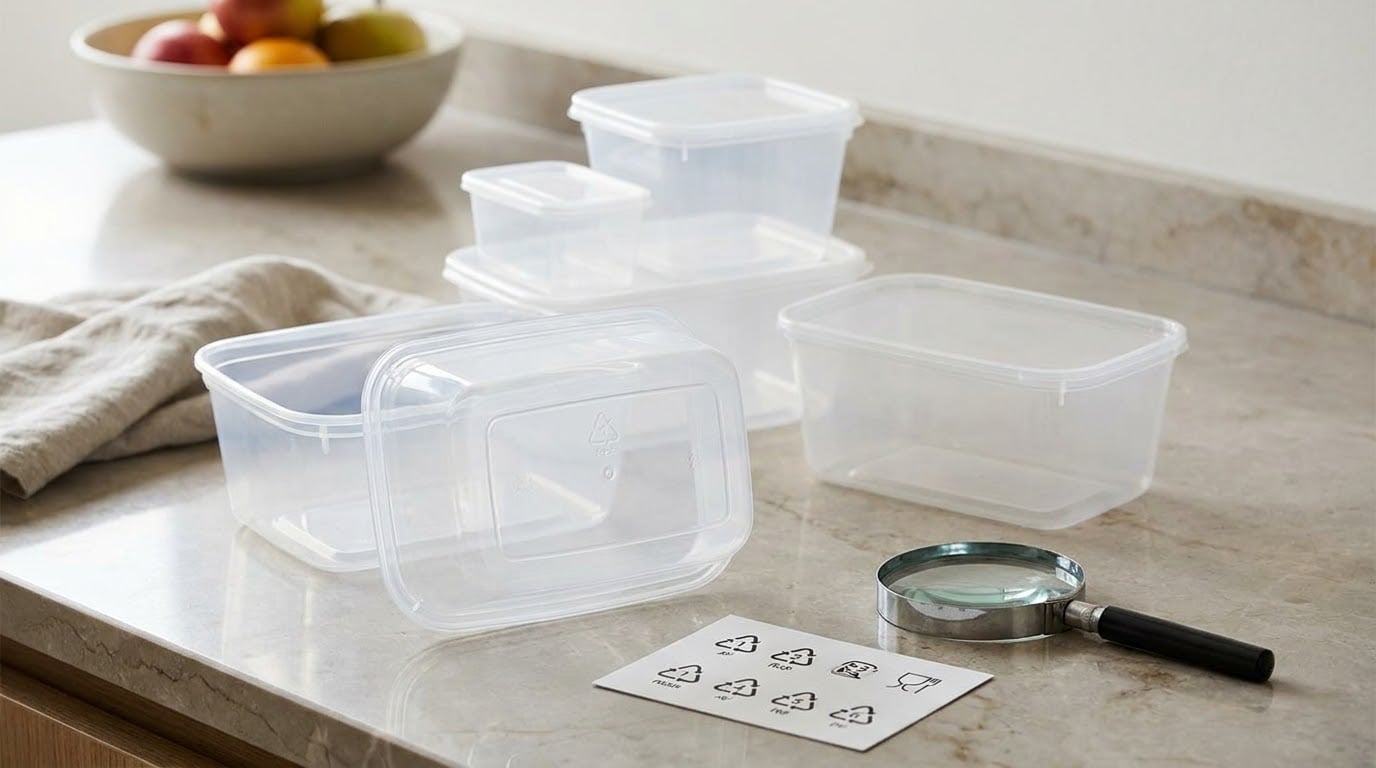
Turn the container over and look at the base. A recycling triangle with a number inside tells you the resin, and numbers 1, 2, 4 and 5 are the ones made for food contact, while a cup-and-fork symbol or a stamped “food safe” label confirms intended use.
The catch is that the triangle alone does not clear a container. It is a recyclability code, not a food-safety certificate, so a complete check takes three things: the resin number, the manufacturer’s food-contact instructions, and a close look at the condition of the container itself.
This guide covers the physical inspection for anyone holding a container in their kitchen, plus the documentation a buyer should request before ordering in volume. It takes about a minute per container once you know where to look.
What You Need
Gather these before you start. Missing one of them usually means the answer ends in “unknown,” and unknown is the only verdict worth acting on.
- Manufacturer instructions: the packaging, product page, or printed care guide that states the resin and intended conditions.
- Food-contact labeling: any stamped text, cup-and-fork mark, or compliance reference on the body or base.
- Resin identification: the triangle number, or molded letters such as PP, HDPE or PET.
- Intended use conditions: whether the food is room temperature, hot, fatty, acidic, or going in the microwave, freezer or dishwasher.
- A clean inspection area: a counter where you can wash the container and read the base without glare.
For a purchase rather than a kitchen drawer, add one more item: a supplier contact who can send a Declaration of Compliance. Our guide to food contact plastics FDA requirements explained covers what that paperwork should contain.
Step-by-Step
Work through the steps in order. Each one either confirms something or removes an assumption, and skipping ahead is what leads people to treat a yogurt lid as proof of food-grade resin.
How to Tell If a Plastic Container Is Food Safe
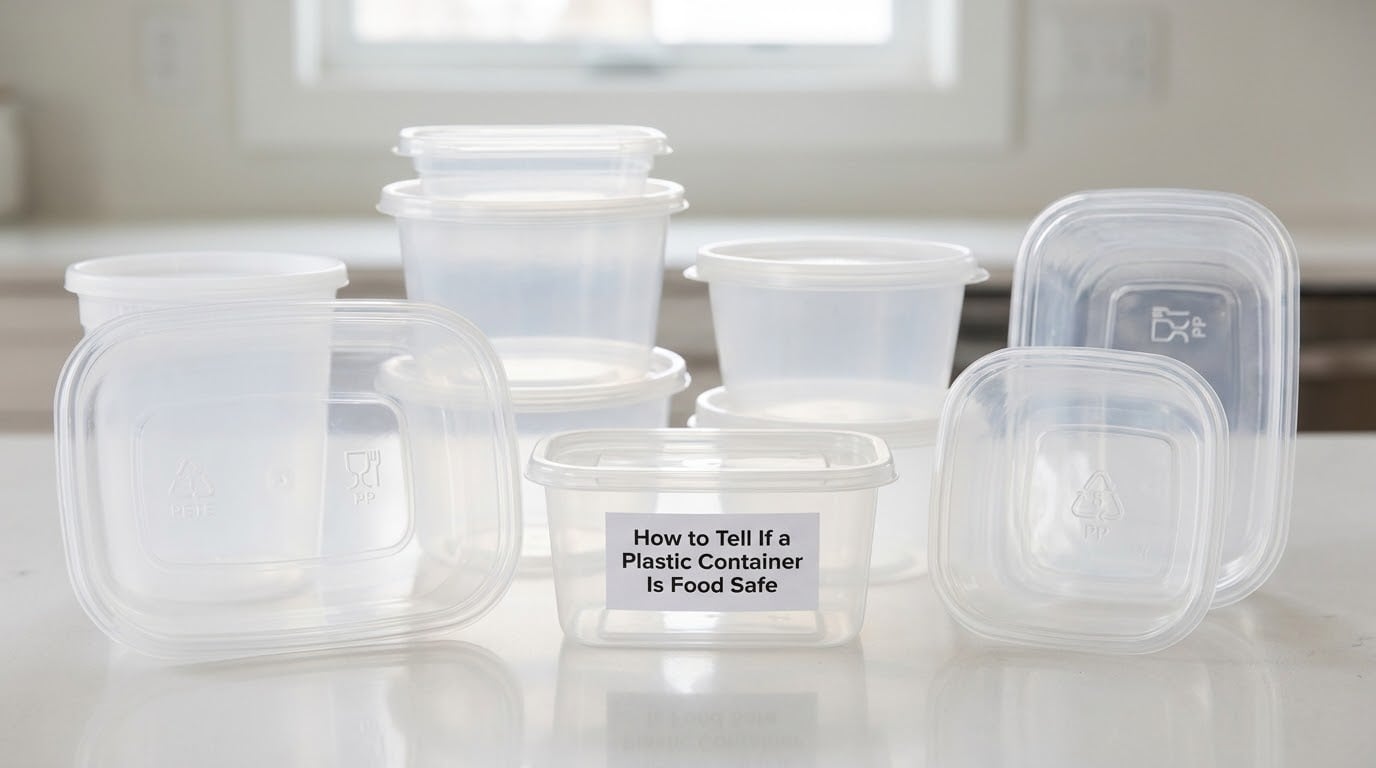
The method is four moves. Identify the plastic, locate the food-contact statement, compare the stated conditions with the food you actually plan to put in it, then reject anything uncertain or damaged.
If you want the short version, the resin number and the manufacturer’s stated use together answer the question, and damage can override both. Confidence in any single mark is not the same as safety.
Run the moves in that order and you will not accidentally treat a recyclability symbol as a safety approval. Most kitchen containers pass or fail on the third and fourth moves.
Check the Resin or Recycling Symbol
Flip the container and find the triangle of arrows with a number inside, usually molded into the base or stamped on the underside. The number identifies the polymer, and it is the single most useful fact on the container.
| Number | Polymer | Food contact | Reuse | Heat limit | Typical uses |
|---|---|---|---|---|---|
| 1 | PET (PETE) | Yes | Single use only | Avoid microwave and hot liquids | Water and juice bottles, salad clamshells |
| 2 | HDPE | Yes | Yes | Microwave generally fine | Milk jugs, detergent and shampoo bottles |
| 3 | PVC (vinyl) | Limited | Avoid | Do not heat | Cling film, pipe, credit-card backing |
| 4 | LDPE | Yes | Yes, short term | Low; not for boiling liquids | Freezer bags, produce bags, squeeze bottles |
| 5 | PP | Yes | Yes | Microwave and boiling liquid safe | Yogurt and margarine tubs, reusable leftovers boxes |
| 6 | PS (polystyrene) | Limited | Single use only | Low; softens quickly | Styrofoam cups and trays, cutlery |
| 7 | Other (PC, acrylic, nylon, bio-resins) | Unclear from the code alone | Case by case | Varies by polymer | Baby bottles, water bottles, opaque containers |
Numbers 2, 4 and 5 are the workhorses for food storage, and 1 is food-contact safe but built for a single use. Number 7 is a catch-all rather than a warning, so a 7 code alone tells you very little and needs a second source.
If the number is molded as letters instead, the logic is the same. PP and PE-HD mean polypropylene and high-density polyethylene, LDPE is low-density polyethylene, PS is polystyrene, PET is the PET resin, and SAN or ABS are typically not food containers at all.
Residents of the two most common food-contact polymers often ask which one to reach for. Our comparison of hdpe vs pp for containers covers the practical differences in heat tolerance and stiffness.
Look for Food-Contact Certification or Labeling
A resin number describes material. A food-contact statement describes purpose, and you need the second one to know the container was approved for touching food at all.
The cup-and-fork or wine-glass-and-fork symbol is the clearest signal, with one important caveat: it is a European requirement under EU Regulation 10/2011, not a US FDA requirement. Its absence on a US container does not make that container unsafe, it just means you need another source.
On US containers, look for these instead:
- Stamped or molded text such as “food safe,” “food grade,” or “BPA-free.”
- A reference to FDA food-contact compliance, or an NSF or USDA marking on commercial food equipment.
- A maximum-use temperature, or a microwave, freezer or dishwasher symbol.
- A warning against incompatible foods, such as a note not to use the container for hot oils or alcohol.
- Manufacturer details: a name, website or address, so you can trace the resin grade later.
“BPA-free” is worth untangling on its own. Bisphenol A comes from polycarbonate and epoxy resins, not from PVC, so a BPA-free claim says nothing about phthalates in a vinyl container, and PVC does not contain BPA. If you are choosing between a #5 PP box and a #3 vinyl box, the resin decides the answer, not the BPA label.
Our read on plastic packaging labeling rules in the US covers which markings are regulated and which are marketing language.
Match the Container to Its Intended Use
US compliance for food-contact substances is conditioned on the intended use. The same resin can be approved for cold water and unapproved for boiling oil, so matching conditions is not a formality.
- Room-temperature, dry or moist food: numbers 1, 2, 4 and 5 all work.
- Hot food, soup or reheating: use 2 or 5 and confirm a microwave or heat marking. Avoid 1, 3, 4 and 6.
- Frozen storage: 2, 4 and 5 handle freezing, though 1 becomes brittle.
- Oily, fatty or highly acidic food: stick with 2 and 5, which have the strongest resistance to migration.
- Long-term storage or bulk food use: 2 and 5, with a documented intended use from the manufacturer.
If a container has no stated use, treat it as single-use. A takeout clamshell or deli tub that arrived without instructions was likely not designed for oven-hot food, and reusing it for leftovers is a guess.
Beyond the resin number, two manufacturing variables sit outside your control. Release agents used during molding and any dye or colorant in the compound both touch the food-contact surface, which is why a container made with a safe resin can still be unsuitable. Food-contact pigment and a non-toxic release agent are part of the specification, not an afterthought.
Inspect the Container for Damage and Wear
Resin and labeling tell you what the container was made for. Condition tells you whether it still does that job. Look at the whole surface in good light, including the lid, the gasket and the grooves around the rim.
- Cracks and splits, especially around the rim or hinge.
- Stress whitening, the pale cloudy streaks that appear after repeated flexing or impact.
- Deep scratches or gouges that do not wash out.
- Warping, where a lid no longer seals or a box will not sit flat.
- Cloudy or yellowed zones, which can indicate chain scission from heat exposure.
- Sticky or tacky surfaces that were not sticky when new.
- Seals and gaskets that have hardened, torn or lost elasticity.
Damage matters for two different reasons, and people usually only think about one. Scratches create crevices where bacteria can hold on after washing, and heat-damaged plastic can shed particles and migrate additives faster than fresh material.
Cleaning protocol matters as much as the plastic. Wash in the top rack of the dishwasher when the container is rated for it, use mild detergent and a soft sponge, scrub the grooves around the opening where MSU Extension notes pathogens can hide, air dry fully before closing, and never stack a hot lid onto a cold box.
Know When to Replace or Discontinue Use
Retire a container when you cannot vouch for it, and that comes down to a short list. Unknown provenance, no documentation of intended use, visible damage, repeated heat exposure, and a history of holding foods outside its instructions.
Age on its own is a weak signal. Long-time owners describe containers that stay in good shape for decades, and product certification specialists generally point to scratches and wear rather than the calendar as the real variable. A twenty-year-old box with no scratches and no odor can still be fine; a three-year-old box that scorched in the microwave should go.
One exception deserves its own rule, and it comes up constantly on kitchen and home forums. Never use a container that held paint, solvents, motor oil, detergent, cleaning chemicals, or hair products and cosmetics, even when the resin number is a 2 or a 5. Residual chemicals soak into the plastic and do not come out in the dishwasher, and a food-contact grade resin does nothing to make a contaminated container safe. A container that arrived holding food with no other history is a different situation and generally fine.
If a container has no resin number at all, work through it in this order. Check for molded letters such as PP or HDPE, then check the original packaging or the manufacturer’s website for the product line, and if neither yields an answer, use the container for non-food purposes only.
Common Mistakes to Avoid
Several errors show up repeatedly in this process, and each one produces a false all-clear.
The first is treating the recycling triangle as an FDA approval. It is a resin identification code for recyclers, and it says nothing about additives, dyes or intended temperature. The second is assuming any plastic handles hot food, which is how warped PP boxes and styrofoam trays end up in a microwave.
The third is judging by appearance or odor. A container can look pristine and still carry an unapproved additive, while a faint smell often means the plastic absorbed something it should not have, not that you can smell the difference between resins. The fourth is reusing single-use containers with no stated conditions, and the fifth is ignoring a damaged coating, gasket or surface while trusting the number on the base.
Common Mistakes
Here is the correction for each mistake worth making, followed by the habits that keep the problem from coming back.
- Reading the triangle as a safety certificate. Pair it with a food-contact statement or manufacturer instructions.
- Assuming every plastic takes heat. Match the resin to the temperature, and skip the microwave without a marking.
- Trusting looks or smell. Neither detects additives, and odor is a reason to discard, not a reason to keep.
- Reusing disposable containers. Use them for storage at cool temperatures, not reheating or hot food.
- Ignoring damage. Replace anything cracked, deeply scratched, warped or sticky.
- Repurposing chemical or cosmetic containers. A safe resin number does not make a contaminated container food-safe.
A few habits go a long way. Buy containers made for food from the start rather than converting non-food ones, label shared containers with the date and contents if you freeze them, keep lids matched to their boxes, and check the base of a container the moment it comes home so you know what you have.
For buyers and specifiers, request a Declaration of Compliance from the supplier, confirm whether the resin is virgin or recycled and what the recycled content is approved for, and ask for the specific grade rather than a family name. Written documentation beats a symbol every time, and it is the only answer that survives a customer audit.
Frequently Asked Questions
How do I know if my plastic is polyethylene or polypropylene?
Look on the base for the recycling triangle with a number inside: a 2 means high-density polyethylene (HDPE) and a 5 means polypropylene (PP). Molded letters work too, with PP or PE-HD pointing to polypropylene and LDPE pointing to low-density polyethylene. PP usually feels slightly more rigid and waxy than HDPE, which is more flexible, but feel is a hint and not proof.
Is number 2, 4, or 5 plastic safe for food storage?
Yes, those three are the resins most commonly approved for food contact. HDPE (2) and PP (5) are the strongest choices for leftovers, hot food and long-term storage. LDPE (4) is food-contact safe but is built for bags and short-term use, so it suits freezer storage and produce but not boiling liquids.
Which plastic containers should I avoid?
Avoid number 3 PVC for food, number 6 polystyrene for anything hot, and any container you cannot identify. Also avoid anything that held paint, solvents, cleaning chemicals, cosmetics or motor oil, and any container with cracks, deep scratches, warping or a sticky surface. A number 7 code needs a second source before you trust it.
Is a 20-year-old storage container still safe to use?
Age by itself is a weak signal. A well-made container that never went in the microwave, has no deep scratches and no odor is usually still usable. Condition matters far more than the calendar, so replace anything warped, clouded from heat, sticky or cracked no matter how new it is, and retire anything you cannot identify.
What if my plastic container has no recycling number?
Check for molded letters such as PP or HDPE, then look for food-contact text on the body. If you can find the product line on the manufacturer’s website, that documentation often names the resin and intended uses. When nothing identifies the container, treat it as single-use and keep it for non-food items rather than guessing.
Is food grade the same as food safe?
In practice people use them interchangeably, but the distinction matters. Food grade describes the material, while food safe describes the material used as intended. A food-grade resin in a container with no stated temperature limit is not food safe for boiling food, and a container made with a safe resin but chemical residues is not food safe either.
Conclusion
Start with the manufacturer’s food-contact guidance and the conditions it states, then read the resin number and inspect the container. If the documentation is missing or the damage is visible, replace it, and never repurpose a container that held chemicals. Updated for 2026, this check takes about a minute and settles the question properly.