
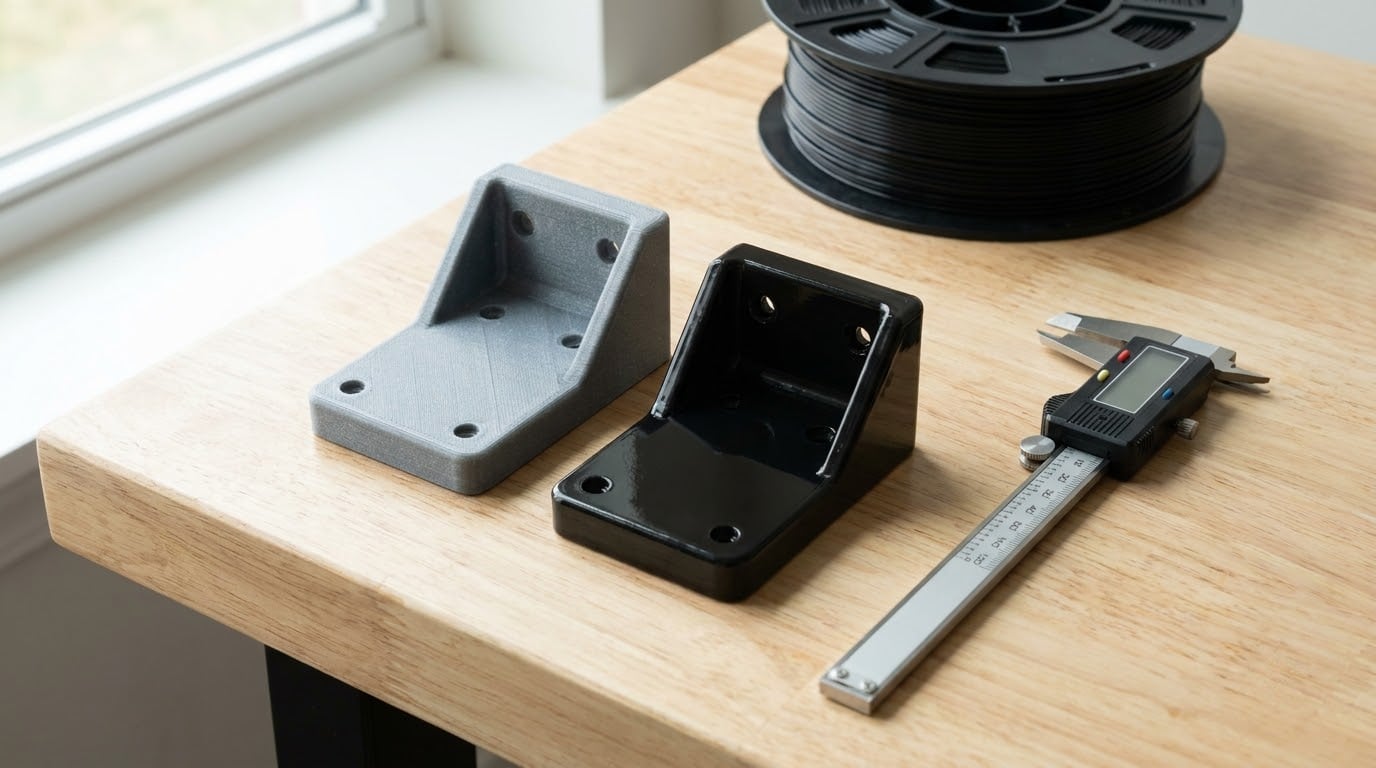
If you only remember one thing about abs vs pla for 3d printing, make it this: PLA prints easier, stays stiffer and costs less, while ABS survives heat and impact and holds up as a real part. Choose PLA for fit checks, concept models and anything decorative. Choose ABS for jigs, housings, clips, automotive interiors and outdoor parts that take a beating in service.
That is the short version. The rest of this guide breaks the two polymers down on the things that actually decide whether a part lives or fails: tensile strength versus toughness, glass transition temperature, warping, post-processing, cost per successful print and the ventilation your workspace needs.
Table of Contents
- ABS vs PLA for 3D Printing at a Glance
- What Are ABS and PLA?
- Strength and Layer Adhesion
- Heat, Chemicals, and Outdoor Durability
- Printability and Dimensional Accuracy
- Post-Processing and Finishing
- Cost, Waste, and Production Scale
- Safety and Handling
- Which Should You Choose?
- Frequently Asked Questions
- What to do first
ABS vs PLA for 3D Printing at a Glance
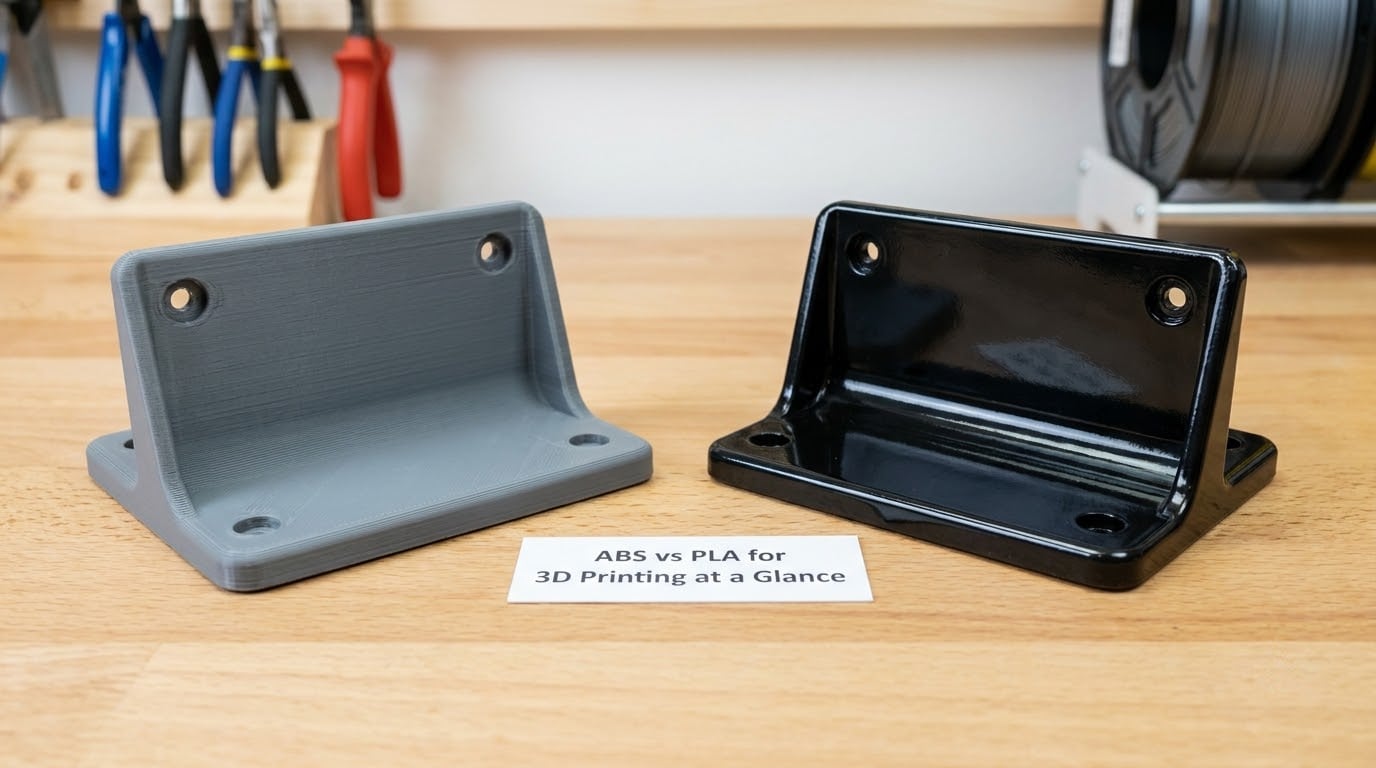
PLA is the easier material. It prints at lower temperatures, clings to most beds, barely warps and needs no enclosure. ABS is the tougher material. It needs a hotter nozzle, a warmer chamber and a workflow that tolerates its fumes, and in exchange it bends instead of snapping and shrugs off heat that would deform PLA.
| Property | PLA | ABS |
|---|---|---|
| Nozzle temperature | 190-220 C | 230-260 C |
| Heated bed temperature | 50-60 C | 90-110 C |
| Enclosure needed | No | Strongly recommended |
| Tensile strength | About 50-60 MPa | About 30-40 MPa |
| Elongation at break | 5-10 percent | 10-20 percent |
| Impact behaviour | Brittle, cracks suddenly | Tough, bends before breaking |
| Glass transition temperature | About 60 C | About 105 C |
| Typical service limit | Below 55-60 C | Up to 90-100 C |
| Warping risk | Low | High without a chamber |
| Bridge and overhang quality | Clean | Needs slowdowns and cooling |
| Dimensional repeatability | Excellent | Good with a stable chamber |
| Surface finish as printed | Matte, fine layer lines | Glossy, hides layer lines |
| Post-processing | Sanding, filler primer, painting | Acetone vapour smoothing, machining, painting |
| Density | About 1.24 g/cm3 | About 1.04 g/cm3 |
| Moisture sensitivity | Higher, pops and stringing | Lower, still needs a dry box |
| Odor and fumes | Mild sweet smell | Pungent styrene, needs ventilation |
| Relative filament cost | Lower | Higher |
| Best suited to | Models, prototypes, fit checks, decor | Functional parts, tooling, housings, outdoor use |
What Are ABS and PLA?
PLA is a polylactic acid thermoplastic built from renewable feedstock
PLA is made from lactic acid, which manufacturers derive from starch sources such as corn or sugarcane. It is an amorphous thermoplastic, meaning it has no sharp melting point. Instead it softens gradually through its glass transition temperature and stays rigid only while it is cool.
That single fact explains almost every practical difference between the two polymers. PLA is stiff and precise while cold, then goes soft and unusable in a hot car or a hot enclosure. PLA is also the easier machine material because it flows at lower temperatures and holds a bed without much help.
ABS is a styrenic thermoplastic with a rubber phase built in
ABS is acrylonitrile butadiene styrene: a styrene-based matrix with butadiene rubber strands and acrylonitrile for strength and chemical resistance. The rubber content is what makes ABS so much harder to snap than PLA, and it is also what makes ABS harder to print.
Both are sold as 1.75 mm or 2.85 mm filament for FDM machines, and both appear in resin and pellet processes too. What changes between grades is additives: PLA+ adds impact modifiers to close part of the toughness gap, and ABS blends often add PC or flame retardants for industrial work.
Strength and Layer Adhesion
PLA is stiffer while ABS bends before it breaks
Unfilled PLA prints around 50-60 MPa tensile, which is higher than the roughly 30-40 MPa of standard ABS. If you load a printed part in tension along a layer line, PLA usually wins. But PLA’s elongation at break sits near 5-10 percent, so the part deflects very little before it fractures.
ABS trades that stiffness for elongation of roughly 10-20 percent. A clip, a snap fit or a bracket that gets knocked takes a bending load and deforms instead of cracking. For a load applied across the layer, in the Z direction, both materials are weak, so orient the part so the load runs along the layers.
Layer adhesion is a temperature problem, not a glue problem
Layer adhesion comes from the previous layer staying above the previous layer’s glass transition temperature while the new bead fuses into it. In a cold room, PLA layers bond well because its Tg is around 60 C and a normal room is already below that. ABS has a Tg near 105 C, so a cold chamber means every fresh layer quenches before it can bond.
This is why ABS printed in a warm, stable room or inside an enclosure survives better than ABS printed in a drafty garage, even though the enclosure is not doing anything clever. Forum reports of tall ABS parts delaminating almost always come back to the same cause: too much part fan cooling, or a chamber that swung 15 C during the print.
Heat, Chemicals, and Outdoor Durability
PLA softens near 60 C and ABS holds to roughly 100 C
Glass transition temperature is the number that matters most for service conditions. PLA’s Tg is around 60 C, so a PLA part in a parked car on a summer afternoon will sag, and its stiffness drops as the material approaches that point. Its heat deflection temperature under load is lower still, often in the 50-55 C range.
ABS runs about 105 C for Tg with a heat deflection temperature near 90-100 C under moderate load. That is the difference between a part that survives a warm enclosure and a part that deforms into a curve on the first hot day.
Neither polymer is truly outdoor rated
Both degrade under long UV exposure. ABS yellows and embrittles as the butadiene phase is attacked by sunlight, and PLA is more UV-sensitive and loses impact strength quickly. If a part lives outside permanently, ASA is the version of ABS designed for it, and PETG holds up better than PLA but still fades.
Chemically, ABS resists oils, weak acids, alkalis and salts, and is attacked by acetone, MEK and many esters. PLA resists oils and greases better but hydrolyses when heat and water combine, so wet PLA filament degrades before it ever reaches the nozzle. For most production work, chemical exposure is a short checklist rather than a deep concern.
Printability and Dimensional Accuracy
PLA prints flat on almost any machine
PLA sticks to a clean PEI sheet at 50-60 C with little fuss, spans bridges without drooping, and holds its dimensions from print to print. That repeatability is why PLA is the default for fit checks: a slot you print in PLA will measure the same tomorrow, so a tolerance decision made on the model carries to the real part.
The trade-off is that PLA hates being scratched. A nozzle that touched the bed mid-print leaves a divot that becomes a crack under load, so switch nozzles rather than pushing through it.
ABS wants a steady, warm chamber
ABS shrinks roughly twice as much as PLA as it cools, and it shrinks more in any direction it is not constrained. Corners lift first, then the whole print peels off the bed. That is the warping problem, and it is the single biggest reason people abandon ABS.
Two changes fix most of it. Keep the chamber temperature swing under about 5 C, and raise the bed to 90-110 C with a brim for anything larger than a palm. Bed adhesion methods that reach the community standard are an ABS slurry, meaning ABS dissolved in acetone, and a thick ABS-ABS glue layer; hairspray alone usually is not enough on large flat parts.
Printer choice matters more than slicer settings. Machines with a full enclosure, such as the Bambu Lab X1C and P1S or a Prusa MK4 with its enclosure, print ABS repeatably. Open-frame machines such as the Ender 3 can do it with a heated chamber modification and a draft shield, and the usual advice from those communities is not to bother until you have both.
Post-Processing and Finishing
Acetone smoothing only works on ABS
Acetone vapour smoothing is the reason ABS holds a reputation for a glossy automotive look. The vapour attacks the surface, the surface reflows, and the layer lines disappear into a smooth skin. It does nothing to PLA, which will not dissolve in acetone at all.
Done in moderation it is the best finish available on a desktop printer. Done for too long it destroys the details you printed, rounds over holes, and can make the part warp as the skin cools unevenly. Acetone is also flammable and the vapour is unpleasant, so run it outdoors or with a sealed vessel and a fan, never in a small closed room.
Both materials sand and paint, but ABS machines cleaner
Sanding works on both. PLA clogs paper almost immediately and softens under a heavy hand, so use 180 to 220 grit, light pressure, and clean the dust between grits. ABS sands to a very smooth surface with less clogging. Both need a filler primer before paint, and both take paint far better after solvent wiping.
For threads, hinges and bearing fits, machining is often faster than reprinting. ABS cuts and drills cleanly and holds a tapped hole; PLA is easier to drill but tends to grab the bit and leave a burr. Heat-set brass inserts work in both materials if you size the hole for the material, and remember that ABS softens enough near 100 C that a hot-end insertion needs a lower temperature than you would use for PLA.
Support removal is the last practical difference. PLA supports pop off with a blade because the interface is weak. ABS supports fuse to the model, and forcing them can crack the surface, so plan an interface zone and expect to sand the mark out.
Cost, Waste, and Production Scale
Before comparing printing against 3D printing vs injection molding cost breakdown, it helps to know which material you would be printing in, because the two do not produce the same part cost.
Cost per successful print beats price per spool
PLA filament is cheaper per kilogram and ABS is more expensive, but that gap is smaller than it looks. ABS has a density near 1.04 g/cm3 against PLA’s 1.24 g/cm3, so an identical part uses roughly 16 percent less filament by weight in ABS. What tips the balance the other way is scrap: a failed ABS print costs more because the material, the 90 C bed, the higher nozzle temperature and the slow layer speed have all been spent by the time the corner lifts off.
Scale changes the arithmetic again. A concept model is one part and one machine hour, so PLA wins on simplicity. A run of 200 identical housings spreads the enclosure, the sliced profile, the fixture and the tuning across every unit, and ABS becomes the cheaper part. If your project has crossed into repeat production, compare per-part cost at volume rather than spool price.
Safety and Handling
Styrene vapour is the reason ABS needs an enclosure
Printing ABS releases styrene and small amounts of other volatile compounds, which is the sharp smell you get at the nozzle. Short exposures are unpleasant and the widely reported complaints from maker forums are headache, nausea and irritation of the eyes and throat in a closed room with poor air exchange.
The fix is straightforward: print inside an enclosure with a HEPA and carbon filter, run the printer in a garage or a shop, or vent outdoors. A window open across the room is better than nothing. Filtration that handles particulates does not handle gas, so check that the carbon stage is real.
PLA emits lactide at far lower levels and the odour is a mild sweet smell, which is why many people breathe it without thinking. Long unattended prints in a bedroom or office still deserve ventilation, particularly if anyone has asthma.
Skin contact is not a real hazard with clean filaments; wash your hands after handling dusty spool material. Storage matters more: PLA absorbs moisture quickly, so keep both in sealed bags with desiccant, and a dry box matters for any filament you keep over the winter.
Neither polymer is food safe as printed without going through your own certification process. Additives and pigments migrate under heat and washing, neither survives a dishwasher, and a printed surface has micro-cracks that hold bacteria. For anything that touches food, buy a filament sold and certified for that contact from a supplier who documents it.
Which Should You Choose?
Choose PLA when the part is about shape and fit
PLA is the right call for concept models and presentation pieces, classroom sets, figurines, cosplay props, jigs that see light duty, and any fit check where you only need to know whether the geometry works. It prints fast, it repeats, and a mistake costs minutes rather than hours.
Choose ABS when the part has to work
Choose ABS for snap fits and clips, tool and shop jigs, electronics housings with internal ribs, dashboard-adjacent automotive interiors, outdoor fixtures, brackets that bolt to something and carry load, and production runs of any of the above. It also handles drilling, tapping and acetone smoothing, which PLA does not.
A workflow that works well in practice: print the fit check in PLA, confirm the clearance, then reprint the same model in ABS for the part that goes into service. You get PLA’s speed during design and ABS’s durability at the end, without buying two machines.
Choose neither when
Reach for ASA when the part lives in sun, for PETG when you want PLA-like printing with a big toughness bump, and for polycarbonate or nylon when the operating temperature is above what ABS will hold. Choosing between PLA and ABS is a useful decision, but it is not the only one.
Frequently Asked Questions
Is ABS stronger than PLA for 3D printing?
It depends on the load. PLA has higher tensile strength, around 50-60 MPa against 30-40 MPa for ABS, so it is stiffer and better in tension. ABS has higher elongation at break and absorbs impact by bending, so clips, brackets and snap fits survive knocks that crack PLA. For a part that will be loaded, dropped or flexed, ABS is usually the safer production choice.
What temperature should I use for ABS and PLA?
Print PLA between 190 and 220 C with the bed at 50-60 C. Print ABS between 230 and 260 C with the bed at 90-110 C. ABS also benefits from an enclosure that holds chamber temperature steady within a few degrees. If a PLA part comes off the bed looking great but warps later, try dropping the nozzle temperature by 5 to 10 C before anything else.
Is ABS or PLA better for outdoor parts?
ABS holds up better outdoors, mostly because it survives heat a PLA part cannot. Neither is UV stable for a permanent outdoor life: ABS yellows and embrittles under sunlight, and PLA degrades faster. For a part that stays outside year round, ASA is the right material because it is the UV-stable version of ABS. Use ABS if the part is shaded, sheltered or seasonal.
Can ABS or PLA be sanded and painted?
Both can. Sand PLA with 180 to 220 grit using light pressure, since it clogs paper and dents easily, and clean the dust between grits. ABS sands to a smoother surface with less clogging. Both materials need a filler primer before paint, and ABS can also be vapour smoothed in acetone for a glossy finish without primer, though long exposure rounds off fine details.
Does PLA warp less than ABS?
Yes, and the difference is dramatic. PLA barely warps because it flows at low temperature and shrinks very little as it cools. ABS shrinks roughly twice as much and lifts at the corners first, especially on large flat parts and on open-frame machines. An enclosure, a bed at 90-110 C, a brim and low fan cooling solve most ABS warping. If it still lifts, dry the filament first.
Which material is better for functional prototypes?
ABS for anything that gets handled, loaded or heated. PLA is fine for fit checks, appearance models and light-duty jigs, and it is much faster to iterate on. Many makers use PLA+ as a stand-in for about 90 percent of former ABS jobs, which is worth testing before you commit to ABS. The remaining cases, snap fits and hot environments, are where ABS still earns its place.
What to do first
Print a small calibration bracket in the material you plan to use, not the one you plan to buy. Load it, flex it, leave it in a warm car for an hour and measure it again. That single test tells you more than any spec sheet, and it takes one evening instead of one failed production run.
If the bracket passes, buy the filament in volume. If it softens or snaps, you already know which way the choice goes.