
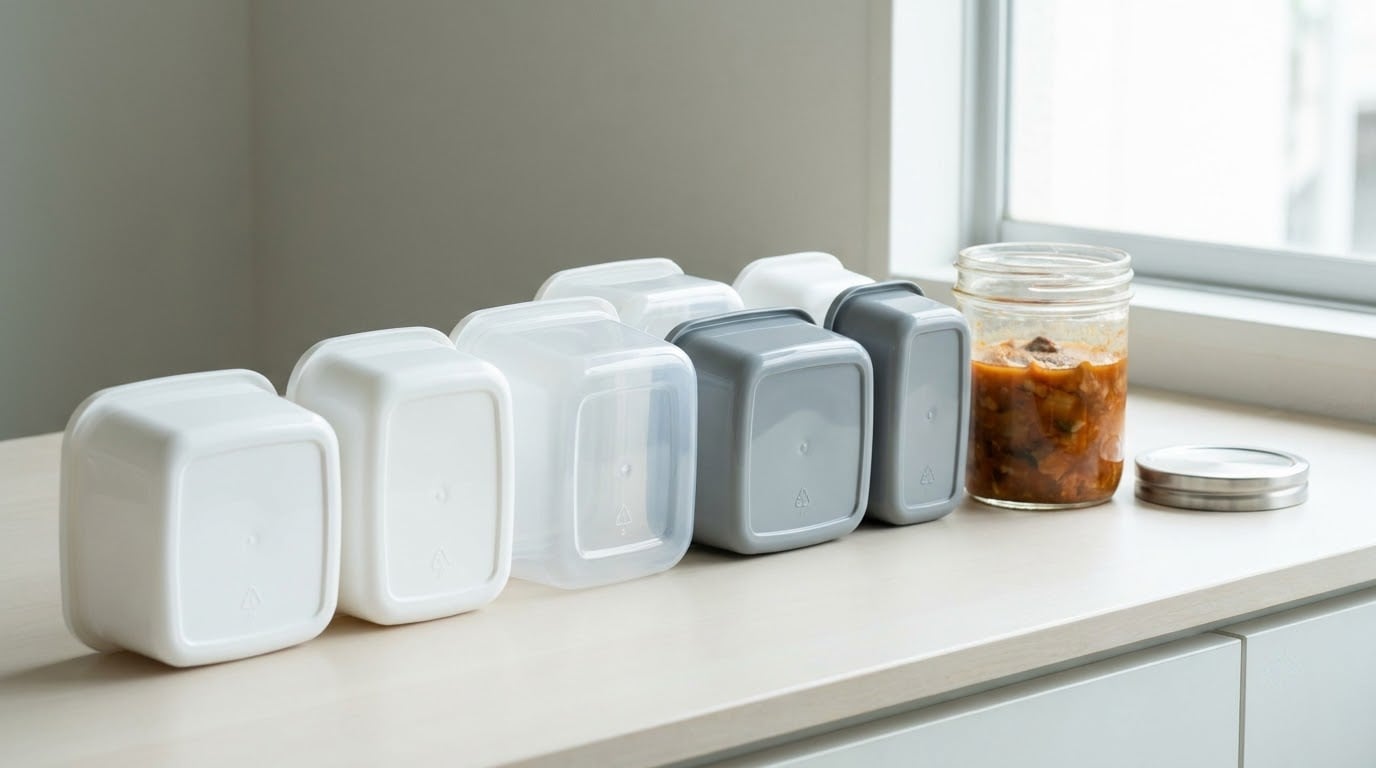
Numbers 1, 2, 4 and 5 are the codes most often associated with food contact, and 2, 4 and 5 are the ones you want on a container you will reuse. But the number is not a safety rating. It tells you the polymer family, which tells you a lot about heat tolerance and chemical behavior, and almost nothing about whether that specific product was formulated, tested and declared for your food.
That distinction matters more than most packaging guides admit. A #5 polypropylene tub from a commercial supplier can carry a full food-contact declaration and a migration test report, while a #5 tub from a dollar-store binner can have neither. The resin is the same. Everything that determines whether it is fit for your food lives in the additive package, the pigment, the molding cycle and the paperwork.
Here is what each number actually identifies, where it holds up, and where it breaks down.
Table of Contents
- What Plastic Numbers Are Safe for Food Storage?
- What Do Plastic Resin Numbers 1 Through 7 Mean?
- Which Plastic Numbers Are Commonly Used for Food Storage?
- Does a Plastic Number Prove a Container Is Food Safe?
- Can Plastic Food Containers Be Reused or Put in the Dishwasher?
- How Do You Check Food Contact Compliance for Plastic Packaging?
- What Plastic Numbers Are Best for Long-Term Food Storage?
- Frequently Asked Questions
- Are plastic numbers 2, 4, and 5 safe for food storage?
- Is plastic number 1 safe for storing food?
- Should I avoid plastic containers numbered 3?
- Does plastic resin number 1 mean the container is BPA-free?
- Can I microwave any plastic container marked with a recycling number?
- How long can food safely be stored in a plastic container?
- Conclusion: Choose by Intended Use, Not the Number Alone
What Plastic Numbers Are Safe for Food Storage?
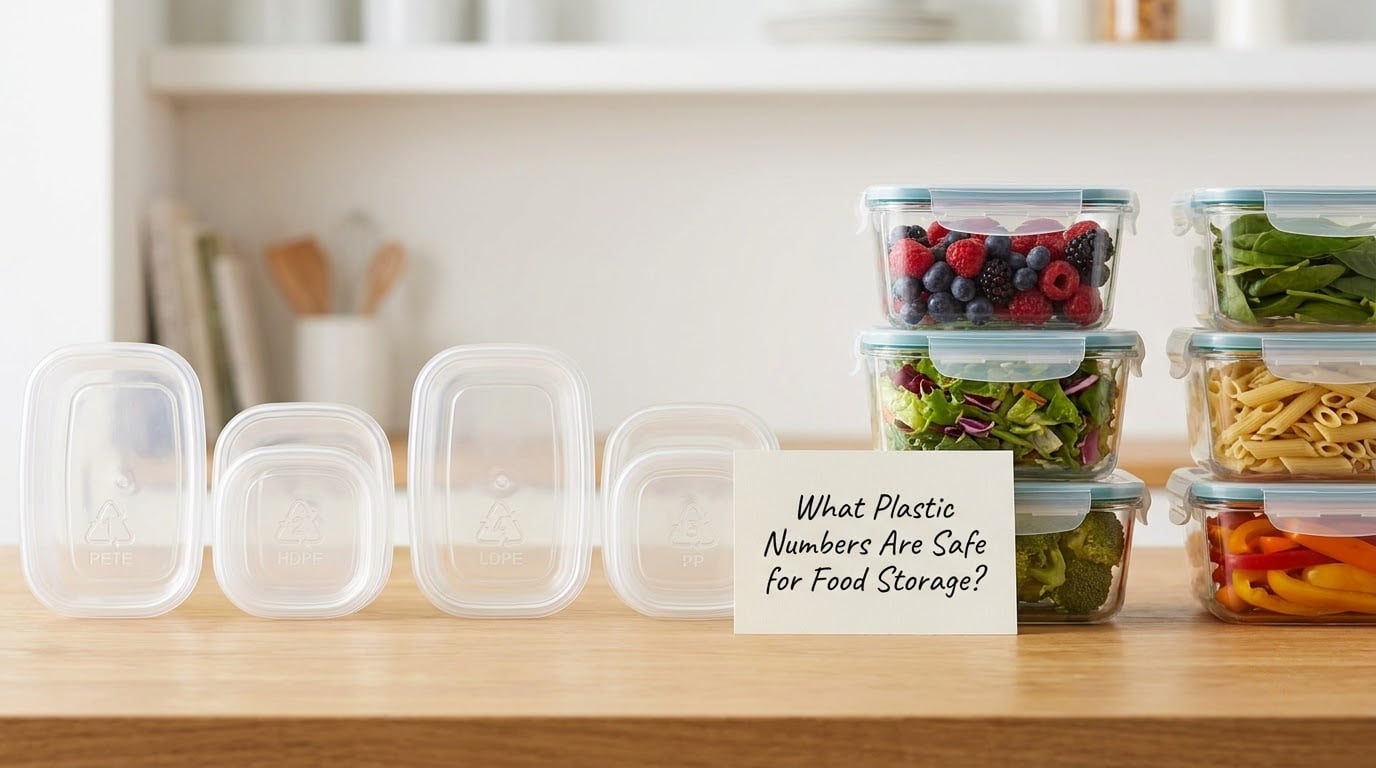
Plastic numbers 2 (HDPE), 4 (LDPE) and 5 (PP) are the safest for storing food. Number 1 (PET) is fine for cold, single-use packaging such as beverage bottles and salad clamshells. Numbers 3 (PVC) and 6 (PS) warrant caution around food, and number 7 covers polycarbonate and mixed plastics where BPA is often, but not always, present.
| Number | Plastic | Abbreviation | Food storage verdict | Typical containers | Max service temperature (supplier data) |
|---|---|---|---|---|---|
| 1 | Polyethylene terephthalate | PET or PETE | Good for cold, single-use food packaging | Water bottles, salad clamshells, juice bottles, tray liners | 70-80°C (158-176°F) |
| 2 | High-density polyethylene | HDPE | Good, widely used for food and drink | Milk jugs, juice bottles, detergent bottles, cutting boards | 120-135°C (248-275°F) |
| 3 | Polyvinyl chloride | PVC or vinyl | Use with caution; formulation-dependent | Cling wrap, tubing, shampoo bottles, some foil | Varies widely by formulation |
| 4 | Low-density polyethylene | LDPE | Good, but softens early with heat | Freezer bags, bread bags, squeeze bottles, produce bags | 80-95°C (176-203°F) |
| 5 | Polypropylene | PP | Best all-round choice for reusable storage | Deli lids, yogurt tubs, reusable containers, straws, bottle caps | 140-160°C (284-320°F) |
| 6 | Polystyrene | PS or EPS | Use with caution; best kept off hot, fatty food | Styrofoam clamshells, foam cups, cutlery, trays | 70-80°C (158-176°F) |
| 7 | Other plastics, including polycarbonate | Other | Varies by resin; check the product declaration | Sport bottles, baby bottles (if sold), stand-up pouches, plant-based containers | 115-130°C for polycarbonate (219-266°F) |
Those temperature figures come from resin supplier data sheets and describe the polymer, not your container. A #2 bottle and a #2 cutting board are the same chemistry, but the cutting board has no thin wall to cook through and no closure that traps steam.
What Do Plastic Resin Numbers 1 Through 7 Mean?
The symbols come from the resin identification system developed by the Society of the Plastics Industry and now standardized under ASTM D7611. Manufacturers mold a triangle of chasing arrows around the number into the base or side of the part. It exists so recyclers can sort material by chemistry.
That is the whole job. It was never designed as a food-contact approval, and treating it as one is the root of most of the confusion on this topic.
Number 1: PET (polyethylene terephthalate)
PET is a polyester with good barrier performance and high tensile strength for a plastic, which is why it dominates beverage bottles. Its service temperature sits well below the polyolefins, so hot-fill applications are limited, and PET softens noticeably before it distorts.
For food storage, PET works well as cold, short-duration packaging. It is also the resin most often in single-use clamshells that end up in a kitchen drawer and get reused for a week. That reuse is not what the material was qualified for. Heat from a leftover reheating in the container is the trigger that changes the migration picture, not the cold food itself.
Number 2: HDPE (high-density polyethylene)
HDPE is a stiff, chemically inert polyolefin with excellent resistance to acids and bases, and it takes sustained heat better than almost any other common packaging resin. Its weakness is clarity, which is why it dominates jugs and opaque bottles rather than clear containers.
HDPE is one of the safest choices for food storage across cold and warm conditions, and it holds up well to repeated washing. Food-grade HDPE sheet is a standard material for cutting boards and food-processing surfaces for that reason.
Number 3: PVC (polyvinyl chloride)
PVC requires the most scrutiny. Food-contact PVC depends on the plasticizer system: unplasticized PVC is rigid and used for pipe and film, while flexible PVC uses plasticizers, historically phthalates, that can migrate into food.
The FDA has set limits on phthalates in food-contact articles and restricts certain plasticizers outright, so compliant products do exist. Consumer guidance from the American Academy of Nutrition and Dietetics and the American Academy of Pediatrics has long advised minimizing contact with number 3 plastics around food. For storage containers you intend to reuse, choose something else.
Number 4: LDPE (low-density polyethylene)
LDPE is the softer, more flexible sibling of HDPE. It seals easily, which is why it dominates freezer bags, zipper closures and produce bags. Its flexibility is also its limit: it begins to soften well below HDPE’s range.
For cold and room-temperature food contact, LDPE is a solid choice. It is not a hot-fill resin, and a container made from it can deform in a dishwasher or under a stream of near-boiling liquid.
Number 5: PP (polypropylene)
PP is the workhorse of reusable food storage. It has the highest service temperature of the common food-contact polyolefins, resists acids and alkalis well, and takes repeated washing better than almost anything else in the kitchen drawer.
The real limit is dimensional. PP softens enough in a hot car or a scalding dishwasher load to take a set, and once a lid no longer seats properly, the container has lost its function even if the plastic itself has not degraded.
Number 6: PS (polystyrene)
Polystyrene is rigid, inexpensive and dimensionally stable, which makes it the standard for foam clamshells, cups and cutlery. The concerns center on styrene, which can migrate in small amounts, particularly into hot, fatty or acidic food.
Expanded polystyrene (the foam kind) is a different matter. It is nearly all air, so it has a high surface area and picks up odors and residues that never come out. It is also a persistent fragment in the environment. Food safety guidance tends to place number 6 in the minimize-around-food category.
Number 7: Other plastics
Number 7 is a catch-all for resins outside the six named families. The best known member is polycarbonate, used in baby bottles and sports drink bottles because it takes impact and heat well, and the best known concern is bisphenol A (BPA), an additive in polycarbonate and in epoxy can linings. Our guide to BPA free plastics and what the label actually tells you covers why that claim needs context.
What gets lost in the shorthand advice is that only some number 7 plastics contain BPA. Polylactic acid (PLA), a compostable bioplastic, carries number 7 and contains no BPA at all. The honest read on number 7 is that it tells you almost nothing, so it has to be resolved by reading the product declaration.
Which Plastic Numbers Are Commonly Used for Food Storage?
In real packaging runs, three numbers cover the overwhelming majority of food-contact applications, and knowing the plastic numbers safe for food storage in practice comes down to which one shows up in which format.
Number 2 HDPE in bottles and jugs
Milk jugs, juice containers, water bottles and detergent bottles. HDPE is easy to blow or injection mold, takes mechanical stress well and has one of the broadest sets of food-contact clearances. In rigid form it is also the standard for food-grade cutting boards and conveyor components in processing plants.
Number 4 LDPE in bags and flexible film
Freezer bags, bread bags, produce bags, cling film that replaced older PVC wrap, and the zip-top seal on many containers. Flexible formats are LDPE’s home turf because the resin’s flexibility and sealability matter more than heat resistance there.
Number 5 PP in tubs, lids and reusable containers
Deli and yogurt tubs, margarine containers, bottle caps, straws, takeout clamshells and most reusable storage containers. When a product claims to be reusable and wants to survive a dishwasher, it is nearly always PP.
Where number 1 shows up
PET is the beverage and ready-meat packaging resin: water bottles, juice, salad clamshells, produce tags, ovenable trays. It is common in the fridge, mostly as packaging that was never meant to become a permanent container.
The distinction worth holding onto: single-use packaging and reusable containers are qualified for different jobs. A PET clamshell is engineered for a cool salad for a few hours. A PP container is engineered to be opened and closed daily for months. Reusing one in place of the other is where most of the confusion gets created.
Does a Plastic Number Prove a Container Is Food Safe?
It does not. A resin identification code tells you the polymer family and nothing about whether the finished article was ever evaluated for food contact.
Food-contact suitability is built on several separate things: the base resin grade, the additive package including stabilizers, lubricants, pigments and anti-block agents, the colorant, the process conditions, and a declaration by the manufacturer that the finished article is intended for use with specific food types under specific temperature and time conditions.
| Term | What it means | What it does not mean |
|---|---|---|
| Resin identification code | The polymer family, marked with a number 1-7 inside a chasing-arrows triangle | Any kind of safety, approval or certification |
| Food safe | The manufacturer’s declaration that the article is suitable for its stated food types and conditions of use | A permanent property of the material; it always applies to every food and temperature |
| Food grade | Resin manufactured to purity specifications for food-contact use | Guarantee that a molded part made from it was tested for migration |
| Food contact notification | A regulatory filing with the FDA describing a substance’s intended food-contact use | Approval of your specific finished product |
| NSF or USDA certification | Third-party assessment for food service equipment andware | Something a consumer container carries |
The principle underneath all of it is “used as intended.” A material is fit for the job it was designed and declared for. HDPE is a fine resin for cold milk in a jug. That does not extend to a #2 tub sitting on a dashboard in July full of leftovers.
What actually drives chemical migration
Migration rate depends far more on contact conditions than on the resin alone. Four variables matter:
- Temperature. Migration roughly accelerates with temperature, and microwave reheating drives steam that penetrates the wall far more effectively than warm storage.
- Fat. Fatty and oily foods are aggressive extractants for many additives and pull lipophilic compounds out of the matrix.
- Acidity. Acidic foods such as tomato sauce, pickles and citrus break down some polymers faster than neutral food at the same temperature.
- Time. Longer contact means more migration. This is why a bottle designed for a single afternoon is a poor choice for a week of leftovers.
Chefs and packaging engineers describe it the same way on industry forums: portion size and contact conditions drive the migration risk, not the resin number in isolation. That is a useful corrective to the “avoid everything that is not a 2, 4 or 5” instinct. If a resin has to hold up against solvents as well as food, the screening questions are different, and it helps to know how to select a plastic for chemical resistance before you spec a resin.
Can Plastic Food Containers Be Reused or Put in the Dishwasher?
Reuse is where resin numbers earn their keep, because the answer depends on chemistry you can actually see on the bottom of the container.
- #5 PP tolerates repeated washing and short microwave reheating better than anything else common. Check for a microwave mark before reheating; the resin being suitable is not the same as the container being tested.
- #2 HDPE handles washing and cold storage well. Avoid it in a dishwasher or with boiling liquid; it can warp and take a permanent set.
- #4 LDPE is fine for freezer and fridge storage but softens early. A bag that has gone slack and will not seal again is finished.
- #1 PET clamshells and trays are single-use packaging. If you reuse one, treat it as a short-term cold container and discard it rather than reheating in it.
- #3, #6 and #7 should stay out of the dishwasher and the microwave unless the manufacturer explicitly states otherwise. Heat is exactly the condition that changes the answer.
Read the other molded symbols too, because they carry information the resin number does not.
| Symbol | What it tells you |
|---|---|
| Triangle with a number 1-7 | Resin identification code for sorting; not a safety rating |
| Wavy lines above a container | Microwave use tested; often combined with a temperature limit |
| Drink glass and fork | Tested for food contact use under stated conditions |
| Plate under water droplets | Dishwasher safe, sometimes with a lower rack or cool-wash condition |
| Knife with a slash | Not intended for cutting, which reduces scratching of the interior |
| Scissors with a line through it | Do not cut on this surface |
| NSF mark | Third-party certified for commercial food service use |
When to throw a container out
Replace it when the interior surface becomes scratched, permanently cloudy or pitted, when it has taken a set and no longer closes, when it has warped or discolored near the rim, or when it carries a persistent odor that washing does not remove. Scratches create surface area where residue and microplastic fragments collect, and a clouded surface usually means repeated heating has already degraded the polymer.
Do not reuse takeout trays or margarine tubs for storage. They were qualified for one hot or cold service event, and the inks and adhesives on those parts are not all rated for prolonged contact.
How Do You Check Food Contact Compliance for Plastic Packaging?
For a household purchase, verification is simple: look for the resin code, look for a food-contact statement on the packaging, and look for the in-mold symbols above. When the number is missing, that is a signal about how the part was made, not proof of anything bad.
For commercial buyers, packaging engineers and converters, the checklist is longer. We have covered the regulatory side separately in food contact plastics FDA requirements explained, which is worth reading before a supplier conversation.
- Resin declaration. The supplier should identify the exact grade, not just the polymer family. “HDPE, food grade” is a starting point; a grade number and a data sheet is the real answer.
- Food-contact statement. Ask which food types are covered: aqueous, acidic, alcoholic, fatty, or a simulant set. These behave differently against the same polymer.
- Regulatory framework. In the US, food-contact substances may be the subject of an FDA food contact notification, listed in the applicable regulatory sections, or covered by a prior sanction. Resins sold as food grade often rest on existing clearances rather than a new filing.
- Migration or extraction testing. Overall migration and, where the substance is regulated, specific migration testing against the intended simulants, time and temperature.
- Traceability and lot control. Resin supplier, lot numbers, and change control if the supplier alters additive packages.
- Fit for the actual job. Fill temperature, storage duration, cold chain, and whether the part sees fat or alcohol. Documented for the real conditions, not generic ones.
One manufacturing detail explains a lot of missing codes. The resin identification symbol is molded into the part, either as an in-mold graphic or on a pad. Glass-filled and black concentrates often suppress it, because a light symbol would be invisible or the contrast would look wrong. So an unfilled white or clear container in your hand almost always carries a number, while a black, glass-filled industrial part frequently does not. If the code is absent, ask the supplier for the resin grade directly.
There is a separate question people in food service ask constantly, so it is worth stating plainly: a resin number is not sufficient documentation for a commercial operation. Equipment and food-contact items used in a regulated food operation are typically expected to carry appropriate third-party certification, such as NSF, and buyers in that space routinely specify certified HDPE or PP rather than relying on a molded-in number.
What Plastic Numbers Are Best for Long-Term Food Storage?
For storage measured in weeks rather than days, #5 PP is the practical answer for a reusable container, and #2 HDPE for rigid packaging. The reason is not a safety ranking; it is heat tolerance and mechanical stability under repeated handling.
Longer storage introduces variables that the resin code cannot express. Barrier performance matters, because oxygen and moisture transmission drive oxidation, sogginess and off-flavors faster than any additive question. PET and some multi-layer structures outperform single polyolefins on barrier, while PP and PE excel on cost, chemical resistance and sealing.
Closure systems matter just as much. A container that leaks, or admits air around the gasket, undermines any material choice. In commercial packaging this shows up as a closure specification, a liner material and a seal test; at home it shows up as a lid that still clicks shut after a month of daily use.
For frozen storage, all three polyolefines tolerate sub-zero temperatures well, and PP containers marked freezer safe are the standard choice because of their low-temperature toughness. The failure mode is a container that becomes brittle and cracks, or a lid that freezes to the rim.
The practical summary: pick 2, 4 or 5 for repeated storage, match the container to the temperature and the food, and treat time and condition as part of the specification rather than an afterthought.
Frequently Asked Questions
Are plastic numbers 2, 4, and 5 safe for food storage?
Yes. HDPE (2), LDPE (4) and PP (5) are the codes most commonly specified for food contact because they are chemically inert, resist acids and fats well, and tolerate repeated handling. For hot food, PP (5) is the most heat-tolerant of the three. The number still is not a certification: confirm the container is declared for food contact, follow its temperature limits, and replace anything scratched, warped or clouded.
Is plastic number 1 safe for storing food?
Number 1 is PET, and it is well suited to cold, short-duration food packaging such as water bottles, juice bottles and salad clamshells. Its barrier and strength properties are excellent, but its service temperature is lower than the polyolefins, so it is not a hot-fill or reheating resin. Treat PET clamshells as single-use packaging and move leftovers to a #2, #4 or #5 container for storage.
Should I avoid plastic containers numbered 3?
For reusable storage, skipping number 3 is a reasonable default. PVC’s food-contact performance depends entirely on its plasticizer system, and flexible PVC historically relied on phthalates that can migrate into food. The FDA regulates plasticizers in food-contact articles, so compliant products exist, and much cling film has moved to LDPE for that reason. For fresh food bought in PVC rigid packaging, risk is low; for a container you reuse daily, choose 2, 4 or 5 instead.
Does plastic resin number 1 mean the container is BPA-free?
No. The resin identification code and additive content are separate questions. PET does not use BPA as a polymer building block, so PET packaging is generally BPA-free, but the code itself makes no statement about any additive. Conversely, only some number 7 plastics contain BPA, since polycarbonate does while PLA and other bio-based number 7 resins do not. BPA-free labeling also is not the same as food-contact suitability, which depends on the whole formulation.
Can I microwave any plastic container marked with a recycling number?
No. The resin number tells you the polymer, not whether the container was tested for microwave use. Microwave safety comes from the molded wavy-lines symbol, sometimes with a temperature limit, and from the wall thickness and additive package of that specific product. If there is no microwave mark, transfer food to glass or a container that carries one. Never microwave a sealed container, and never reheat food in a single-use takeout tray.
How long can food safely be stored in a plastic container?
Follow the food, not the plastic. Refrigerated leftovers are generally safe for three to four days at or below 40°F (4°C); cooked poultry, ground meat and fish need to reach 165°F, 160°F and 145°F respectively during cooking. Freezer storage keeps most foods safe indefinitely at 0°F, with quality degrading over months. Replace the container when it is scratched, clouded, warped or no longer seals, regardless of how short the storage period was.
Conclusion: Choose by Intended Use, Not the Number Alone
Start with the number, then keep going. Numbers 2, 4 and 5 are the common choices for food storage because they are inert, tough and heat-tolerant in the right combination, and number 1 works well for cold, single-use packaging. That is where a molded-in number stops helping.
Before you commit, check the manufacturer’s food-contact statement, match the container to the temperature and the food inside it, and follow the molded symbols rather than your assumptions. For anything commercial, ask for the resin grade, the applicable regulatory basis and migration testing for your actual conditions of use. And when a container turns up scratched, clouded or warped, replace it rather than reasoning about whether the resin was safe in theory.