
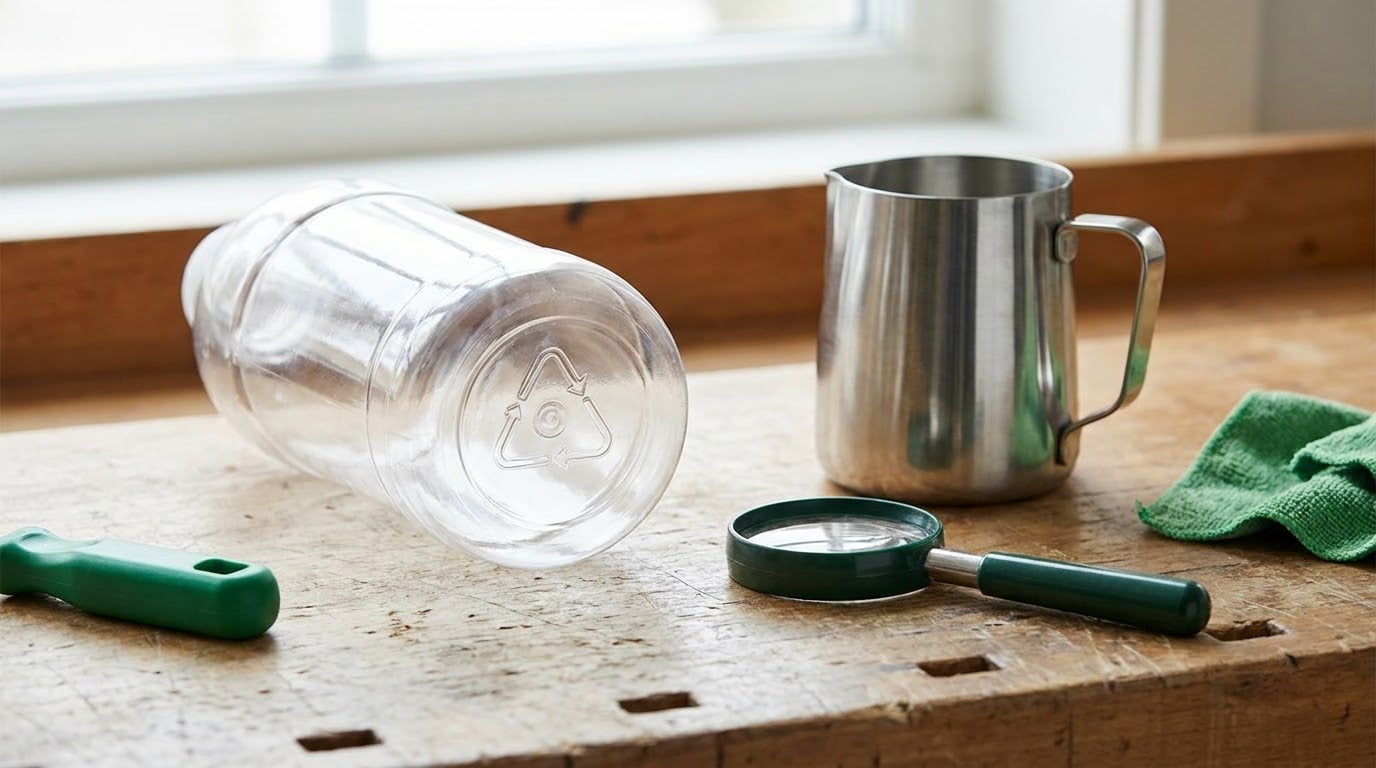
To identify plastic types by recycling number, look for the number molded or printed inside a triangle on the item. It tells you the polymer family: 1 is PET, 2 is HDPE, 3 is PVC, 4 is LDPE, 5 is PP, 6 is PS and 7 is everything else. That number describes the material, not whether your local program accepts it.
Last updated October 2026.
That distinction matters more than it sounds. The single most repeated mistake I see is someone holding a bottle, seeing the chasing arrows, and assuming the item is destined for a recycling bin. The code answers a chemistry question, not a logistics one.
Below is the process I use when a part arrives without paperwork: find the mark, read it correctly, match it to a family, sanity-check it against how the part looks and feels, and escalate to documentation or a lab when the number alone isn’t enough.
Table of Contents
- What You Need
- Step-by-Step: How to Identify Plastic Types by Recycling Number
- Step 1: Find the Recycling Symbol and Number
- Step 2: Read the Number Inside the Recycling Triangle
- Step 3: Match the Number to a Plastic Family
- Step 4: Check Context Before Assuming the Material
- Step 5: Verify the Resin When the Mark Is Missing or Unclear
- Step 6: Record the Identification for Material Handling
- Common Recycling Number Mistakes
- Frequently Asked Questions
- What are the 7 recycling codes?
- Does the recycling number mean the plastic is recyclable?
- How do I figure out what type of plastic I have if there is no code?
- Is number 2, 4 or 5 plastic safe for food and reheating?
- Which plastic numbers should I keep out of my recycling bin?
- Why did the three-arrow recycling symbol change?
- Conclusion
What You Need
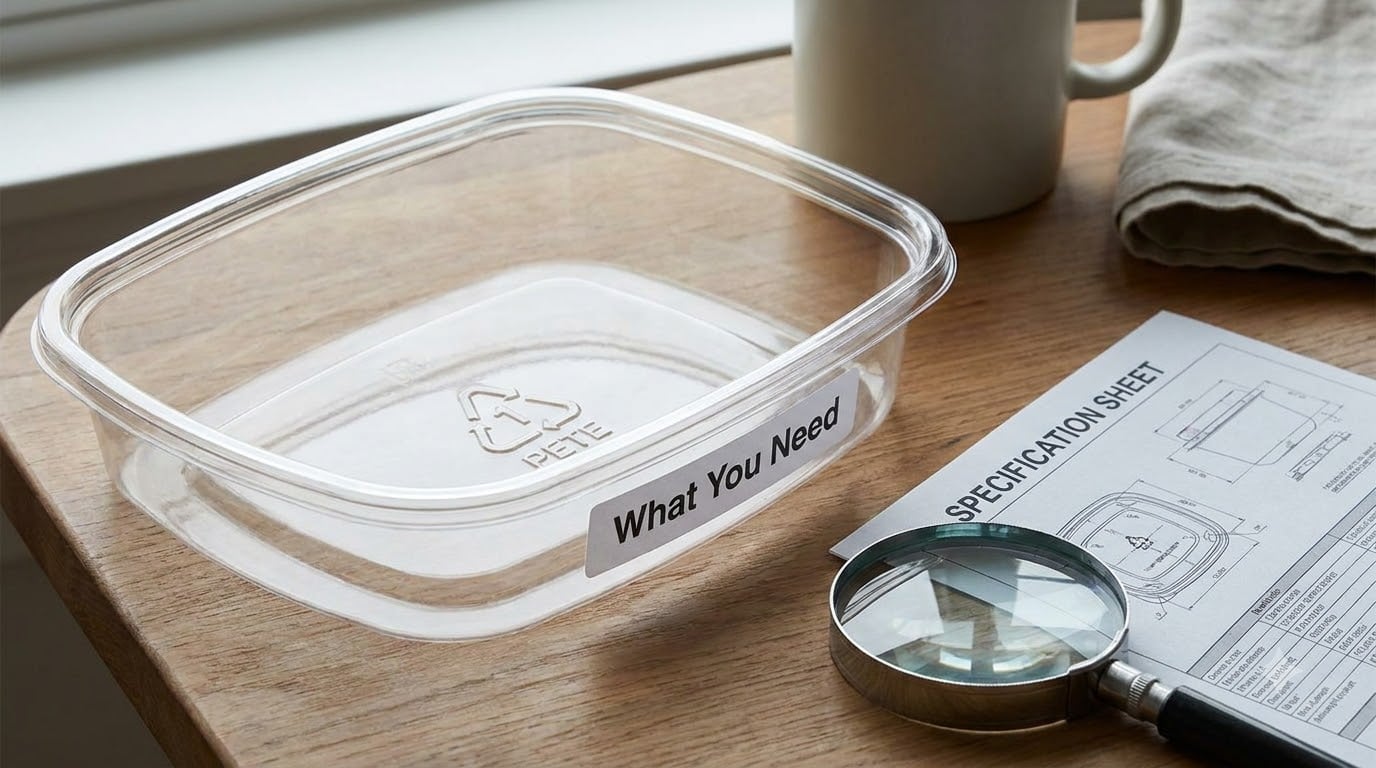
You need very little to read a resin code. You need a bit more to confirm what you are holding.
- The item itself and any packaging, labels or stickers still attached. Stickers frequently cover the molded mark, so check before peeling anything.
- A clean, dry surface. Grease, dried soap and label residue hide embossed marks. A wipe with warm water and a drop of dish soap reveals codes on dark and textured plastic that are otherwise invisible.
- A magnifier or loupe (10x is plenty). Small molded numbers on a bottle neck are hard to read at arm’s length, and the difference between a 2 and a 5 matters.
- A reliable reference. For consumer plastics, ASTM D7611 is the standard practice for the resin identification symbol. For a specific part, the manufacturer’s datasheet or material declaration beats any reference chart.
- Your local program’s accepted-material list if the goal is a disposal decision. Codes 1 and 2 land in virtually every curbside program; 4 and 5 sometimes; 3, 6 and 7 rarely. A quick search for your city or hauler plus accepted plastics gets you the real answer.
- For unlabelled parts: a glass of water for a float check, calipers or a ruler for wall thickness, and access to a datasheet, supplier, or resin distributor.
A note on the last item. Pliers, a file, and an open flame are part of traditional field identification, and I cover them below because they work. I would rather you read the safety warnings first than figure them out the hard way.
Step-by-Step: How to Identify Plastic Types by Recycling Number
Step 1: Find the Recycling Symbol and Number
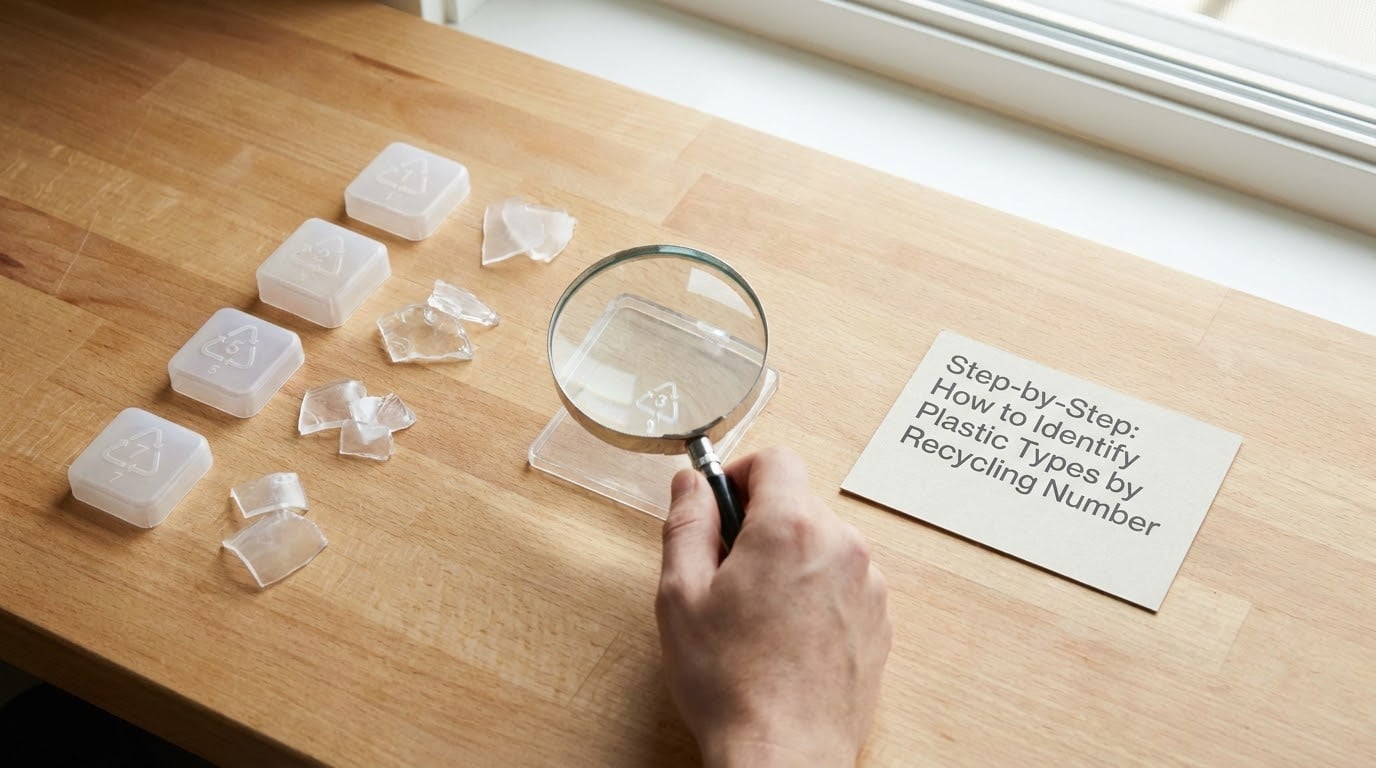
The mark is nearly always molded into the plastic rather than printed on it, which is why it survives scrubbing and why it can be nearly impossible to see on dark, textured, or transparent surfaces without light hitting it at an angle.
Work in this order:
- Base and underside. The single most common location, especially on bottles, tubs, and injection-molded parts.
- Sidewall or near the handle on larger containers and crates.
- Neck, shoulder, or base of the cap on beverage bottles. Many caps carry their own code, and it is often not the same as the bottle body.
- On or behind the label for film, flexible pouches, and shrink wrap. A folded corner can hide it.
- Directly under the product sticker on consumer goods, which is where people give up.
- Near the gate or on a flat area of the molded part for industrial components. Molders put it where it will not interfere with a thread, boss, or sealing face.
If you find a triangle and no number, you have hit one of the most common real-world cases. A screw-on water bottle with a worn or unreadable digit is the canonical example: the symbol is there, the number is not. Go to Step 5 rather than guessing.
Step 2: Read the Number Inside the Recycling Triangle
The symbol matters less than the digit. You will run into two versions.
The older chasing arrows triangle is what most people picture. ASTM International retired it in favour of a plain solid equilateral triangle because the arrows implied a recycling instruction that the code never gave. If you see both on the same shelf, they are the same numbering system.
Now read the digit carefully, because several marks get confused:
- A percentage sign near the symbol usually refers to recycled content, not resin.
- A digits-only string like
05or07is a date code (May 2007, July 2020). A leading zero on an older part almost always means the year. - A letter-number pair such as
05PPis a material designation in the ASTM D7611 format, where the digits identify the polymer family and the letters add detail like recycled content or a manufacturing method. - A two-letter abbreviation (PETE, HDPE, PEHD, PELD, PS, PVC) is common on European and Asian packaging. HDPE is PEHD in French and Spanish; LDPE is PELD. Same polymer, different language.
Photograph the mark and record the number before you do anything else. A photo taken against a light background resolves ambiguity that squinting at the part will not.
Step 3: Match the Number to a Plastic Family
Here is the reference table. Everything below it elaborates on what the number means in practice.
| Code | Polymer | Abbreviation | Common products | Curbside status | Food-contact notes |
|---|---|---|---|---|---|
| 1 | Polyethylene terephthalate | PET / PETE | Water and soda bottles, food trays, shampoo bottles, polyester film | Widely accepted | Good for single use; repeated heating and washing degrades it |
| 2 | High-density polyethylene | HDPE / PEHD | Milk jugs, detergent bottles, juice bottles, shampoo bottles, caps | Widely accepted | Stable, microwave-safe in most forms, good for hot fill |
| 3 | Polyvinyl chloride | PVC / V | Pipe and conduit, blister packs, shrink film, medical tubing, vinyl flooring | Almost never accepted curbside | Pure PVC is not food-contact approved; do not burn it |
| 4 | Low-density polyethylene | LDPE / PELD | Plastic bags, film, produce bags, flexible tubing, squeeze bottles, lids | Accepted in some programs, film often needs a store drop-off | Stable and flexible; widely used for food bags and closures |
| 5 | Polypropylene | PP | Caps, yogurt containers, straws, takeout containers, hot-fill bottles, automotive parts | Accepted in many programs | Heat-tolerant; the usual resin for hot-fill and microwave containers |
| 6 | Polystyrene | PS | Styrofoam cups, clamshell containers, CD cases, packing peanuts, cutlery | Rarely accepted curbside | Not recommended for hot foods or drinks; avoid for fatty foods |
| 7 | Other | OTHER | Polycarbonate (baby bottles, electronics housings), ABS, SAN, acrylic, polycarbonate blends, PLA and other bioplastics | Program by program; usually no | Varies entirely by polymer. Polycarbonate can contain BPA-derived compounds |
The system was introduced by the Society of the Plastics Industry in 1988 to replace an earlier US code that used two- and four-digit numbers. The numbering has been stable for decades, so a 2 on a 1995 jug means the same as a 2 on last week’s jug.
What the number does not tell you is the grade. Within code 2 you will find everything from thin-walled detergent bottles to thick-walled chemical drums, with different densities and additives. A resin supplier specifies grade with a density value (typically 0.91 to 0.97 g/cm³ for HDPE) and a melt flow rate; the recycling number tells you the family, the datasheet tells you the grade.
Step 4: Check Context Before Assuming the Material
Once you have a number, run a quick consistency check against what you can see. Context is a sanity check, never proof.
- Transparency. PET and clear PS are rigid and clear; HDPE and PP in thin form are semi-opaque or milky; LDPE is flexible and slightly cloudy.
- Rigidity. If a part is marked 2 (HDPE) but behaves like a hard engineering component with a glass-filled look, you may have a filled or blended resin.
- Wall thickness. HDPE is easy to squeeze in a 20-mil wall and difficult in a 100-mil wall. That is a fill factor difference, not a code difference.
- Surface. Smooth, slightly waxy, and cool to the touch points to a polyolefin (2, 4, 5). Hard, dense, and ringing when tapped points to PS or a filled engineering grade.
- Color. Pigment does not change the code, but a clear part with a colored neck label still counts as one resin for sorting purposes unless it is multi-layer.
- Manufactured features. Living hinges and thin snap tabs are typical of PP. Deep drawn walls suggest PET or HDPE. Coextruded layers and visible delamination on a screw cap mean code 7 or a multi-material construction.
Where context and code disagree, trust the code, then verify with documentation. Manufacturers occasionally mislabel, and molded-in marks on recycled material can be inherited from an earlier life rather than representing the current resin.
Step 5: Verify the Resin When the Mark Is Missing or Unclear
This is the escalation path, and it is where a lot of the real value is. Work down the list and stop when the evidence is strong enough for your decision.
1. Look harder. Clean the part, check the underside with a magnifier, and light it from a low angle. Embossed marks on dark plastic show up clearly with side lighting. Check caps and closures separately; they are frequently a different resin from the body.
2. Field tests, safe ones first.
| Test | What you do | Reading |
|---|---|---|
| Water float | Fill a glass with water and drop the sample in | HDPE and LDPE float. PET, rigid PS, ABS, PC, PVC sink. Most polyolefins float even with fillers |
| Bend or flex | Flex a strip with pliers or by hand | LDPE bends repeatedly without cracking. PP takes a sharp crease then whitens. PET, PS and ABS are rigid and snap or crack |
| Scratch | Score the surface with a knife tip | Polyolefins mark whitish. PS and ABS mark shiny. A soft, gouging cut suggests a softer resin |
| Tap test | Tap the part against a hard surface | PS rings flat and bright. PET has a thinner, higher tone. Filled and glass-fiber grades are dull |
| Solubility (nail polish) | Apply acetone to a hidden spot | PS softens and dissolves; ABS gets sticky and gummy; polyolefins and PET are unaffected |
3. Burning test, last resort only. Hold the smallest possible sample with metal tweezers over an alcohol lamp or small burner, in a ventilated space away from anything flammable, and never on material of unknown provenance. Keep it to a few seconds and have water or an extinguisher within reach.
| Resin | Flame | Smoke | Behaviour | Safety flag |
|---|---|---|---|---|
| PE (2, 4) | Blue with a yellow tip | Minimal | Melts and drips, continues to burn | Low risk, large wax drip |
| PP (5) | Blue, brighter, more vigorous | Minimal | Drips, black smoke late in the burn | Larger wax drip |
| PS (6) | Yellow-orange | Sooty | Bubbles, black crumbly char | Sooty residue |
| PVC (3) | Yellow-green | Acrid, heavy | Chars, does not cleanly melt | Do not burn. Releases hydrogen chloride and dioxin-forming compounds |
| PET (1) | Yellow-orange with black smoke | Smoky | Melts, can ignite | Smoke residue |
Never burn PVC or polyurethane, and never burn waste-stream material of unknown origin. If the flame test is the only evidence you have, the answer is not “probably” enough for a purchasing or processing decision.
4. Documentation. For any part that matters, go to the source: the manufacturer’s datasheet or material declaration, the supplier’s certificate of conformance, the purchase order, or the resin supplier’s technical data sheet. If you are specifying a material for a chemical service rather than a packaging line, how to select a plastic for chemical resistance covers the compatibility checks the recycling number cannot do for you.
5. Laboratory analysis. When documentation is unavailable and the decision is real, send a sample for FTIR or DSC analysis. FTIR identifies the polymer family in seconds and is the standard method for unknown plastics; DSC gives transition temperatures that pin down the grade. It costs money, and that is fine, because it replaces an argument.
Step 6: Record the Identification for Material Handling
Write down what you did and how sure you are. A one-line record prevents the same identification from being re-litigated six months later.
- Code and symbol: the number as read, and whether the mark was chasing arrows or the solid triangle.
- Polymer family: PET, HDPE, PVC, LDPE, PP, PS, or Other (narrow the 7 where you can: PC, ABS, SAN, PMMA, PLA, PETG).
- Evidence source: molded mark, datasheet, field test, or lab report.
- Confidence: confirmed by documentation, confirmed by field test, or inferred. Mark unverified samples so nobody downstream treats them as certified.
- Additives and construction: flame retardant, glass or mineral filler, pigment, multi-layer coextrusion, barrier layer.
- Decision and its basis: accepted by which program, routed to which stream, or quarantined pending verification.
One practical note if you work with molded parts. Molders commonly emboss the code into a flat near the gate so it does not interfere with threads, gates, or sealing surfaces, and so it is visible after ejection. For sorting equipment, that placement matters: a mark on a curved wall is harder to read optically than one on a flat, and some sorting lines read marks at specific points in the bale stream. If you specify molded parts, decide where the code goes before the first shot rather than after.
Common Recycling Number Mistakes
Mistake 1: The triangle means it is recyclable. The chasing-arrows symbol was retired precisely because it implied a recycling instruction. The number identifies the polymer; whether it can enter your program is a separate decision made by your hauler. If you want to know what happens next, our mechanical versus chemical recycling explainer breaks down the routes a sorted resin can take.
Mistake 2: No number means no recycling. A missing mark tells you the manufacturer skipped it or it wore off. It says nothing about the chemistry. Small parts, film, hardware, and molded components are routinely unmarked and perfectly recyclable through specialty streams.
Mistake 3: Treating the resin code as a recyclability guarantee. Every one of the seven resins is technically recyclable in principle. In practice, curbside programs across North America and the UK mostly take 1 and 2, sometimes 4 and 5, and rarely 3, 6 and 7. All seven can be recycled somewhere; most material recovery facilities simply do not handle all seven streams.
Mistake 4: Confusing the resin code with a consumer recycling label. How2Recycle in North America and OPRL in the UK use a different visual language, with the material named in words alongside instructions such as “Check with your local program.” These labels are directional advice, not material identification. Our guide to plastic packaging labeling rules in the US covers what manufacturers are and are not allowed to claim.
Mistake 5: Believing that a product with no arrow symbol is banned or toxic. It is usually a claim decision, not a hazard one. Some brands removed the symbol to avoid recyclability claims. California’s SB 343 tightened what counts as a defensible recyclability claim, which pushed many manufacturers to drop chasing arrows without changing the resin at all.
Mistake 6: Assuming the number is the same everywhere. In the United States, ABS falls under code 7. European decision 97/129/EC and China’s GB 16288-2008 use different schemes, and both have their own code for ABS. A part imported from Asia may carry a symbol that means something else. UK kerbside collections, for example, are usually limited to codes 1, 2 and 5, which is a useful reminder that the code travels poorly across borders.
Mistake 7: Guessing the resin from colour or shape. A black bottle is not automatically HDPE; black PET and black ABS exist. A translucent rigid container could be PET, PS, or clear ABS, and the same product can be made from a different resin than the one you held last year. Multi-layer and coextruded structures break the assumption entirely, and a cap is routinely a different resin from the bottle neck.
Mistake 8: Believing two identical-looking products carry the same code. Shampoo bottles are the classic case: one manufacturer uses HDPE, another uses PET, and the bottles look identical in the hand. If two codes are possible for the same object, the code is the only answer; the object itself is not.
Mistake 9: Overheating a single-use container. Reusing a PET bottle for weeks or microwaving it in a closed form degrades the polymer and can migrate additives. Codes 2, 4 and 5 are the food-safe ones people ask about most, and all three are fine for their intended single use or hot-fill service.
Frequently Asked Questions
What are the 7 recycling codes?
The 7 plastic recycling codes are 1 for PET (polyethylene terephthalate), 2 for HDPE (high-density polyethylene), 3 for PVC (polyvinyl chloride), 4 for LDPE (low-density polyethylene), 5 for PP (polypropylene), 6 for PS (polystyrene), and 7 for Other, which covers polycarbonate, ABS, SAN, acrylic and bioplastics. Each number identifies the polymer family, not whether your local program accepts the item.
Does the recycling number mean the plastic is recyclable?
No. The number tells you which polymer the item is made from, nothing more. Every one of the seven resins is technically recyclable, but curbside acceptance depends on your local program, the item’s size and shape, and whether your material recovery facility handles that stream. Codes 1 and 2 are accepted almost everywhere; 4 and 5 in many places; 3, 6 and 7 rarely.
How do I figure out what type of plastic I have if there is no code?
Start with a water float test, then flex, scratch and tap the sample, and try a drop of acetone on a hidden spot to separate polystyrene from ABS. These narrow the family but never confirm the grade. For anything that matters, go to the manufacturer’s datasheet or your supplier’s certificate of conformance, and if neither exists, send a sample for FTIR analysis.
Is number 2, 4 or 5 plastic safe for food and reheating?
Codes 2, 4 and 5 are the polyolefins most often used for food contact, and all three are stable at typical serving temperatures. Code 5 polypropylene handles hot fill and microwaving best. Code 4 LDPE is common in flexible food bags. Code 2 HDPE is microwave-safe in most forms. All are intended for their designed service, so replacing a single-use item rather than washing and reusing it repeatedly is the safer habit.
Which plastic numbers should I keep out of my recycling bin?
Code 3 PVC is the main one: it is rarely accepted curbside and it should never be burned. Code 6 polystyrene is also excluded by most programs, and code 7 depends entirely on which polymer is inside it. Multi-layer pouches, film, and anything with a foil or metal layer are rejected almost everywhere regardless of code, because sorting equipment cannot separate them.
Why did the three-arrow recycling symbol change?
ASTM International replaced the chasing-arrows triangle with a plain solid equilateral triangle because the arrows implied that the item was recyclable, which the number never guaranteed. The numbering did not change, so older parts showing chasing arrows use the same 1 through 7 system as newer parts with a solid triangle. Other numbering families exist for other materials, including batteries, paper, metals and glass.
Conclusion
Four actions cover most cases. Find the molded mark, usually on the base or the underside. Read the digit and ignore the arrows. Treat it as a family-level clue rather than a verdict on your bin. When the mark is missing or a decision matters, verify with the datasheet, the supplier, or a lab.
Last reviewed October 2026.