

To become a manufacturing engineer, you need a four-year engineering degree in manufacturing, mechanical, or industrial engineering, hands-on experience with real production processes, and working knowledge of quality methods, CAD, and data analysis. Most people follow a four-year degree plus two to five years of shop-floor experience, and plenty of technicians and career changers get in through a Manufacturing Engineering Technology degree or an apprenticeship.
That is the honest version. The path is long, but it is not locked to people who entered college at eighteen with a perfect math record. The part that trips people up is not the degree. It is the gap between what school teaches and what the job actually asks you to do on a Tuesday morning when a line stops running.
This guide breaks that path into eight steps, each with a clear measure of success so you know whether you actually moved forward or just read something about moving forward.
Table of Contents
- What You Need
- Step-by-Step: Build Your Manufacturing Engineering Career
- Step 1: Choose the Right Manufacturing Engineering Path
- Step 2: Build a Job-Ready Technical Foundation
- Step 3: Learn Industry-Standard Design and Data Skills
- Step 4: Get Hands-On With Manufacturing Processes
- Step 5: Develop Data, Quality, and Problem-Solving Skills
- Step 6: Gain Real Experience Before Applying for Full-Time Roles
- Step 7: Create a Resume and Prepare for Interviews
- Step 8: Start the Role and Build Your Professional Growth
- Common Mistakes
- Frequently Asked Questions
- Do I need an engineering degree to become a manufacturing engineer?
- Which engineering degree is best for manufacturing engineering?
- What technical skills should I learn before applying?
- Are manufacturing engineering certifications worth pursuing?
- How do I get manufacturing experience without a full-time job?
- How do I move from manufacturing engineer to engineering manager?
- Conclusion
What You Need
Manufacturing engineering sits between product design and the factory floor. That middle position explains almost everything about the qualifications: you need enough design literacy to know why a part was drawn a certain way, and enough production reality to know what the machines will actually do with it.
Educational background. A bachelor’s degree in manufacturing engineering is the most direct route. Mechanical engineering is the most common feeder, and industrial engineering is the strongest alternative because it already covers factory layout, work measurement, and cost. What matters more than the program name is whether the school teaches the processes it claims to. Read the actual course list, not the brochure.
Technical disciplines to understand. You do not need to be an expert in each one, but you need working knowledge: mechanics of materials, machine tooling basics, heat and fluid systems as they apply to equipment, and the statistical methods behind quality control. Most manufacturing engineers are generalists who know where to look things up.
Software. At minimum, learn a 3D CAD package, spreadsheet-based data analysis, and a statistics package. Depending on the sector you may also touch CAM programming, PLC troubleshooting, MES reporting, or PLM. Start with CAD and spreadsheets; the rest arrives with the job.
Personal qualities. The job involves persuading a machine operator to try a new setup, writing instructions a tired person can follow at 3 a.m., and explaining to a finance manager why a cheap fixture is not cheap. Communication and documentation discipline matter as much as technical depth here.
Career planning and finances. Plan a four to six year runway if you take the degree route, and decide how you will cover it. Scholarships, community college transfer, employer tuition programs, and night classes all exist. Starting a degree you cannot finish is the most common way people stall out.
Step-by-Step: Build Your Manufacturing Engineering Career
Eight steps, in the order that actually works. Each one has a finish line you can check.
- Pick a degree or training route that matches where you are now.
- Build the technical foundation: materials, statistics, quality, machine safety.
- Learn CAD, GD&T, tolerances, and process selection.
- Get real time on real manufacturing processes.
- Practice data-driven problem solving: root cause analysis, FMEA, control charts.
- Accumulate documented experience through internships, co-ops, labs, or technician roles.
- Build a resume with numbers and prepare for the interview.
- Start the role and grow into senior, quality, NPI, or operations leadership.
Here is what each one looks like in practice.
Step 1: Choose the Right Manufacturing Engineering Path
Four degree families send people into this role, and they differ more than job ads suggest.
Mechanical engineering gives the deepest theory: mechanics, thermodynamics, machine design, manufacturing processes. It is the most requested degree on job postings and the hardest to complete. Choose it if you want optionality across product design, process, and equipment roles.
Industrial engineering focuses on the system rather than the machine: work measurement, line balancing, ergonomics, cost, quality, supply chain. It maps almost directly onto manufacturing engineering work and often includes a co-op program. This is the path I would pick for someone certain about the manufacturing side.
Electrical engineering reaches manufacturing through automation, controls, and electronics assembly. It is the right choice if you are more interested in robots, PLCs, and machine controls than in machining and materials.
Manufacturing engineering as a named degree is the most on-target, though fewer schools offer it. It bundles design for manufacturability, process planning, and production systems in one program.
A Manufacturing Engineering Technology (MET) degree is the practical sibling. MET programs are hands-on, lab-heavy, and design-focused rather than analysis-focused, and they usually include co-op terms. The trade-off is real: some employers and most state engineering licensure paths treat MET differently from a conventional engineering degree, so check the specific wording in job postings before committing. GD&T basics for plastic parts covers one of the drawing skills both degree types need.
How you know it worked: you can name three roles you could apply for with this degree, and you have looked at ten real postings in your target region to confirm it.
Step 2: Build a Job-Ready Technical Foundation
Degree coursework matters most when it connects to something you have seen run. Here is the core set and the plant-floor application of each.
- Statistics and probability — needed for capability studies, sampling plans, and control charts. A defect rate means nothing without knowing how many parts you looked at.
- Materials and mechanics of materials — why a part warps, cracks, or wears, and what tolerance it can hold.
- Thermodynamics and fluid mechanics — heat exchangers, pumps, compressors, drying, cooling, and pneumatic systems that fill most plants.
- Quality methods inspection techniques, measurement error, control plans, and the difference between inspecting and controlling.
- Machine operation and tooling enough to write a sensible setup sheet and hold a conversation with a machinist.
- Machine safety and regulatory basics guarding, lockout, and why a process change cannot skip a safety review.
- Production economics labor burden, scrap cost, capital recovery, and the break-even math behind automation proposals.
How you know it worked: you can take a part drawing and answer three questions about how it will be made, what will go wrong, and what it will cost to produce.
Step 3: Learn Industry-Standard Design and Data Skills
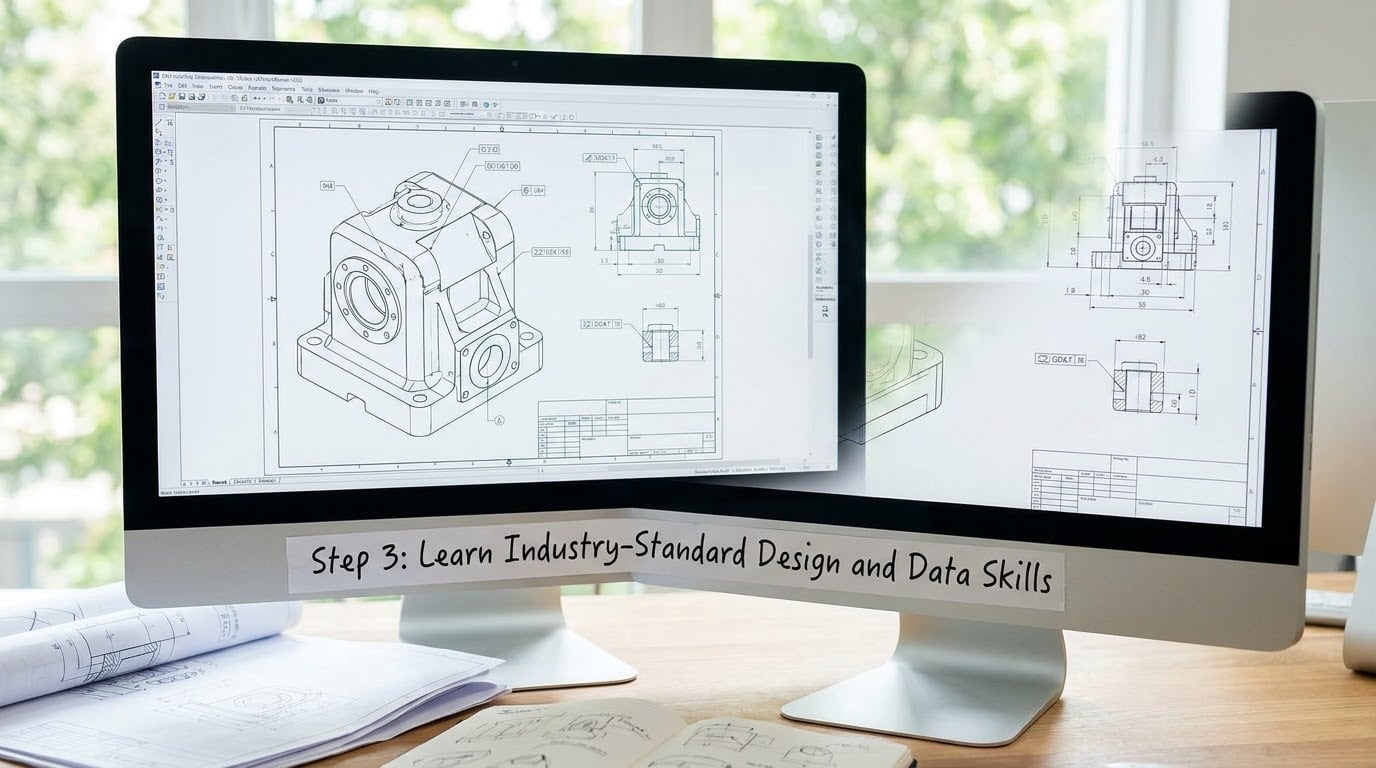
You do not need to be a CAD artist. You need to read drawings the way a machinist reads them, and understand why the drawing says what it says.
Start with GD&T, the geometric language that says how a part must fit, go flat, and stay in tolerance beyond just its overall size. Datum references, position tolerance, profile, and true position come up in every interview once you have a manufacturing role, and they are the difference between a designer and an engineer who can release a part to production.
From there: tolerance stack-up, which shows whether a part can physically be built when every hole and face is at its worst; process selection, which picks machining over stamping over molding; bill of materials, which records what the part is made of and in what quantity; and standard work instructions, which describe the sequence a person follows on the line.
Keep one software project you can talk about in depth. Modeling a part, then figuring out how it would actually be made, is worth more in an interview than a list of ten software names.
How you know it worked: you can pick up an unfamiliar drawing and explain what the designer intended, where the part is most likely to fail, and which process you would use.
Step 4: Get Hands-On With Manufacturing Processes
This is the gap that surprises people. Degree programs cover processes in theory and hand you in labs. What they rarely hand you is a running line, an operator who knows a trick, and the reality that a process capable on paper will behave differently at volume.
Cover the main families: machining, forming and stamping, welding, casting, molding, assembly, inspection, and material handling. You do not need to be an operator. You need to know what each process is good for, what it costs to set up, what the realistic cycle times are, and what the failure modes look like.
There are four ways to get that exposure. A university lab or capstone project with real tooling is the easiest. An internship or co-op at a plant is the most valuable. A machining or fabrication shop tour takes an afternoon and tells you a lot about how much variation exists between plants. Supervised shop work, whether through an apprenticeship program or a community college facility, gives you the muscle memory that interviews pick up on.
Note what you learned and how long you were there. Hours matter less than whether you can describe a specific problem you observed.
How you know it worked: you can describe one process you have seen up close, in enough detail that the description sounds like experience rather than a textbook.
Step 5: Develop Data, Quality, and Problem-Solving Skills
Manufacturing engineers get paid to reduce variation. That work is almost entirely data-driven, and it follows a repeatable loop: define the problem, observe the process, gather reliable data, identify the root cause, change something, verify the result, then standardize it so the gain sticks.
Build the tools in this order.
- Spreadsheets for cycle-time data, defect counts, and cost comparison. Pivot tables and lookups are enough for most entry-level work.
- Process documentation — routing sheets, work instructions, control plans. Writing clearly for someone else is a core skill, not admin work.
- Statistical process control — control charts, sampling, and how to know when a process has actually shifted rather than just wobbling.
- Process capability (Cp/Cpk) — whether a process can consistently meet its specification.
- FMEA, especially PFMEA, for ranking what could go wrong by severity, occurrence, and detectability.
- Root cause analysis — 5 Whys, fishbone diagrams, and A3 problem solving. Root cause analysis methods for manufacturing defects walks through the tools with examples.
- Continuous improvement methods — value-stream mapping, 5S, standard work, and changeover reduction.
How you know it worked: you have one real problem solved end to end, with data before and after, and can explain why the improvement held.
Step 6: Gain Real Experience Before Applying for Full-Time Roles
Experience is the filter most entry-level candidates fail, so the arrangement matters more than the title.
Internships and co-ops are the strongest route. A co-op puts you inside a plant for six months or more, which often means you qualify for an offer before you graduate. If your school has one, treat it as a requirement rather than an option.
Capstone and lab projects count when they involve real tooling, real tolerances, and a measured result. A redesign that cuts cycle time by a documented amount reads better than a simulation with no physical build.
Apprenticeships through a manufacturer, a union program, or a community college teach a trade in depth and often lead to full-time roles with a company that already knows your work. The CMfgT credential from the Society of Manufacturing Engineers fits naturally into this path for people coming up through the shop.
Technician and operator roles are underrated for people without a degree. Running a process teaches you the same fundamentals a manufacturing engineer applies, and the promotion path into process or manufacturing engineering is common when you also pick up the analysis skills above.
Contract and freelance assignments work for people already in adjacent fields: quality, production supervision, CAD design, or data analysis. Small documentation or process-mapping contracts give you legitimate, describable work.
How you know it worked: you can show a document, drawing, or analysis you produced for a real process, and someone else confirmed the work was used.
Step 7: Create a Resume and Prepare for Interviews
Manufacturing resumes fail in one specific way: they list duties instead of results. “Supported production” tells a hiring manager nothing. Every bullet should follow the shape: situation, action, measured result.
Before: “Assisted with the packaging line.” After: “Rebuilt the line’s changeover sequence using SMED steps, cutting changeover from 45 to 18 minutes across two product families.” The second version is what an interviewer can follow up on.
Interviewers typically probe three areas. First, technical depth: walk them through a drawing, ask how you would make a part, and ask what GD&T tells you about fit. Second, problem solving: describe a real defect, how you found the cause, and what evidence confirmed the fix. Third, behavior: describe a time you disagreed with a more senior person, or handled an equipment problem nobody had seen before. A safety-first mindset comes through when you describe what you checked before running anything.
Bring printed artifacts to the interview: a process map, a capability study, a PFMEA you built in school, a time study. Ten pages of your own work does more than a certificate list.
Have two or three specific questions ready about the equipment, the product, and how process changes get approved. Engineers who ask how the plant decides what to improve tend to get hired faster.
How you know it worked: a recruiter can read your resume in thirty seconds and name the process you improved and the number it moved.
Step 8: Start the Role and Build Your Professional Growth
The first year is about learning how the plant actually works. You will read more standard work, ride more lines, and sit in more meetings about material shortages than you expect.
Expect a common progression. In the first six months, you shadow the lines, learn the products, and start taking small process changes. Between six months and a year, you own something: a part, a work cell, a documentation package, or a capability study. After a year, you handle a new product introduction or a capital project, which means tooling, trial runs, ramp planning, and working with quality, supply, and maintenance at the same time.
Take the FE exam once you are close to graduating if you are on a licensure track. It matters most for public infrastructure, utilities, and consulting work, and less inside private manufacturing, so decide deliberately.
Add credentials in the right order. The Society of Manufacturing Engineers ladder runs CMfgA, then CMfgT, then CMfgE. The CMfgE is a mid-career credential, not an entry ticket: SME recommends a minimum of eight combined years of manufacturing education and work experience, including at least four years of work, and holding a CMfgT reduces that to seven combined years. Practitioners on Practical Machinist debate it against a bachelor’s degree for exactly that reason. Before you spend on exam prep, check whether you are even eligible yet.
From there, the paths branch: senior manufacturing engineer, process engineering manager, NPI lead, quality engineer, continuous improvement lead, or industrial engineer. Operations and supply chain management are also open if you build those skills deliberately. How setup reduction with SMED works is a good example of the kind of project that moves you toward a lead role.
How you know it worked: after a year, you are the person other people ask when a process misbehaves.
Common Mistakes
Staying in theory. You can ace every course and still freeze when asked how a part gets made. Fix: pick one process this month and learn it from a machine setup sheet, a process video, and one conversation with someone who runs it.
Avoiding the shop floor. Manufacturing engineering done only from a desk becomes industrial engineering, and often becomes management. Fix: commit to a recurring reason to be on the floor, whether that is a co-op term, a volunteer role, or a monthly visit to a partner plant.
Treating communication as a soft skill. The most common performance problem in this role is a process change that operators resist because it was announced instead of explained. Fix: write the work instruction yourself, and test it with the person who will use it.
Collecting credentials you are not eligible for. Wasting money preparing for the CMfgE before you meet the experience requirement is a common and expensive mistake. Fix: list each credential with the experience it requires before you register for anything.
Pursuing management too early. A title change before you have owned a process end to end leaves you unable to answer technical questions later. Fix: stay hands-on for two to three years, then move.
Applying to roles that do not match your industry. Semiconductor and battery plants, for instance, run on standards a general mechanical degree does not cover. Fix: read ten postings and let them tell you which gaps to close.
Frequently Asked Questions
Do I need an engineering degree to become a manufacturing engineer?
Most employers require a bachelor’s degree in engineering, but not always in manufacturing engineering specifically. Mechanical and industrial engineering degrees qualify for nearly all openings. A Manufacturing Engineering Technology degree is accepted by many plants, though some employers and state licensure rules treat it differently, so check postings before choosing. Apprenticeships and technician-to-engineer promotions are also real paths into the role without a four-year degree.
Which engineering degree is best for manufacturing engineering?
A named manufacturing engineering degree is the most direct. Industrial engineering is arguably the closest fit because it already covers work measurement, line balancing, cost, and quality. Mechanical engineering gives the deepest technical theory and the most options afterward. Choose based on what you want to do daily: machines and materials, or systems and flow. Read the actual course list, since program names vary widely between schools.
What technical skills should I learn before applying?
Prioritize CAD, reading technical drawings, and GDu0026amp;T, then add process selection and tolerance stack-up. Beyond design, you need statistics and control charts, PFMEA, root cause analysis, and spreadsheet-based data analysis. Familiarity with CAM, MES reporting, and PLC basics helps in automation-heavy plants. Pick one software package and learn it properly rather than collecting shallow knowledge across ten tools.
Are manufacturing engineering certifications worth pursuing?
They are worth it when they match your career stage. The Society of Manufacturing Engineers ladder runs CMfgA, CMfgT, and CMfgE, and the CMfgE requires a recommended minimum of eight combined years of education and work, including four years of work. Lean Six Sigma belts carry weight in continuous improvement roles. For early-career candidates, a co-op and real project evidence usually buy more than any exam.
How do I get manufacturing experience without a full-time job?
A co-op or internship is the fastest route, and many convert to full-time offers. A university lab or capstone with real tooling and measured results works nearly as well. Community college machining and fabrication programs give supervised shop time. If you already work in production, quality, or maintenance, look for internal process projects and document them. Small contract documentation or process-mapping work also counts if someone used the result.
How do I move from manufacturing engineer to engineering manager?
Spend two to three years owning a process end to end, including the result, not just the plan. Build a track record of measurable gains and get comfortable with budgets, capital requests, and cross-functional meetings. Leading a new product introduction or an equipment project is usually the step that reads as readiness. Many managers also pick up an MBA or a master’s in engineering management, though employers rarely require it.
Conclusion
Knowing how to become a manufacturing engineer comes down to three things: a program that teaches real processes, hours on a floor where those processes run, and evidence that you improved something measurable.
Start this week. Research three accredited programs and compare their actual course lists. Pick one manufacturing process to learn deeply, then choose one job-relevant skill and practice it, whether that is reading a drawing, building a control chart, or running a capability study in a spreadsheet. That combination is what separates a candidate with a degree from a candidate who gets the offer.