
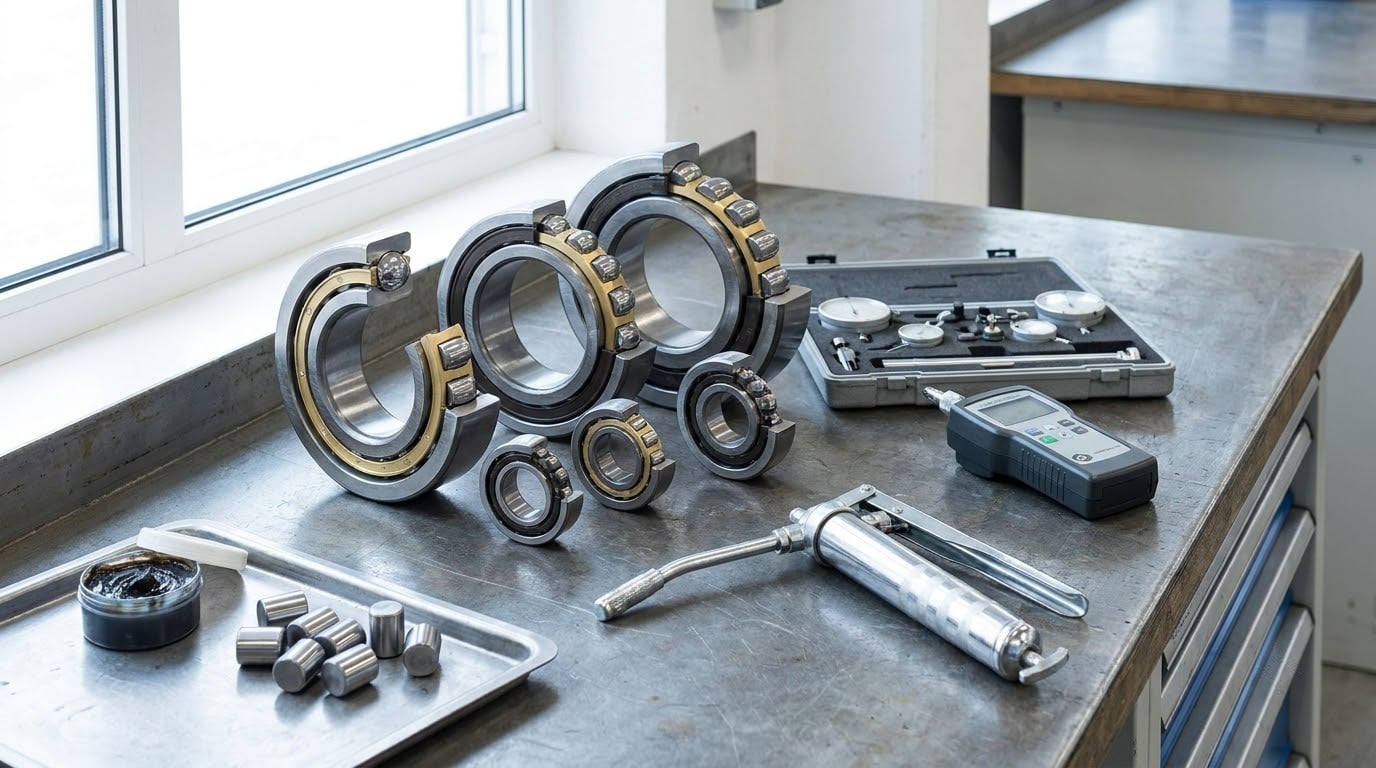
Bearings fail early for a short list of reasons: not enough lubricant, the wrong lubricant, dirt in the rolling contacts, a load or alignment problem, electrical current arcing through the raceway, or damage done during installation. Industry studies often put lubrication and contamination together at the top of that list, accounting for a large share of premature failures across motors, gearboxes and conveyors.
The odd part is that a bearing is rarely the thing that was actually wrong. It is the cheapest component in most rotating machines, so it absorbs the abuse and wears out while the expensive parts keep running. Learn to read the damage and you can fix the cause instead of swapping the same bearing every six months.
Table of Contents
- Common Causes of Bearing Failure at a Glance
- What Is Bearing Failure?
- What Are the Most Common Causes of Bearing Failure?
- How Does Inadequate Lubrication Cause Bearing Failure?
- How Do Contamination and Moisture Damage Bearings?
- What Role Do Overload, Misalignment, and Installation Errors Play?
- What Symptoms Usually Appear Before a Bearing Fails?
- How Can You Diagnose the Cause of Bearing Failure?
- How Do You Prevent Bearing Failure in Industrial Equipment?
- When Should You Replace a Failing Bearing?
- Frequently Asked Questions
- What is the most common cause of bearing failure?
- How can you tell if a bearing is failing before it seizes?
- Does excessive grease cause bearing failure?
- Can misalignment damage a bearing even when the load is normal?
- Should a noisy bearing always be replaced immediately?
- How often should industrial bearings be lubricated and inspected?
- Bottom Line
Common Causes of Bearing Failure at a Glance
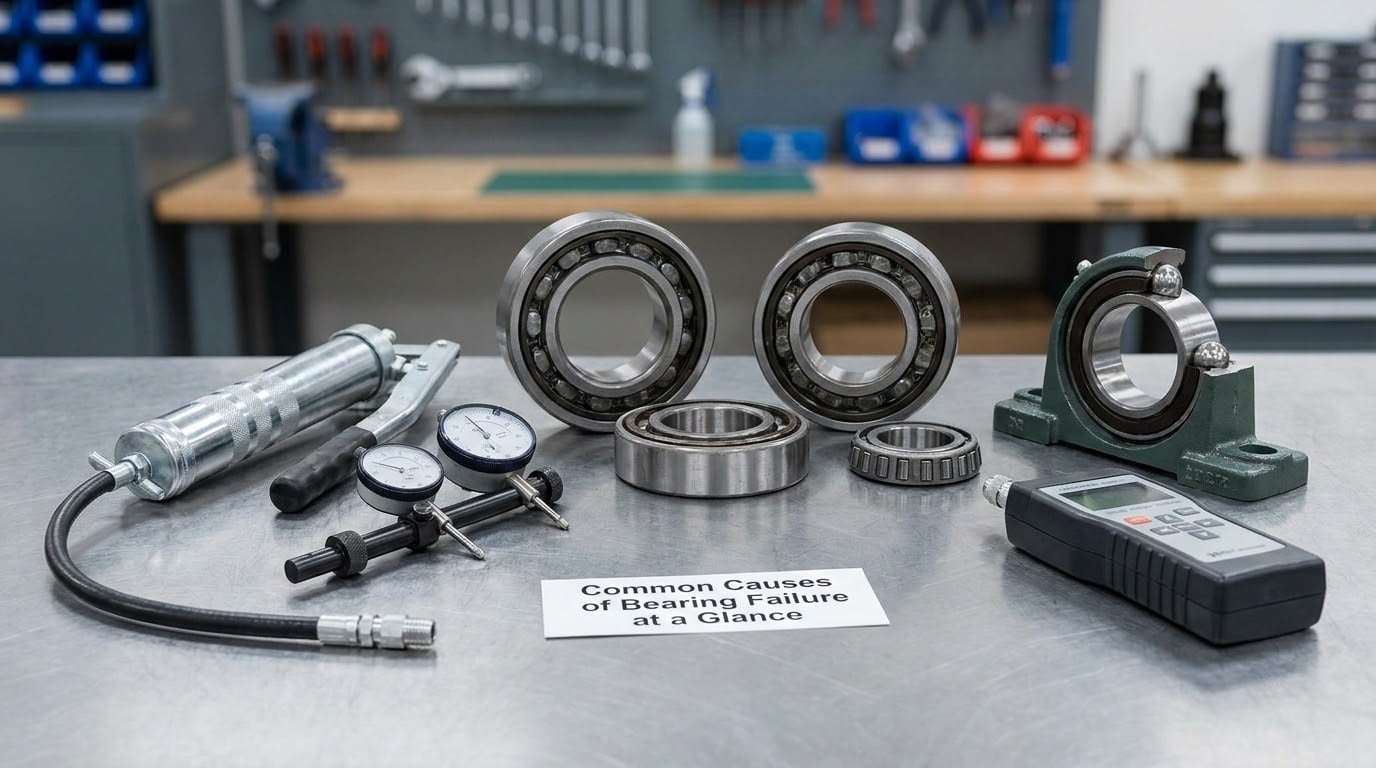
Each cause leaves a different signature. The table below is the short version; the sections after it explain the mechanism behind each row.
| Cause | Typical Symptoms | Conditions That Produce It |
|---|---|---|
| Insufficient lubrication | Rising temperature, chattering or squeal, dark thin grease, rapid wear | Relubrication missed, wrong viscosity, blocked relief port, oil starves at high speed |
| Excessive lubricant | High temperature shortly after greasing, grease at the seals, seals pushed out | Over-greasing, wrong NLGI grade, sealed bearings filled anyway |
| Contamination | Rough running, scoring, grit in the grease, corrosion stains | Dust, abrasive dust, water, coolant, chemicals, cleaning residue |
| Overload | Heat, flaking, deep brinelling, rapid lubricant breakdown | Static overload, shock load, wrong bearing series, incorrect internal clearance |
| Insufficient load | Smearing, scuffing, shallow surface wear, no heat spike | Very light or intermittent duty, near-zero preload, excessive clearance |
| Misalignment | Non-linear vibration, rising temperature, uneven raceway wear, noise that tracks speed | Angular or parallel shaft offset, bent shaft, out-of-spec coupling |
| Improper installation | True brinelling, scoring from mounting, immediate failure after service | Hammering a tight bearing on, forcing through a tight fit, wrong shim stack, dirty bore |
| Electrical erosion | Fluting, washboarding, grey or black melted streaks, rapid groove wear | Shaft voltage from a VFD-driven motor, ungrounded shaft, damaged insulation |
| Corrosion | Rust pits, blue or black smearing, roughness with no immediate heat | Water ingress, condensation during storage, aggressive chemicals, washdown |
| Inadequate maintenance | All of the above building over time, alarms ignored, seals perished | No lubricant schedule, missed inspections, running a damaged bearing to destruction |
What Is Bearing Failure?
Bearing failure is the loss of function in a rolling-element bearing: the point where the raceway, rolling elements or cage can no longer carry the intended load at the intended speed without excessive heat, noise or wear. A bearing has not fully failed when it first gets loud, but it has lost function once the surface it rolls on is damaged beyond what the lubricant film can protect.
There is a difference between a bearing that seizes and a bearing that has suffered a localized failure. A seized bearing is the end state: metal has welded to metal, the rolling elements are locked, and the shaft may barely turn. A localized failure is a pit, a flake, a scored band or a corroded zone in an otherwise intact bearing. For a long time before seizure, the machine runs on a locally damaged surface that keeps generating debris into the lubricant.
Lubrication is what separates those two states. Bearings roll instead of sliding so a thin film of grease or oil can keep metal surfaces apart. Nearly every premature bearing failure happens when that film breaks down, or when load, alignment, contamination or electrical current exceeds what the bearing was designed to tolerate. This is why bearing life is quoted as L10 rated life, the life within which 90% of a large enough group of bearings would still be running under defined conditions. Reliability engineers have long observed that most bearings never get there, which tells you the operating conditions, not the steel, set the real limit.
That is also why bearings matter more than their price suggests. They are the deliberately weak link in a rotating machine, so they report a lubrication, alignment, mounting or electrical problem while the rest of the machine is still intact and the shutdown is still a plan rather than an emergency.
What Are the Most Common Causes of Bearing Failure?
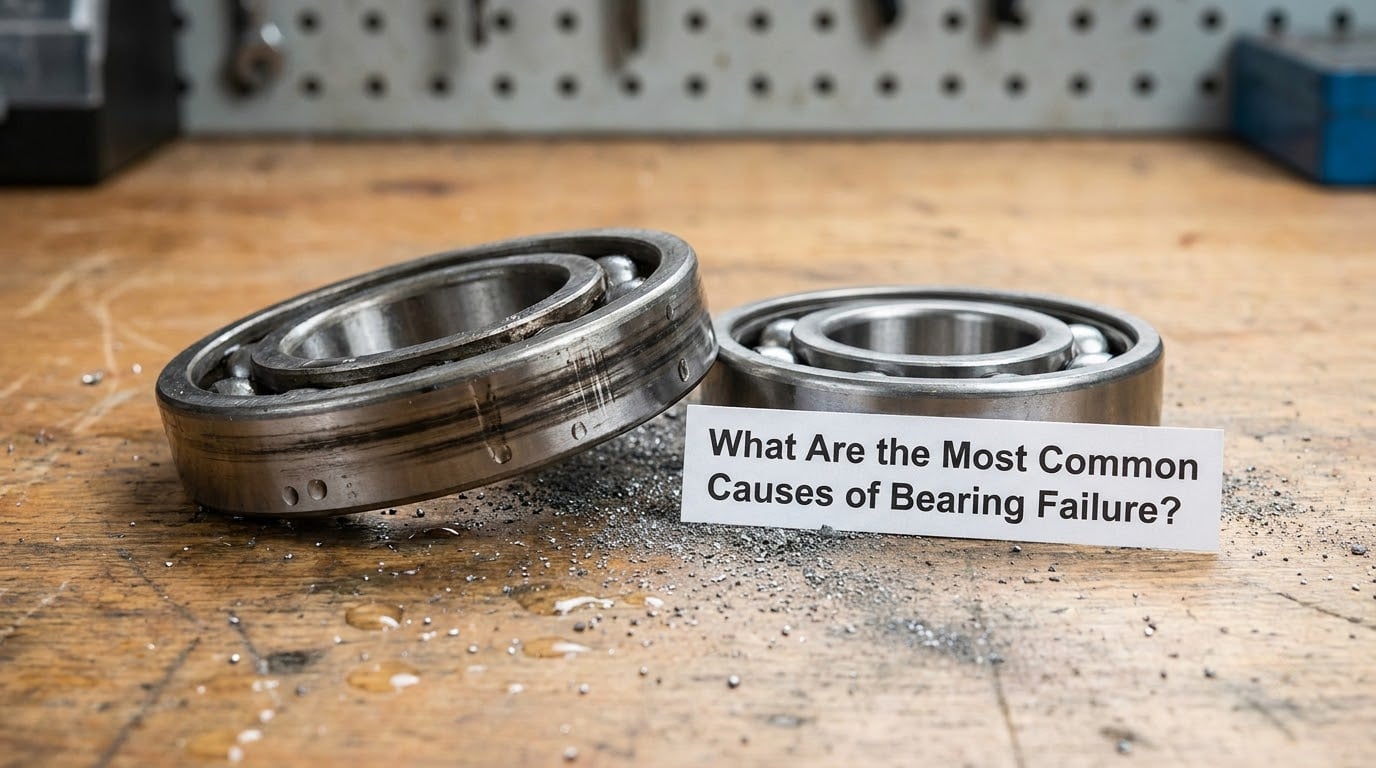
Ranked by how often they turn up in failure reports, the causes run from lubrication to installation errors. Each one has a mechanism and a set of warning signs you can look for before the bearing comes apart.
1. Inadequate lubrication
The single most reported cause. A bearing on an oil film is a bearing on a thin film, and when the film thins, metal touches metal. Boundary friction generates heat, the grease oxidizes, and wear debris accelerates the damage. Expect rising temperature, a chattering or squealing sound that tracks speed, and grease that looks thin, darkened and gritty instead of smooth.
2. Contamination
Foreign particles get carried into the rolling contacts and act as an abrasive. A single grain of silicon dust is enough to leave a groove that then becomes a stress riser. Dirt also holds moisture against the steel, and the combination shows up as scoring on the raceway, roughness under load, and grit or water in the lubricant.
3. Improper installation
A large share of bearings that fail within days of service were damaged on the way in. Hammering a tight bearing onto a shaft, forcing a bearing over a shaft with a burr, or driving through a tight interference with the wrong press force leaves dents and scoring that do not show up until the bearing runs. The failure then gets logged as a bad part when the fault was the method.
4. Misalignment
When two shafts that should share an axis do not, the load is distributed unevenly across the rolling elements. Some carry far more than the design load while others barely touch. The pattern in vibration is a giveaway, and the temperature usually climbs within minutes of start-up. On many machines misalignment is the cause that keeps coming back after a rebuild.
5. Overload or underload
Load beyond the dynamic rating produces heat, lubricant breakdown and flaking. Just as damaging is too little load: with near-zero preload the oil film becomes microscopic, sliding replaces rolling, and the surface smears. The absence of heat is what distinguishes smearing from a grease problem.
6. Electrical erosion
Motors driven from a variable frequency drive can build voltage on the shaft, and that voltage discharges through the thin oil film between rolling element and raceway. The result is fluting, a washboard pattern of evenly spaced grooves across the raceway, or a darkened melted streak. It can eat a bearing in weeks.
7. Vibration damage (false brinelling)
Bearings left loose in storage, or operating while loose in a housing, are damaged by relative movement between the race and the rolling elements. The pattern is a set of evenly spaced dents that match the ball spacing. It looks identical to damage from a hammer on the shaft, which is why the two get confused so often.
8. Corrosion
Water, condensation, coolant and aggressive chemicals attack the steel. You see rust pits, reddish-brown staining, or blue and black smearing when the lubricant film fails over corroded metal. Bearings stored in unheated rooms through a seasonal swing are frequent victims, and they can be quietly pitted long before they are installed.
9. Inadequate maintenance
This one is an umbrella, but it deserves its own line. Missed lubrication intervals, seals that have split, bearings running past their condition limits and a culture of running equipment until it stops all produce failures that show up as one of the eight causes above. Fixing the schedule fixes a surprising share of repeat failures.
How Does Inadequate Lubrication Cause Bearing Failure?
Inadequate lubrication fails in four different ways, and each one leaves a different clue. Understanding the difference tells you whether to change the lubricant, the interval, or the seal design.
Starvation. Too little lubricant means the rolling contacts run directly on steel. The contact patch is tiny, so the heat generated is concentrated, and the grease in the raceway oxidizes faster than fresh grease can replace it. On a grease-lubricated bearing this shows up as a sudden rise in temperature over a few hours and a smell of burnt lubricant.
Wrong viscosity or wrong grade. A grease that is too thin for the speed and temperature of the contact escapes the raceway. Too thick, and it will not flow into the rolling contacts in the first place, particularly on high-speed spindles. The NLGI grade tells you how thick the grease is, while the base oil viscosity and the operating temperature tell you whether it stays in place. Matching a grease to a speed rating matters more than most people expect.
Degradation over time. Grease does not last forever. It shears, oxidizes, absorbs moisture and picks up wear debris from the bearing it is protecting. Once it does, the base oil no longer forms a film, additives are consumed, and the bearing starts abrading itself with the debris suspended in the grease. That is why a re-lubrication interval exists at all, and why a fixed calendar interval is only a rough guide for a machine with a variable load.
Blocked relief and fill paths. Bearings fail at the seal because the lubricant is still inside and has nowhere to go. Overfilled or over-greased bearings generate churning heat inside the housing, push seals outward or past their lip, and let contamination in. The failure is then blamed on the seal when the fill volume behind it was the real error. Filling a sealed bearing through its shield does the same thing on a much shorter timeline.
Over-greasing deserves its own warning. Excess grease mixes and shears at high speed, and a large share of the energy going into the bearing is spent churning grease rather than moving load. The temperature spikes within minutes of greasing, the seal weeps, and on high-speed equipment the grease degrades far faster than it ever would at a correct fill.
How Do Contamination and Moisture Damage Bearings?
Contamination is a volume problem. The most common types in a plant are abrasive dust from cutting and grinding, general dirt from handling, water and coolant from seals that have failed, and chemical residues from washdown or process leaks.
Dust and dirt form a grinding paste when they get into the raceway. The particle rolls under high contact stress and scores the surface, and the groove it leaves traps more particles. A seal that has been nicked during a rebuild does the same job less effectively from day one.
Water causes corrosion, and corrosion causes failure even with plenty of lubricant. Moisture in a grease forms rust, the rust roughens the surface, and the roughness cuts the oil film. Once the film is gone, adhesive wear takes over and the damage accelerates fast. A useful field clue is that a corroded bearing often has no heat history at all, just roughness, staining and a lubricant that carries a distinctly metallic smell.
Cleaning residue is the sneaky version. New bearings arrive with a protective oil or solvent in the cage, and if the bearing is washed and dried without care, traces of the cleaner or water are left in the races. Same for a shaft that was cleaned just before mounting. If several bearings from the same batch fail soon after installation, look at what happened to them between the box and the housing.
Moisture control is rarely a bearing-only problem, either. In molding and assembly areas, water that gets into resin changes how the finished part behaves later, so if you are chasing damp in a cell that feeds a machine, drying times for common engineering plastics is worth reading alongside it.
What Role Do Overload, Misalignment, and Installation Errors Play?
These three are grouped together because they all change where the load actually goes, and because they frequently appear together on the same machine.
Static overload is a load the bearing sees while the machine is stopped or starting, such as a shaft under heavy hydraulic force. Dynamic shock load is the impact of something harder than a ball: a gear tooth, a seized coupling or a jam. Shock loads spike the contact stress far above the dynamic load rating for a fraction of a second, and the damage shows up as spalling or deep dents.
Insufficient load gets less attention and deserves more. A deep groove ball bearing running a light load with near-zero preload has almost no oil film between the contacts. Sliding replaces rolling, the surface smears, and a wear pattern builds in the raceway without a dramatic temperature rise. Correct preload or choosing a bearing with a smaller bore or a higher series restores the film.
Misalignment has two forms. Angular misalignment tilts the inner ring relative to the outer ring, and parallel or offset misalignment pushes the inner ring sideways against the shoulder. Both distort the load distribution. The vibration signature is distinctive and grows with speed rather than with load, and bearing temperature usually climbs shortly after start-up.
Installation errors are the easiest to prevent and among the most common. Driving a bearing onto a tight shaft with a hammer leaves true brinelling: rounded, evenly spaced dents pressed into the raceway. Stacking too many shims behind the inner ring, installing a bearing with the wrong orientation of its shoulders, or leaving a burr or step on the seat produces the same class of damage. A tight interference fit is meant to be pressed on with the correct force at room temperature, not forced. Check shaft and housing condition before fitting a new bearing, not after.
Every one of these is a stress concentration problem, and the same thinking shows up outside rotating equipment. Anything that concentrates stress in a small volume, from a sharp notch to a bad weld, is a reasonable place to look for what causes brittleness in plastic parts in a molded component feeding the same machine.
What Symptoms Usually Appear Before a Bearing Fails?
Bearings do give warning. The signal is rarely sudden, and it usually arrives through more than one channel at once. Organized by what you can actually observe:
- Noise. A hum that rises with speed, a growl that changes with load, or a periodic chirp or rumble with the shaft turning are all early signs. A steady whine from the motor itself is normal and not a bearing symptom.
- Vibration. Broadband high-frequency energy at the bearing frequencies, and vibration that grows when the load is applied, point at rolling contact damage. Non-linear or once-per-revolution vibration points to looseness or misalignment.
- Temperature. A steady climb well above the running norm, or a temperature that keeps rising over days, is a lubrication or loading signal. A sharp rise within minutes of greasing usually means too much grease.
- Lubricant condition. Darkening, thickening, a burnt smell, visible metal particles, water or dirt in the grease.
- Radial play and looseness. Movement felt at the shaft, a knock at the housing mount, or a hub that feels slack on one side.
- Seal and housing leakage. Grease at the seal lip, a seal pushed out of its seat, or a housing that is weeping.
On vehicles and hubs the same symptoms show up differently. Road noise that increases with speed and changes or fades when you turn is the classic wheel bearing cue, and a hub that is hot to the touch after a short drive is a strong one. These overlap with alignment, tire wear, CV joints and brakes, which is why the misdiagnosis is so common in the field. Play felt at the hub with the brake and rotor held still, plus noise that tracks speed, points at the bearing rather than the brake.
Run or stop. Keep running with a bearing that is making a steady noise and a slow temperature rise if the machine has condition monitoring, the load is stable, and you have a plan to inspect. Shut down and inspect if the noise changes suddenly to a grinding or metallic roar, if the temperature rises fast or the bearing is too hot to hold a hand near it, if you see grease leaking from the housing, or if you feel play. Metal-on-metal contact is not recoverable by running longer, and on many machines it damages the shaft and housing bore as well as the bearing.
How Can You Diagnose the Cause of Bearing Failure?
Diagnosing properly means working from the machine back to the metal. Six steps, in this order, keep you from replacing the wrong part twice.
- Get the operating history. Hours run, lubricant type and quantity, last lubrication date, last alignment, recent changes to load, speed or drive, and any change in the machine’s behavior. Most root causes are visible here.
- Read the removed bearing before you clean it. Run it slowly by hand first for roughness, play and noise. Then match the damage pattern to the cause. Always keep the failed bearing, in its original condition, and never scrub the raceway before an inspection.
- Sample the lubricant. Look at the color, thickness and smell, and check for water, metal debris or dirt. Send a sample for lab analysis if the failure is repeat, unexplained or safety related.
- Check the surfaces the bearing rode on. Shaft and housing bore for wear, fretting, corrosion, dents, a step or a burr. Misalignment shims and locknuts. A bent shaft changes the alignment after the bearing is removed.
- Verify alignment and loading. Check the actual running alignment of the connected machine, then check the load path and the preload or internal clearance that the application requires.
- Review the installation and equipment practice. Was the correct mounting method used, was the bearing handled without impact, was the correct part fitted, and was the lubricant at the correct volume?
Useful tools, with limits. Vibration analysis identifies the damage type and its location and can catch degradation months before failure, but it tells you what is happening, not necessarily what caused it. Infrared thermography finds the imbalance of heat, missing, blocked or over-filled lubrication, and worn or failing bearings at a distance, but a temperature is a lagging symptom. Ultrasound locates a lubrication problem while a machine is running and costs little to use, but it is weak on other faults. Oil or grease analysis measures contamination, water and wear metals over time, and it cannot see misalignment, preload or installation damage at all.
| Symptom | Likely Cause | First Check |
|---|---|---|
| Grease darkens and thins, temperature climbs | Wrong viscosity or grade, degraded grease | Grease specification against the speed and temperature of the contact |
| Temperature spikes right after greasing, seal pushed out | Over-greasing, fill path blocked | Fill volume and the grease fill port or relief opening |
| Evenly spaced dents matching the ball spacing | Vibration while loose in storage or in service | Transport and storage handling; internal clearance in the housing |
| Rounded dents of varying depth on the raceway | Installation impact, hammering on a tight fit | Mounting method and tool, shaft seat condition |
| Ripple pattern, fluting or grey streaks across the raceway | Electrical erosion from a VFD-driven motor | Insulation condition on the shaft and grounding path |
| Noise and vibration that grow with speed, not with load | Misalignment | Running alignment of both machines, shaft runout |
| Roughness with no heat and reddish staining | Corrosion from water or storage | Seal condition, storage conditions, sampling of the grease |
| Shallow surface wear, no temperature rise | Insufficient load or preload | Application load versus bearing selection, preload setting |
How Do You Prevent Bearing Failure in Industrial Equipment?
Most bearing failures are preventable with practices that cost very little compared with the unplanned downtime they avoid.
- Select the right lubricant and the right amount. Use the viscosity and NLGI grade matched to the contact speed and temperature, and use the fill volume the manufacturer specifies. Some bearings are filled at the factory and sealed forever, and they should be left alone.
- Set a lubrication interval you can actually meet. Base it on run hours, temperature and duty rather than on a calendar date alone, and record it. A grease that has been topped up repeatedly is usually a symptom of a lubrication problem, not a fix for it.
- Keep contamination out. Labyrinth or magnetic face seals beat a plain contact seal in dirty environments. Check seals at every service, keep housings clean, and stop washing bearings and shafts right before assembly. In molding cells this matters twice over, because loose flash and short-shot fragments travel through the air and land on the closest machine. Understanding what causes mold flash and how to prevent it is the upstream half of the fix.
- Mount bearings correctly. Use a press that loads only the ring being fitted, keep force on the ring that is tight, heat the bearing rather than the housing, and follow the manufacturer’s mounting instructions. Every impact mark is a future fatigue site.
- Verify alignment after every rebuild. Use laser alignment for anything above small pillow blocks, and record the result. A coupling that was aligned years ago may be well outside tolerance now.
- Watch the load and the preload. Check that the bearing series suits the shock and static load, and that clearance or preload matches the application. Correct an intermittent or very light duty load rather than leaving a bearing running on an empty film.
- Protect bearings in storage and transport. Store them flat, in the original packaging, in a dry room at stable temperature, rotate shafts on a monthly basis, and use a locking device on the shaft during transport. Damage picked up on a shelf can cost you a bearing a year later.
- Monitor condition rather than reacting. Vibration, temperature and lubricant analysis on critical rotating equipment give you a lead time of weeks or months instead of minutes. A route-based inspection with recorded readings catches a slow trend that a one-off check will miss.
On motors fed by a variable frequency drive, the specific measures are an insulated bearing, a hybrid ceramic bearing, a conductive shaft grounding ring, or a sine wave filter at the drive. The choice depends on the motor size, the drive characteristics and the environment.
When Should You Replace a Failing Bearing?
Replace a bearing when the evidence says it can no longer do its job, not because a reading crossed an arbitrary line. Concrete reasons: visible spalling, flaking, cracking or deep scoring; corrosion pits that have reached the rolling surface; play you can feel with the load off; a worn or deformed cage; or lubricant analysis showing wear metals climbing. Debris in the lubricant is evidence that material is still coming off the bearing, and it is one of the clearest cases for replacing it during the next scheduled stop rather than running on.
A noisy bearing is not automatically a replace-now bearing. Noise without a vibration or temperature trend, with clean lubricant and no play, is often a lubricant selection or seal issue. A bearing with a rising vibration trend and a visible rolling-element defect is a scheduled replacement with a short window. A bearing that is grinding, running very hot or throwing grease is an immediate stop.
Two rules matter more than the decision itself. First, keep the failed bearing and package it with the lubricant sample and the machine’s history, because the damage pattern is the evidence. Second, do not install a new bearing into an uncorrected cause. Replacing a bearing without fixing the lubrication interval, the alignment or the contamination path usually buys you the same failure in the same amount of time, at the cost of a second bearing and a second shutdown.
Frequently Asked Questions
What is the most common cause of bearing failure?
Inadequate lubrication is the single most common cause, and contamination is usually right behind it. Together they account for a large share of premature failures in motors, gearboxes and conveyors. Symptoms include rising temperature, chattering, darkened grease and wear debris in the lubricant. Over-greasing, wrong viscosity and missed intervals all fall under the same heading.
How can you tell if a bearing is failing before it seizes?
Look for changes, not just readings. A hum that rises with speed, vibration that grows when load is applied, a steady temperature climb and lubricant that darkens or picks up metal all appear well before seizure. On hubs, play felt at the shaft with the brake held still plus road noise that changes with turning points to the bearing. Grabbing heat or a sudden change to a grinding sound means stop.
Does excessive grease cause bearing failure?
Yes, and it does so quickly. Over-greased bearings churn the lubricant at high speed, generating heat that degrades the grease and pushing seals out of position, which then lets contamination in. The temperature typically spikes within minutes of greasing. Fill only to the manufacturer’s specified volume, and leave factory-filled sealed bearings alone.
Can misalignment damage a bearing even when the load is normal?
Yes, because misalignment changes where the load goes rather than how much there is. A tilted or offset shaft loads part of the rolling elements far beyond the rating while the rest barely touch. Vibration that grows with speed rather than with load is the classic sign, and bearing temperature usually climbs shortly after start-up. Check alignment after every rebuild and record the result.
Should a noisy bearing always be replaced immediately?
Not always. Noise on its own, with stable temperature, clean lubricant and no measurable play, often points to a lubricant or seal issue rather than a damaged rolling element. Check vibration and temperature trends and inspect the lubricant before deciding. Grinding, a sharp temperature rise, visible play or metal in the grease are different: those bearings should come out at the next planned stop, or immediately if they are getting worse.
How often should industrial bearings be lubricated and inspected?
There is no universal interval, because duty, speed, temperature and lubricant type decide it. Follow the manufacturer’s recommendation as a starting point, then set the interval by run hours and temperature rather than calendar dates, and record every service. Inspect grease condition, seals, temperature and vibration on a route schedule, and use oil analysis on critical equipment to catch trends weeks before failure.
Bottom Line
When a bearing fails early, the useful question is not which part to order but what left the damage pattern it carries. Keep the failed bearing, read the raceway, and check lubrication, alignment and mounting before anything else.
Start with the grease. Confirm the type, the volume and the interval, then verify alignment and look for contamination paths. Those three checks cover most repeat failures, and they cost a grease gun and a laser alignment tool rather than a production shutdown.